
British discussion of energy policy has become so intellectually degrading that I was dubious when Mr Bickley asked me to join it. One side talks as if we can continue indefinitely importing hydrocarbons through increasingly unstable maritime chokepoints while deindustrialising ourselves into a kind of museum economy built around coffee shops and financial manipulation. The other speaks in the language of apocalypse and moral purification, insisting that modern prosperity itself is somehow unsustainable and that ordinary people must be trained into accepting less heat, less mobility, less meat, and fewer nice things of every other kind. Between these camps there is little serious discussion of what an advanced civilisation requires in physical terms.
This is unfortunate, because energy policy is not a branch of ethics or psychology. It is a branch of applied physics. A country either possesses sufficient concentrated energy to maintain industrial civilisation or it does not. The slogans attached to the process are secondary. You can no more run a modern economy on moral enthusiasm than smelt steel with inspirational speeches.
As you may imagine, I have no time for the present climate hysteria. The Earth’s climate changes because climate has always changed. There are also obvious reasons to distrust a movement whose proposed solutions always involve greater bureaucratic power and more taxes, plus a giant enrichment scheme for the usual mob of City speculators. The carbon-trading markets alone ought to have discredited much of the green movement. Great fortunes have been made through what amounts to the creation of politically managed artificial scarcity. We are told this is about saving the planet. It is really a transfer mechanism where wealth is sucked upwards from households and industry into the pockets of the well-connected.
None of this means, however, that Britain should remain indefinitely dependent on imported oil and gas. The past few years have exposed the danger of that assumption. The instability that remains all round the Strait of Hormuz shows how vulnerable hydrocarbon economies are to geopolitical shocks. Roughly one-fifth of globally traded oil still passes through that narrow waterway. A nation dependent on distant fuel imports is a nation whose prosperity depends on the continued stability and good will of foreign governments, then on favourable maritime insurance markets and naval logistics and military alliances. All this happened more or less as wanted during the high noon of American global dominance. It looks less probable now.
The real question is therefore not whether Britain should move beyond hydrocarbons. In the long term, we must. The real question is what should replace them. The answer cannot simply be “renewables,” because that word obscures more than it clarifies. There is a physical difference between a system based on diffuse and intermittent energy capture and one based on dense, controllable generation. Modern political discourse tends to ignore this because most of the people shaping it have never had to think seriously about engineering constraints.
The central problem is reliability. Industrial civilisation requires stable electrical output over time. Grid frequency must remain tightly controlled. Voltage fluctuations must remain within tolerances. Heavy industry, rail systems, semiconductor fabrication plants, water infrastructure, and datacentres all require continuous and predictable energy flows. An aluminium smelter cannot conveniently shut down because a high-pressure weather system has settled over the North Sea and reduced wind speeds for four days. The laws of electromagnetism are not suspended because politicians have announced a climate emergency.
This is why so much contemporary energy accounting is misleading. Official levelised cost figures present wind and solar generation as suspiciously cheap. What these figures often conceal are the wider system costs imposed by intermittency. A wind turbine is not useful because it generates electricity occasionally. It must generate electricity within a grid that requires constant balancing. This balancing demands backup generation, reserve spinning capacity, large-scale transmission reinforcement, frequency-control systems, storage infrastructure, and curtailment payments when excess generation overwhelms local demand.
Germany discovered this at memorable expense. After spending a fortune on renewable deployment, it ended up simultaneously dependent on Russian gas and tied to some of the highest electricity prices in Europe. The decision to close nuclear stations while increasing reliance on imported hydrocarbons was hailed as moral leadership. In retrospect it appears more like the triumph of ideology over engineering reality.
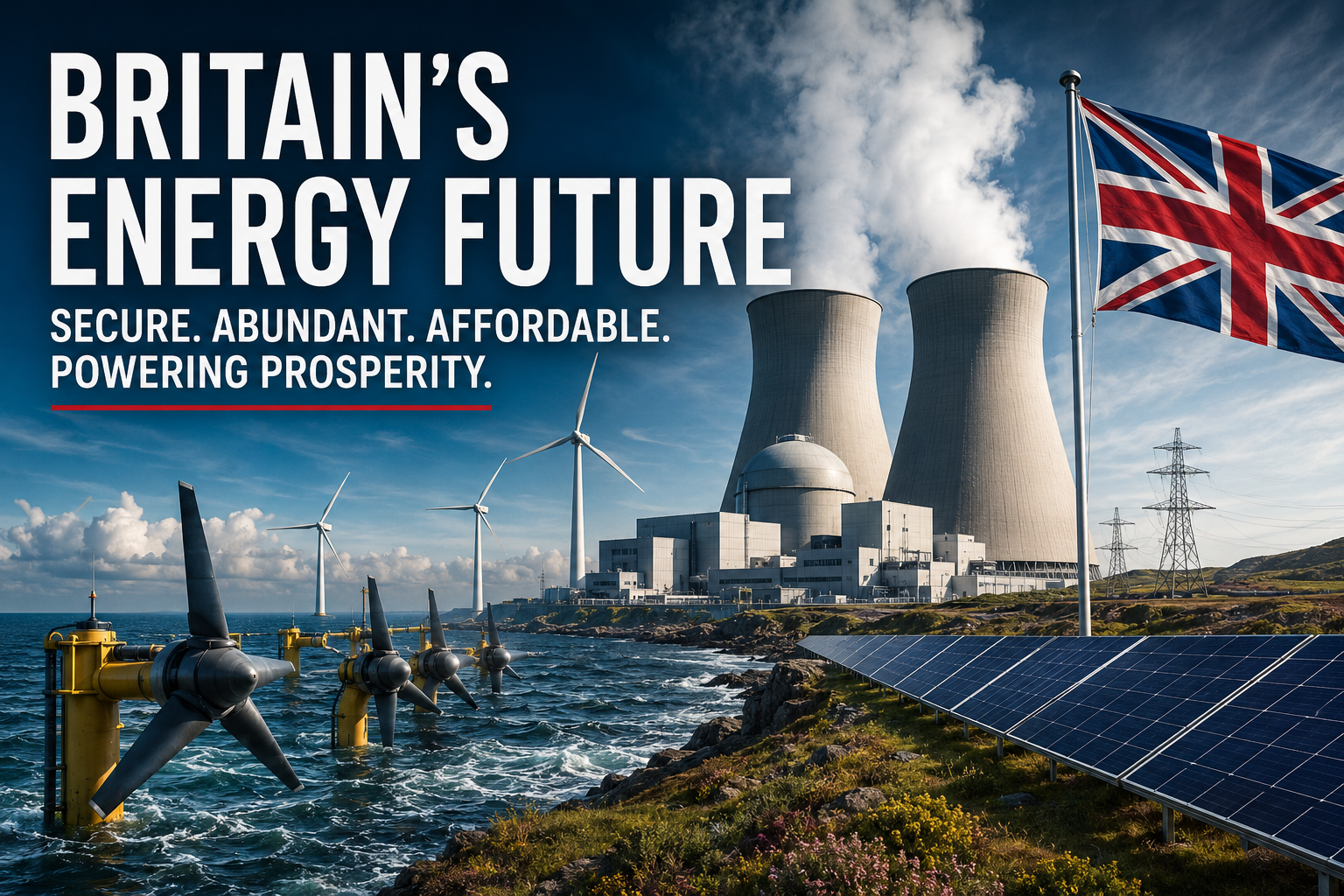
Britain still possesses an opportunity to avoid the same fate because we still have two big advantages: a long if neglected nuclear tradition and favourable tidal geography. If approached rationally, these together could provide the basis for an energy system capable not only of keeping up at least our present living standards but also of supporting a comprehensive reindustrialisation.
The main advantage of nuclear fission is energy density. The amount of usable energy obtainable from uranium is very large compared with chemical fuels. This is because nuclear reactions convert small masses into much larger energies. A small amount of fuel can therefore enable reactor operation for extended periods. Unlike gas-fired generation, nuclear systems do not require continuous bulk fuel transport across oceans or pipelines vulnerable to geopolitical disruption. Fuel can be stockpiled years in advance.
More importantly, nuclear generation is dispatchable. It operates continuously. A modern reactor can achieve capacity factors exceeding ninety per cent, meaning that it produces near-maximum output for the majority of the year. By contrast, wind systems in Britain often operate at effective capacity factors closer to thirty or forty per cent, while solar performs poorly at best during winter, when demand is highest.
These are important and non-negotiable facts. They do not change according to the needs of the current news cycle. Civilisation progresses through the increasing control of energy flows. Countries that possess abundant and predictable electricity become technologically dynamic because reliable energy lowers uncertainty across the entire economy. Heavy industry becomes viable. Electrified transport becomes practical. Advanced manufacturing becomes scalable. Artificial intelligence infrastructure, whose energy demands may become immense in the coming decades, becomes supportable. Cheap electricity also transforms domestic life. Heated homes cease being a luxury calculation. Consumers spend less income on survival and more on productive activity elsewhere in the economy.
This is why Britain’s abandonment of serious nuclear development during the late twentieth century was so destructive. We effectively chose dependence over sovereignty.
The newer generation of Small Modular Reactors may offer the best opportunity to undo this mistake. Much public discussion treats SMRs merely as “smaller reactors,” but their real significance lies in manufacturing economics. Traditional nuclear projects in the West became too expensive to be useful because every station evolved into a bespoke megaproject surrounded by regulatory uncertainty and constantly changing specifications. SMRs instead aim at standardisation. Components can be factory-produced repeatedly using stable designs, reducing construction risk and allowing cumulative learning effects similar to those seen in aerospace or shipbuilding. Recent progress confirms the momentum: in April 2026, Rolls-Royce SMR and Great British Energy–Nuclear signed contracts for the delivery of the first three units at Wylfa in Wales, with work starting immediately and targeting mid-2030s grid connection.
This matters because the largest cost in most nuclear projects is not fuel but financing. If construction periods shorten substantially, financing costs fall correspondingly. Standardisation also permits supply chains and skilled labour pools to stabilise around repeated deployment. The result is that nuclear ceases to be an exceptional state vanity project and becomes instead an industrial process.
Britain should therefore pursue not one or two reactors as symbolic gestures, but a sustained programme of reactor construction extending across decades. The country still has significant expertise in metallurgy, turbine systems, naval reactor engineering, and precision manufacturing. Rebuilding a civil nuclear ecosystem around these strengths would itself generate technical industries and skilled employment. Energy policy and industrial policy here become inseparable. The infrastructure can be designed and produced in our own country, and by our own people.
This is not to say that nuclear alone can or should provide the entirety of our future energy mix. Tidal energy deserves particular attention because it also avoids many of the physical weaknesses associated with wind and solar. The tides are governed not by weather but by gravitational interactions between the Earth, Moon, and Sun. Their timing is therefore astronomically predictable decades in advance. Britain’s coastal geography gives us some of the strongest tidal resources in Europe, particularly around Scotland and the Severn Estuary. Projects such as MeyGen in the Pentland Firth continue to demonstrate operational reliability and steady progress toward scale.
At present, tidal systems remain relatively expensive. Critics often present this as decisive. Yet almost every major energy technology initially appears uneconomic before scaling and standardisation reduce costs. Offshore wind itself underwent steep cost reductions after deployment expanded. Independent forecasts show tidal stream costs potentially falling to £116/MWh or lower by 2030 and £60–80/MWh by 2050 with volume and learning. The more important point is strategic rather than merely financial. Tidal systems provide domestic, fuel-free generation with very long infrastructure lifespans. Some tidal-range installations could operate for more than a century with appropriate maintenance. A civilisation should occasionally build things intended to outlive its politicians.
There are technical challenges, of course. There is marine corrosion: salt water is not our friend here. Underwater maintenance is difficult. Grid integration remains necessary. Yet these are engineering problems, not mystical impossibilities. Britain once specialised in solving engineering problems. We ought to do so again.
Longer-term, fusion offers another promising avenue grounded in Britain’s strengths. The UK’s STEP (Spherical Tokamak for Energy Production) prototype power plant programme is advancing, with detailed design work and industry partnerships (including Tokamak Energy) targeting operations around 2040. While not imminent, sustained investment here could deliver abundant, fuel-flexible power in the second half of the century.
The real obstacle to a rational energy transition is political culture. Our governing class has thought for a long time in terms of managerial optics rather than physical systems. Energy policy has been made an exercise in signalling virtue rather than maximising abundance. Entire industries now exist whose profitability depends on subsidy extraction and regulatory manipulation. Fortunes are made through carbon-credit trading, renewable obligation schemes, planning distortions, and government-backed financing structures. This encourages the continued presentation of energy scarcity as morally desirable. But energy scarcity is not desirable. It is historically associated with poverty.
The proper aim of an advanced civilisation should be abundant electricity so cheap and reliable that energy-intensive industry naturally gravitates toward it. Britain once had this mentality. The nineteenth-century industrial revolution was fundamentally an energy revolution built on coal and steam. The future industrial revolutions of automation, electrification, and artificial intelligence will similarly depend on huge and stable energy supplies.
Hydrogen may eventually play an important secondary role within such a system, even if much nonsense is spoken about it now. Hydrogen is not an energy source but an energy carrier. Producing it through electrolysis requires electricity input. Conversion losses are substantial. Nevertheless, for sectors difficult to electrify directly—certain industrial processes, shipping, perhaps aviation—it may become useful if abundant nuclear baseload generation lowers the cost of production sufficiently. This being given, synthetic fuels derived from hydrogen and captured carbon compounds may also become economically viable. What matters is that these possibilities depend first on achieving large surpluses of cheap electricity. Without that foundation, the rest is fantasy.
The irony underlying the entire climate debate should be obvious. The green movement often speaks as though reducing energy consumption were itself civilisation’s goal. In reality, I repeat, every historical improvement in living standards has depended on increasing the quantity of controllable energy available per capita. A society with abundant energy can desalinate water, heat homes cheaply, automate dangerous labour, power transportation networks, support scientific research, and sustain sophisticated healthcare systems. A society that deliberately constrains energy production becomes poorer whether it admits this or not.
Britain must therefore reject both hydrocarbon romanticism and green primitivism. Fossil fuels remain strategically useful and will remain essential for the next generation. But the long-term future belongs to countries capable of generating enormous quantities of stable electricity independent of volatile fuel imports. Nuclear power provides the only presently available technology capable of doing this at national scale. Tidal systems offer Britain a complementary domestic advantage unavailable to most competitors. Sensible use of wind, hydroelectric storage, and perhaps future hydrogen infrastructure can supplement these foundations. But the foundation itself must be dense, dispatchable generation.
The essential issue is not climate morality. It is whether Britain intends to become an advanced civilisation again, or remain a deindustrialised financial casino governed by accountants and public-relations managers. Physics will decide the outcome regardless of which slogans appear on ministerial lecterns.
Suggested Reading List
- Electricity Generation Costs 2025 (DESNZ, January 2026): Official LCOE and system assumptions. https://www.gov.uk/government/publications/electricity-generation-costs-2025
- Contract signed for delivery of UK’s first SMRs (World Nuclear News, April 2026): Details on Rolls-Royce SMR at Wylfa. https://www.world-nuclear-news.org/articles/contract-signed-for-delivery-of-uks-first-smrs
- UK Fusion Energy Strategy and STEP updates (UKAEA / STEP Fusion site, 2026): Long-term fusion pathway. https://stepfusion.com/
- Cost Reduction Pathway of Tidal Stream Energy (ORE Catapult reports): Projections for tidal economics. https://ore.catapult.org.uk/wp-content/uploads/2022/10/Tidal-stream-cost-reduction-report-T3.4.1-v1.0-for-ICOE.pdf
- Germany’s nuclear phase-out analyses: Impacts on prices and emissions. https://www.foronuclear.org/en/updates/in-depth/germanys-nuclear-shutdown-mistake-rising-prices-increased-emissions-and-economic-recession/
- MeyGen Tidal Project updates: Real-world performance data. https://ampeak.energy/tidal-stream/meygen/
Discover more from The Libertarian Alliance
Subscribe to get the latest posts sent to your email.



I think this essay misses a most important point. Using fossil fuels does not necessarily mean using imported fossil fuels. There are very large quantities of gas, and still a fair amount of oil, underneath the UK or in UK waters. To write on UK energy policy without even mentioning fracking, or the extraction of oil from partially depleted fields using new techniques, is to miss two elephants in the room.
Besides, if the troubles in the Middle East remain confined to Iran, I expect that the Gulf states will find alternative routes to bring their wares to their markets quicker than many will expect. Geopolitics aside, there is no real shortage of fossil fuels today (though 50 years’ time may be another matter).
Tidal energy would be a “nice to have” if it can be made cost-competitive, but I don’t see it as a primary power source for the future. Once the demonization of CO2 has become generally seen as the fraud it is, the argument that tidal energy is “green” will seem irrelevant. Also, there may be genuine side-effects of tidal power on marine life and other aspects of the environment; these do not seem to have been very much investigated yet.
As to hydrogen, I don’t see it going anywhere soon. Never mind the cost, it just doesn’t look either practical or safe. And once the CO2 fraud has been exposed, it will be irrelevant.
Personally, I would set a two-phase energy plan. Phase I would rely on gas, mainly from fracking, while building up nuclear capability. Solar would continue to be used, but only for off-grid applications; and wind would be effectively dropped as a power source. Phase II would move to nuclear fission as the primary energy source.
Beyond that, there ought to be a side project, in which energy convertibility is the key. Once you have an abundance of affordable energy, it makes sense to use some of that to synthesize liquid fuels with high power density for applications that need them – notably road transport and aviation. That way, you can still have fossil fuel equivalents for applications that need them, without having to import anything. If we can get moving down this route, then “widespread electrification” becomes completely unnecessary. Indeed, counter-productive.
Then there are the low-probability but high-payoff projects. Nuclear fission and solar power collected in space are two possibles. I’m not talking about a beam-me-down-scotty system – that would be very dangerous if the beam moved even slightly – but about converting abundant solar energy into high-power-density fuels while still in space, then bringing them down by more “conventional” means.
Of course, we cannot have any sensible discussions on future energy policy in the UK until the general public have grasped the fraudulence of the CO2 accusations; and those that took part in the fraud have been made to pay reparations to those harmed by it, and received appropriate criminal punishment.
See https://www.facebook.com/groups/1447393845476229?locale=en_GB
[…] think this essay misses a most important point. Using fossil fuels does not necessarily mean using imported fossil fuels. There are very large […]
[…] Lock has written a thoughtful reply to my original article, and I am grateful for it. Much discussion of energy policy now consists […]