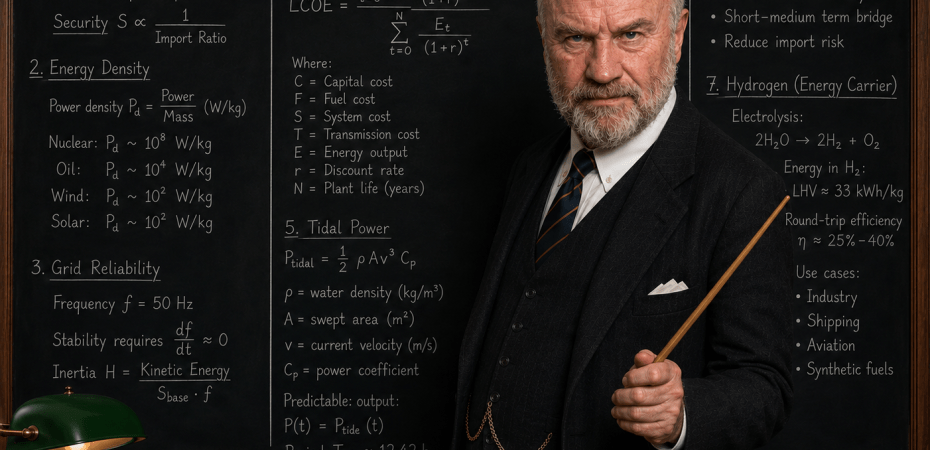
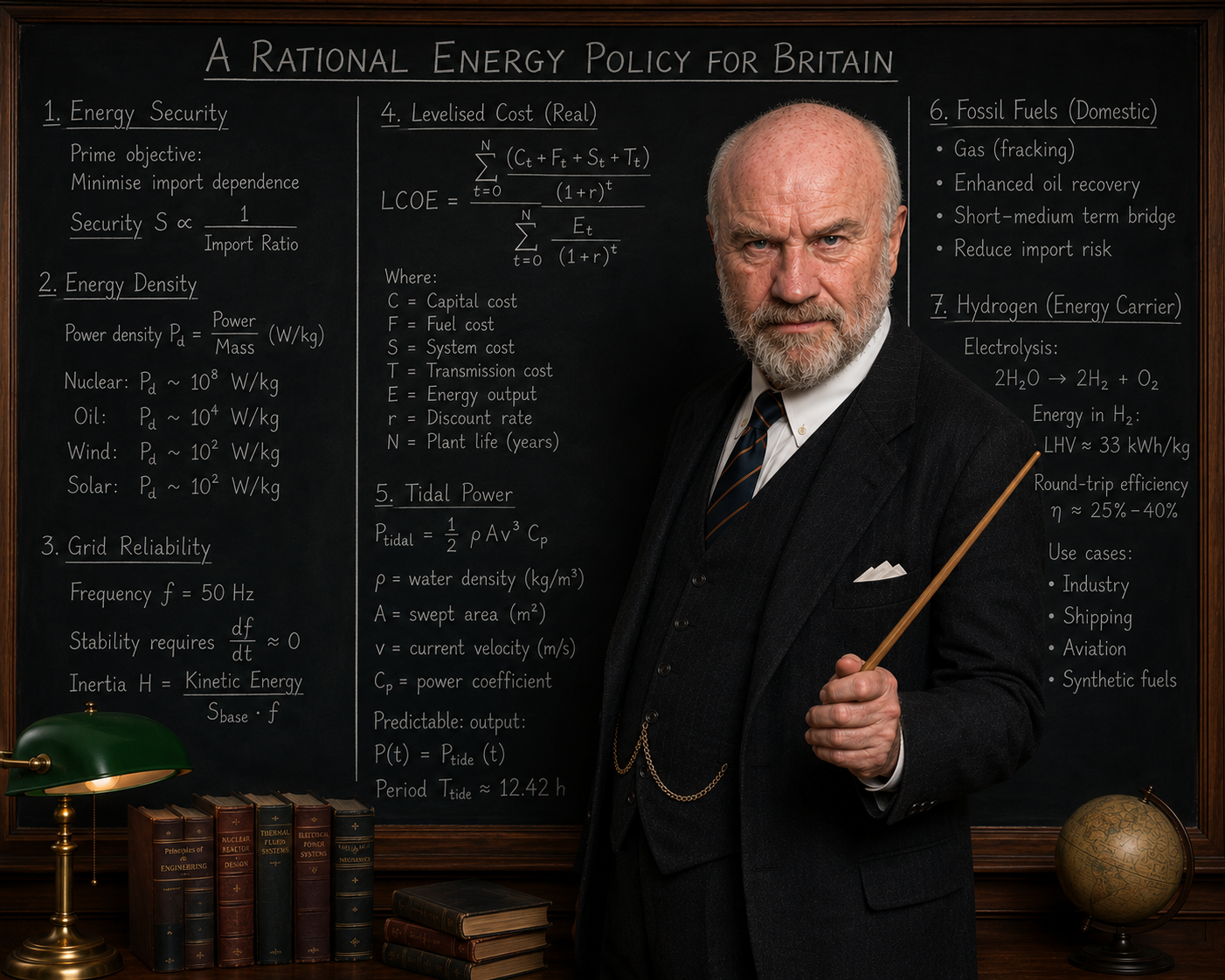
I think this essay misses a most important point. Using fossil fuels does not necessarily mean using imported fossil fuels. There are very large quantities of gas, and still a fair amount of oil, underneath the UK or in UK waters. To write on UK energy policy without even mentioning fracking, or the extraction of oil from partially depleted fields using new techniques, is to miss two elephants in the room.
Besides, if the troubles in the Middle East remain confined to Iran, I expect that the Gulf states will find alternative routes to bring their wares to their markets quicker than many will expect. Geopolitics aside, there is no real shortage of fossil fuels today (though 50 years’ time may be another matter).
Tidal energy would be a “nice to have” if it can be made cost-competitive, but I don’t see it as a primary power source for the future. Once the demonization of CO2 has become generally seen as the fraud it is, the argument that tidal energy is “green” will seem irrelevant. Also, there may be genuine side-effects of tidal power on marine life and other aspects of the environment; these do not seem to have been very much investigated yet.
As to hydrogen, I don’t see it going anywhere soon. Never mind the cost, it just doesn’t look either practical or safe. And once the CO2 fraud has been exposed, it will be irrelevant.
Personally, I would set a two-phase energy plan. Phase I would rely on gas, mainly from fracking, while building up nuclear capability. Solar would continue to be used, but only for off-grid applications; and wind would be effectively dropped as a power source. Phase II would move to nuclear fission as the primary energy source.
Beyond that, there ought to be a side project, in which energy convertibility is the key. Once you have an abundance of affordable energy, it makes sense to use some of that to synthesize liquid fuels with high power density for applications that need them – notably road transport and aviation. That way, you can still have fossil fuel equivalents for applications that need them, without having to import anything. If we can get moving down this route, then “widespread electrification” becomes completely unnecessary. Indeed, counter-productive.
Then there are the low-probability but high-payoff projects. Nuclear fission and solar power collected in space are two possibles. I’m not talking about a beam-me-down-scotty system – that would be very dangerous if the beam moved even slightly – but about converting abundant solar energy into high-power-density fuels while still in space, then bringing them down by more “conventional” means.
Of course, we cannot have any sensible discussions on future energy policy in the UK until the general public have grasped the fraudulence of the CO2 accusations; and those that took part in the fraud have been made to pay reparations to those harmed by it, and received appropriate criminal punishment.
Discover more from The Libertarian Alliance
Subscribe to get the latest posts sent to your email.
Related posts:
 Looking Beyond Net Zero: An Energy Policy for British Recovery
 “Contingent Libertarianism” Dissected – a Further Reply to Bryan Mercadente
 Free Trade, Hard Reforms: A Reply to Bryan
 Looking Beyond Trump: Random Thoughts from a Dirty Shower
 Free Trade: Mercadente v Whitmore — A Friendly Exchange
 Free Trade, Protection, and an Occupation Government: Whitmore v. Mercadente on the Foundations of Liberty
 Whitmore-Mercadente-Lock-Wang-Kinsella: What this argument is really about
 Commentary on “Your Duty to Be Beautiful” by Bryan Mercadente
Bryan Mercadente: A Beautiful Mind, and an Ugly Soul
Commentary on “Your Duty to Be Beautiful” by Bryan Mercadente
Bryan Mercadente: A Beautiful Mind, and an Ugly Soul
 Bryan Mercadente: A Mind Wasted on Wire-Cutters?
 Fabricated Heat and Frigid Homes: The Real Cost of Britain’s Climate Data Scandal
 Profit before People
Powered by YARPP.