Empires rarely understand the sources of their own success, and therefore almost never recognise the causes of their decline. They notice military reverses. They notice budget crises and foreign defeats. They notice rivals becoming inconveniently assertive. What they generally fail to notice is the gradual corruption of the assumptions and habits that first made them powerful. Decline does not usually arrive with drums and proclamations. It arrives more quietly, in the composition of ruling classes and in the priorities of civilisations. It arrives when those who govern cease understanding where wealth comes from and begin mistaking the management of power for its creation. The American decline that now becomes visible even to respectable newspapers did not begin with military humiliation in the Gulf, nor with the awkward spectacles of American presidents receiving lectures abroad. Those are merely symptoms. The process began much earlier, and its origins lie not principally in military failure but in a profound economic and civilisational error. America won the Cold War and then spent thirty years dismantling the foundations of its own supremacy.
After 1991, the United States occupied a position unique in modern history. The Soviet Union had collapsed. Europe accepted strategic dependency with a relief approaching gratitude. Russia entered a decade of humiliation and looting overseen by imported economists and local gangsters. China was viewed chiefly as an immense reservoir of cheap labour. The dollar governed world trade. American military superiority appeared permanent. The language of the age reflected extraordinary confidence. We heard of a “new world order.” We heard of “the end of history.” Liberal democracy and financial capitalism had supposedly solved the central problems of political organisation. Future disputes would concern efficiency and administration. Nations themselves would decline in significance. Production would matter less than information. Economic life would become global, frictionless and post-industrial. These ideas were not merely mistaken. They represented a particular form of imperial vanity. Great powers become vulnerable when they confuse temporary advantages with permanent laws. The confidence of the American establishment during the 1990s was not the confidence of men who understood reality. It was the confidence of men who had ceased believing reality required examination.
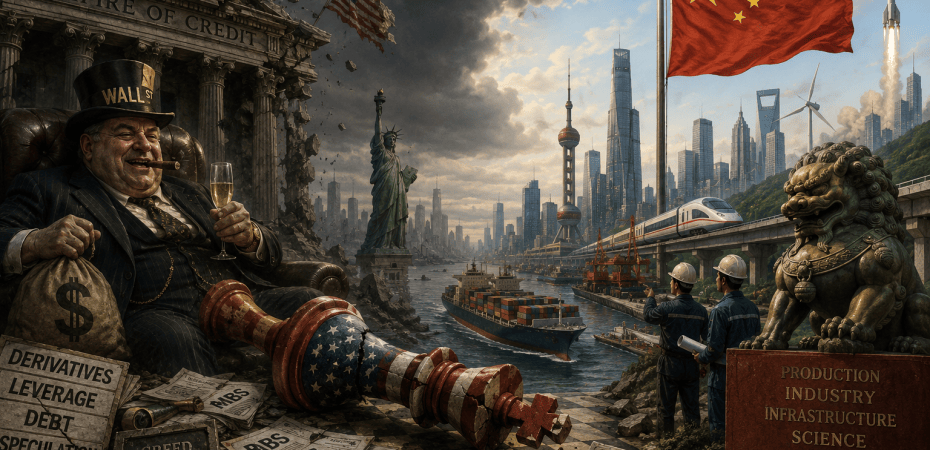
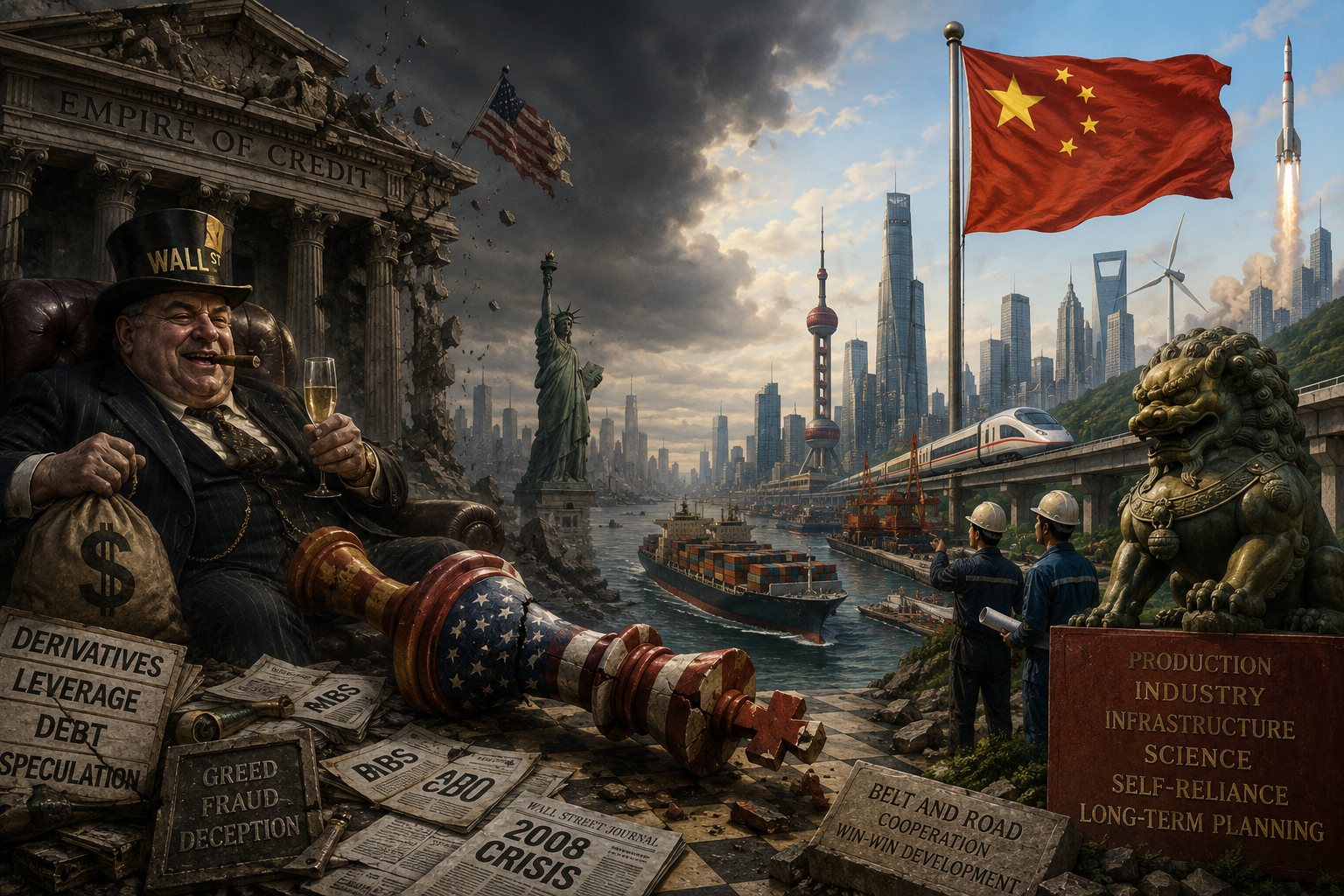
This outlook suited the class that had emerged triumphant from the late twentieth century. These people were not industrialists in the older sense. They did not build railways or chemical plants. They did not establish manufacturing systems or transform landscapes with power stations and factories. Their instincts were financial. They belonged increasingly to the transatlantic alliance centred on Wall Street and the City of London, that oligarchy of consultants and speculators who gradually persuaded themselves that civilisation itself had entered a new stage of development. The heroes of earlier capitalist societies had been engineers, inventors and manufacturers. They had looked at the world and asked what could be built. The newer elite looked at the world and asked what could be sold onward at a profit. They increasingly resembled court financiers at the end of ancien régimes, men expert in accounting tricks and financial instruments yet detached from the productive life of the societies on which they fed.
The distinction mattered because finance possesses instincts different from industry. Industrial societies create rooted populations and stubborn loyalties. Factories generate communities. Engineers and manufacturers develop interests tied to permanence and material reality. Men who build things become interested in continuity and national strength. They care whether productive capacity remains within the societies to which they belong. Finance prefers fluidity. It prefers labour markets over populations and consumers over citizens. Factories are expensive and socially awkward. Communities acquire expectations. Populations develop habits of resistance. The solution was to export industry. The process arrived wrapped in the language of comparative advantage and economic inevitability. We were told that manufacturing no longer mattered. America and the West would retain finance and innovation while production occurred elsewhere. The arrangement was presented not as a policy choice but as a law of historical development. In practice, however, it involved something simpler and more dangerous: immediate financial gain was being preferred over long-term strategic resilience.
For a time the arrangement seemed miraculous. Factories disappeared while stock valuations increased. Industrial regions weakened while financial centres prospered. Communities declined while asset prices rose. Because markets continued climbing, the financial classes concluded they had discovered a higher stage of civilisation itself. We should pause here to appreciate the absurdity. Men whose principal occupation increasingly involved arranging transactions and extracting commissions persuaded themselves that they represented humanity’s intellectual summit. The confidence trick eventually became so elaborate that the confidence men forgot it was a confidence trick. There is a danger in financial civilisations. Numbers steadily replace realities. Wealth becomes accounting entries. Debt becomes prosperity. Speculation becomes productivity. A swindler may deceive others for years and flourish greatly. The swindler who begins believing his own fraud enters more dangerous territory.
Meanwhile the Chinese refused to remain poor. American corporations viewed China as a permanent workshop. The arrangement seemed ideal. Capital would obtain cheap labour while retaining strategic superiority. China would assemble products while remaining subordinate. Instead the Chinese used Western investment for purposes beyond those intended by its architects. They accepted technology transfers. They trained engineers in immense numbers. They expanded technical education and built integrated industrial systems of astonishing scale. Manufacturing advanced steadily through successive levels of complexity. China moved from consumer goods toward heavy industry, advanced machinery and strategic production. The workshop became a rival.
This development should have produced panic. Instead it produced denial. American elites had become increasingly financial in their assumptions. Share prices remained healthy. Consumption continued. GDP figures looked respectable enough. The underlying deterioration remained obscured because financial systems permit illusions for very long periods. America consumed accumulated wealth while imagining itself richer than before. Industrial erosion disappeared beneath credit expansion and speculative profits. Then came 2008. The crisis revealed something deeply embarrassing. Much of the prosperity celebrated by Western elites turned out not really to exist. Securities worth hundreds of billions suddenly resembled confidence tricks supported by assumptions nobody could defend. I can hardly avoid a certain cold amusement. Men whose chief delight lay in defrauding others had finally managed to defraud themselves. For decades they had specialised in multiplying abstractions and transforming liabilities into apparent wealth. They manipulated markets and repackaged debts until eventually they themselves ceased understanding the distinction between symbols and realities.
What followed was even more revealing. You might have expected reconstruction or reform. You might have imagined a rediscovery of productive priorities. Instead the financial system rescued itself. Systems rarely prosecute themselves. Banks were protected. Credit expanded further. Little changed except outside America and its Western satrapies, where rivals observed carefully. Russia learned that financial systems could be weaponised. China concluded that alternatives were necessary. Infrastructure projects multiplied. Trade systems expanded. Industrial integration deepened. Strategic partnerships developed outside direct American supervision. Meanwhile American policy relied upon sanctions and military coercion. The contrast became difficult to miss. Confident powers prefer production. Declining powers rely on financial manipulation and force.
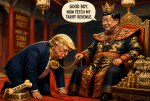
This underlying transition became unconcealable during the Trump-Xi summit in Beijing during 2026. Chinese protocol conveyed what words scarcely needed to explain. Xi Jinping did not greet Trump personally at the airport. The symbolism was precise. The era of automatic American deference had ended. Taiwan discussions resembled lectures rather than negotiations. American assumptions of strategic primacy looked increasingly absent. The details themselves matter less than the broader point. China increasingly behaves as a civilisation conscious of ascending power while America increasingly resembles an empire managing decline.
China did not defeat America through military spectacle. No Chinese D-Day occurred. No fleet sailed triumphantly toward California. China won through patience and through productive seriousness. While America produced consultants, China produced engineers. While Wall Street and the City of London generated elaborate forms of organised fraud disguised as innovation, China built ports and industrial systems. While financial elites multiplied abstractions and congratulated themselves on entering a post-industrial future, China retained an older and less fashionable understanding: power rests ultimately on productive realities.
This does not make China perfect. Every civilisation develops pathologies and every ruling class acquires illusions. Yet there remains a certain justice in watching a civilisation that mistook financial manipulation for civilisation itself discover that engineers remain more useful than speculators. For decades America presented itself as civilisation’s guardian while behaving increasingly as an apparatus of sanctions, debt extraction and military coercion. It imagined these habits represented strength. They represented decay. Finance capitalism, especially in its Wall Street and City form, gradually became less a means of generating wealth than a system for redistributing and extracting it. Men who delighted chiefly in defrauding others eventually found themselves trapped inside their own fantasies. Reality, unlike financial markets, possesses no public relations department. Unlike central banks, it cannot create further liquidity. Unlike investment houses, it does not extend credit forever.
And reality, having waited patiently, has finally begun presenting its bill.
Discover more from The Libertarian Alliance
Subscribe to get the latest posts sent to your email.