by A Tired Israeli
As a liberal Israeli, I have spent much of my adult life believing that somewhere there existed a morally satisfactory answer to the conflict into which I happened to be born. I assumed that time, goodwill and sufficient pressure from reality itself would eventually produce a formula by which security and ordinary human decency could be reconciled. I believed that enough negotiations, enough concessions and enough exhaustion might finally persuade both peoples to live beside one another without fear. I believed that history, if left long enough, had a tendency to settle into compromise. I do not think I believe this any longer.
Age has a way of stripping away intellectual comforts. It becomes harder to sustain faith in elegant solutions after decades of watching reality refuse to cooperate. One sees peace initiatives announced and forgotten. One watches conferences produce communiqués and communiqués produce nothing. One observes leaders speaking grandly of coexistence while the dead continue to accumulate beneath the earth. Eventually one begins to wonder whether the language of peace processes and road maps has become less a programme than a liturgy repeated because no one wishes to admit that previous assumptions may have failed.
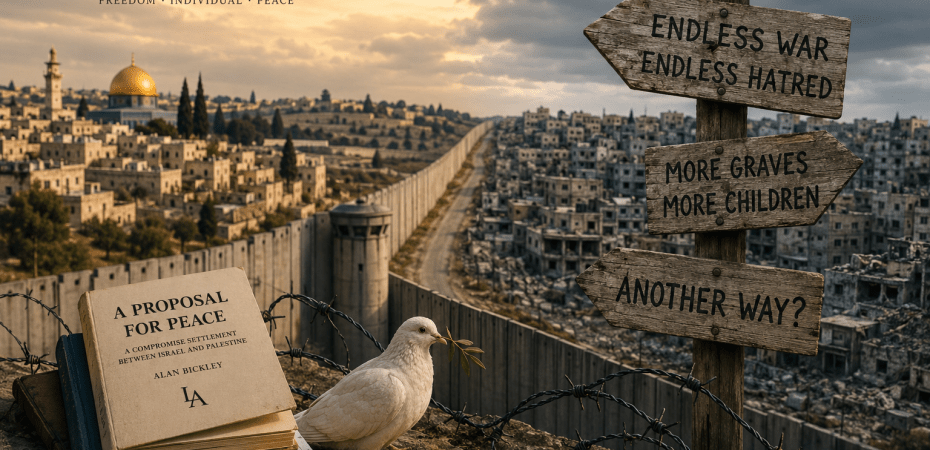
I recently read Alan Bickley’s proposal in the Libertarian Alliance for a compromise settlement between Israel and Palestine. My first reaction was dislike. My second reaction was discomfort. My third reaction was the realisation that I had continued thinking about it long after finishing it. That disturbed me more than agreement would have done.
The proposal disturbed me because much of it seemed instinctively repellent. Population transfers possess a terrible reputation. They evoke some of the ugliest episodes in modern history. They suggest uprooting, coercion and the reduction of human beings to demographic units. No liberal wishes to think sympathetically about such things. I certainly did not. Yet revulsion by itself does not settle difficult questions. Moral disgust tells us that something appears ugly. It does not necessarily tell us whether every alternative is uglier still. Perhaps I should begin with what I regard as obvious truths.
I believe much of the Palestinian case against Israel is historically correct. I believe that Israel came into existence through large-scale dispossession. I believe villages were emptied, populations frightened or driven away and facts established on the ground through violence and force. I believe the process began before 1948 and continued afterwards. I believe that the occupation after 1967 represented less a departure than a continuation. I think many supposedly voluntary arrangements occurred within structures designed to favour Jewish ownership over Arab ownership. I believe that Gaza itself has now reached a point where language becomes difficult because the scale of destruction overwhelms ordinary political vocabulary.
Many Israelis know these things already, though we often discuss them defensively or not at all. The problem lies elsewhere. What exactly am I supposed to do with such knowledge? I was born here. Hebrew is my language. Israel is my only citizenship. I did not personally expel anyone. I did not choose the circumstances into which I arrived. I occupy a place in a historical process I inherited rather than created. Am I expected to hand over my flat to strangers whose families once lived nearby and who may understandably regard me as the beneficiary of theft? Am I expected to become a refugee myself in order to repair a refugee crisis created before my birth? Am I supposed to try my luck in Europe or America and hope that societies with their own long and complicated histories of attitudes towards Jews remain permanently welcoming? These are not rhetorical evasions. They are practical questions.
None of this means Israel is uniquely wicked. Human history consists largely of conquests that lasted long enough to become traditions. Nearly every state now existing occupies territory taken at some point from previous possessors. Those possessors often took it from others still earlier. Human history resembles a long succession of seizures interrupted by periods sufficiently lengthy for myths of permanence to emerge. The unusual feature of Israel is perhaps only that the process happened recently enough for many of those involved still to remain alive. The wounds remain visible. The moral arguments remain fresh.
For many years I believed in a two-state solution. I marched for it. I defended it repeatedly. I thought it possessed a beautiful symmetry. Two peoples desired self-determination and therefore two states would satisfy both aspirations. Reality, however, proved less accommodating. I increasingly struggle to imagine living beside a sovereign Palestinian state inhabited by people who possess understandable grievances and whose political consciousness has been formed by generations of loss, humiliation and war. Human beings do not become saints through suffering. Suffering often creates hatred and hatred acquires its own momentum. I do not say this because Palestinians are uniquely vindictive. I say it because they are human.
The federal alternatives proposed abroad seem no more persuasive. Foreign commentators occasionally speak as though constitutional engineering might somehow produce another Switzerland or another America. I cannot understand this confidence. Two populations who hate and fear one another do not become fellow citizens because political theorists produce an elegant structure. I sometimes suspect that such arrangements would resemble less the Swiss Confederation than a parliament of armed factions frequently interrupting debate with gunfire.
This returns me to Bickley’s proposal and to the reason it continued troubling me after I had finished reading it. What interested me was not agreement with every detail. I remain uncertain about large parts of it. What interested me was its determination to begin not with ideal outcomes but with circumstances as they actually exist.
The starting point is stark and many readers will immediately dislike it. Israel possesses overwhelming military superiority. Israel controls Gaza, the West Bank and the wider territory in practical terms. No major external power appears willing to force a reversal of that position. One may regard this as cynical. One may regard it as surrender to brute force. Yet one may also ask whether international politics has generally operated in any other manner. States speak endlessly of justice and legality, but borders often survive because someone possesses the power to enforce them.
Bickley therefore asks readers to begin with an uncomfortable assumption: Israel has effectively won. Not morally, and perhaps not historically, but strategically. The question then ceases to be how one restores a vanished landscape. The question becomes how one transforms a victory that currently resembles an ongoing catastrophe into a settlement that prevents future catastrophes.
The proposal unfolds in stages.
First, the existing territorial reality would be formally recognised. Israel would receive international recognition not merely within its older boundaries but across the territories it now controls. The wider Arab world would establish normal diplomatic relations and exchange ambassadors. The endless state of half-war and suspended legitimacy would finally end. The objective here is not to reward conquest in a moral sense. The objective is to acknowledge a situation that already exists and to prevent continued killing in pursuit of reversals that may never happen.
The second element is the most controversial and the one that initially repelled me. The proposal assumes that large numbers of Palestinian Arabs would leave these territories and be resettled elsewhere in the Arab world. Bickley argues that this should occur through organised and internationally supervised population transfer rather than through the current mixture of bombardment, deprivation and informal displacement. He points out, correctly, that populations have been moved before, sometimes with long-term success in reducing future conflict, though often at terrible immediate human cost.
The difference, he argues, would lie in compensation and administration. These would not be desperate refugees abandoned in camps or driven across borders with whatever possessions they could carry. The displaced population would receive extensive support and reconstruction funding intended to create genuinely viable futures elsewhere.
This leads to the third and perhaps most important component of the proposal: Israel must pay.
Bickley repeatedly insists that recognition cannot simply become a free reward for military success. Israel would be required to compensate for annexed territories, destroyed infrastructure, lost property and displaced populations. These payments would not rely upon Israeli promises, because he clearly does not trust future Israeli governments to honour voluntary obligations. Instead, payment mechanisms would operate internationally and automatically.
His proposed mechanism is surprisingly concrete. He suggests a United Nations Compensation Authority funded by mandatory tariffs on Israeli exports collected internationally and transferred directly into compensation funds. Over decades, and supplemented by bonds and other financial instruments, these revenues would fund resettlement, infrastructure and long-term development programmes. The intention is that neighbouring countries accepting populations would receive enough support to regard participation as materially beneficial rather than burdensome.
What interested me here was not merely the proposal itself but the strange mixture of realism and pessimism beneath it. Bickley appears to assume that no one involved is particularly virtuous. He assumes governments behave largely as self-interested actors. He assumes Israeli leaders cannot be trusted. He assumes neighbouring states respond to incentives rather than moral appeals. He assumes that human beings frequently choose advantage over principle.
There is something bleak in this. There is also something oddly refreshing. One sometimes feels that discussions of Israel and Palestine involve moral theatre performed by people who privately know better. Bickley strips much of this away and asks a simpler question: given human beings as they are, rather than as we wish them to be, could a bargain be constructed that gives everyone enough reason to stop killing?
I do not know whether the answer is yes. I know only that I found myself continuing to think about the question. That alone makes the proposal harder to dismiss than I initially expected.
I dislike much of this proposal. Yet I find myself unable entirely to dismiss it. The difficulty is not coherence. The proposal possesses a severe and disturbing coherence. The difficulty concerns legitimacy. Could such a settlement ever command sufficient consent? Could people who have endured generations of dispossession regard departure as compromise rather than surrender? Could financial compensation, however generous, compensate for homes, memories, family histories and attachments to land? I do not know. I also wonder whether there exists a point beyond which compromise ceases truly to be compromise and becomes merely the formal recognition of victory by the stronger party.
Yet alternatives themselves have acquired severe difficulties. The two-state solution increasingly resembles a geographical puzzle with missing pieces. A single democratic state appears likely to institutionalise conflict rather than dissolve it. Endless occupation promises permanent instability. Endless war promises eventual catastrophe. I find myself asking not whether Bickley’s proposal is ideal, but whether any ideal options remain.
Part of my exhaustion comes from Israeli politics itself and from the man who has dominated it for far too long. I despise Benjamin Netanyahu. I do not merely oppose him politically. I think he has poisoned the spirit of the country. He possesses many talents, but leadership is not among them. His great gift has always been survival. He survives scandals, military failures, corruption allegations and political crises because he understands fear better than anyone else in Israeli politics. He has spent years transforming permanent emergency into a governing principle. Problems remain unresolved because unresolved problems justify his continuation in power. Wars become opportunities for postponement. Crises become instruments of political preservation.
By ordinary standards his career should already have ended. Hostages remained in Gaza while military operations devastated the territory around them. Corruption charges continue to hang over him. International isolation deepens. Yet somehow he remains present, wriggling through every difficulty like a man who regards accountability as an inconvenience rather than a principle. He has empowered religious extremists and fanatics while presenting himself as civilisation’s defender. He has left Israel more isolated internationally, more divided internally and morally exhausted. I am tired of him. I am tired of funerals and demonstrations and endless mobilisation. I am tired of politicians who convert grief into strategy. I am tired of hearing every conflict presented as existential and every compromise described as surrender.
Above all I am tired of the cycle itself. Hatred creates retaliation. Retaliation creates hatred. Each atrocity justifies another. Each grave prepares the ground for future graves. Perhaps Bickley’s proposal is flawed. Perhaps it is impossible. Perhaps it merely reorganises injustice. I do not know. What I admire, however, is that the Libertarian Alliance was willing to publish it at all.
I first discovered the Libertarian Alliance through articles on gold and monetary questions. I am not a libertarian and have never felt much temptation to become one. Even so, I gradually developed respect for an institution willing to permit difficult arguments and uncomfortable ideas. That quality has become rare. Too many publications now function as ideological churches. Their purpose is reassurance rather than inquiry. Readers are informed that they already possess the correct opinions and dissent becomes a form of heresy.
The Libertarian Alliance occasionally publishes things that annoy me deeply. More often, it publishes articles that leave me scratching my head. Would I ever want to sit in a room with Bryan Mercadente and Sebastian Wang? One would try to convert me to Romanism, the other attack me with fat callipers. Yet I do value institutions willing to risk discomfort in pursuit of thought. Civilisations do not become healthier by narrowing the range of discussable possibilities.
Coming back to my main argument, I do not know whether Bickley’s proposal could work. I do not know whether it could command legitimacy or consent. I do not know whether it would diminish suffering or merely redistribute it. I know only that I am an old liberal growing tired of watching children inherit reasons to hate one another. I know that I am tired of killing and tired of grief. And I know that anyone seriously attempting to imagine an end to this long and terrible cycle deserves, at the very least, to be heard.
Discover more from The Libertarian Alliance
Subscribe to get the latest posts sent to your email.
Related posts:

Powered by YARPP.
There are three sets of proposed solutions to the conflict between Israelis and Palestinians in the territory claimed by a state that calls itself Israel:
(1) Two states.
(2) One state.
(3) Zero states.
This article, rightly, demolishes the first two of these.
I think I’ll stop here.
[…] will repeat the admission of my earlier article: Israel was founded in wholesale theft and murder. It was never a “Land without people for a […]
I believe Palestinians could move on IF they’re offered excessive financial reparations together with a genuine apology, including acknowledgement the zionists were wrong to take Palestine by force, and Palestinians are equals.
The world needs assurance this will never happen again (i.e. the greater Israel project has ended).
Israeli’s have nothing to fear from Palestinians IF they treat them with respect and love, as the Palestinians initially showed the migrants in the 20th century.
Today the international community cannot be trusted to manage reparations to Palestinian’s, because organisations like the UN and ICC are beholden to external nefarious interests. Therefor before anything can be done about this conflict, the UN would need to remove article 27 so none of the permanent members could veto any decision. Also all members must recognise the authority of the ICC.
Israeli politics does indeed seem the problem today, because it perpetuates the problem of Israeli supremacy. Palestinians never had a problem with Jews, they simply reacted to increasing abuse from immigrant colonists. Conversely Israeli’s think and treat Palestinian’s as if they aren’t human. That needs to be rectified before Palestinians can trust Israeli’s again.
Absolute respect to the Libertarian Alliance for publishing and providing a platform for high-level debate.