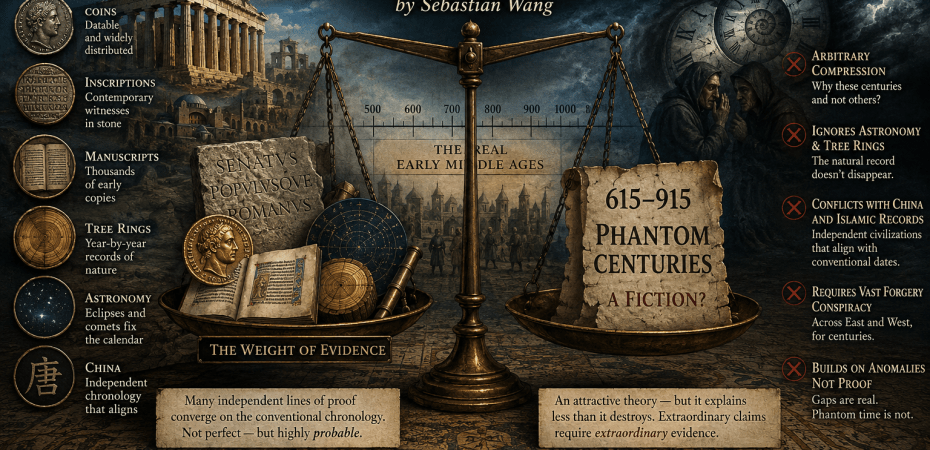
Chronology, Cranks, and the Weight of Probability: A Reply to Laurent Guyénot
by Sebastian Wang
There is a particular kind of intellectual temperament that finds established chronology almost impossible to leave alone. I touched on this in my earlier article on historical dating and the construction of chronology. Once you realise how much of ancient and medieval dating was assembled retrospectively—from regnal lists, synchronisms, king lists, astronomical observations, scattered inscriptions, and later harmonisation projects—it becomes difficult not to wonder whether the whole thing might shift under pressure. Historical chronology can look less like a finished cathedral than a giant scaffold erected over many centuries. Some people see this and become cautious. Others become intoxicated.
The temptation is understandable. If chronology is assembled rather than handed down complete, then perhaps the assembly went wrong, or was even made wrong. Perhaps centuries have been duplicated. Perhaps whole civilisations have been displaced in time. Once that suspicion takes hold, every coincidence begins to look like evidence and every gap begins to look deliberate. The imagination starts to race ahead of the evidence.
This impulse has a long history. One sees it in Isaac Newton’s attempts to compress ancient chronology. One sees it later in Nikolai Morozov and, in a much more extravagant form, in Anatoly Fomenko, who virtually dissolved Antiquity into the Middle Ages. Gunnar Heinsohn shortened whole civilisations into overlapping strata. Heribert Illig erased centuries entirely. The pattern is often similar. A real anomaly is noticed. A genuine difficulty is identified. Then, instead of treating it as a local problem, it becomes the key that supposedly unlocks all history.
Laurent Guyénot belongs within this tradition, though perhaps now with increasing reluctance. His earlier work moved into some very radical territory indeed. Alexander and Caesar were treated as potentially fictional; Rome and Constantinople seemed capable of changing places in history; the first millennium itself looked unstable. Yet unlike many revisionists, he appears willing to retreat when evidence pushes back. He now accepts that Late Antiquity possesses a genuine chronological sequence and that some of his earlier ideas simply do not work.
This is not nothing. Intellectual retreat is rare. Most chronological revolutionaries do not retreat. They advance. When difficulties appear, they usually solve them by proposing larger conspiracies and broader distortions. Guyénot, to his credit, seems increasingly willing to admit limits. He has not entirely abandoned the attraction of grand revision, but he no longer appears eager to set fire to the whole timeline merely because some stones in the structure are loose.
But a retreat from the most extravagant position is not the same as a return to sound method. Guyénot now appears to favour the more moderate Phantom Time thesis associated with Heribert Illig and popularised in English by Emmet Sweeney, writing as Emmet Scott. This theory claims that roughly three centuries, usually 614–911 or 615–915, were inserted into the calendar. Illig’s version has Otto III and Pope Sylvester II creating the false chronology to place themselves around the symbolic year 1000; Sweeney’s version adjusts details but keeps the main compression. The theory is widely treated as pseudohistory, and its basic claim is that the early Middle Ages, or a substantial part of them, did not exist.
The attraction is obvious. The early Middle Ages are difficult. Urban life contracted. Written sources are uneven. Archaeology can appear sparse. Some chronicles are late, derivative, or frankly suspicious. The Carolingian Renaissance does seem strange if imagined as a sudden blaze after darkness. Charlemagne’s image was certainly cultivated by later rulers. Some pious forgeries existed. The Donation of Constantine is real proof that medieval clerics could lie for institutional advantage.
Yet the conclusion does not follow. A period may be poorly documented without being imaginary. A civilisation may decline without vanishing. A source tradition may contain forgeries without being entirely fabricated. It is precisely here that Guyénot’s argument remains weak. He has moved from impossible revisionism to seductive revisionism, but seduction is not evidence.
The central difficulty is probability. The conventional chronology is not certain in every detail. No serious historian claims that. Some regnal synchronisms remain debated. Some archaeological layers are hard to interpret. Some texts are late or corrupt or politically shaped. But the broad chronology is highly probable because many independent lines of evidence converge. The Phantom Time theory asks us to believe that the convergence is forged or misread across archaeology, dendrochronology, astronomy, Byzantine history, Islamic history, Chinese chronology, numismatics, and manuscript transmission. That is not impossible in the formal sense. Almost nothing historical is impossible in that sense. But it is so improbable that only overwhelming evidence could make it credible. Guyénot and Sweeney do not provide overwhelming evidence. They provide anomalies, then build a chronology out of them.
Their strongest claim is the archaeological hiatus. They argue that material evidence for the seventh to ninth centuries is thin, and that layers from the early seventh century often seem to sit directly beneath those of the tenth. This is worth discussing. It is not absurd to say that early medieval archaeology is uneven. But the explanation is not that three centuries were invented. The explanation is that the post-Roman world was poorer, less urban, less monumental, and more archaeologically elusive than the Roman world before it or the high medieval world after it.
Wood decays. Pottery changes. Settlement shifts. Coins circulate differently. People build less in stone. Administrative cultures alter. Literacy contracts in some regions. Archaeology is not a neutral photograph of population size. It is a record of survival and excavation. A prosperous marble city leaves one kind of trace. A poorer timber settlement leaves another. To confuse archaeological thinness with chronological non-existence is to demand that every century leave the same sort of evidence.
The Charlemagne problem is similar. Guyénot follows Illig in treating Charlemagne as suspiciously literary, even semi-fictional. Einhard imitates Suetonius. Later rulers cultivated Charlemagne’s memory. Aachen is treated as anomalous. But none of this proves invention. Medieval writers imitated classical models constantly. Political cults often grow around real rulers. Monumental architecture can be exceptional. Aachen Cathedral itself is recognised as having a Carolingian core, with antique columns brought from Rome and Ravenna, and its Palatine Chapel is treated by UNESCO as a surviving nucleus of Charlemagne’s complex.
The argument “this looks too advanced” is dangerous. It has been used in every century to deny human achievement. Aachen may be impressive, but impressive buildings do not require missing centuries. They require patronage, money, models, craftsmen, and political ambition. Charlemagne had all four.
Astronomy is even more damaging to Phantom Time. Chronology is not built from chronicles alone. Eclipses, comets, and planetary observations create fixed points. Illig’s supporters have tried to answer this, but the problem does not go away. Remove three centuries, and astronomical records cease to align. Ancient and early medieval observations are not all perfect, but enough are datable to make a wholesale insertion of 297 or 300 years extraordinarily difficult. Popular summaries of the Phantom Time problem rightly point to dendrochronology and eclipse evidence as among the decisive objections.
Dendrochronology is still worse for the theory. Tree rings do not care about Otto III. They record annual growth patterns produced by climate. Long master sequences tie timber samples across centuries. These sequences are not literary. They cannot be forged by monks. If three centuries were invented, tree-ring sequences would display a hole or forced duplication. They do not. The natural world quietly keeps the calendar that the revisionists wish to erase.
Then there is China. This is the witness that pseudo-chronologies usually avoid. Chinese history developed independently of Western medieval politics. Chinese astronomical observations, dynastic records, reign periods, and bureaucratic traditions were not designed to validate European chronology. Yet they align broadly with the conventional chronology of Eurasia. If the years 615–915 were invented in the West, what happened to Tang China? Was the Tang dynasty shortened? Were Chinese eclipse records altered? Did Chinese scribes, working within an entirely different civilisation, somehow join an Ottonian-papal fraud? The question answers itself.
The same problem applies to Islam. Guyénot and Sweeney regard the obscurity of early Islamic archaeology as a clue that much of early Islamic history is misdated or duplicated. But early Islam is not a blank page. It has coins, inscriptions, papyri, non-Muslim references, administrative changes, and an expanding archaeological record. The historical narrative is certainly complicated. Patricia Crone and others raised serious questions about the traditional Islamic account. But questioning the later Muslim literary tradition is not the same as removing three centuries. It is the difference between criticism and demolition.
Guyénot is right that the seventh century was a period of massive disruption. Pirenne was possibly right to insist that Islam transformed the Mediterranean world. But a transformation followed by contraction is not evidence for phantom time. It is evidence for crisis. Trade routes broke. Papyrus supply diminished. Urban habits changed. The old Roman tax-state weakened or disappeared in the West. The survival of fewer documents after such a rupture is not mysterious. It is exactly what one would expect.
What makes the revisionist argument seductive is that it often begins with real observations. There are gaps. There are suspicious texts. There are forgeries. There are duplicated names. There are odd continuities. But history is full of repetition. Names recur because dynasties imitate ancestors. Political divisions recur because geography endures. Steppe peoples appear again and again in the Hungarian plain because that geography is a corridor into Europe. The Avars and Magyars need not be the same people merely because both were mounted outsiders entering similar strategic spaces. Similarity is not identity.
The deeper methodological error is that Illig-style chronology treats anomalies as sovereign. Every difficult point is allowed to overthrow the entire structure, but the theory itself is not held to the same standard. This is backwards. A theory that removes three centuries must explain more than the conventional model. It must explain all the evidence the conventional model explains, and then explain the anomalies better. It does not. It solves a few puzzles by creating dozens of larger ones.
Guyénot’s treatment of Rodulfus Glaber is a good example. A chronicle contains date errors apparently close to 300 years. This is interesting. It deserves attention. But medieval date errors are common. Scribes miscopy numerals. Authors combine regnal years, indictions, local eras, and Anno Domini dating badly. A mistake of roughly 300 years is not proof that 300 years were inserted into the calendar. It is proof that medieval chronological notation can be messy.
Nor is the existence of the Donation of Constantine enough. Yes, medieval institutions forged documents. But the argument “they forged one thing, therefore they forged three centuries” is not reasoning. It is escalation. The Donation of Constantine worked because it was one document serving one institutional claim. A three-century chronological insertion would require coordinated alteration across Latin Christendom, Byzantium, Islam, China, archaeology, astronomy, coinage, dendrochronology, and environmental evidence. This is not a bigger version of the same trick. It is a different category of impossibility.
Fomenko’s “New Chronology” shows where this kind of reasoning leads when allowed to run. Fomenko argues that ancient Greece, Rome, and Egypt belong largely to the Middle Ages, more than a thousand years later than conventionally dated. His system depends on large repeating chronological shifts and statistical pattern-matching across dynastic lists. It has gained attention in Russia partly because anti-Western civilisational narratives find it useful, but it is treated by mainstream historians as pseudohistory.
Illig is less extravagant than Fomenko, but the family resemblance remains. Both begin by distrusting the received chronology. Both discover patterns. Both compress time. Both explain resistance as institutional blindness. Both underestimate the independence of evidence.
A fair critique must admit that conventional chronology is not a revealed doctrine. It was constructed historically, and sometimes badly. Scaliger, Petavius, Ussher, and later scholars built large chronological systems from difficult materials. Some early modern assumptions have been corrected. Egyptian and Near Eastern chronologies have been revised. Radiocarbon calibration has changed arguments about the Bronze Age. No serious historian should pretend that every date in every textbook is equally secure. But this admission strengthens the conventional position rather than weakens it. The mainstream chronology has survived because it is corrigible. It can absorb corrections. It does not require every source to be authentic or every date to be exact. It is a probabilistic structure. It says, in effect: given the present state of textual, archaeological, scientific, and astronomical evidence, this sequence is overwhelmingly the best explanation.
Revisionist chronologies generally cannot say the same. They are brittle. They depend on dramatic compression. They must treat ordinary uncertainty as systemic fraud. They must convert silence into evidence. They must explain away independent witnesses. Above all, they must insist that the absence of expected evidence proves non-existence, while the presence of contrary evidence proves forgery or misdating.
Guyénot’s article is therefore best read as a half-conversion. He has abandoned the most reckless parts of his earlier chronological revisionism. That is commendable. But he still wants the thrill of radical reconstruction. He still sees the Dark Age as perhaps too dark to be real. He still allows anomalies to pull him towards a simpler, more dramatic pattern.
The conventional view is less exciting. It says that the first millennium really happened, but unevenly. Roman civilisation did not collapse everywhere at once. Late Antiquity did not become the high Middle Ages in a single step. The seventh century brought plague, war, religious transformation, Arab expansion, economic contraction, and administrative rupture. The eighth and ninth centuries were poorer in many places, but not imaginary. The tenth and eleventh centuries saw recovery, reform, renewed building, and institutional memory-making. That memory was sometimes false, sometimes propagandistic, sometimes confused. But it was built on real time.
Probability matters. The established chronology is not sacred. It is simply much more probable than its rivals. To reject it, one must do more than point to gaps. One must produce a model that explains archaeology, texts, coins, calendars, tree rings, eclipses, Chinese records, Islamic evidence, Byzantine continuity, and linguistic development better than the one we already have.
Illig does not do this. Sweeney does not do this. Fomenko does not do this. Guyénot, for all his intelligence and his welcome retreat from wilder claims, does not do this either.
The past is not perfectly lit. There are shadows, especially in the early Middle Ages. But a shadow is not a missing century. It is only a place where evidence is harder to see.
Reading List
Chronology and historical method
E. J. Bickerman, Chronology of the Ancient World.
Anthony Grafton, Joseph Scaliger: A Study in the History of Classical Scholarship.
C. R. Cheney, Handbook of Dates for Students of English History.
L. D. Reynolds and N. G. Wilson, Scribes and Scholars: A Guide to the Transmission of Greek and Latin Literature.
Late Antiquity and the early Middle Ages
Peter Brown, The World of Late Antiquity.
Chris Wickham, The Inheritance of Rome: A History of Europe from 400 to 1000.
Michael McCormick, Origins of the European Economy: Communications and Commerce AD 300–900.
Henri Pirenne, Mohammed and Charlemagne.
Richard Hodges and William Whitehouse, Mohammed, Charlemagne and the Origins of Europe.
Carolingian Europe and Charlemagne
Rosamond McKitterick, Charlemagne: The Formation of a European Identity.
Janet L. Nelson, King and Emperor: A New Life of Charlemagne.
Matthias Becher, Charlemagne.
Roger Collins, Charlemagne.
Byzantium and Islam
Cyril Mango, Byzantium: The Empire of New Rome.
John Haldon, Byzantium in the Seventh Century.
Robert Hoyland, Seeing Islam as Others Saw It.
Patricia Crone, Meccan Trade and the Rise of Islam.
Fred Donner, Muhammad and the Believers.
China as an independent chronological witness
Mark Edward Lewis, China Between Empires: The Northern and Southern Dynasties.
Mark Edward Lewis, China’s Cosmopolitan Empire: The Tang Dynasty.
Denis Twitchett and John K. Fairbank, eds., The Cambridge History of China, especially the Sui and Tang volumes.
Revisionist chronologies and their critique
Heribert Illig, Das erfundene Mittelalter.
Emmet Sweeney, A Guide to the Phantom Dark Age.
Anatoly Fomenko, History: Fiction or Science?
David M. Perry, “The Phantom Time Hypothesis,” The Public Medievalist.
A. Edward Siecienski and other specialists on early medieval historiography may also be useful for checking claims about chronology, Byzantium, and ecclesiastical memory.

Discover more from The Libertarian Alliance
Subscribe to get the latest posts sent to your email.

Thank you for your well-documented tour de force debunking alternative history hypotheses. Permit me to summarize another historical revision and put this into the context of cyclical cosmology.
Simcha Jacobovici, a documentary filmmaker and popularizer of alternative biblical history, argues that the Exodus reflects real events tied to the mid‑2nd‑millennium upheavals—he links the story to the Hyksos expulsion from Egypt and to the catastrophic Thera (Santorini) eruption, proposing a revised Exodus chronology that compresses Egyptian timelines and reads volcanic and textual evidence as a single causal chain. Critics say this reconstruction forces disparate data into a neat narrative, conflates distinct peoples and episodes, and relies on circumstantial synchronisms rather than secure archaeological stratigraphy. Further, his recent suggestion that Israelites were enslaved to build the pyramids directly contradicts both his Hyksos thesis and established archaeology, since the major pyramids predate any plausible Israelite presence and were constructed by organized laborers, not a mass slave workforce.
Due to randomness and free will, the future is a cloud of possibilities. If we consider the viewpoint of the past, that logically implies the history of our timeline was (past tense from our viewpoint) simply one of many other possibilities. If we assume that reality goes through cycles, the same particles are recycled in a different configuration for each cycle. This indicates the possibility of a quantum link between any given particle at different times, within a given cycle or between cycles.
I propose a cyclical cosmology where the Big Bang is a burst of particles from a central near‑singularity; those particles travel on curved paths shaped by the singularity’s gravity, forming structure as the universe expands. Midway through each cycle the cosmos undergoes a coordinated contraction (without reversal of trajectories) that reshapes the underlying geometry and sets up the next cycle, with entropy and the arrow of time managed by that geometric reconfiguration rather than by a simple, one‑way buildup.
In conclusion, some alternative histories might actually occur in different cycles of existence.
Quite apart from the Tang dynasty, why would anyone think there was a gap in European history? To choose a year at random, plenty seems to have happened in AD 822.
The men of Ard Cianacht, were routed by Cumuscach son of Congalach, and Eudus son of Tigernach and many others fell. (The Annals of Ulster)
This year two aldermen were slain, whose names were Burhelm and Mucca; and a synod was holden at Cliff’s-Hoo. (The Anglo-Saxon Chronicle)
Duke Winigis of Spoleto in his declining years…entered the monastic life. But not much later he was stricken by disease and died. Suppo, count of Brescia replaced him. (The Royal Frankish Annals)
Were three hundred years of forgotten sensations like this really invented from whole cloth? And purely for propaganda purposes, to create a calendrical illusion? It is not the least bit plausible.