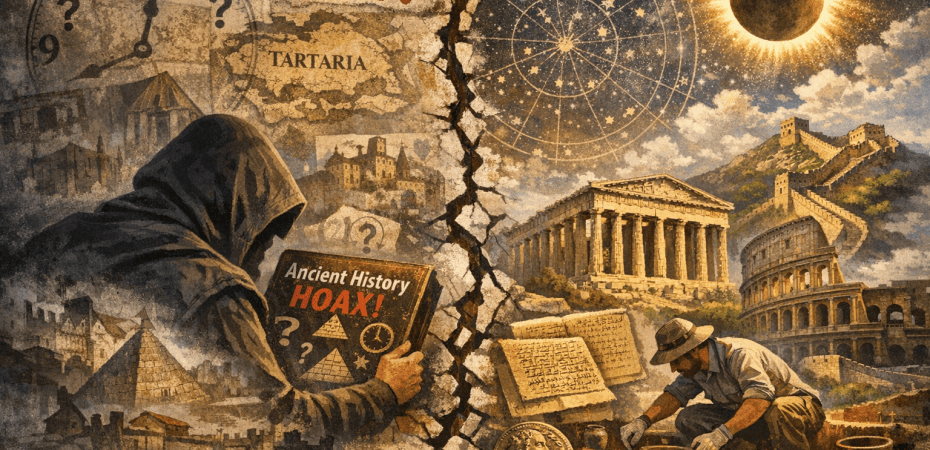
A comment was left here yesterday on the Libertarian Alliance Blog, attacking Dr Gabb’s video course on Greek history. For those who may not have noticed it, here is the comment in full and without editing:
suppose its challanging to realize the fake history, Greece never Xisted as such as her own
separated culture, as agrocultural settlements all along northafro-dite, all of mediteranian coast, all of so named middle east, all of Tartaria and certain iberia/afrowestcoast was worked by international communities with that early mazedonian dialect which became early bhulgar/greek/tartarian and that accounting script Latin for the AI. And thats before the resets of 16/18century, which them couldnt remember, so the prereset-data is kind of lost and not well interpritated. So i even challange that idea of Rom before the 14cent.
Those criminal kingdoms of early where all called barbaric (not fit for diplomatic Xchange) and unimportand for tributes to the motherland idea in asia…
just saying your handfull of videos dont make history…
The message is semi-literate, but its meaning is not difficult to extract. It is not a normal disagreement about interpretation, and it is not a request for sources. It is a familiar attempt to abolish the ancient world wholesale by asserting that the entire conventional chronology is a fraud. The correspondent writes, “suppose its challanging to realize the fake history”, then states baldly that “Greece never Xisted as such as her own separated culture”. He introduces the idea of “resets of 16/18century”, after which “the prereset-data is kind of lost”, and finally he “challange[s] that idea of Rom before the 14cent.” He closes with a sneer aimed not only at Dr Gabb but at the very concept of teaching history: “just saying your handfull of videos dont make history…”
The last line is true in a narrow sense, and it offers a useful starting point. A handful of videos does not make history. Nor, for that matter, does a handful of professors, universities, museums, or even a civilisational consensus. History is made—so far as it is “made” at all—by the stubborn existence of evidence and by the development of methods for judging that evidence. If you want to refute a historical argument, you do not begin by declaring fraud. You begin by showing how the evidence can be replaced by a better model that explains more.
The reason I have bothered to take this e-mail seriously is not that it is persuasive. It is not. The reason is that the genre is common. “Crank chronologies” are everywhere online. They come in different costumes, but the inner mechanism does not change. Time is compressed. Vast stretches of the past are declared invented. When asked for details, the proponent retreats into a vague catastrophe, a cover-up, a purge, a “reset”, or some other magical event that destroys all inconvenient proof while leaving a perfect residue of whatever the believer already wants to be true. At that point, one is no longer discussing history. One is discussing a form of faith, because the belief is constructed so that no evidence can ever dislodge it.
A particularly well-known example of this family of ideas is the “missing centuries” claim about the early Middle Ages, which holds that a long period—often around the seventh to tenth centuries—was invented or duplicated for political reasons. Another large branch of the same family is Russia’s “New Chronology”, associated most famously with Anatoly Fomenko, which attempts to push much of what we call antiquity into the medieval period, sometimes with the additional insinuation that “Western” scholars fabricated the classical past. One does not need to believe that every Russian shares this view to notice that the idea has enjoyed a strange kind of popular resonance in Russia and its online diaspora, helped along by national bitterness, post-Soviet suspicion of official narratives, and the seductions of identity politics. When people feel humiliated in the present, they become eager to rearrange the past. This is one of the oldest compensatory instincts in politics.
I have read somewhere that Alexander Dugin believes something similar. I checked again, but cannot now find reliable evidence that Dugin is personally committed to the specific thesis that antiquity is a medieval forgery in the way Fomenko is. It would be irresponsible to assert that he is. What is fair to say is that crank chronologies often flourish in the same cultural ecosystem as grand anti-Western narratives, and that contemporary Russian political-intellectual life contains a visible current of “history as a weapon”, in which the West is cast as a forger and Russia (or some mythic “Horde”, or a fantasised “Tartaria”) is cast as the true civilisational centre. Whether Dugin himself endorses a particular re-dating scheme is less important than the broader environment that makes such schemes psychologically attractive.
The point, however, is not to diagnose motives. The point is to show why the conventional chronology of the ancient world is highly likely to be broadly correct, while also admitting, frankly, that certain dates and synchronisms remain open to argument. This is what separates historical method from crank belief. Method thrives on uncertainty at the margins. Crank chronologies require total destruction at the centre.
The first thing to understand is that “the conventional chronology” is not one claim. It is a mesh of independent constraints. If you are used to arguing about history as a matter of texts, you may imagine that historians simply read manuscripts and decide upon dates. That caricature is precisely what the crank chronologist depends on. He can then declare that manuscripts are forged, and he thinks the whole building comes down. It does not. The timeline of antiquity is built from many different kinds of evidence, developed in different centuries by different disciplines, and cross-checked against each other. To compress the ancient world into the late Middle Ages is not merely to disagree with a professor. It is to declare that archaeology, linguistics, astronomy, and the physical sciences are all simultaneously mistaken in a way that happens to produce the same wrong answer everywhere.
Begin with the most basic sort of chronology: the relative kind. Ancient societies did not date by BC years. They dated by regnal years and civic eras: year 5 of one king, the archonship of another, the consulship of another, the Olympiad of a festival cycle. On their own, these systems float. They tell you sequence, not absolute date. Yet they interlock because states interacted. Treaties are signed. Wars are fought. Embassies are exchanged. Coinage and inscriptions name rulers. One ruler is said to have faced another. Administrative tablets and monumental inscriptions cross-reference the same political world from different corners. The result is not a clean, modern timeline, but it is a tightly constrained relative order. If you try to shift entire civilisations forward by a millennium, you do not merely move a date. You snap a net.
Next, add the material record. Manuscripts can be forged. Stone and soil are less accommodating. Inscriptions, especially those cut in stone for public display, are not the sort of thing that can be invented in a library and then retroactively placed in plausible contexts across thousands of sites. Coins, likewise, are awkward for conspiracy narratives. They move through markets. They accumulate in hoards. They appear in sealed deposits. They sit beneath later occupation layers. When archaeologists excavate, they do not conjure a date from mood. They establish stratigraphy. What lies beneath tends to be older than what lies above, and when a sealed layer contains a set of coins, pottery, and organic remains that match similar sealed layers elsewhere, you are no longer arguing about texts. You are arguing against the geography of time itself.
At this point, the crank tends to invoke the magic word: “reset”. This e-mail does exactly that. “Before the resets of 16/18century … the prereset-data is kind of lost.” Notice how convenient it is. A “reset” is not defined as war, plague, administrative collapse, archival purge, or anything with a mechanism and a trace. It is a floating permission slip. It allows the writer to claim that missing evidence was destroyed and that existing evidence is misinterpreted. It also allows him to avoid doing the one thing a serious revisionist must do: specify what happened, who did it, how it was executed, and what physical and documentary residues would remain. Real catastrophes leave debris. They do not erase it.
The physical sciences make the crank’s job worse. Radiocarbon dating is not a medieval invention. Dendrochronology—the matching of tree-ring patterns into long master sequences—is not a medieval invention. When these methods are applied to organic material from ancient contexts, they do not produce dates clustering in the fourteenth century. They produce dates clustering across the Bronze Age, the Iron Age, the classical period, late antiquity, and the medieval period in the expected order. The significance is not that every sample yields a perfectly precise year. The significance is that the distributions are coherent across regions and sites. To sustain the “Rome before the 14cent” claim, one must believe that medieval forgers planted vast quantities of organic material with isotopic decay properties that would only later be discovered by twentieth-century physics, then buried it in layered sequences that imitate natural deposition and cultural change.
Astronomy is the hardest wall. Ancient observers recorded eclipses. Eclipses can be calculated backward. When a text describes a solar eclipse at a certain stage of a war, the sky provides a check that does not care about scholarly fashion. This is not “Western” or “Eastern”. It is planetary mechanics. If a revisionist wishes to compress the ancient world into the late Middle Ages, he must explain why multiple independent traditions recorded eclipses and planetary phenomena that match their conventional placements. You can argue about scribal error in a single report. You cannot wave away the cumulative structure without positing a conspiracy that would have needed a modern knowledge of orbital computation centuries before that knowledge existed.
Language offers a different kind of continuity, and it is an underappreciated one among non-specialists. Greek does not simply exist as “classical Greek”. It exists in layers. There is a Greek attested in Bronze Age administrative tablets (Mycenaean Greek, written in Linear B). There are archaic and classical dialect inscriptions. There is Koine Greek. There is medieval Greek. There is modern Greek. These layers align with what we know about linguistic evolution: phonological shifts, morphological simplifications, vocabulary changes, and the patterns of borrowing. When someone writes, as this comment does, that an “early mazedonian dialect … became early bhulgar/greek/tartarian”, he is not offering linguistics. He is gesturing with exotic labels. “Tartarian” in this context is not a language family at all; it is an internet myth used as a bucket for whatever the speaker cannot otherwise name. Genuine linguistic arguments do not look like that. They cite inscriptions. They trace sound changes. They show how a form becomes another form over time. They do not rely on vibes.
This is already enough to show that the comment’s central claims are not merely unproven but structurally incapable of proof. I will, however, give a further argument. Since I am myself of Chinese heritage, it is an argument that comes naturally to me, but is also in itself probably decisive. The is the correspondence between the mainstream chronology of the West and the Chronologies of China.
Crank chronologies often present themselves as a war between “Western academics” and “truth”. They can do this only by keeping the discussion inside a Western corridor: monks, popes, emperors, universities, museums. China refuses to cooperate. Chinese historical record-keeping did not develop as an appendage of Western classicism. It developed as an administrative and cosmological necessity inside an imperial civilisation with its own priorities. Chinese court historiography, calendar reforms, and astronomical observation were not performed to impress Oxford. They were performed to predict auspicious days, and manage the state. Chinese sources record eclipses and other celestial phenomena in ways that can be checked astronomically. They also record geopolitical events across Central Asia and contacts with distant western polities. The result is not that China “proves” every Greek date to the year, but that China makes the global compression fantasy unworkable. If you claim that antiquity is a Western forgery produced after 1300, you must explain why an independent civilisation’s continuous bureaucratic and astronomical traditions align with the broad shape of the conventional ancient timeline. You must also explain, in sober terms, how medieval Europeans forged Chinese archives in classical Chinese, inside a state apparatus they did not control, in a way that later matches astronomy.
This is the decisive point. The e-mail’s worldview depends on shrinking the number of independent witnesses. China expands them again. That is why the “reset” theory, once confronted with China, typically responds not with evidence but with silence or further abstraction.
At this stage, a fair-minded reader may ask: if the conventional chronology is so robust, why do historians dispute dates at all? The answer is that robust does not mean perfect, and confidence does not mean certainty. The ancient world contains genuine uncertainties. The further back you go, the more the record fragments. There are debates about high and low chronologies in parts of the Bronze Age Near East. There are disputed synchronisms where one regnal list may be incomplete or where an inscription is damaged. There are uncertainties about the dating of particular poetic texts and the historical cores behind epic traditions. There are even cases where the conventional date of an event is a best-fit compromise among competing sources rather than a mathematically deduced certainty. These are real issues, and historians argue about them loudly.
Yet notice the scale. These debates move dates by decades, sometimes by a century, occasionally a little more at the deep margins. They are refinements within a structure. They are not an invitation to abolish the structure. When scholars dispute whether a given reign began in one year or another, they do so by tightening constraints: recalibrating radiocarbon sequences, reassessing archaeological contexts, reconsidering astronomical identifications, re-reading inscriptions with improved imaging. They do not do it by asserting that Rome did not exist until the fourteenth century.
This is why the e-mail is not a critique of Dr Gabb’s course. It is an attack on the possibility of learning history in the first place. A course teaches students that chronology is made from evidence and method, and that evidence can be checked. The crank chronologist cannot tolerate this because his system requires that checking never occur. He therefore tries to make the argument personal: “your handfull of videos dont make history”. The correct reply is to agree, then pivot back to first principles. No, videos do not make history. Evidence does. If you want to challenge the timeline, show a model that explains the evidence better than the conventional one. Show your workings. Name your mechanism. Provide sources that can be interrogated. Explain why Chinese astronomical records align with the broader global timeline if antiquity is a medieval invention. Explain why stratigraphy produces coherent sequences beneath medieval layers across thousands of sites. Explain why languages show layered evolution rather than a single-point fabrication.
If you cannot do this, you have not challenged history. You have merely announced a personal mythology. It may feel thrilling. It may even feel morally charged. It is not knowledge.
The e-mail’s semi-literacy is relevant here, and I say that without malice. The inability to write coherently often tracks the inability to reason coherently. This letter does not merely contain spelling errors. It contains category errors. It treats undefined abstractions—“resets”, “motherland idea in asia”, “Latin for the AI”—as though they are explanatory. It treats the mere existence of cultural contact as proof that cultures do not exist. It treats “barbaric” as a technical diplomatic label rather than an evolving ethnolinguistic slur. It substitutes atmosphere for mechanism at every step. Such writing is not a sign of hidden genius. It is a sign that the writer has not learned the discipline he is attempting to overthrow.
History is not fragile. The conventional chronology is not a single narrative that can be punctured by one cynical e-mail. It is a scaffold built from many independent beams. You may argue about the placement of a plank here and there, and you should, because that is how the discipline improves. What you cannot responsibly do is declare the scaffold imaginary while still standing on the floor it supports.
Reading list
I have chosen works that do two things: they explain how chronology is constructed, and they show how different regions lock together. I have also included one or two sources on the “crank chronology” phenomenon itself, not because they are intellectually serious but because they are culturally influential and therefore worth understanding as an opponent.
How chronology is built and checked
- E. J. Bickerman, Chronology of the Ancient World (2nd ed.).
- Anthony Grafton, Joseph Scaliger: A Study in the History of Classical Scholarship (for how modern chronological method was forged).
- R. J. van der Spek and colleagues (eds.), works on Near Eastern chronologies and synchronisms (choose an accessible survey volume if you prefer).
- Colin Renfrew and Paul Bahn, Archaeology: Theories, Methods, and Practice (for stratigraphy, dating, and method in plain language).
Greek history within the wider Mediterranean
- P. J. Rhodes, A History of the Classical Greek World (solid, source-aware narrative).
- Simon Hornblower (ed.), The Oxford Companion to Classical Civilization (useful for quick orientation and terms).
- Robin Osborne, Greece in the Making (for early Greece and the development of the polis).
Rome and material evidence
- Mary Beard, SPQR (popular, but good on what we can and cannot know).
- Andrew Wallace-Hadrill, Rome’s Cultural Revolution (for the texture of change rather than a single “invented” moment).
China as an independent witness
- Mark Edward Lewis, The Early Chinese Empires: Qin and Han (for state formation and bureaucratic continuity).
- The Cambridge History series volumes relevant to early and imperial China (dip in for chronology and administrative record-keeping).
- Works on Chinese astronomical records and eclipses in historical astronomy (choose a modern survey chapter; these exist in several academic collections).
Crank chronologies as a cultural phenomenon
- Anatoly Fomenko, representative “New Chronology” texts (not for truth, but to understand how the argument is sold).
- Scholarly critiques of Fomenko and of pseudo-history in post-Soviet culture (choose peer-reviewed articles or university-press discussions).

Discover more from The Libertarian Alliance
Subscribe to get the latest posts sent to your email.