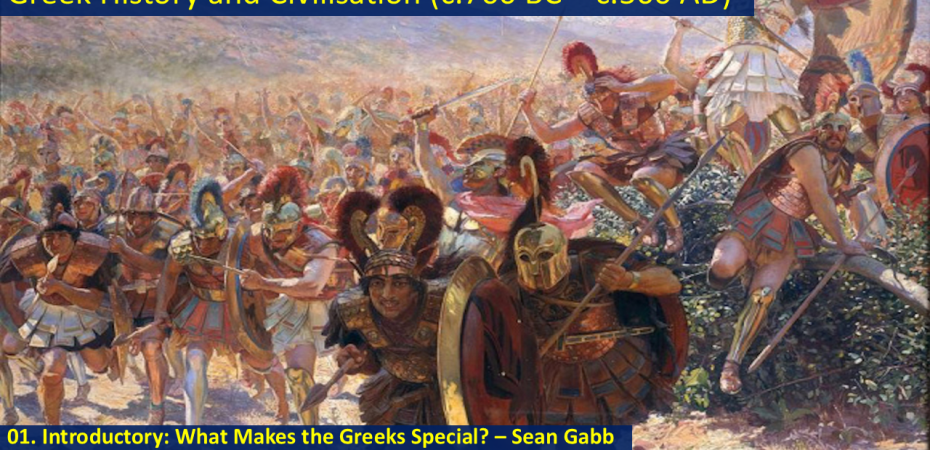
This playlist presents a structured course on Greek history from roughly 700 BC to AD 500, covering the emergence, development, transformation, and eventual absorption of the Greek world into the Roman Empire.
The course does not idealise Greek civilisation. Instead, it examines the Greeks as they actually were: politically fragmented, often violent, deeply unequal, and frequently brutal. Women were excluded from public life, slavery was central to the economy, and violence against children was institutionalised.
At the same time, Greek civilisation produced forms of thought and expression that continue to shape the modern world, including philosophy, history, mathematics, science, realistic art, and political argument.
Each lecture in the course focuses on a major theme or period. Individual lectures are divided into shorter sections for clarity and accessibility.
The series is intended for students, teachers, and serious general readers who want a historically grounded account of Greek civilisation without romanticism or modern sentimentality.


Discover more from The Libertarian Alliance
Subscribe to get the latest posts sent to your email.
Related posts:
 Hoppe’s Lost Civilisation: A Review of A Short History of Man: Progress and Decline
 Greek Fire: The Secret Weapon That Saved Constantinople and the Civilised World
 Ears, Stones, and Ghosts: Ancient Greek Theatre as Acoustic Engineering
 A World Reconsidered: The Greek Polis and the Sino-Hellenic Turn
 Why I’m Fat, Fabulous, and Furious: A Response to Bryan’s Ancient-Greek Skinnyboy Delusion
 David Dürr on Swiss Anarchism – Property and Freedom Society Bodrum 2025
 Pope and Patriarch: A Review of Their Joint Declaration
Powered by YARPP.
suppose its challanging to realize the fake history, Greece never Xisted as such as her own
separated culture, as agrocultural settlements all along northafro-dite, all of mediteranian coast, all of so named middle east, all of Tartaria and certain iberia/afrowestcoast was worked by international communities with that early mazedonian dialect which became early bhulgar/greek/tartarian and that accounting script Latin for the AI. And thats before the resets of 16/18century, which them couldnt remember, so the prereset-data is kind of lost and not well interpritated. So i even challange that idea of Rom before the 14cent.
Those criminal kingdoms of early where all called barbaric (not fit for diplomatic Xchange) and unimportand for tributes to the motherland idea in asia…
just saying your handfull of videos dont make history…
Reply coming
I have been asked to reply to this very strange comment. I will do so for tomorrow. In the meantime, here is a summary of what I will say: To compress antiquity into the late Middle Ages, one must believe that mediaeval people forged not only manuscripts but also tree rings, ice cores, eclipses, volcanic ash layers, language evolution, metal chemistry, and the orbital mechanics of the Solar System — centuries before physics existed.
https://libertarianism.uk/2026/02/17/dissident-chronologies-and-why-the-past-refuses-to-move/
[…] comment was left here yesterday on the Libertarian Alliance Blog, attacking Dr Gabb’s video course on Greek history. For those who may not have noticed it, here is the comment in full and without […]