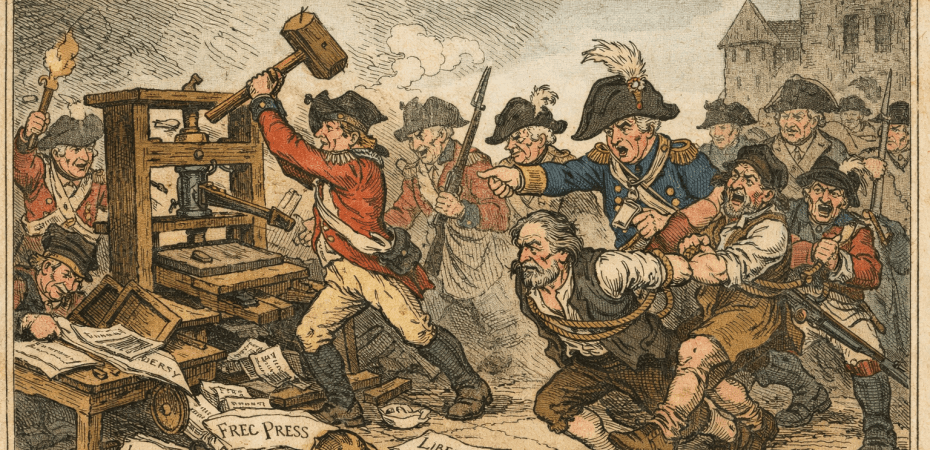
The British State has developed a reliable reflex. Whenever it seeks to extend its reach into the regulation of speech, it invokes children. The language is always grave, the framing always moral. Ministers stand before microphones and pronounce certain material “disgusting and not to be tolerated.” They speak of harms accelerating, of the need to act before it is too late. They suggest that hesitation is complicity.
It is a performance that has grown familiar. It is also a displacement. For what does child abuse look like when it is not abstracted into a parliamentary speech or a regulatory impact assessment? It does not usually present itself as an algorithmic glitch. It does not emerge because a social media platform permitted too much debate about immigration or energy policy or foreign wars. It emerges in kitchens, in bedrooms, in parked cars, in the shadowed spaces where fear, coercion and misplaced loyalty do their work.
On 12 February 2026, the Daily Mail carried a report whose headline was admirably blunt: “Labour mayor is found guilty of helping hide her son’s phone after he raped a 15-year-old girl.” There is nothing metaphorical here. No AI chatbot is implicated. No global platform is the enabling instrument. There is instead a crime and a prosecution.
The report states that Naheed Ejaz, a former mayor of Bracknell Forest, “refused to let officers in for over a minute and a half, giving 41-year-old Diwan Khan time to conceal the device.” The device in question is said to have contained “a video of him sexually assaulting the teenager.” The account continues that the fifteen-year-old victim had “blacked out” from MDMA placed in her drink. She awoke in the back seat of his car without clothes and without memory. He later showed her the video. He threatened to “slit her throat” if she told anyone.
The language is stark because the conduct was stark. The prosecution described how Ejaz had let her “mother’s love cloud her judgement.” Body-worn police footage captured her son referring in Urdu to the “big bell,” understood to mean the phone, and her reply, “keep silent, I know.” A jury convicted her of perverting the course of justice. Her son was convicted of rape.
You need not soften this. You may condemn it without qualification. But you must also observe something that the managerial rhetoric prefers to obscure. The offence was investigated under existing criminal law. The police obtained evidence. The Crown prosecuted. The court heard the case. A jury returned verdicts. Sentencing will follow.
This is how a society addresses sexual violence. It does so through the machinery of criminal justice. It does not do so by narrowing the permissible range of political speech on a communications platform.
The State now threatens to block access to X on the grounds that its integrated AI tool, Grok, has been misused to generate non-consensual sexualised imagery. Ministers insist that this is an emergency involving children. They speak as if failure to act would constitute moral abdication. Yet the case reported by the Mail demonstrates the hard truth that sexual violence and the obstruction of justice are matters for police and courts, not for speech regulators.
Nothing in the Bracknell case suggests that the absence of additional censorship powers was the enabling factor. Nothing implies that Ofcom’s capacity to impose fines amounting to ten per cent of global turnover would have altered the sequence of events. The crime did not occur because a political forum allowed excessive dissent. It occurred because an individual committed rape and another obstructed the investigation.
The distinction matters. It matters because the Online Safety Act operates overwhelmingly in the domain of speech regulation. It empowers Ofcom to issue enforcement notices. It allows for “business disruption measures.” It makes provision for court-ordered access restriction. It introduces criminal liability for senior managers who fail to comply with regulatory demands. These are formidable tools. They are tools directed at platforms. They are not tools directed at rapists.
The modern British State is quick to expand its supervisory authority over discourse. It is slower when confronted with institutional weakness in policing or prosecution. It finds it easier to threaten a global company than to reform creaking evidential systems. It prefers visible assertion of power to the quiet labour of competence. The language of child protection is the solvent in which this preference is dissolved and made palatable.
This is not an accusation against a single party. Human frailty does not respect partisan boundaries. Every major political organisation in Britain has had and still has members who failed morally or legally. The Bracknell case does not prove that Labour is uniquely compromised. It demonstrates that criminality can exist within the orbit of public office, as it can within any large institution. That is precisely why the conflation of child protection with censorship is so suspect. The existence of crime does not logically entail the necessity of regulating political speech.
If the Government wishes to protect children from sexual violence, it must invest in policing, strengthen investigative capacity, and ensure that cases are brought swiftly and competently before courts. It must focus on evidence, on procedure, on accountability. If it wishes to regulate speech in the name of preventing exposure to harmful material, it should state that objective plainly. The two enterprises are not identical. They do not share the same mechanisms. They do not succeed or fail for the same reasons.
When ministers declare that blocking a communications platform is required to safeguard the young, they invite a question. By what mechanism does silencing a forum for political argument reduce the incidence of rape committed in private? By what chain of causation does narrowing debate diminish the likelihood that a mother will delay police entry to protect her son? The answer, if it is honest, is that it does not.
The State’s appetite for narrative control grows in proportion to its discomfort with uncontrolled scrutiny. X remains one of the few platforms where journalists, academics, politicians and citizens can collide without prior filtration by an approved set of assumptions. It is unruly. It is often coarse. It is also difficult to manage. That difficulty is intolerable to a governing class that prefers consensus manufactured by regulation.
The Bracknell convictions remind us that child protection is a function of law enforcement, not of speech management. They expose the gap between rhetoric and reality. They show that evil is not abolished by altering terms of service. They demonstrate that the true work of safeguarding is procedural and human. It is based on the enforcement of laws that no one denies should exist.
To wrap the expansion of censorship powers in the banner of child safety is politically effective. It is emotionally compelling. It is also conceptually misleading. The crimes reported by the Mail were not committed because Ofcom lacked sufficient authority. They were committed because individuals chose to act wickedly, and because familial loyalty overrode legal duty.
A serious government would recognise the distinction. It would resist the temptation to convert every scandal into a justification for regulatory reach. It would accept that liberty and safety are not advanced by rhetorical conflation.
The protection of children requires criminal justice. The regulation of speech serves a different end. When the two are merged, both are degraded. The former becomes a slogan. The latter becomes an instrument.
The proposed banning of X is not a measured intervention against sexual violence. It is the latest escalation in a long campaign to subordinate political discourse to bureaucratic supervision. The Bracknell case does not strengthen the argument for censorship. It exposes the fragility of the moral pretext.

Discover more from The Libertarian Alliance
Subscribe to get the latest posts sent to your email.
Related posts:

Powered by YARPP.