Elmer Sholderburg
For most of my adult life, I considered myself a reliable supporter of the American-Israeli alliance. I was not an uncritical supporter, certainly, but someone who believed the relationship rested on genuine strategic interests, shared democratic traditions, and decades of cooperation. I never regarded Israel as infallible, but neither did I have much patience for those who insisted that Jerusalem was constantly manipulating Washington into fighting its wars. Too often those arguments seemed to blur into conspiracy theories or outright prejudice. I rejected them. Even a few months ago, I would have rejected the various commentaries that I have found on the Libertarian Alliance site. I would certainly have found them offensively anti-American, and profoundly ungrateful for all the help given to the United Kingdom since 1940. I am no longer so sure.
What changed my mind was not an ideological conversion. It was not Gaza. It was not social media. It was not a sudden sympathy for the Iranian regime, which I regard as dangerous, oppressive, and hostile to American interests. What changed my mind was something far simpler: I began paying attention to what our own government was saying.
On April 21, 2026, White House Legal Adviser Reed D. Rubinstein issued a State Department memorandum entitled Operation Epic Fury and International Law. Buried beneath the legal language was a sentence that every American ought to read carefully:
As the United States has explained in multiple letters to the U.N. Security Council, including most recently on March 10, the United States is engaged in this conflict at the request of and in the collective self-defense of its Israeli ally, as well as in the exercise of the United States’ own inherent right of self-defense.
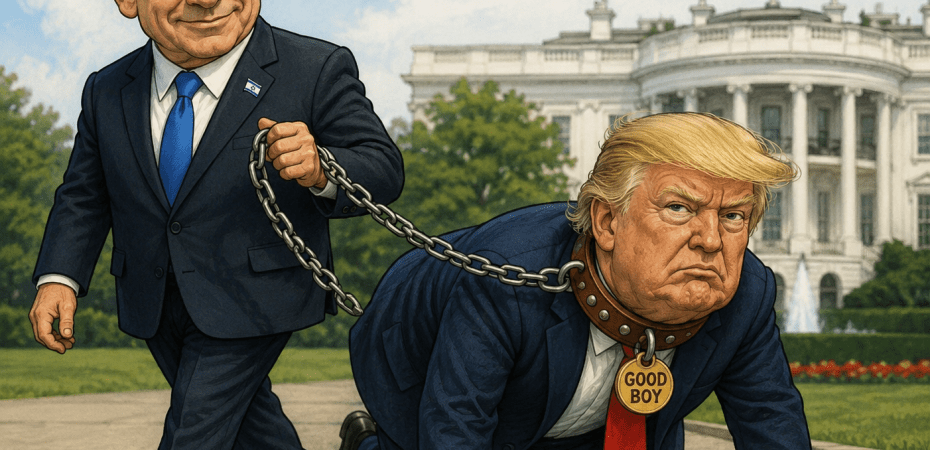
Those words stopped me in my tracks. The phrase “as well as” attempts to establish an independent American interest, but the order of the sentence matters. According to the official legal justification offered by our own government, the United States entered this war at Israel’s request. That is an extraordinary admission. We are not discussing intelligence sharing, military aid, or diplomatic support. We are discussing Americans fighting and dying in a war that our own government acknowledges began because an ally asked us to fight it. That ought to trouble conservatives more than almost anything else.
American foreign policy has always involved alliances, and alliances inevitably create obligations. But there is a profound difference between honouring a treaty commitment after an attack on a NATO ally and allowing another country to define our strategic priorities in one of the world’s most volatile regions. A sovereign republic should never surrender its own judgement about when and why it goes to war.
Operation Epic Fury began on February 28, 2026. Its objectives were ambitious: eliminate Iran’s offensive missile capability, destroy its missile production, cripple its naval forces, dismantle key elements of its security apparatus, and ensure that Iran would never possess nuclear weapons. Months later, the United States remains deeply involved in a conflict that has consumed American resources, taken American lives, disrupted energy markets, and offered little indication of a decisive or affordable victory. Wars are easy to begin and difficult to conclude. Conservatives, of all people, used to understand that.
I have also found myself reconsidering the events that preceded the conflict. When Prime Minister Benjamin Netanyahu visited the Oval Office shortly after President Trump’s dramatic foreign-policy successes elsewhere, he reportedly argued that Iran would never have the opportunity to exploit the Strait of Hormuz because American military action would degrade Iranian capabilities before Tehran could respond effectively. That prediction was always optimistic.
What now seems more plausible is a different calculation altogether: once the United States had committed itself militarily, withdrawing would become politically impossible. American prestige would be on the line. Any administration would face immense pressure to escalate rather than admit that the original assumptions had been mistaken. A limited intervention would gradually become an open-ended commitment. If that was indeed the expectation, it represents something fundamentally at odds with the obligations of friendship between nations.
The return of Donald Trump to office unsettled many of America’s traditional allies. Most approached his presidency cautiously, recognising both the opportunities and the uncertainties that accompany any unconventional administration. Israel appears to have seen something different: an opportunity to secure long-desired strategic objectives while Washington was led by a President unusually confident in his own instincts and unusually resistant to contrary advice. Perhaps he was open to unusual pressure, though I still find some of the claims about the Epstein Files hard to believe. Whether one admires or dislikes Donald Trump is almost beside the point. The larger question is whether any ally should regard temporary political circumstances in Washington as an occasion to advance objectives that serve its own regional interests while exposing the United States to enormous long-term risks. That is not how allies should behave.
In recent months I have heard defenders of the relationship complain that critics have become irrationally obsessed with Israel. Perhaps some have. Every political movement attracts its share of cranks. But I can only speak for myself. My own reassessment has nothing to do with ethnicity, religion, or historical grievances. It has everything to do with the nature of alliances. Alliances are supposed to strengthen both partners. They are not supposed to place one partner in the position of assuming enormous military burdens primarily because the other believes it has little to lose and much to gain.
I supported this alliance for decades because I believed it ultimately served American interests. I no longer find that assumption self-evident. When our own government openly acknowledges that we are fighting “at the request of” another country, Americans have every right—and indeed every obligation—to ask whether the relationship has drifted far beyond what the Founders would ever have considered prudent.
The question is no longer whether Israel is an important ally. It plainly is. The question is whether the current relationship encourages a dangerous moral hazard in which American power is increasingly treated as a strategic resource available for another nation’s regional ambitions.
Friends do not place friends in that position. Great nations certainly do not allow themselves to remain there indefinitely.

Discover more from The Libertarian Alliance
Subscribe to get the latest posts sent to your email.
Related posts:
 The Dollar as a Weapon: How Washington Uses Economic Terrorism to Topple Regimes
 Iran, Biden, Trump: Senile and Braindead vs Senile but Demented
 What the @#!* is Going Going on?
 A War of Depraved Atrocity
 More on Murder as Policy of State: Reply to Bickley
 Murder as Policy of State: Reply to Bjornson
 The Islamabad Standoff: America’s Strategic Defeat Disguised as Diplomacy
 The Joyful Spectacle of American Humiliation: Goliath Slaughtered by Persia
 The Real Defeat of America
 My Vote for Trump and the Moral Catastrophe in Iran
Powered by YARPP.
“Profoundly ungrateful for all the help given to the United Kingdom since 1940”? Like what? Name one thing!