I have a reliable way of taking the political temperature of America, and it does not require polling organizations or professors of political science. I run a motel in one of the more unfashionable states in our Matchless Union. I watch the people who come through the door.
Until the attack on Iran, many of my guests arrived wearing MAGA hats. Some wore them almost as part of their travelling clothes. They were salesmen, construction workers, retirees heading south or north, small businessmen with trucks full of equipment, families on their way to see relatives. They were not, in the main, political obsessives. The hat meant something simple. They had voted for Donald Trump because they were tired of being lied to, tired of foreign wars, tired of being told that the disappearance of their industries was an economic triumph, and tired of being instructed by people richer than themselves that every deterioration in American life was really evidence of progress.
Then came Iran. For a while, the number of MAGA hats increased. There were occasional Israeli flags as well. I suppose this was the instinctive—er—rally-round-the-flag response. The President had begun a war, therefore the war must be supported. Fox News said things were going splendidly. Trump said things were going splendidly. The Iranians were supposedly about to collapse. Victory was always another bombing raid away. Six months into the greatest military embarrassment since Russia failed to conquer Finland, the hats are disappearing.
The people have not disappeared. They still come through my motel. But they sit about looking glum. They watch Fox News without much enthusiasm. Politics comes up and the conversation dies. Some are angry. More are embarrassed. They had been promised America First and received another Middle Eastern war. They had been promised an end to the old Republican establishment and discovered that the establishment had learned to wear a red baseball cap.
This matters more than another opinion poll. Donald Trump did not break a campaign promise when he attacked Iran. Politicians break promises as dogs shed hair. He broke the promise on which his whole political movement rested. MAGA was held together by disagreements over immigration, trade, cultural policy and the uses of government, but beneath these disagreements was one great proposition: the people who had governed America since the end of the Cold War were fools, liars and crooks, and Trump would break with them. He did not break with them. He joined them. Indeed, he has done something worse. The old Republicans normally broke their promises apologetically. Trump breaks his and gloats about it.
The meaningful question is therefore no longer whether MAGA can recover. It is whether the constituency that MAGA revealed can be separated permanently from the Republican Party. If that happens, Donald Trump will be remembered less as the founder of a new political order than as the accidental discoverer of the electorate that destroyed the old one.
And this is why Tucker Carlson suddenly matters. Carlson has been threatening the American political establishment for years, though not in the way his enemies generally imagine. He is not dangerous because he is a gifted broadcaster, or because he says outrageous things, or because millions watch him. America has always produced successful political entertainers. Most are eventually absorbed into one of the parties, where their function is to excite voters who are then delivered to the same candidates and policies as before. Carlson may be different because he has begun attacking the mechanism of absorption itself.
His argument, stated in his recent interview with the Columbia Journalism Review, is that on the two matters he considers fundamental—war and finance—the Democratic and Republican establishments substantially agree. From this he draws a conclusion more radical than anything Trump was willing to say while campaigning for the presidency. If the decisive questions are excluded from electoral competition, America is not meaningfully governed by a two-party system. It is governed by a single establishment offering voters two administrative factions.
“That’s not a democracy,” Carlson said. “That’s a one-party state posing as a democracy.” His conclusion was equally explicit: “I’m going to help build a third party.”
The qualification matters. Carlson has repeatedly denied wanting to run for office himself, and he has contradicted himself about whether he intends to create a party. This may be indecision. It may simply reflect the fact that his thoughts are developing faster than his organizational plans. But to concentrate on whether papers for the Tucker Carlson Party have been filed somewhere in Washington is to miss the importance of what he is doing.
A political order is threatened long before its opponents have acquired an office and a treasurer. It is threatened when large numbers of people cease accepting the categories by which that order legitimizes itself. For generations, the most effective argument of both American parties has not been “Vote for us because we are good.” It has been “Vote for us because the other side is worse.” This is the hidden foundation of the two-party system. Republicans can disappoint their voters almost without limit so long as those voters remain terrified of Democrats. Democrats can treat their own dissidents with equal contempt so long as Republicans remain sufficiently frightening. The system is therefore protected not primarily by enthusiasm but by reciprocal fear.
Carlson is attacking the fear. He is telling Republican voters that voting Republican may not protect them from the things they most fear because, on the questions that matter most, Republican leaders are themselves part of the problem. That is a more dangerous proposition than saying Donald Trump is a bad president.
Trump’s great achievement in 2016 was to discover that the Republican electorate was considerably less Republican than the Republican Party. The party establishment had spent decades offering a recognizable package: global free trade, high immigration tolerated for economic reasons, lower taxes where politically possible, social conservatism as an electoral language, and an interventionist foreign policy inherited from the Cold War but extended almost without limit after 1991. The establishment regarded these positions as naturally connected. Many Republican voters did not. Trump discovered that enormous numbers of them would cheer attacks on free trade, oppose foreign wars, demand immigration restrictions and support Social Security and Medicare. In conventional ideological terms, this made little sense. In social terms, it made perfect sense. These people were not subscribing to a political philosophy. They were expressing the interests and resentments of a particular America—the America outside the richest metropolitan areas that had watched its industries disappear and its communities decline, and its sons sent abroad to fight wars whose purposes became harder to explain with every repetition. The genius of Trump was to recognize these people. His failure was to suppose that recognizing them gave him permanent ownership of them.
Iran may have destroyed that assumption. For the war strikes directly at the central contradiction of Trumpism. “America First” could survive larger deficits. It could survive disappointing immigration figures. It could survive the continued growth of federal power. Trump could always claim obstruction by Congress, the courts or the bureaucracy. But America First cannot easily survive a discretionary war in the Middle East undertaken after years of denunciations of such wars. The issue is not merely that the war has gone badly. Failure has made the betrayal more visible, but victory would not have removed the contradiction. A movement built partly on opposition to Iraq cannot indefinitely become the movement of Iran without admitting that its anti-war language was decorative.
Carlson understood this earlier than most. He tried to dissuade Trump from military intervention. Their relationship then broke down. He now says he has no interest in speaking to Trump. That personal history is politically useful because it gives Carlson something few prospective leaders of a post-MAGA Right possess: standing to say I supported him, I defended him, and there came a point beyond which I would not follow him. That is the difference between apostasy and opposition. The establishment knows how to deal with enemies. Apostates are more troublesome because they know where the bodies are buried.
Carlson’s recent ten-point manifesto is consequently more interesting than it first appears. Much of it is vague. Some of it is sentimental. Parts of it would be difficult to translate into legislation. But its significance lies in the fact that it cannot easily be placed on the conventional American political spectrum. He wants equality before the law and punishment for officials who lie. He attacks financialization and wants a productive economy based again on farming, manufacturing and craftsmanship. He denounces ugly cities and treats beauty as a legitimate political concern. He embraces Robert F. Kennedy Jr.’s assault on processed food and overmedication. He wants greater official transparency, including the release of records concerning Kennedy and September 11th. He treats family formation as a public good, rejects much of the ideology taught in modern schools, condemns the killing of foreign civilians and proposes a halt to immigration while artificial intelligence transforms the labor market.
There are obvious objections to several of these proposals. A libertarian will ask what business government has defining beauty or health. An economist will ask how far manufacturing can or should be restored. A constitutional conservative may wonder what some of these aspirations mean as exercises of federal power. These are legitimate questions. They are also secondary to the present significance of the program. Carlson is trying to change the axis along which American politics divides. The established division asks whether government should tax somewhat more or somewhat less, whether cultural progressivism should advance rapidly or be complained about while it advances more slowly, and whether the latest foreign intervention should be managed by Democrats or Republicans. Carlson’s proposed division is between a political economy organized around the welfare of Americans and one organized around institutions whose interests transcend the American nation. That formulation can absorb people from both conventional sides. It can appeal to the anti-war Left without adopting the cultural Left. It can appeal to traditional conservatives while rejecting Republican interventionism. It can appeal to libertarians by attacking censorship, surveillance and state-corporate collusion, while offending libertarians who regard restrictions on immigration or economic nationalism as violations of free-market principle. This ideological untidiness is not necessarily a weakness. Successful political realignments generally begin by scrambling older categories.
Carlson’s emphasis on “war and finance” deserves particular attention because this is where his analysis becomes genuinely subversive. The conventional American political argument assumes that Republicans and Democrats represent competing governing philosophies. Carlson’s claim is that beneath their visible disagreements lies agreement on the structure that distributes wealth and power. One need not accept the more extravagant versions of this argument to see its force. The United States has accumulated a foreign-policy establishment whose personnel move among government departments, defense companies, think tanks, universities and television studios. Its members disagree among themselves, but they begin from assumptions about American global leadership that are rarely submitted to serious electoral challenge.
The financial system shows something similar. Republicans praise markets while Democrats demand regulation, yet neither party has shown much appetite for dismantling a structure in which enormous financial institutions operate under an elaborate mixture of implicit guarantees by the state and barriers to entry. What Americans are encouraged to regard as a struggle between capitalism and socialism is often an argument about how a corporatist settlement should be administered. This distinction matters to anyone with libertarian leanings. Private ownership does not sanctify an institution that depends on political privilege. A bank protected by barriers to entry and confident of rescue in a crisis is not operating in the same moral universe as the man who owns a hardware store and goes bankrupt if his customers stop coming. The error is to confuse the legal form of private property with the economic substance of free competition.
Carlson’s attack on finance can therefore reach voters whom Bernie Sanders once reached, without requiring them to become socialists. His attack on war can reach people who marched against Iraq without requiring them to embrace the Democratic cultural program. His nationalism supplies the element that the economic Left abandoned when it ceased speaking primarily to American workers and began speaking the language of universal identities.
Put these things together and the potential coalition becomes easier to understand. It is also easier to understand why both establishments would hate it. The immediate danger is greater for Republicans than Democrats because Carlson is not trying to convert Democrats. He is disputing Republican ownership of the populist electorate. This is why the insults directed at Carlson, Thomas Massie, Marjorie Taylor Greene and the other Iran dissidents are revealing. They are denounced as traitors, turncoats or irrelevant malcontents. But if they were genuinely irrelevant, nobody important would need to say so.
The Republican leadership faces a problem for which it has no easy answer. If it argues that loyalty to Trump is the defining test of conservatism, it converts a political movement into a personality cult at just the moment when Trump’s decisions are alienating part of his old coalition. If it instead argues that Republicans must support the Iran war on conventional national-security grounds, it admits that the foreign-policy revolution promised by MAGA never occurred. Either answer assists Carlson.
His strongest position is therefore not necessarily to run for anything. Indeed, candidacy might diminish him. A candidate must compromise, raise money, explain tax policy and answer questions about farm subsidies. A broadcaster can ask a more destructive question:
Why are you still voting for these people?
Once enough Republican voters begin asking themselves that question, the party’s elaborate machinery becomes less impressive. Primaries, donor networks and congressional leadership positions matter only if voters continue accepting that the Republican nominee is presumptively entitled to their votes.
This is why independent candidacies in Montana and Nebraska deserve attention. Seth Bodnar and Dan Osborn are not Carlsonites, and it would be misleading to treat them as members of one emerging movement. Their importance is structural. They show that independence from the two parties can, under certain conditions, cease to be an automatic sentence of electoral death.
The United States has seen third-party excitement before. Ross Perot won nearly nineteen per cent of the popular vote in 1992 and no electoral votes. The institutional barriers remain unchanged. Single-member districts punish fragmentation. Ballot laws protect incumbents. Campaign organizations and donor networks favor the established parties. But those barriers explain why a new political movement might develop before a new political party. Carlson does not need to elect fifty senators next year. He needs only to make Republican betrayal electorally expensive.
This is the point generally missed in discussions of third parties. A dissident movement does not initially need to win. It needs to become willing to make its former party lose. For decades, Republican leaders have relied on what might be called the lesser-evil tax. They can disappoint their voters because, as election day approaches, they can point towards the Democrats. The voter who dislikes the latest Republican betrayal is told that abstention or a third-party vote will elect someone who wants more immigration, more gun control or another variety of cultural radicalism. So the voter submits. Carlson threatens to remove this discipline by making refusal honorable.
His declaration that there was “no chance” he would support either Republicans or Democrats in the midterms is therefore potentially more important than an endorsement of some independent candidate. He is asserting that there are circumstances in which defeating your nominal enemies is less important than punishing your supposed friends. Every cartel depends on barriers to exit. Carlson is lowering the psychological barrier. If ten or fifteen per cent of habitual Republican voters became willing to abstain, vote independent or support selected anti-war Democrats, they would not need to win control of anything. They would possess a veto over Republican victory in competitive states. At that point, the Republican establishment would face a choice between accommodation and repeated defeat. This is how political minorities often acquire influence disproportionate to their numbers. They do not persuade everyone. They make themselves impossible to ignore.
There is a certain justice in this. Trump made Carlson possible as an independent political force. Before 2016, a broadcaster attacking Republican orthodoxies on trade, foreign policy and immigration would have remained on the margins of conservative politics. Trump demonstrated that the Republican electorate could be detached from Republican doctrine. Carlson then spent years developing the implications of that discovery more consistently than Trump himself. Trump’s political method was personal. Carlson’s emerging argument is structural. Trump said the establishment was corrupt because it opposed Donald Trump. Carlson increasingly says Donald Trump is corrupt—or at least politically discredited—because he has joined the establishment.
The difference is enormous. The first proposition makes Trump indispensable. The second makes him expendable.
That is why a post-Trump movement based on Carlson’s example could prove more dangerous to the existing order than MAGA ever was. MAGA concentrated an anti-establishment rebellion into the person of one man. Once Trump controlled it, the establishment needed only to capture, persuade or accommodate Trump. A decentralized movement organized around certain tests—opposition to unnecessary war, hostility to financial privilege, immigration restriction, civil liberties and economic reconstruction—would be much harder to neutralize. There would be no single deal to make. The Republican establishment spent ten years learning how to live with Trump. It may discover that Trump was the easy version.
There are reasons for skepticism. Carlson has not demonstrated the organizational ability required to build a political party. His ten principles are aspirations rather than a governing program. Some of his potential allies disagree violently with one another. Economic populists and libertarians will quarrel about tariffs and regulation. Social conservatives and civil libertarians will quarrel about morality. Anti-war activists from the Left may find Carlson’s immigration views intolerable.
There is also Carlson himself. His greatest strength as a broadcaster—his willingness to follow an argument wherever it presently takes him—would be a weakness in a party leader. Political organizations require patience, boring administration and consistency. Carlson openly admits that he operates by “smell and instinct”. I would rather have him asking questions than administering the Department of Agriculture. But none of this disposes of the threat.
Political revolutions are often begun by people who could never govern the order that follows. The Levellers did not rule England. William Lloyd Garrison never became President. Barry Goldwater lost forty-four states. Their importance lay partly in changing what other people believed it was possible to say. Carlson may perform the same function. He is giving the post-MAGA Right permission to imagine politics without Donald Trump and, more importantly, without the Republican Party.
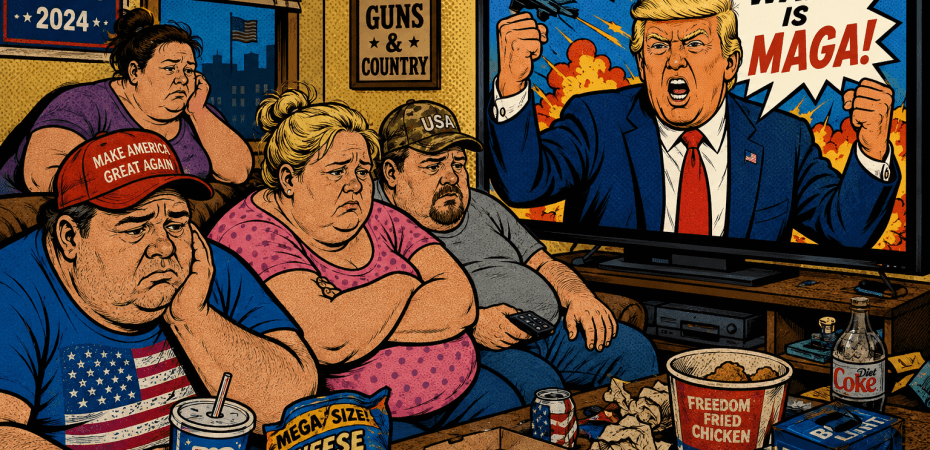
This brings me back to my motel. The people sitting glumly in the lobby are not political theorists. They are not comparing electoral systems or reading essays about the decline of party identification. Most would probably laugh at the suggestion that their silence constitutes evidence of an historic realignment. But political systems ultimately rest on habits, and habits are visible in small things. The MAGA hat was one of them. It said that its wearer belonged to something. It transformed political support into personal identity. This was Trump’s greatest political asset. People did not merely vote for him; they displayed him on their heads, their trucks and their lawns. Now the hats are coming off.
The Republican establishment may suppose these people will return when confronted with the Democratic alternative. Perhaps many will. The machinery of two-party politics remains powerful, and fear remains a dependable electoral argument. But Carlson is introducing a dangerous thought into their minds: you do not have to go back. He does not yet possess a party capable of receiving them. Perhaps he never will. Seth Bodnar and Dan Osborn represent different varieties of independent revolt, not a ready-made national coalition. Carlson’s ten principles are not yet a platform, still less a governing philosophy. That may not matter. The first stage in the destruction of a political monopoly is not the appearance of a successful competitor. It is the discovery by its customers that they can walk away.
Trump exposed the Republican establishment’s weakness by showing that its voters hated much of what it believed. Iran has exposed Trump’s weakness by showing that his voters need not continue believing in him. Carlson is taking the final and most dangerous step by suggesting that they need not believe in the Republican Party either.
This is why I would watch Carlson rather more closely than the independent candidates now attracting polite attention from political journalists. A Senator Bodnar or Senator Osborn would be interesting. A dozen independents would be more interesting still. But none of these in themselves would overturn the American party system. Carlson is attacking something deeper. He is attacking the assumption that the system deserves obedience.
For the moment, he has a television studio, a large audience, several disaffected political allies and no obvious organization. Against him stand two ancient parties, billions of dollars, the donor class, the consultants, the lobbyists and most of the institutions through which respectable political opinion is manufactured. On paper, there is no contest. But political orders rarely collapse on paper. They collapse first in the imagination.
I look across my motel lobby and see bare heads where there used to be red hats. I do not know what will replace them. For the first time, neither does the Republican Party.

Discover more from The Libertarian Alliance
Subscribe to get the latest posts sent to your email.