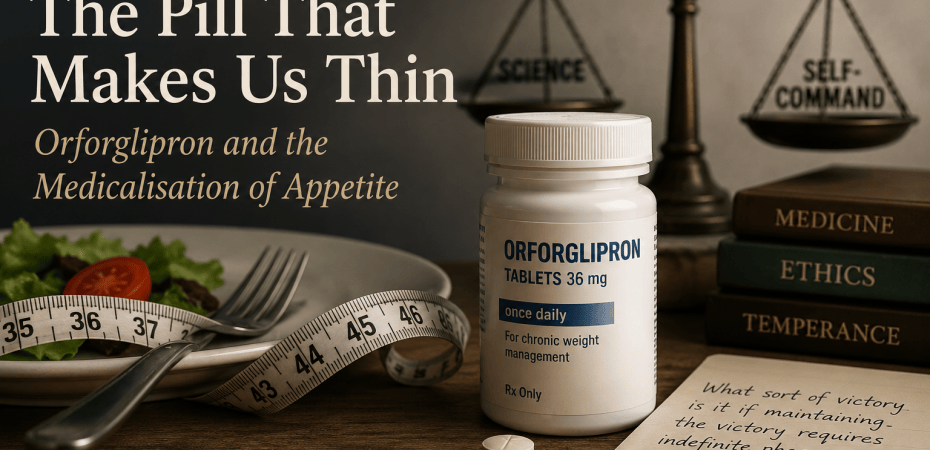
There is something almost miraculous about the new generation of obesity drugs. I use the word carefully. For most past ages, becoming seriously overweight was difficult and losing a large amount of weight after becoming so was harder still. In our own strange age, the first problem has become easy. Cheap calories surround us. Highly processed food is designed to encourage continued eating. Physical labour has disappeared from much of ordinary life. Not surprisingly, growing numbers have become obese. Medicine has now responded with drugs capable of reversing much of this.
The latest development may prove important. Orforglipron, marketed in the United States as Foundayo, is a GLP-1 receptor agonist like the better-known semaglutide, but unlike the familiar injections it is a small-molecule drug taken as an ordinary daily tablet. In April this year the American FDA approved it for long-term weight reduction. More strikingly for British readers, the UK has just approved it as well. U.S. Food and Drug Administration
The new Nature Medicine paper on the ATTAIN-MAINTAIN trial therefore deserves attention. It is not really a trial showing that orforglipron makes obese people thin. We already knew that it causes substantial weight loss. The question being asked is more interesting: after someone has lost a great deal of weight using powerful injectable drugs, can he stop the injections, switch to a daily pill, and remain thin?
The answer appears to be yes — provided, crucially, that he keeps taking the pill. That qualification is where things become interesting.
What the researchers actually did
The study followed 376 people who had already completed the SURMOUNT-5 trial. These were not people walking into a clinic at their original weight. They had already spent 72 weeks receiving either tirzepatide or semaglutide and had lost substantial amounts of weight. The researchers then divided them into two cohorts. Those who had previously taken tirzepatide formed one group; those previously treated with semaglutide formed another. Within each cohort, participants were randomly assigned either oral orforglipron or placebo for another 52 weeks.
The results were striking. Among those who had previously used tirzepatide and whose weight had reached a plateau, orforglipron preserved an estimated 74.7 per cent of the previous weight reduction, compared with 49.2 per cent among those receiving placebo. Among the former semaglutide patients, orforglipron preserved 79.3 per cent, compared with only 37.6 per cent on placebo. Nature
Look at the actual weights and the achievement becomes easier to understand. The people switched from tirzepatide to orforglipron had originally averaged about 116kg. Tirzepatide brought them down to roughly 91kg. After another year on orforglipron they averaged about 96kg. They had regained something, certainly, but remained almost 20kg lighter than when they began.
Those switched from semaglutide did even better at maintenance. Their original average was about 114kg, which fell to about 95kg after semaglutide. A year later, after switching to orforglipron, they remained at about 96kg.
This was not merely cosmetic. Waist circumference remained substantially reduced, while improvements in blood glucose, insulin, triglycerides and blood pressure were largely preserved. It would be silly to pretend these results mean nothing. They mean quite a lot. Indeed, earlier evidence makes the comparison more impressive. In the STEP 1 extension, patients who stopped semaglutide regained roughly two-thirds of their lost weight during the following year. Many of the associated cardiometabolic improvements also drifted back towards their original values.
Something real is therefore happening. These drugs are not slimming snake oil. They alter human appetite and metabolism powerfully enough to produce results which traditional dieting usually struggles to reproduce.
What exactly is GLP-1 doing?
GLP-1 — glucagon-like peptide-1 — is a hormone naturally released in response to eating. Among other things, it helps regulate insulin, slows gastric emptying and signals satiety. Pharmacological GLP-1 receptor agonists imitate or amplify parts of this system.
The practical result is familiar from the accounts of people taking Ozempic, Wegovy and related drugs. Hunger diminishes. Portions become smaller. The cake that previously demanded to be eaten can suddenly sit on the table without exercising quite the same power. This last point deserves more attention than it usually receives because GLP-1 signalling does not operate only as a mechanical switch in the stomach. It interacts with brain systems involved in motivation and reward. Research increasingly suggests that GLP-1 agonists can reduce food-seeking behaviour and alter responses to food cues; related work is investigating whether this influence on reward pathways might even prove useful in treating binge eating and addictions.
A recent review describes reports from patients that food becomes less tempting or sometimes less enjoyable while receiving GLP-1 treatment. That does not mean everyone loses the pleasure of eating, nor that the drugs simply destroy taste. The effects seem subtler, involving the distinction between tasting something, liking it and actively wanting it.
And this is where I begin to feel uneasy.
Is obesity simply a chronic disease?
The Nature Medicine paper opens with the statement that:
“Obesity is a chronic, relapsing and treatable multifactorial disease.”
There is much truth in this. I have never found the opposite extreme particularly convincing: the idea that every fat person is simply lazy or greedy and would become thin if only he possessed sufficient moral fibre. People plainly differ in appetite, metabolism and susceptibility to weight gain. A person who feels ravenously hungry on 2,000 calories faces a different problem from someone who naturally forgets lunch. Modern food makes matters worse. We have created an environment well suited to producing obesity and then become surprised when millions of people become obese.
Nor should Christians turn every bodily disorder into evidence of vice. Gluttony is a sin. Obesity is a physical condition. The two overlap in some people, but they are not synonyms.
Yet I am not entirely comfortable with the medical language either. Calling obesity a chronic disease carries an implication which becomes explicit later in the paper. The authors describe it as a “common misconception” that obesity medication can be stopped once weight has been lost. The analogy they offer is hypertension or high cholesterol: we do not expect blood pressure to remain low merely because someone swallowed tablets for a year, so why expect obesity to remain treated after its medication disappears? Perhaps that is correct. But notice where it leads us.
A person becomes obese. He takes a powerful drug that suppresses appetite. He loses weight. If he stops taking it, appetite and weight tend to return. Therefore he should continue pharmacological appetite modification, perhaps for decades. This may be good medicine. I am less certain that it is an entirely good vision of human life.
The physical question is not settled
There is first the obvious matter of safety. ATTAIN-MAINTAIN lasted one year. That is enough to tell us something important about short-term tolerability. It cannot tell us what happens when a healthy 25-year-old takes GLP-1 medication until he is 65.
In the trial, gastrointestinal problems — nausea, constipation, vomiting and diarrhoea — were the commonest adverse effects. There was also one confirmed case of pancreatitis. The study found no new general safety signal, which is reassuring. But the current American prescribing information itself warns about pancreatitis, severe gastrointestinal reactions, kidney injury associated with dehydration, gallbladder disease and delayed gastric emptying, among other issues. FDA Access Data
There is also an unresolved question about body composition. Weight is not a substance. A kilogram of visceral fat and a kilogram of quadriceps muscle are not medically interchangeable. Rapid weight reduction can involve loss of lean tissue as well as fat, and researchers have consequently begun emphasising resistance exercise, sufficient protein and the preservation of skeletal muscle during GLP-1 treatment.
None of this proves the drugs are dangerous. Obesity itself is dangerous. For a severely obese patient with hypertension, impaired glucose regulation and aching joints, the known dangers of remaining at 140kg may greatly exceed the hypothetical danger of taking a medicine for twenty years. What bothers me is the ease with which “safe for 52 or 72 weeks” slips culturally into “suitable for lifelong consumption”. Those propositions are not identical.
A pharmaceutical answer to a spiritual problem
There is a deeper problem, however, and here I risk sounding old-fashioned. Human beings have always had appetites which require government. Christianity does not teach that bodily pleasure is evil. Quite the reverse. Food is good. Wine is good. Feasting is good. The problem begins when appetite ceases to occupy its proper place and starts ruling the person who ought to rule it.
Traditionally we called the virtue which establishes this order temperance. Modernity increasingly prefers another solution. Instead of forming desire, we modify its chemistry. There is an understandable attraction in this. Imagine a man who has fought his appetite for thirty years. He has counted calories, lost four stone, regained five, joined slimming clubs and begun again. Then he takes a tablet and the continual whisper of food simply becomes quieter. I would find it difficult to lecture him about character.
Indeed, it may be that the drug finally gives him enough freedom from overwhelming appetite to acquire better habits. Medicine and virtue need not be enemies. We do not tell an alcoholic suffering delirium tremens that medical treatment interferes with his moral development.
But there remains a difference between helping the will govern appetite and making appetite disappear sufficiently that government becomes unnecessary. That distinction seems important.
One intriguing recent paper has even argued against the assumption that food pleasure itself causes obesity. Justin Sung and Dana Small suggest instead that unhealthy diets may damage normal sensitivity to the internal signals which regulate food reward. On this account, pleasure is not necessarily the enemy; disordered eating may actually represent a disordered relationship between pleasure, satiety and nutrition. If so, abolishing desire is not necessarily the same thing as restoring order.
The temptation of the permanent prescription
Orforglipron may transform obesity medicine precisely because it removes the inconvenience of injections. There is no needle, no refrigeration and no special requirement to take the medicine on an empty stomach. The FDA describes it simply as a once-daily tablet. That is commercially brilliant. It may also be socially enormous. The injectable GLP-1 drugs still feel like medical interventions. A daily pill can become ordinary. Statins did. Antidepressants did. Blood-pressure tablets did. Perhaps appetite medication will as well.
We could therefore be approaching a world in which millions of otherwise healthy people pharmacologically regulate hunger throughout adult life.
Perhaps this will make us healthier. Perhaps future generations will regard obesity as we regard scurvy: a once-common affliction largely eliminated by understanding its biology.
But there is another possibility. We may be constructing an increasingly pharmaceutical civilisation in which the consequences of our environment are corrected chemically rather than the environment itself being changed. Food companies may continue manufacturing products designed for maximum consumption; lives may remain sedentary; families may eat separately in front of screens; physical exercise may disappear further from everyday existence — and medicine will adjust the resulting human organism until the blood tests come out right.
There is something slightly absurd about that bargain. We design a world in which maintaining a healthy appetite becomes exceptionally difficult and then celebrate our ingenuity in inventing a lifelong pill that suppresses the appetite our world has disordered.
A remarkable medicine, but not salvation
I do not think orforglipron should be dismissed. The ATTAIN-MAINTAIN trial is persuasive evidence that it can preserve much of the considerable weight loss achieved with semaglutide or tirzepatide. For someone suffering serious obesity, that may be an extraordinary gift. The improvement in metabolic risk factors is real, and so is the misery that severe obesity can cause.
My objection is to the larger philosophy quietly forming around these drugs. We should distinguish curing disease from managing symptoms, and both from pharmacologically redesigning ordinary human experience. GLP-1 medicines sit awkwardly across all three categories. They improve disease. They suppress a symptom — hunger. But they also alter one of the fundamental appetites through which human beings experience the world. Perhaps the alteration is worth it. For some people I am sure it is.
Yet the Nature Medicine study accidentally reveals the problem alongside the achievement. Stop pharmacologically suppressing the biological forces that encourage weight regain and much of the weight returns. The proposed solution is therefore not liberation from treatment but a more convenient form of permanent treatment.
That is a medical success of a peculiar kind. Christianity has never required us to reject medicine in favour of willpower. Grace itself works with nature rather than pretending nature does not exist. But neither should we imagine that every disorder of appetite can finally be solved by chemistry. There are diseases of the body, but there are also disorders of habit, culture and desire. Sometimes they become entangled so thoroughly that separating them is impossible.
A pill may help a man eat less. It cannot tell him what food is for, what pleasure is for, or why self-command matters. It cannot restore the family meal, replace physical activity or teach temperance. Most importantly, it cannot answer the question of what sort of people we become when every troublesome appetite is regarded primarily as a biochemical inconvenience awaiting pharmaceutical correction.
Orforglipron may turn out to be an excellent medicine. I hope it does. I am simply not prepared to mistake an excellent medicine for a cure for the human condition.
Web Sources
Aronne, Louis J., et al., “Orforglipron for maintenance of body weight reduction: the double-blind, randomized phase 3b ATTAIN-MAINTAIN trial”, Nature Medicine 32 (2026), 2679–2687. Nature Medicine — ATTAIN-MAINTAIN trial
Wharton, Sean, et al., “Orforglipron, an Oral Small-Molecule GLP-1 Receptor Agonist for Obesity Treatment”, New England Journal of Medicine 393 (2025), 1796–1806. PubMed — ATTAIN-1 trial
Wilding, John P., et al., “Weight regain and cardiometabolic effects after withdrawal of semaglutide: The STEP 1 trial extension”, Diabetes, Obesity and Metabolism 24 (2022), 1553–1564. PMC — STEP 1 extension
Sanchis-Gomar, Fabian, Ian J. Neeland and Carl J. Lavie, “Balancing weight and muscle loss in GLP1 receptor agonist therapy”, Nature Reviews Endocrinology 21 (2025), 584–585. Nature Reviews Endocrinology — muscle and GLP-1 therapy
Sung, Justin J., and Dana M. Small, “In defense of pleasure: We need to rethink food reward and obesity”, PLOS Biology 23 (2025). PLOS Biology — food reward and obesity
Du, Jiayi, Zhuo Yang and Yan Chen, “Altered eating experience during GLP-1 receptor agonist therapy”, Frontiers in Nutrition 13 (2026). Frontiers — GLP-1 drugs and eating experience
U.S. Food and Drug Administration, “FDA Approves First New Molecular Entity Under National Priority Voucher Program”, 1 April 2026. FDA — Foundayo approval
U.S. Food and Drug Administration, Foundayo (orforglipron) Prescribing Information, 2026. FDA — Foundayo prescribing information

Discover more from The Libertarian Alliance
Subscribe to get the latest posts sent to your email.


