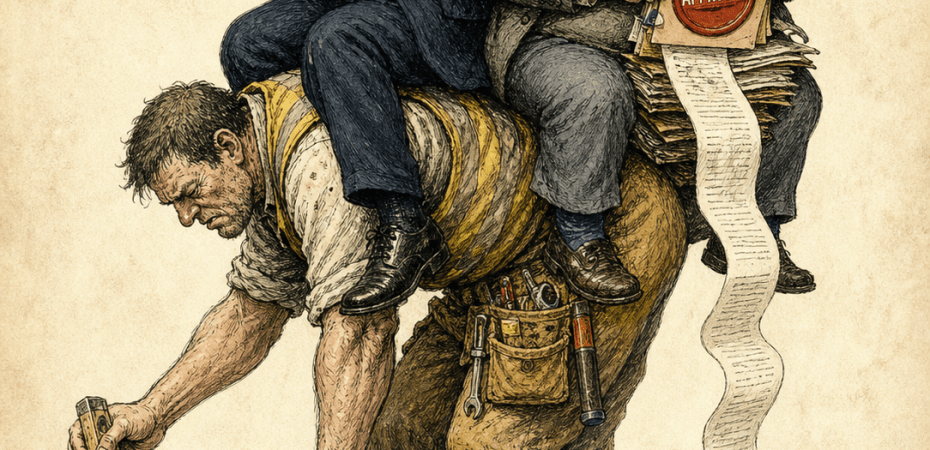
Andy Burnham has found a new enemy. This is wonderful news. After a half century of destroying everything it can touch, the British State, in the person of our new Prime Minister, has identified yet another class of men to blame. They are builders who ask for deposits.
The Government announced this morning [the 28th August 2026] that it is “putting the cowboys out of business.” From September, householders will be offered a government-supported payment system under which money is held and released as agreed stages of building work are completed. There will also be an Approved Code, administered through the Furniture and Home Improvement Ombudsman and the Chartered Trading Standards Institute. Builders who join will be allowed to show customers that they satisfy official standards of transparency and dispute resolution. And this is one of Leader Burnham’s “everyday fixes” for the cost of living.
Already, the vocabulary smells of a room in Whitehall where no window has been opened since 1997. There are trusted payments, approved codes, higher standards, key milestones, established ombudsmen and practical everyday fixes. It is the language of people who believe that piling reassuring adjectives on top of a transaction will make it safe. Nothing is merely paid. It must be paid securely. No standard may exist without being approved. No arrangement between two adults can be trusted until some pallid functionary has turned it into a framework.
I was wondering whether the cost of living might have something to do with the destruction of the pound. I was wondering whether creating money and credit faster than the production of goods and services might cause the monetary price of those goods and services to rise. I was even wondering whether government borrowing, energy policy, taxation and planning restrictions might have some influence on the cost of employing a builder. I was certainly beginning to wonder about the monetary effects of getting us ready for an unwinnable and therefore insane war with Russia. But I am seventeen and therefore lack the accumulated wisdom of the drooping managerial organisms who advise the Prime Minister. No, the problem is cowboy builders. That is now official.
And yes, there are dishonest builders. There are men who take deposits, tear out kitchens, appear twice with a hammer, and then disappear to Spain. There are old people who hand over money they cannot afford to lose. There are unfinished roofs, dangerous wiring, fraudulent quotations and work so bad that repairing it costs more than doing it properly would have cost. The Government says—and I will not argue with the claim, even if it probably is substantially untrue—that more than one in four adults who commissioned home improvements during the preceding eighteen months experienced some kind of problem. More than a third of those incurred additional costs, with an average loss of £750. These figures cover a large assortment of complaints, and do not prove that Britain is crawling with criminal tradesmen. Even so, the underlying problem exists.
Milestone payments are a sensible response. Escrow may be sensible. Written contracts, references, insurance and independent inspection are sensible. Anyone handing a large deposit to a stranger without carrying out elementary checks is a fool.
And that last category has been omitted from the Government’s announcement. No one is now allowed to be a fool. There can only be vulnerable consumers failed by inadequate systems. If a man sends his savings to a Nigerian prince, the problem is insufficient online regulation. If a woman hires a builder because his quotation is half the price of every other quotation, gives him £20,000 in cash and never bothers to ask where he lives, the problem is a loophole in consumer protection. Every act of human stupidity creates another job for a graduate with a lanyard.
This is how Britain is governed. The population is treated as a collection of fat toddlers wandering through a kitchen filled with knives. Nothing may be left to judgement, because judgement may be wrong. Nothing may be left to agreement, because one party may regret it. Nothing may be left to experience, because experience sometimes hurts. Instead, the state must crawl between us. It must hold the money. It must approve the builder. It must define the milestones. It must recognise the code. It must provide an ombudsman to supervise the people supervising the transaction. Then, when the scheme fails, it must appoint a review to discover why the supervision was insufficient.
This is not protection. It is the administrative castration of the public. Adults are stripped of judgement and the right to arrange their own affairs, then handed back a laminated card explaining which approved professional may make decisions on their behalf. The Government first turns citizens into dependants and then points to their dependence as proof that government is indispensable.
The present scheme is described as optional. Builders will not yet be compelled to join it, and Burnham has not imposed price controls. This distinction matters. If Trusted Payments offers a useful escrow service and people freely choose it, I have no objection. If an honest builder finds that official accreditation attracts customers, he may decide that the fees and paperwork are worth paying. But we know how “optional” government schemes develop. Insurance companies begin to prefer them. Councils recommend them. Banks ask about them. Search platforms promote them. Journalists start referring to unapproved builders as “unregulated.” Eventually, declining to join an official scheme becomes evidence that you are the sort of person from whom the scheme was designed to protect us. I cannot prove that this will happen. I merely possess eyes and a functioning memory.
Indeed, the ratchet is already visible. The Federation of Master Builders has responded by warning that the crackdown requires statutory licensing. The Government has announced an optional scheme in the morning, and before lunch the respectable representatives of the industry are asking when compulsion begins. This is how regulation grows. One group demands government approval to distinguish its members from competitors. Another complains that voluntary approval leaves gaps. The gaps become loopholes. The loopholes become dangers. The dangers require licensing. Licensing requires enforcement. Enforcement requires money, officers, forms, appeals, databases and a new class of offences. Then everyone involved expresses surprise that small firms are disappearing.
The official announcement itself is followed by the usual procession of interested applause. The Furniture and Home Improvement Ombudsman welcomes recognition of its Approved Code. Trusted Payments welcomes government support for trusted payments. The Chartered Trading Standards Institute welcomes a system of trading standards and calls for consumer protection to be “properly funded.” Citizens Advice welcomes an enlarged role for organisations like Citizens Advice. This is presented as independent support. It resembles a trough congratulating the farmer on his decision to fill it.
I do not allege that anyone involved is personally corrupt. Corruption is hardly necessary when institutional appetite will do. Every organisation sees in the scheme an enlarged function, enhanced authority, greater relevance or another reason why its budget must continue. No one invited to comment says: “This is unnecessary; adults can make their own arrangements; please do not give us any more power or money.” Such people do not rise in ombudsmanry.
The announcement already plants the suggestion. Approved businesses will be able to show that they meet “higher standards.” Higher than what? A builder may have worked honestly for thirty years. His customers may recommend him. His houses may still be standing. But unless he has submitted to an Approved Code devised by people whose greatest practical accomplishment is getting both sides of an A4 leaflet to print, he will not have demonstrated that he “does things properly.” The roof is no longer proof. The badge is proof.
What does an Approved Code actually certify? It cannot certify that every wall will be straight, every quotation accurate or every employee honest. No administrator has prophetic powers. It certifies that a business has complied with the preliminary rituals of approval. It has supplied the required documents, adopted the correct procedures, paid whatever charges are required, and promised to speak politely when a customer complains. The code tests a capacity for compliance. The Government then markets this as a test of competence.
A clever rogue will adapt. He will acquire the badge, reproduce the approved language and learn which boxes must be ticked. He may find official respectability an excellent sales aid. The honest but disorganised tradesman, meanwhile, may continue building sound houses while failing to answer an email within the approved period. Guess which one will look safer on the Government-supported application.
This is the natural religion of the administrative classes. They believe that reality becomes real only after it has been converted into paperwork. A wall may be straight, but has the builder completed the module on Inclusive Customer Outcomes? The lights may come on, but is the electrician committed to a transparent dispute-resolution framework? The boiler may work, but does the plumber have the approved sticker designed by a communications consultant and printed at public expense?
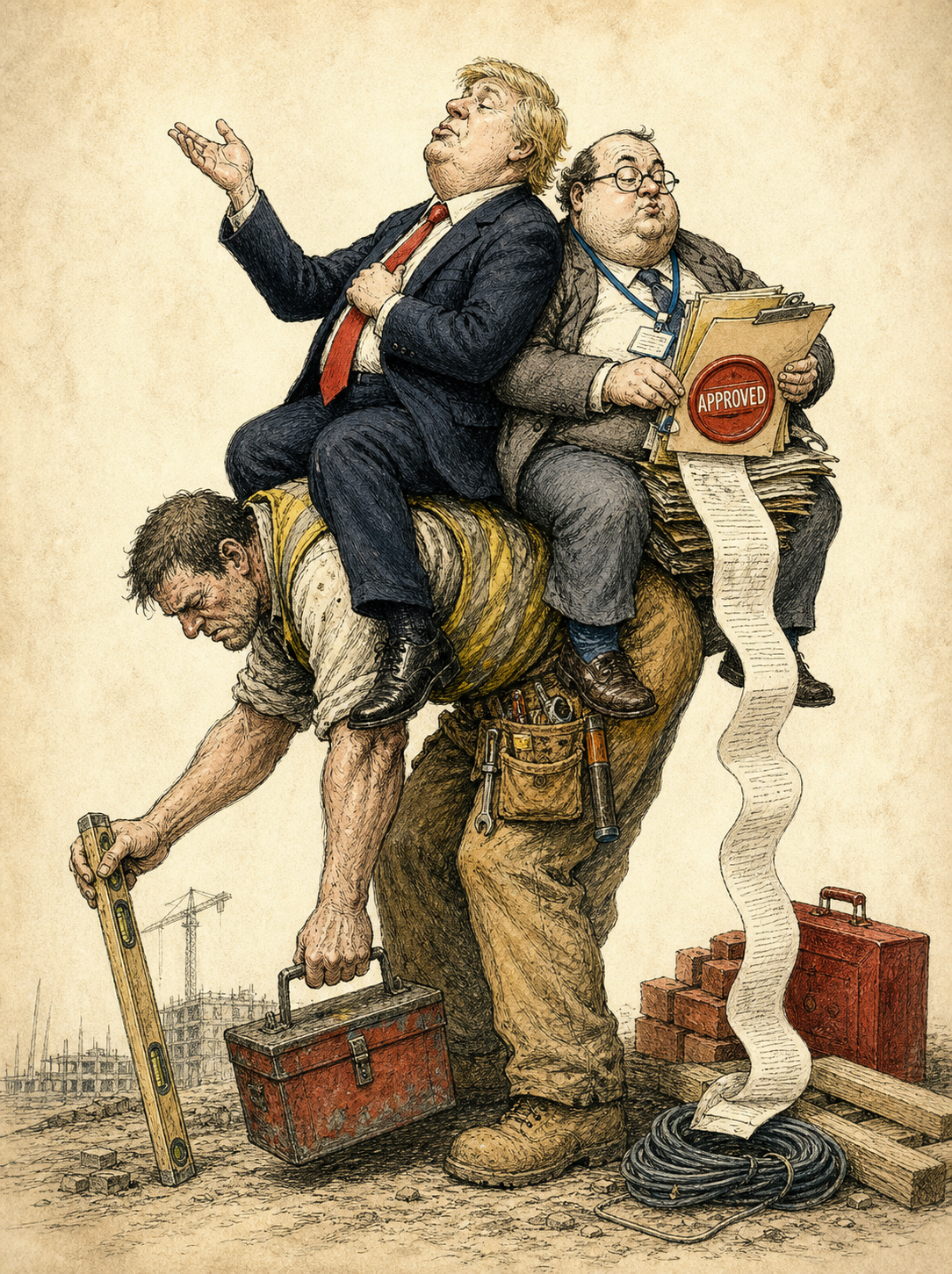
The tradesman must prove himself because he does something useful. A builder creates houses and extensions. An electrician stops houses from burning down. A plumber prevents their occupants from drowning in sewage. Their competence is tested by physical reality, which has the habit of refusing to respect qualifications. A wire is either live or it is not. A roof leaks or it does not. A wall stands or falls. The administrator produces standards for the builder. He produces nothing that can be inhabited, eaten, driven or switched on. He writes guidance. He attends meetings. He moves phrases from one document to another and calls this “delivery.” His hands are as soft as suet, and his principal encounter with danger is finding that the almond milk in the departmental refrigerator has passed its use-by date. Yet he looks down on the tradesman.
He has been trained to do so. From school onwards, he was told that practical work was for people who had failed. Clever children went to university. The rest became builders and electricians. He therefore spent three years producing essays that no one wished to read, then emerged with a degree no one wished to buy. Then he entered the public sector, where the absence of demand for his abilities could be concealed by taxation. He now encounters a man who left school at sixteen, possesses an intelligible skill and earns twice his salary. The resentment must be unbearable.
The lower levels of the British state are infested with middle-class drones clutching degrees that would have less market value than used toilet paper if public employment did not exist to provide them with gentle welfare. They have BAs in subjects ending with “studies” and master’s degrees obtained to postpone adulthood. They have added to these professional qualifications invented by the same class that requires them. They could not hang a door. They could not change a fuse. Most of them would die beside an unopened tin of beans if the ring-pull came off. But they can regulate the men who keep them alive.
Observe the physical type. The male version is already balding at twenty-eight, though the remainder of his hair has been sculpted into something he believes looks informal. His limbs have the soft cylindrical quality of refrigerated dough. His shirt strains at the waist and hangs loose at the shoulders. He owns expensive running shoes in which he has never run. The female version is wrapped in layers of cloth, beneath which she bulges with grievance and professional concern. Both have the grey complexion of creatures raised without sunlight. Both speak in the damp vocabulary of wellbeing and lived experience. Both believe a clipboard confers command over men who could lift them with one arm.
These are Burnham’s natural people. He has spent his career among them: creatures of committees and protected institutions, endlessly promoted without ever being exposed to a market test. They know how to launch a scheme and stand before a sign containing several logos. They know nothing of the relation between risk and price, because their own risk is carried by taxpayers. They know nothing of satisfying customers, because their customers cannot take their money elsewhere. They know nothing of completing work on time, because every missed target becomes an argument for additional resources.
This is why the word “cowboy” comes so easily. It expresses the resentment of the credentialled useless for the practically competent. A self-employed builder may have left school at sixteen and still earn more than a policy officer. He may own a van and employ an apprentice. He may negotiate his own terms. His customers telephone because they need him. No one needs an assistant stakeholder-engagement manager. Such people have to be imposed through taxation. The builder is independent. That is the offence.
Yes again, there are crooked builders. There are also crooked solicitors, crooked accountants, crooked doctors, crooked civil servants and crooked politicians. No one proposes holding back ministerial salaries until election promises have been completed to an agreed standard. No Approved Code allows us to distinguish honest Prime Ministers from those who collect taxes, create money, waste the proceeds and then disappear with our purchasing power. Were such a code introduced, Whitehall would empty.
Imagine applying Burnham’s principle consistently. Ministerial salaries would be placed in escrow after an election. A portion would be released when immigration fell, another when public debt declined, another when housing became affordable and the balance only when the manifesto had been delivered without defects. Disputes would be decided by a panel of builders chosen at random from a Screwfix car park. “Do the work, get paid,” Burnham tells the tradesmen. Very well, Leader. You first.
And here we reach Burnham’s use of the “cost of living.” The phrase has become a verbal air freshener sprayed over every new intervention. The Government says that its builders’ scheme will help families with the cost of living. How? Will the ombudsman make timber cheaper? Will the Approved Code refine copper? Will a government-supported application produce more electricians? Will Jonathan Reynolds whisper “customer confidence” over a pallet of bricks until its price falls?
The scheme may protect some deposits. That is not the same as reducing the cost of living. It may reduce a particular risk for people who choose to use it. That is not the same as making building work cheaper. Indeed, compliance, administration and dispute resolution all consume resources. Someone must pay. Perhaps the cost will be charged directly. Perhaps builders will incorporate it into their prices. Perhaps taxpayers will be forced to support the institutions surrounding it. However the bill is presented, it will not be paid by the fairies.
Burnham has sprayed a half-baked fraud-prevention scheme and presented it as economic policy. This is rather like responding to a house fire by introducing stronger rules on the labelling of buckets. The labels may be legible. The house will continue to burn.
The cost of living has risen because the purchasing power of money has fallen. General price inflation is not a spontaneous epidemic of greed among tradesmen. If greed determined prices, everything would always cost infinity. Sellers generally ask what buyers will pay, and competition restrains them. What changes across the economy is the quantity and distribution of money relative to the things available to buy.
Governments want to spend. They are frightened to raise taxes far enough to cover that spending, because even the British public may eventually object to being stripped naked. They borrow, but borrowing creates visible debts and interest costs. So the monetary system creates additional money and credit. Ministers do not need to stand beside a nineteenth-century printing press stuffing banknotes into sacks. Central banks and commercial banks can accomplish the same transfer with greater cleanliness and less public comprehension.
The new money enters the economy somewhere. Its first recipients spend it before prices have adjusted fully. They buy assets, goods, labour and services at something near the old purchasing power. The money then passes outward. Prices rise unevenly. By the time the final recipients get their share—through a wage increase that trails inflation or a pension adjusted after the event—the value has already been skimmed away. This is the Cantillon effect. It is not an eccentric theory that prices rise because shopkeepers become naughtier. It explains why monetary inflation redistributes wealth as well as reducing purchasing power. Those nearest the creation of money benefit first. Those living on fixed incomes, cash savings and slow-moving wages pay later. Asset markets inflate. Relative prices are disordered. Cheap credit encourages projects that appear profitable but are unsupported by real saving. Labour and capital are pulled into the wrong uses. Then the correction comes, and politicians blame whichever private group is most photographically convenient. At present, it is builders.
The Government will not address the monetary cause because monetary debasement is useful to government. It allows spending without an immediate tax demand. It lightens debts in real terms. It transfers resources quietly. The public sees prices rising in shops and on quotations but does not see the moment at which purchasing power was taken. Inflation is taxation designed for people who would notice a hand in their pocket but not the gradual shrinking of the coins already there.
Builders are convenient scapegoats because their prices are visible. A householder sees the quotation and experiences the increase as a demand made by a particular man. He does not see the earlier monetary expansion, the energy regulation, the planning restrictions, the taxes embedded throughout the supply chain or the public borrowing competing for real resources. The builder arrives at the end of the process and presents the bill. Therefore, the builder is blamed. The politician creates the conditions. The tradesman receives the hatred.
A builder’s charges incorporate the price of materials, fuel, tools, insurance, tax, transport and skilled time. They also incorporate risk. Customers can cheat tradesmen just as tradesmen can cheat customers. They can change specifications, delay decisions, deny access, invent faults and withhold final payments after the work has been completed. Burnham’s touching formula—“Do the work, get paid”—suggests that he has never met anyone who has actually worked for himself. It is the sort of slogan that sounds profound to a man whose salary arrives from the Treasury whether his work succeeds, fails or causes a national catastrophe. “Do the work, get paid.” How beautifully simple employment must appear when one has spent a lifetime inside politics, where payment is guaranteed and failure usually brings promotion.
When an approved milestone is disputed, the money will not release itself out of gratitude for government support. Someone will decide whether the stage has been completed. There will be correspondence and delay. The people providing this service will need to be paid. The system may distribute risk more efficiently, but it cannot abolish risk. It merely moves part of it into an administrative process. And what happens while the dispute is considered? The customer has an unfinished room. The builder has paid for materials and wages but cannot obtain his money. An official who has never laid a brick reviews photographs, requests further information and promises an outcome within twenty working days. The scheme has not removed mistrust. It has placed mistrust in a queue.
If people want that process, let them buy it. If they prefer some other bargain, let them make it. Some will make bad bargains. Some will be cheated. Their tough luck. I do not say this because fraud is admirable. Fraudsters should be stripped of their gains and punished. I say it because a society in which no one is permitted to bear the consequences of stupidity becomes a society incapable of intelligence. Pain teaches. Loss teaches. Embarrassment teaches with particular efficiency. The man who loses a deposit will check references next time. His neighbours will check theirs. Firms that protect customers will acquire reputations. Insurers, escrow providers and trade associations will offer services to those willing to pay. Diverse safeguards will develop because different jobs present different risks.
Government infantilisation interrupts this process. It teaches people not to judge a tradesman, but to look for a symbol. It replaces prudence with compliance. When the approved builder cheats them, they will not conclude that badges are unreliable. They will demand a better badge. The customer becomes stupider. The honest builder becomes more burdened. The clever rogue acquires a logo. The administrator acquires a salary. This is called consumer protection.
And the administrative grubs will rejoice. Another gap has been found. Another framework is needed. Another tranche of public money must be shovelled into the moist darkness where they breed. Britain is already being eaten alive by people whose employment depends on the rest of us being declared incompetent. They regulate childcare because parents cannot be trusted. They regulate food because adults cannot be trusted. They regulate speech because listeners cannot be trusted. They regulate employment because workers and employers cannot be trusted. Now they will help regulate the arrangement by which one adult pays another to build a wall. At every stage, they tell us the measure is for our protection. At every stage, we become poorer and less capable of directing our own lives. At every stage, the same pasty faces appear to explain that the latest failure proves the need for more of them.
They never finish. This is important. A builder who never finishes a house is eventually dismissed. An administrator who never finishes regulating an industry has established a career. The persistence of the problem is his strongest argument for continued employment. Were consumer fraud ever reduced to nothing, an entire ecology of regulators, advisers, ombudsmen, researchers, charities and professional bodies would lose its reason for existing. Fortunately for them, human dishonesty is inexhaustible. The cowboy builder takes one deposit and disappears. The administrative class takes a percentage of everything forever and calls itself protection.
Nothing can be done through ordinary politics. The measure is too small to provoke resistance and too sentimentally packaged to permit argument. Anyone who objects will be accused of defending criminals who steal from pensioners. The scheme will begin. Respectable organisations will welcome it. The official ecosystem will thicken around it. Five years from now, some chinless minister will announce a strengthened version after an accredited builder absconds with an old woman’s money. We can only add this to the indictment.
This country needs a cleansing revolution. This is not another change of party, not a commission, not a “bonfire of regulations” in which three obsolete forms are abolished and seventeen new ones introduced. It needs the entire parasitic caste lifted from our backs and thrown into the world it has spent decades arranging for everyone else. The Approved Codes should be shredded. The professional protectors should be deprived of compulsory funding. The ombudsmen should be made to offer services for which people choose to pay. The institutes should discover whether anyone values their standards when government no longer gives those standards artificial prestige. Departments should be emptied, quangos closed and their inhabitants returned to the population they have spent their careers patronising.
Let the policy advisers retrain. Let the ombudsmen compete. Let the stakeholder managers discover what their labour is worth when no one is forced to buy it. Let them acquire tools, learn a trade and experience the dignity of being useful. The builders may need apprentices.
Discover more from The Libertarian Alliance
Subscribe to get the latest posts sent to your email.