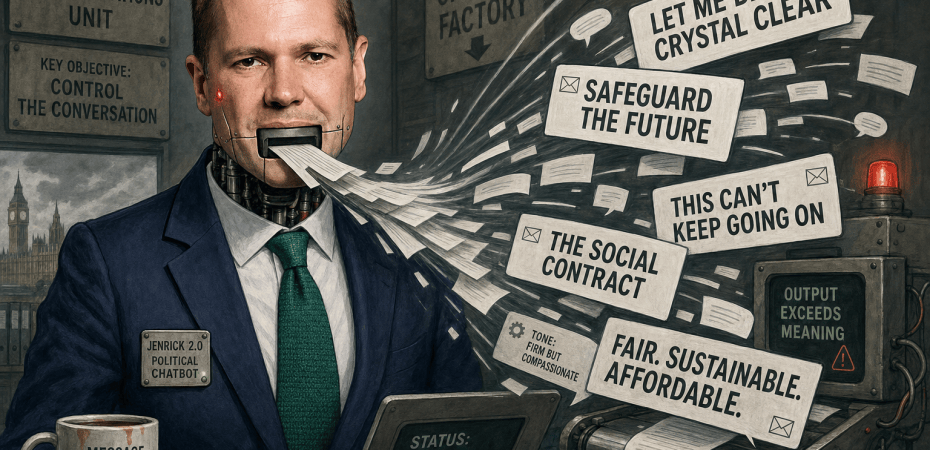
I am not a member of Reform UK. I have never applied to become a member, nor have I expressed any wish to be mistaken for one. Nevertheless, by one of those mysteries of political organisation, I have found my way onto the party’s mailing list. I therefore receive periodic communications informing me what “we” believe, what “we” shall do, and how much money “we” are about to save the average British family.
The latest comes from Robert Jenrick, lately of the Conservative Party and now Shadow Chancellor of Reform UK. I reproduce it in full below, partly because its general direction deserves approval, and partly because the letter deserves preservation as a fine example of how not to reach out to the electors.
I should begin by stating my own position. I am no friend of the welfare state. I do not regard it as one of the great achievements of civilisation, and I reject the pious assumption that every problem for the poor of sickness lack of thrift must be answered by creating another statutory entitlement and raising another army of officials to administer it. Before the growth of the welfare state, the British people were not devoid of compassion. They supported relatives, churches, friendly societies, mutual-aid associations, charitable hospitals and innumerable local institutions. These arrangements were neither universal nor perfect. Nothing devised by human beings is. But they often preserved distinctions that the modern state has laboured to abolish: between voluntary benevolence and compulsory transfer, between misfortune and improvidence, and between the deserving poor and those who have made dependency into a way of life.
The old-age pension is a special case. For generations, people have been taxed and regulated, or otherwise bled white while being promised that, in return, the state would provide security in old age. During the same period, taxation and monetary inflation have made private provision harder, while the welfare state has displaced many of the institutions through which working people once provided for themselves. It would therefore be outrageous suddenly to tell those approaching retirement that the promise has been withdrawn. Whatever one may think of the original bargain, the state has made commitments on which millions have ordered their lives. Those commitments must be honoured.
There is also a case for public relief of the deserving poor: those ruined by unavoidable misfortune, the severely disabled, children without proper support and others who genuinely cannot maintain themselves. I would prefer such relief to be local, discriminating and, wherever possible, administered through families and voluntary institutions. But I do not propose that people incapable of supporting themselves should be abandoned in the street while political philosophers discuss the finer points of coercive redistribution.
What I reject is the monstrous expansion of welfare during the past forty years. A limited provision for old age and genuine incapacity has swollen into a vast system of subsidies, allowances, tax credits, housing payments and incentives not to work. It taxes independence and rewards dependence. It encourages people to arrange their affairs according to the requirements of official forms. It subsidises choices that previous generations would have understood must carry personal consequences. It has helped transform millions of citizens into clients of the administrative state.
The enormous welfare bills of recent decades cannot be explained by an equally enormous increase in unavoidable destitution. They are the result of bureaucratic appetite and the gradual conversion of every difficulty into an entitlement. Governments buy acquiescence with money taken from the productive economy. Departments justify their existence by discovering new categories of need. Claimants naturally respond to the incentives placed before them. The wonder is not that dependency has grown, but that anyone should have expected a different result.
Against this background, Mr Jenrick is broadly right. He is right that welfare should not provide an indefinite alternative to work for those capable of supporting themselves. He is right that a national system of relief must give priority to members of the nation that finances it. He is right that the ever-growing cost of dependency threatens whatever provision is to remain for pensioners, the severely disabled and others who cannot reasonably be expected to fend for themselves. Indeed, he does not go far enough. His object appears to be the preservation of the welfare state by making it less irrational. Mine would be to reduce it to the smallest provision compatible with honouring existing promises and relieving genuine distress. He wishes to save the system from its excesses. I regard many of those excesses as the system’s predictable consequences.
Even so, direction matters. A government prepared to admit that not every claimant is entitled to indefinite maintenance would be an improvement on governments that measure compassion by expenditure and success by the number of people placed on benefits.
There is nothing outrageous in saying that British welfare should exist primarily for British citizens. Indeed, until very recently, most people would have regarded this as inherent in the idea of a national welfare state. If benefits financed by British taxpayers are available on something approaching equal terms to everyone who establishes residence, then the system is not a social contract. It is an international money pump. Nor is it cruel to expect able-bodied people, after a year on benefits, to perform useful work in return for their maintenance. Twenty hours a week spent cleaning streets or otherwise serving the community is scarcely forced labour. It is a modest recognition that a person maintained by others owes something in return. Such work might also restore habits—punctuality, routine, obedience to reasonable instruction, the expectation of getting out of bed before noon—that prolonged unemployment tends to dissolve. It may expose some supposedly unemployable claimants as perfectly capable of employment when continued payment depends on it.
There are, of course, practical objections. Local councils are seldom models of administrative competence. Any scheme of compulsory community work would invite evasion, litigation, inflated contracts and bureaucratic empire-building. Councils might spend more supervising the work than the work itself was worth. Public employees and their unions might object to claimants performing tasks otherwise assigned to salaried workers. But these are arguments about execution, not principle. If a man is able to work, and if his neighbours are compelled by taxation to maintain him, it is not unreasonable to require some useful service in return. The better long-term solution is to reduce both the benefits and the taxation, allowing employment, family provision and voluntary charity to resume their proper functions. Until then, conditional assistance is preferable to unconditional dependency.
Mr Jenrick is equally sensible to address disability benefits without pretending that everyone receiving them is a fraud. A civilised country ought not to abandon those who cannot work. At the same time, it should not operate a system in which temporary illness is allowed—sometimes encouraged—to harden into permanent economic exclusion. The phrase “generous support” makes me uneasy. Politicians are always generous with money taken from other people. The proper standard is not generosity but adequacy, justice and careful discrimination. Those genuinely incapable of work should receive what is necessary for a decent life. Those capable of some work should be helped—or required—to do what they can. Whether the Dutch arrangements can be transplanted successfully into Britain is a question of detail; the principle of preventing avoidable long-term dependency is sound.
So much for the substance. The presentation is another matter. The letter has obviously been written—or at least vigorously interfered with—by a chatbot. It bears all the familiar marks of artificial intelligentese: the solemn announcement that “the social contract is being ripped to shreds”; the command to “let me be crystal clear”; the portentous warning that “unless we change course” catastrophe awaits; the inevitable promise to “safeguard the future”; and, above all, the succession of verbless miniature sentences intended to simulate urgency:
“Money that could have been used to fix roads. Build hospitals. Cut your taxes.”
This is not English prose. It is a PowerPoint presentation that has escaped from the office and learned to use a mail merge.
Short sentences can be effective. So can sentence fragments. Tricolons have their place. But their effectiveness depends on contrast, timing and the possession of something worth emphasising. When every third paragraph consists of staccato declarations, the effect is not urgency but automation. One does not hear the voice of a politician moved to indignation. One hears a content generator obeying the instruction: “Make this punchier.”
Then come the mechanically balanced assurances. The vulnerable will be protected. Those who can work will work. The taxpayer will get something back. The system will be fair, sustainable, generous and affordable. Everything arrives in groups of three, each abstraction polished to the same synthetic sheen. Even the people allegedly encountered in “conversations across the country” resemble the imaginary citizens invented by language models when asked to add a human touch. The image of a diligent worker leaving home and observing the closed curtains next door may conceivably derive from a real conversation. But it has been processed into such a perfect specimen of focus-group resentment that it no longer sounds like anything said by an actual human being.
One can almost see the prompt: Write a firm but compassionate political email about welfare reform. Use short sentences. Emphasise fairness to working families. Include a relatable anecdote about a benefits claimant next door. Reassure disabled people. End with a strong statement of values.
There is also the incessant throat-clearing: “That’s why”; “Let me be crystal clear”; “Finally”; “Because we believe”. These expressions do not carry the argument forward. They are verbal stage directions, informing the reader when to feel alarmed and when morally uplifted.
The letter suffers from the artificial habit of announcing conclusions before making any serious attempt to establish them. The existing arrangement is a “foreign welfare rip-off”. The new policy will “make welfare work for Britain”. Reform alone will “safeguard” the system. Its proposals will save precisely £1,700 for every family. Perhaps all this is true. But the language supplies no reason for believing it. The reader is given slogans and statistics in alternating doses, as though emotional certainty and numerical specificity must together amount to an argument.
There are legitimate questions that the letter avoids. Does the reference to “British citizens” exclude Irish citizens, whom it has just mentioned separately? What happens to foreign nationals who have paid taxes and National Insurance for many years? What exactly counts as being able-bodied? Who determines which claimants are capable of community work? What happens when councils cannot find twenty hours of useful activity for each person? How is the figure of £1,700 per family calculated? A persuasive political letter need not answer every technical objection. But it should give some indication that the writer knows such objections exist. Otherwise, it reads less like an appeal from one reasoning adult to another than like a collection of approved messages arranged by software.
The most irritating expression may be “social contract”. This is an abstraction used whenever a politician wishes to give some comparatively recent administrative arrangement the dignity of an immemorial constitutional settlement. I do not remember signing a contract by which I agreed to support an unlimited number of claimants in return for the possibility of becoming one myself. Taxation imposed by statute is not a voluntary insurance contribution, and a benefit schedule drawn up by civil servants is not a contract merely because a copywriter calls it one.
Mr Jenrick writes: “We all pay in, so that help is there for us when we need it.” But we do not all pay in. That is part of the problem. Some pay in far more than they are ever likely to receive. Some receive far more than they have ever paid. Many of the largest liabilities were created by politicians without the consent of those expected to finance them. One may defend this arrangement as taxation followed by redistribution. One should not disguise it as a friendly society.
Perhaps I am unjust about the authorship. Mr Jenrick may possess a mind that naturally produces artificial intelligentese instead of English. Years of ministerial statements and centrally approved talking points may have trained his internal monologue to sound like ChatGPT without any electronic assistance. If so, the poor man is less an offender than a victim. Otherwise, his people should pay rather more attention to the niceties of political communication. Artificial intelligence can assemble facts and manufacture competent slogans. What it cannot readily supply is a recognisable human voice. A politician asking for trust should sound as though he has considered the subject and then chosen his own words—not as though a committee fed six bullet points into a machine and selected “firm but compassionate” from a menu of tones. Reform presumably wishes to attract people who are weary of the managerial language of the old parties. It ought therefore to be especially careful not to communicate in the same prefabricated idiom. If its purpose is to say that politics must change, it should not sound like every other political party after the communications department has finished sanding away every trace of individuality.
The proposals deserve serious attention. The restrictions on foreign access to benefits, the work requirement and the attempt to move capable claimants out of long-term dependency all deserve support in principle. But they should be regarded as the beginning of retrenchment, not as the means by which an inflated welfare state can be preserved indefinitely. Honour the pensions that were promised. Maintain decent provision for those who genuinely cannot support themselves. Then cut away the swollen mass of dependency, subsidy, administrative supervision and electoral bribery that has accumulated during the past forty years.
That is a message worth sending. All the more reason, therefore, to express it in English.
For reference—and as a warning to anyone entrusted with political correspondence—here is Mr Jenrick’s complete message:
Dear Reginald,
The uniparty has let Britain’s most vulnerable people down.
Reform UK believes that the welfare state should be a safety net protecting the vulnerable among us. Children, pensioners and people with severe disabilities will not be affected by our announcement and will maintain their cash awards.
We all pay in, so that help is there for us when we need it. Reform UK is the only party that will safeguard this deal.
Under Labour and the Tories, that social contract is being ripped to shreds.
One in six Universal Credit claimants isn’t even a British or Irish citizen. They’ve taken £55 billion in benefits in just four years. Money that could have been used to fix roads. Build hospitals. Cut your taxes.
There are 6.6 million working age people claiming out of work benefits. Too many of them could work, should work, and are choosing not to.
In my conversations across the country, I’ve heard stories from you about how it feels to leave the house to go to work, and see the curtains next door closed while your taxes pay their benefits.
This is unfair, and it’s unsustainable. Let me be crystal clear: unless we change course, we are headed for a financial crisis that would put the most vulnerable in our society at risk.
Reform UK will never allow this to happen.
That’s why, on Monday, we set out our plans to make welfare work for Britain. It’s a plan to safeguard the future of the welfare state, to make sure the disabled get the support they need, to put 241,000 British nationals back into work, and to save £1,700 a year for every family in the country.
A government led by Nigel Farage will end the foreign welfare rip-off. Only British citizens will be entitled to welfare.
We will also make sure that those on welfare pay their way. There are hundreds of thousands of adults on Universal Credit who could work, who are meant to be looking for work, who have been claiming benefits for more than a year.
This can’t keep going on.
A Reform Government will make sure that these people will pay their way. We would make it a condition of receiving welfare that able-bodied claimants, on benefits for 12 months or more, give back to their community.
Each one would be expected to contribute 20 hours of work each week to their community, organised by the local council.
They’ll clean up high streets and parks, beautify neglected areas, carry out minor repairs, and learn the skills – hard work, punctuality, routine – that will help them back into the workforce.
And the taxpayer will get something back for their money.
Finally, we will fix the disability benefits system. We’ll bring in a Dutch-style system of Return to Work Cover, tasking employers with helping sick workers keep their jobs for two years after diagnosis.
For those unable to go back to work, we’ll put in place generous support through reformed and enhanced Personal Independence Payment / Health Security Allowances.
Because we believe that those who are genuinely in need should be looked after. That those who can work, should. And that you deserve a welfare state that works, and that the country can afford.
Yours sincerely,
Robert Jenrick
Shadow Chancellor
Reform UK

Discover more from The Libertarian Alliance
Subscribe to get the latest posts sent to your email.
Related posts:
 Welfare and the Luxury of Abstraction: A Polite Critique of Alex Zychowski’s “Britain in Decline”
 Libertarian Delusions and the Machinery of Empire: Welfare as Alibi, Not Engine
 Zahawi and the Managed Collapse of Reform
 The Pension as Pretext: How the Blairite Clerisy Proposes to Loot the Old and Call It Reform
 Britain’s Youth Exodus: Labour’s Crime, Conservative Guilt
 Britain’s Welfare Empire: A State that Feeds Strangers and Starves Its Own
 Reform UK and the Politics of the Scrapheap
 Curse of the Sin Eater (2023): A Thoughtful Exploration of Temptation and Responsibility
 The Honest Realtor: Japanese Comedy with a Curse of Integrity
 Who’s a Fascist?
 Makerfield and the Politics of Pressure
 Bullion Falls, Fiat Rots
Powered by YARPP.