Suddenly, the British ruling class has discovered that it needs British boys. I suppose I should be flattered. For most of my seventeen years, the British state has shown little interest in what people like me might want from it. We are taxed through our parents, regulated directly, educated according to whatever theory has most recently colonised Whitehall, and increasingly watched in case something we say on the Internet upsets somebody. We are told that the country is constantly changing and that this is both inevitable and none of our business. Its history is presented as something between an embarrassment and a criminal record. Any strong attachment to nation is liable to be treated as evidence that we have not been properly educated.
Then the Government looks at Russia, counts the soldiers available, and remembers that we are British. The change is almost touching. The 2025 Strategic Defence Review demands “warfighting readiness”, a “NATO First” policy and a “whole-of-society approach” to defence. It says that Britain must be able to “transition to, scale for, and sustain a war against a ‘peer’ adversary”, and that government should work with industry, finance, universities, schools and communities to prepare the country. This is not yet conscription: Britain still has a professional volunteer military. But it is plainly the language of mobilisation, and it is accompanied by a growing European argument that young people must recover their willingness to serve.
I have already said that I have no objection to the principle that a free country may sometimes require its citizens to defend it. If Russian soldiers somehow arrive in Kent, I shall accept that shooting at them takes priority over most of my objections to the British state. If Britain is genuinely fighting for its survival, I shall not hide under my bed with a copy of The Constitution of Liberty and insist that somebody else deal with the matter. I live here. My family lives here. My ancestors are buried here – or many of them are. This is my country, and belonging to something carries obligations as well as advantages.
But Britain is my country. The British state is not. Still less is the collection of politicians, officials, financiers, contractors, think-tankers and media people who decide what the British state should do. I see no reason why their interests should automatically become mine, and even less reason why their mistakes should acquire a mortgage on my life.
This distinction is the one our rulers most urgently need us to forget.
The Country and the People Who Own It
The British state has never been some neutral expression of the wishes of the British people. Since time out of mind, it has been run by a shifting coalition of political fantasists and asset strippers. The personnel change and the interests change with them, but the arrangement is durable. There are always people who have discovered some grand purpose for which Britain must be reorganised, taxed or sent to war, and there are always other people who discover that the grand purpose offers excellent opportunities for making money. Sometimes the same people manage both.
The modern British state is particularly good at disguising this arrangement because it speaks almost entirely in abstractions. Nobody goes to war for BAE Systems, ministerial prestige or a foreign-policy establishment that cannot bear admitting it has made a mistake. We go to war for Britain, freedom, our values, European security and the rules-based international order. The abstraction performs a useful laundering operation. A policy chosen by a few thousand people in London becomes the interest of sixty-odd million people who were never consulted about its underlying assumptions.
Then, if the policy becomes sufficiently expensive, the sixty or eighty or ninety-odd million (the real population figures are too embarrassing to be published) are informed of their duties. This is the point at which I become difficult. I am willing to defend Britain because Britain is mine. I am not willing to defend every interest claimed by the people who govern Britain because they are not me and their interests are not necessarily mine. The state naturally dislikes the distinction. It borrows the emotional capital of the country because the state on its own inspires little affection. Nobody has ever looked at the HMRC website and felt the stirring of ancestral loyalty. I doubt many men would climb out of a trench shouting “For Ofcom!” But attach the Union Flag to the same institutions and suddenly scepticism becomes disloyalty.
The trick works well with war because there is no subject on which the state is more anxious to begin the story halfway through.
The First World War and the Invention of Necessity
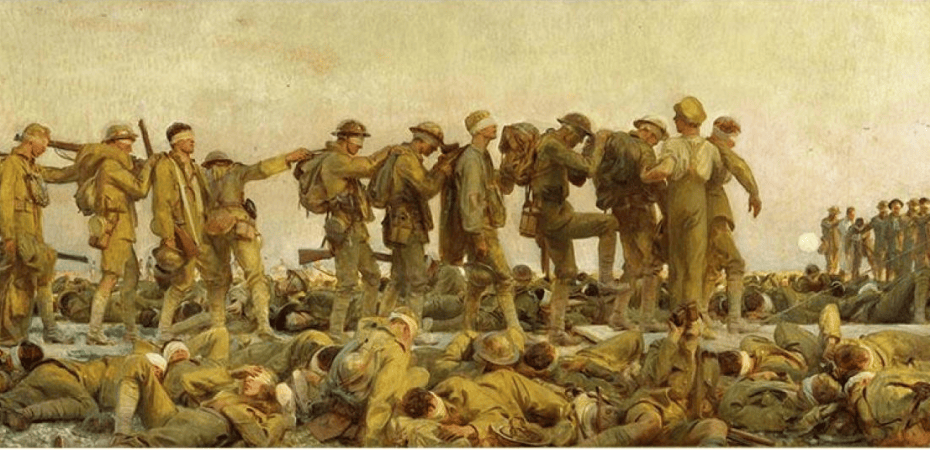
We are constantly told that our great-grandfathers fought in 1914, as though this were a complete argument for anything proposed in 2026. They fought and enormous numbers died. Therefore we must be prepared to do likewise. My response is to ask why they were fighting.
Germany invaded Belgium. That is a fact, and Belgian neutrality formed an important part of the British case for entering the war. But Britain itself was not invaded in August 1914. The decision to enter the war came from a wider conception of British imperial and commercial interests, not the smallest part of which was to make sure that Britain and not Germany would control the oil resources of the Middle East. Then there was the hope that a big European war would cripple Germany and France and Russia all at once, while the British Government handed out careful subsidies and the Royal Navy swept the seas clear of German trade and German colonial ambitions.
Two years later, however, it was clear that the British ruling class had miscalculated. The French and Russians had collapsed. The Turks were not the pushover everyone had assumed they would be. We now needed enormous armies in France and those armies required enormous numbers of replacement soldiers. Voluntary recruitment could no longer supply enough of them, so conscription was introduced in 1916. The need for men was by then perfectly real. Once you have committed yourself to feeding human beings into an industrial war on the Western Front, running short of human beings is indeed an emergency.
But notice the sequence. First the Government decides what interests must be advanced. Then it makes commitments to advance those interests. The commitments require a vastly enlarged army. The army consumes more men than will volunteer. At this point the Government announces that there is a national emergency and claims the men by law. The political decision at the beginning has been transformed into a patriotic obligation at the end.
This is why I am unimpressed when someone tells me that conscription became “necessary” in 1916. Of course it did, given everything the Government had already decided. If I buy a tiger and keep it in my bedroom, the subsequent need to purchase large quantities of meat may also become unavoidable. This tells us very little about the wisdom of buying the tiger. The ruling class prefers to discuss the meat.
The War We Are Not Supposed to Discuss Like Other Wars
The Second World War is harder to criticise because it has become not merely history but political scripture. There are approved questions and questions that produce an immediate change in the atmosphere. You may discuss whether Chamberlain should have rearmed faster, whether particular generals were competent and whether this or that campaign was well managed. What you are not really supposed to ask is whether Britain’s fundamental strategic choices before September 1939 served British interests at all.
This is odd. Governments are normally judged by the consequences of their policies. The British Empire entered the war as one of the principal powers on earth. It emerged victorious in name, but financially exhausted and increasingly dependent on the United States. Germany was destroyed – as if that had ever been a wise British interest – but the Soviet Union had advanced into the centre of Europe and the United States emerged overwhelmingly dominant in the Western alliance. Within a short time, British imperial power was collapsing.
None of this makes Hitler pleasant. But foreign policy is not supposed to be an international prize for niceness. The relevant question for a British government in 1939 should have been what arrangement best preserved British security and power at an acceptable cost.
The answer chosen was to guarantee Poland. This was no minor diplomatic gesture. When Chamberlain proposed compulsory military training in April 1939, he openly justified it as necessary not only for “the safety of the country” but for “the fulfilment of the undertakings recently given to certain countries in Europe”. There is no need to invent a secret plan. The Prime Minister announced the mechanism in the House of Commons. The Government had expanded Britain’s continental commitments, and British young men were now required because the commitments needed soldiers.
This is the part that disappears from the national mythology. We jump from Hitler to September 1939 and then rapidly to May 1940. By the summer of 1940, Britain genuinely was in danger. France had collapsed, Germany controlled the opposite coast and the possibility of invasion could not sensibly be dismissed. Had I been alive then, I might have willingly fought. At that point the distinction between foreign policy and direct national defence had become unusually narrow. What does not follow is that every decision that brought Britain to that position was therefore wise. And I really would like to see an account of the pressures brought on Neville Chamberlain after the occupation of Prague in March 1939 that is not an obvious pack of lies.
The fact that you eventually face a genuine emergency does not retrospectively sanctify the policies that created it. If a government makes a series of commitments, goes to war to honour them and eventually finds the country in mortal danger, the mortal danger may be real while the original decisions remain disastrous or criminal. Yet this is the retrospective trick performed by our national mythology. Because Britain had to fight in 1940, Britain therefore had to make the choices of 1939. Because Hitler was evil, every policy directed against him becomes strategically correct. Because we ultimately won, the interests of the British ruling class that took us into the war become identical with the interests of Britain.
That is very convenient for the British state. If the most destructive war in our history can be remembered as an uncomplicated struggle between Good and Evil, it supplies an inexhaustible analogy for every later confrontation. Saddam becomes Hitler. Putin becomes Hitler. Anyone proposing negotiations becomes Chamberlain. Every disputed frontier is Czechoslovakia and every demand for restraint is Munich. The 1930s have become less a historical period than a government-owned box of rhetorical costumes. There is always another 1938 when someone wants a war.
The Empire Goes, the Habit Remains
The continuation of National Service after 1945 makes the underlying principle clearer because the moral splendour of fighting Hitler is no longer available. Britain continued compelling young men to serve because the British state had military commitments around the world and insufficient professional manpower to maintain them. More than 2.3 million men performed post-war National Service, serving in Britain and overseas. The system lasted until 1960, with the final National Servicemen leaving the forces in 1963.
This is worth remembering whenever National Service is presented as a charming institution for teaching untidy teenagers how to polish boots. It was not an outward-bound course. The state took control of young men’s time and bodies because it wanted soldiers for policies those young men had not chosen. The arrangement eventually became too inefficient even for the British State. Modern armed forces required increasingly specialised training, while constantly processing reluctant civilians wasted resources. The professional military that replaced National Service was therefore not some outbreak of libertarian principle. It was a more effective way of maintaining the military establishment Britain then required.
The important advantage of a professional volunteer military is one the state rarely advertises: it places some limit on foreign policy. If the Government wants soldiers, it must persuade people to become soldiers. If not enough volunteer, it can raise pay, improve conditions or reconsider the number of wars and commitments it expects the armed forces to sustain. A shortage of volunteers is information. Conscription allows the state to throw the information away.
Here We Go Again
This brings us to Russia. The Government’s Strategic Defence Review is unusually helpful because it says much of the quiet part itself. Britain must adopt a “NATO First” policy. It must achieve “warfighting readiness”. It must prepare to “sustain a war against a ‘peer’ adversary”. Defence is to be connected more closely with industry, education and society, while the Government promotes “unity of effort” and explains to the public why all this is necessary. This is not a plan for Russian soldiers landing at Dover. The document explicitly discusses war “at home or on mainland Europe” and treats Britain’s NATO commitments as part of the requirement for national mobilisation.
There is nothing improper about NATO planning for the defence of its members. Russia invaded Ukraine and is plainly capable of aggression. Poland and the Baltic states have geographical reasons for taking Russian power seriously. If Russia attacked a NATO member, Britain would face a serious decision about treaty obligations that governments have undertaken in our name. But look again at the geography. Britain is an island nuclear power at the western end of Europe. A Russian conventional invasion of Britain would require the Russian Army to perform feats in Poland, Germany and Western Europe that it has conspicuously failed to perform in Ukraine. If we require a mass army to fight Russia, it will not be because Russians are marching through Surrey. It will be because our rulers intend to send British soldiers east. That may or may not be justified. What I object to is calling it the defence of Britain before the argument has even taken place.
The linguistic inflation is already well advanced. Ukrainian security is European security. European security is NATO security. NATO security is British security. Therefore anything necessary to obtain the desired result in Ukraine can gradually be presented as necessary for the defence of Britain. The chain contains enough truth at each individual link to conceal the absurdity produced at the end. A seventeen-year-old British boy can therefore be told that dying in Eastern Europe is really the defence of his home. I would prefer the Government not take me for an idiot.
Europe Discovers That Wars Require People
The Ukraine war has performed one useful service. It has demolished the fantasy that modern war is something conducted by a small number of professionals pressing buttons while everyone else continues ordering takeaway food. Large wars consume things. They consume shells and missiles. They consume vehicles and money. Most inconveniently, they consume people.
Western governments can respond to the first shortages by spending more. This is their favourite solution because taxpayers are numerous and mostly compliant. Industrial shortages can be addressed with subsidies, procurement programmes and attractive contracts for large corporations. Everyone important can therefore benefit from rearmament before anybody has been shot. Manpower is harder. There is no defence contractor from which the Government can order another hundred thousand nineteen-year-olds.
This explains the return of conscription to respectable conversation across Europe. The political class has objectives requiring armies larger than the armies its populations are voluntarily willing to provide. The obvious conclusion would be to reconsider the objectives. Instead, it increasingly considers changing the conditions under which the population may refuse.
This is where the coalition of fantasists and asset strippers reaches something close to perfection. The fantasists announce a geopolitical objective. The asset strippers receive enormous contracts to supply the means. When neither the money nor the equipment produces the promised outcome, the remaining deficit is measured in human beings.
That part is to be supplied by us.
Saudi Arabia and the Revolutionary Concept of Arithmetic
The present Saudi crisis provides an almost comic contrast. Saudi Arabia has had critical oil infrastructure attacked. Three pumping stations on its East-West Pipeline were damaged in September, temporarily shutting a route carrying roughly four to five million barrels a day. The line has since resumed operation, but the attacks demonstrated something that ought to be obvious: strategic ambition eventually collides with physical objects that can be broken.
I have no admiration for the Saudi monarchy. It is corrupt and spent years prosecuting a revolting war in Yemen. But its rulers possess an intellectual faculty increasingly rare in Europe. They can count. A pumping station is either working or it is not. Oil either reaches a tanker or it does not. Revenue either arrives or it does not. If enough of the physical assumptions underlying your policy disappear, eventually you must reconsider the policy.
European governments have developed a more sophisticated approach. When reality contradicts policy, they announce a larger policy. Not enough weapons means more defence spending. Not enough ammunition means more factories. Not enough soldiers means more recruitment. If recruitment fails, National Service begins to look attractive. If the population does not want the war, the population needs greater resilience and a new national conversation. Everything may be reconsidered except the policy.
This is the mentality of people who grew up politically during the period of Western supremacy after the Cold War. They became accustomed to military operations against countries unable to inflict serious damage on Western Europe. They could bomb Serbia, invade Iraq and destroy Libya while treating the consequences at home chiefly as matters of expenditure. The political class acquired the habits of an imperial elite after the empire itself had largely disappeared.
Russia presents a less accommodating problem. It is a large nuclear state fighting beside its own borders. Whatever anyone may feel about Vladimir Putin, Russia cannot be bombed into compliance with the confidence produced by a good dinner in Brussels. There are limits. The Saudis, when sufficiently battered, seem capable of noticing limits. Our rulers regard them as challenges to communications strategy.
The Asset Strippers
There is another aspect of this that deserves more attention. Rearmament is immensely profitable. No conspiracy is needed to explain this. Governments decide that defence spending must rise. Vast quantities of public money are transferred to companies producing weapons, electronics and military services. Financial institutions arrange the funding. Consultants advise everyone. Politicians leave office and discover that their expertise has commercial value. The taxpayer carries the cost while shareholders collect the return.
I am, for the avoidance of doubt, a capitalist. But big business is not the opposite of big government. The state supplies compulsory taxation and political objectives. The corporations supply goods and technical competence. The financial system converts future taxation into present spending. Everyone inside the arrangement has a rational reason for wanting it to grow. The only people without an obvious material interest in expansion are those expected to pay for it and, eventually, fight for it. We are then told that sacrifice is noble. I am sure it is, especially when somebody else makes it.
Why Should I Trust You?
This is the question the British ruling class never answers. Why should I trust its judgement? Look at the record. The state entered the First World War for reasons not honestly stated and emerged weakened. It entered the Second and emerged victorious but effectively stripped of much of the world position its rulers claimed to be defending. It spent the post-war decades managing decline while liquidating assets accumulated over centuries. More recently it participated in the destruction of Iraq and Libya, neither of which became conspicuously more liberal or stable as a result.
At home, the same state has sold public assets when it wanted cash, loaded future generations with debt and built a political economy in which productive assets can be sold while the proceeds are treated as prosperity. Governments of supposedly opposing parties have participated because the governing philosophy changes rather less than the election posters suggest. This is the state that now asks for a blank cheque on Russia. I will not give this.
I do not believe that every politician is corrupt. I do not believe every defence company wants war. I do not believe there is a room somewhere in which the ruling class plans how to kill teenagers. Reality is both duller and more depressing. The system does not need villains. It needs incentives. Politicians gain status from grand commitments. Bureaucracies gain functions. Defence establishments gain budgets. Companies gain contracts. Think tanks gain relevance. Newspapers gain drama. Retired generals gain television bookings. Everyone can sincerely believe that what benefits his institution also benefits the country. Then the bill arrives. The money comes from taxpayers. The blood comes from people my age.
Do Not Lecture Me About Duty
This is why I find lectures about my generation’s lack of patriotism intolerable. You cannot spend decades dissolving the relationship between citizenship and inheritance, then rediscover inheritance when you need infantry. You cannot teach people to regard the country chiefly as a collection of public services and regulations, then complain that loyalty has become transactional. You cannot treat working-class patriotism as something faintly embarrassing during peace and expect it to become sacred when the recruiting figures disappoint you.
Nor can you organise society increasingly around racial and sexual categories, sometimes even allowing those categories to influence recruitment, and then demand that everyone recover an undifferentiated sense of citizenship at the moment when danger is being allocated.
I do not claim that white British men are persecuted – well, we are. My complaint at the moment is the staggering arrogance of a ruling class that assumes it may alter the moral basis of society indefinitely while retaining the obligations produced by the society it dismantled. They want the new Britain when distributing benefits and the old Britain when collecting debts. They want individualism when selling us things, group identities when managing us, and 1914 when recruiting us. I decline.
My Life Is Not a State Asset
At seventeen, I possess little worth confiscating. I have no house and only a limited investment portfolio. If the Government increases taxes, most of the immediate pain falls on somebody else. There is, however, one substantial asset that belongs entirely to me. My life. I am rather attached to that. The state may find this selfish. States have always found individual attachment to life inconvenient during wars. The language of sacrifice exists partly to overcome the awkward fact that the person making the sacrifice loses considerably more than the person praising him for it.
I am not ashamed of wanting to live. I have things I want to do. I have books I have not read, places I have not seen and an entire adult life I should like to experience. I do not regard any minister’s geopolitical theory as automatically more valuable than these things. If Britain itself were threatened, the calculation would change because there are things worth risking your life to preserve. My family is one. My home is another. The continued existence of the country to which I belong may be another. The reputation of the British foreign-policy establishment is not.
Neither is the credibility of NATO as an abstraction. Neither is the maintenance of promises made by politicians who will be nowhere near the battlefield. Neither is the refusal of European leaders to admit that an objective they announced several years ago may no longer be achievable at an acceptable price. Those are their interests. They are welcome to die for them.
Fight for Your Country
The distinction I am making is not pacifism. Pacifism would require me to reject violence even in defence of my home. I reject nothing of the sort. If somebody attacks me, I reserve the right to hurt him. If somebody attacks my country, I accept that defending it may require organised violence. What I reject is the political alchemy by which every interest of the state becomes an interest of the country and every interest of the country becomes an obligation on me. If Russia invades Britain, give me a rifle. If Russian missiles are falling on British cities and there is a genuine shortage of people capable of defending them, I shall accept conscription. I will not demand perfect liberty before defending an imperfect country, because no country has ever met that standard.
If Russia attacks a NATO member, explain the treaty obligation and the British interest. Do not hide either behind slogans. If the case is persuasive, persuade us. If you want British soldiers in Ukraine, ask for volunteers. Tell them precisely what they will be fighting for and what victory is supposed to mean. If enough people agree, you will have your army. And if they do not agree, listen.
A shortage of volunteers may mean the population is cowardly. It may mean the recruiting campaign needs improvement. But it may also mean that free people have examined your policy and decided that it is not worth dying for. That answer is inconvenient only if you believe the population exists to service the policy. I believe the opposite.
The British state exists, insofar as it has any legitimate purpose, to protect the British people. The British people do not exist to provide money and bodies whenever the state acquires another geopolitical ambition. We are not livestock attached to the national balance sheet.
For the past century, our ruling classes have fought wars for balances of power and imperial positions, sold assets to cover the bills, accumulated debts and then explained the resulting decline as another reason why still more power must be entrusted to them. Now their descendants are talking about national mobilisation against Russia. They may sincerely believe themselves. That makes them more dangerous, not less.
I will fight for my country because it is mine. I will not die to rescue the ruling class from its fantasies, preserve the value of its commitments or provide the final expendable asset after it has finished stripping everything else. If that disappoints them, they know where the recruiting office is.
Discover more from The Libertarian Alliance
Subscribe to get the latest posts sent to your email.
Related posts:


Powered by YARPP.
Now there’s a manifesto! Well done.
[…] [16] https://libertarianism.uk/2026/09/25/fight-for-your-country-not-your-ruling-class/ […]
Brilliant article and so well written. I refuse to accept that you are 17. I believe you are a mature, well educated man writing under a pseudonym. Brilliant anyway.
Bryan is a most prolific young man
But, but, but… I am an Englishman. My country is England, not Britain. My national flag has no blue, it is white and red. It is for my Scottish friends and allies to carry their flag with the blue. (Disclaimer: genetically, I am three-eighths Scottish).
The Union flag is not the flag of the people of the islands called Great Britain. It is the flag of the local state, currently called the “United Kingdom of Great Britain and Northern Ireland.” It was created in 1606 by order of James I. In 1634, Charles I ordered that it should only be flown by government officials. It is not, and never has been, a flag of the people.