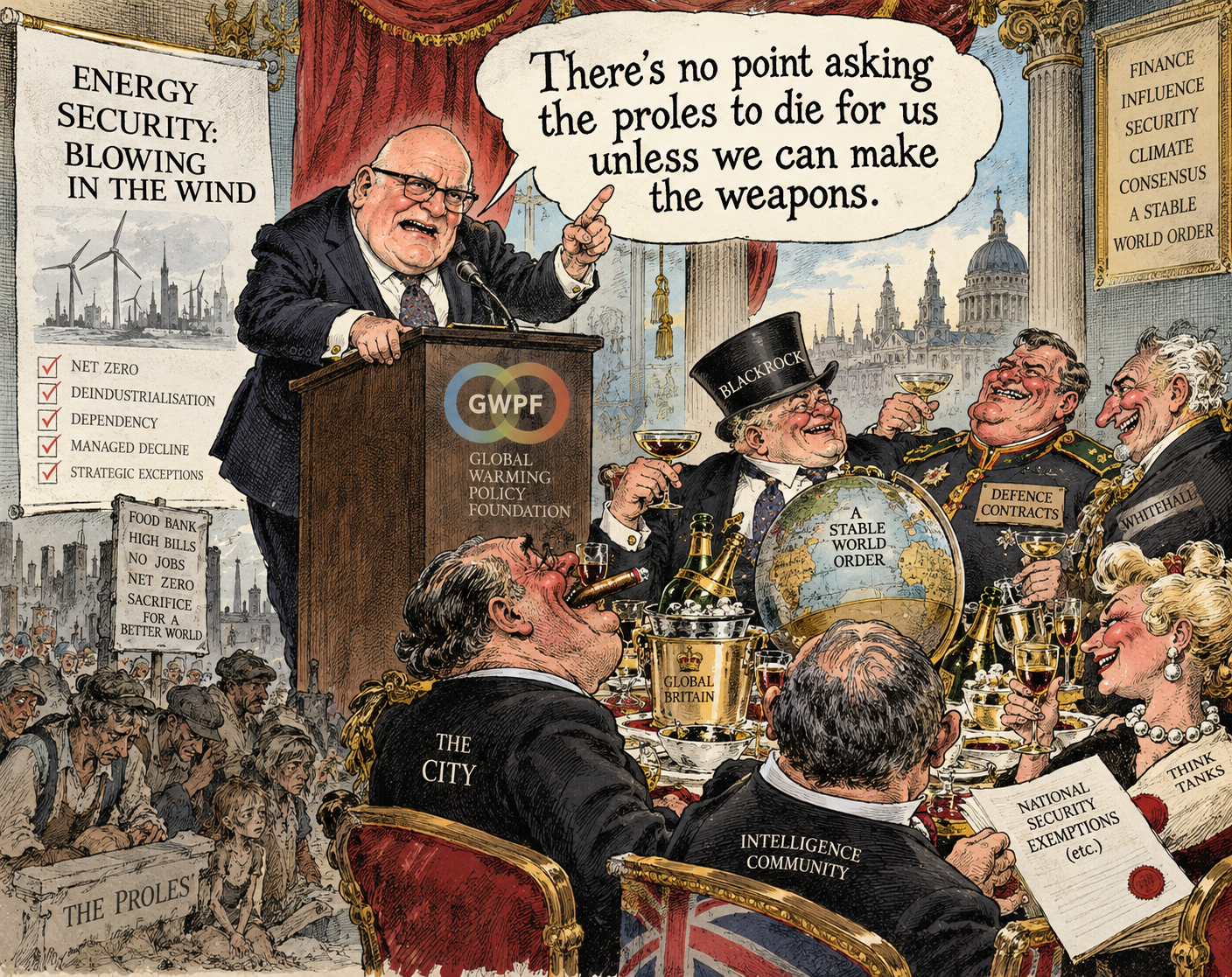
On the 18th September 2026, Richard Dearlove, former head of MI6, gave a lecture to the Global Warming Policy Foundation. His subject was Energy Security: Blowing in the Wind. In this, he explains why a country that cannot reliably power its remaining industries, or manufacture the equipment needed to maintain its electricity supply, is in no position to conduct an independent foreign policy. The lecture deserves attention, though not the unqualified gratitude its author may have expected.
His central complaint is well expressed:
“I do not think that the government has a proper energy policy. Perhaps it has a climate policy.”
This is a distinction that ought to have been obvious long before it became suitable material for a lecture by a retired intelligence chief. An energy policy concerns the provision of reliable power at prices that allow people to live comfortably and businesses to produce things profitably. A climate policy may subordinate both purposes to targets whose achievement is celebrated even when production has simply moved abroad. The emissions disappear from our accounts. The factories disappear from our towns. We then import what those factories once produced and congratulate ourselves on our progress.
I agree with the substance of Mr Dearlove’s argument. The pursuit of Net Zero has aggravated an industrial decline that began well before anyone had thought of the phrase. It has helped reduce the British State to international impotence, however much noise its representatives continue to make at international meetings. A government can announce its intentions in the sternest language available to its speechwriters. It still needs electricity, steel, machinery and the ability to replace things that wear out or are destroyed.
Mr Dearlove is particularly good on this last point. Dependence means more than needing a cargo of gas to arrive on time. It means needing the machinery without which the gas cannot be turned into electricity and the electricity cannot be delivered. As he puts it:
“The country has lost the industrial capacity to reproduce its own energy system.”
This is the most important sentence in the lecture. We have lost more than particular factories and their payrolls. We have lost much of the connected productive system that made recovery from damage possible. Buying a replacement abroad is satisfactory while the seller is willing, the shipping routes are open, and no one else has arrived first with a larger order. It becomes less satisfactory in an emergency. Mr Dearlove’s description of the State’s remaining options is admirably brief:
“It can join the queue or it can beg.”
All this is true. The difficulty is understanding why Mr Dearlove has discovered it in 2026. British deindustrialisation did not begin last Thursday. It has been one of the central facts of our economic history for nearly half a century. There was no earthquake that swallowed Sheffield, nor did Birmingham disappear beneath a volcano. Successive governments adopted policies that made production in Britain less attractive while congratulating themselves on the growth of finance and services. The transfer of productive capacity abroad was not concealed. The decline of steelmaking was visible. So was the abandonment of cheap domestic energy. The official statistics themselves record a long decline in industrial energy consumption since 1970.
Mr Dearlove is not a disinterested observer who has wandered in from outside the governing establishment. He introduces himself as someone who spent thirty-eight years in the intelligence service and more than twenty years afterwards as one of the intelligence community’s public voices. This is an unusually clear statement of institutional continuity. Retirement has given him greater freedom to speak. It has not made him a representative of the people whose taxes supported his career. Nor does his discovery of our industrial weakness establish that he and we have suddenly acquired the same purposes. He may be entirely sincere. Sincerity is compatible with a conception of the national interest in which ordinary people appear chiefly as resources to be used and discarded after use.
Indeed, the obvious question is where Mr Dearlove and the rest of the national-security establishment were while this was happening. If the dependence he now describes is so dangerous, why was it allowed to develop? If the people whose professional speciality was supposed to be the identification of strategic threats understood what was happening, why did they apparently achieve so little in preventing it? If they did not understand, we are entitled to ask why their strategic judgement should now command automatic respect.
Perhaps Mr Dearlove warned against all this in secret. I have no access to the classified papers and will not pretend otherwise. But a man who has spent most of his life inside the governing apparatus cannot stand beside its handiwork in old age and speak as though someone else had done it. He is not the traveller who has come upon the ruins. He belonged to the civilisation that made them.
To understand the speech, I will briefly restate my view of how this country is ruled. Ultimate power in Britain lies with a monied interest centred on the City of London and closely connected with its equivalents abroad, particularly in New York. Its concern is to preserve Britain as a reliable platform for international financial operations. Below it stands the governing and administrative class: politicians, senior officials, broadcasters, academics, intelligence officers and the various professional interpreters of whatever is currently described as progress. This does not require a committee issuing secret instructions every Thursday. Shared interests, appointments, patronage and the intelligent anticipation of what will be rewarded are sufficient to produce a remarkable degree of agreement. There are factions and quarrels. There are also durable assumptions about what must never be seriously challenged. The governing class has interests of its own and considerable freedom in pursuing them, but it operates within a larger settlement whose ultimate beneficiaries are those who control financial capital and the streams of economic rent that flow through it.
On this reading, three generations of deindustrialisation and cultural disintegration have served a coherent purpose. A substantial manufacturing interest has roots in particular places. It needs skilled workers, dependable infrastructure and continuity across generations. The communities around it can acquire both the means and the confidence to resist. A financial trading platform has fewer uses for such attachments. The old industrial order therefore contained concentrations of power inconvenient to the new one. A manufacturer whose wealth consists of machinery and factories in Britain has interests that cannot be moved to Singapore by pressing a key. Skilled workers who know that society needs what they do possess a bargaining power unavailable to an interchangeable service employee. Settled communities develop memories, loyalties and institutions of their own. The miners were an extreme example. Whatever may be said about the economics of coal or the behaviour of Arthur Scargill, the mining communities possessed an independence that allowed them to confront governments directly. Their disappearance was more than a change in the composition of national output.
Mass immigration helped the larger transformation along. Its scale, together with an official multiculturalism that discouraged a common national identity, made integration into the historic nation increasingly difficult. The resulting fragmentation was convenient for those who preferred a population of separate clients and consumers to a people capable of acting together.
Net Zero fitted neatly into the same settlement. It gave deindustrialisation a moral justification. A factory closure could now be treated as environmental progress. Cheap and abundant energy, once regarded as an obvious blessing, became something for which apologies were required. Domestic extraction could be obstructed while goods manufactured with Chinese coal continued arriving through British ports. Meanwhile, carbon trading and subsidised investment created new opportunities for the financial interest, while the administrative bourgeoisie acquired another collection of consultancies and regulatory powers.
For a time, this arrangement appeared secure. The Soviet Union had collapsed. China could be regarded as an obedient sweatshop. Lesser governments that obstructed the prevailing order could be sanctioned or subjected to more direct attention. The financial system could continue extracting its returns under the protection of a Western power that seemed to have no serious rival. The mistake was to suppose that the means of maintaining this supremacy could be dismantled without affecting the supremacy itself. That mistake is now becoming impossible to ignore. China did not remain a giant workshop subordinate to Western finance. Russia has demonstrated a greater capacity to resist Western pressure than was anticipated. Iran has shown how difficult it can be for even vastly richer powers to translate technological and financial superiority into the political obedience of a determined regional opponent. None of these countries needs to form a harmonious alliance, or possess equal strength, to make the old assumptions unusable. It is enough that they cannot all be expected to submit.
Suddenly we need cheap energy. We need factories. We need engineers who know how to make things and workers who know how to repair them. We may even need some national feeling. Above all, the governing class may again need young men willing to fight. The young white men whose inherited attachments have so often been treated as a social problem become useful again when the governing class contemplates a serious war. They must somehow be persuaded that the country is theirs, that its rulers deserve their loyalty, and that dying in some foreign dispute is the natural conclusion of loving the place where they were born.
This is the recalibration within which I place Mr Dearlove’s lecture. I do not claim that his speech proves a coordinated change of direction throughout the establishment. Nor do I imagine that he received an envelope from the City instructing him to discover British industry. That is not how the system normally operates. The important people notice which arguments have become respectable, which old assumptions have become embarrassing and which new requirements are emerging. Editors change emphasis. Officials rediscover forgotten dangers. Retired intelligence chiefs make speeches. The change proceeds by osmosis. What matters is that the damage becomes intolerable when it begins to obstruct the exercise of power.
Consider the terms in which Mr Dearlove recalls the Cold War:
“The country’s warfighting potential resided ultimately in its industry.”
There we have the organising concern. Industry supplies the material foundation of military power. Later, he urges the rebuilding of strategic industries so that Britain can:
“Effectively defend our island fortress and be a reliable ally to friendly democracies around the world.”
Defending this country is a proper function of government. The remainder needs rather more examination. What commitments are concealed within being a “reliable ally”? Who decides which foreign quarrels require our participation? How frequently does the defence of Britain turn out to require intervention thousands of miles from its shores? My reading is that Mr Dearlove wishes to restore the capacity of the British State to act within the Western system of power. That is a considerably different ambition from restoring the independence and prosperity of the British people. The danger is that industrial recovery becomes preparation for renewed wars of enforcement on behalf of what is called the rules-based international order. I prefer the less evasive expression, the New World Order.
This distinction is central. I want cheap energy because cheap energy makes people richer. I want industry because a country that can produce what it needs is less dependent than a country that must beg foreigners to sell it essential goods. I want productive employment because it creates capital and skills outside the administrative State. I want British people to live in warm houses without being told that comfort is a moral failing.
Mr Dearlove’s argument requires none of this. I do not claim to know what he privately thinks about the living arrangements or diets of ordinary people. But nothing in his strategic argument requires him to object to a population eating processed bug pulp in unheated shared accommodation, provided the State retains enough productive capacity to discharge its preferred commitments. His objection becomes urgent when national impoverishment disables the machinery of international action.
This is why his proposed remedy is so revealing. Mr Dearlove suggests:
“National security exemptions to net zero.”
Not abolition, please be aware – just exemptions.
After explaining that the existing policy has contributed to strategic weakness, he proposes that the State should decide which favoured activities may escape it. The military and its suppliers may be allowed relief because their work is deemed essential. The ordinary manufacturer must still make his application to the prevailing orthodoxy. The householder may still be expected to accept sacrifices.
Why should cheap and dependable energy require a certificate of strategic usefulness? A family has a sufficient reason for wanting a warm house. A manufacturer has a sufficient reason for wanting to remain in business. A free and prosperous country is worth having without demonstrating that it can support another expeditionary war. There is something almost perfect about the mentality revealed here. The governing class discovers that one of its policies has become destructive, and its first instinct is not to abolish the policy but to create exceptions for itself. The factory producing something Whitehall regards as strategically important may be permitted cheap energy. Everyone else can continue saving the planet.
This brings me to Thermidor. I use the term for a retreat from revolutionary excess undertaken by people who intend to preserve the underlying distribution of power. Some destructive enthusiasms are restrained because they have become inconvenient to those who benefited from the revolution. Competence returns to fashion. Certain truths become speakable. The people are allowed to recover enough strength to be useful again.
Mr Dearlove is interesting because he looks like an early Thermidorian. He is not repudiating the governing order. He is warning that some of its policies have weakened the State beyond the point of prudence. Deindustrialisation was acceptable while the physical economy could safely be located elsewhere. Expensive energy was tolerable while Britain could rely on imports. National fragmentation was manageable while the governing class saw no serious need for mobilisation. These policies become less attractive when China possesses the factories, foreign governments prove unwilling to obey Western commands, and military power once again depends on manufacturing capacity at home.
The retreat should therefore be welcomed without being misunderstood. There is no obligation to reject a sound argument because of the purposes for which it may be employed. Cheaper energy would benefit us. Industrial recovery would benefit us. A weakening of the apparatus that treats prosperity as an environmental offence would benefit us. We should accept every such improvement and demand that it extend beyond favoured strategic sectors.
But acceptance must not become enlistment. We owe no political loyalty in exchange for the partial correction of policies that should never have been imposed. Nor should we allow a revival of patriotic language to settle the question of whose interests the State serves.
There is also a possibility that the recalibration will produce consequences its managers do not intend. Industry creates more than armaments. It creates productive capital rooted in particular places. Skilled workers who know their value may become less tractable. Manufacturers whose fortunes depend on Britain may discover interests different from those of international finance. A governing class that teaches young men to love their country sufficiently to fight for it may discover that they begin asking whether the people who govern that country deserve their loyalty.
This is the risk the ruling class must take. It has weakened the host too far and must now restore some of its strength. Yet the institutions and social relationships required for industrial recovery may themselves recreate some of the independent power that the old deindustrialising settlement helped destroy. Recovery on our terms would mean affordable energy for households and businesses, the rebuilding of productive independence, and a government answerable for the commitments it undertakes abroad. It would allow the British people to enjoy the fruits of their work and to decide what sacrifices, if any, their actual defence requires.
Recovery on Mr Dearlove’s terms may mean something rather different: enough factories to supply the State, enough cheap energy to maintain them, enough national feeling to staff the armed forces, while the distribution of political and economic power that produced the original disaster remains substantially untouched.
That is why I find his lecture both useful and objectionable. He has explained with considerable force why the existing course cannot continue. We should use his admission. But we should resist the assumption that those who helped administer the old order are thereby entitled to direct its reconstruction.
Mr Dearlove and his friends have finally noticed that a financial empire cannot indefinitely rest on an industrial desert. They have discovered that a State cannot project power with diversity officers and derivatives. They have remembered that electricity must come from somewhere and that weapons must actually be manufactured.
Very good. Let us have the electricity. Let us have the factories. Let us have the industrial recovery. But let us have no illusions about why the discovery has been made. The governing class has not decided to return the country to us. The monied interest has not repented of the settlement from which it profited. The imperatives have changed, and the policy is being recalibrated accordingly.
They spent a generation weakening Britain because weakness served their purposes. Now they need some of its strength back.
Discover more from The Libertarian Alliance
Subscribe to get the latest posts sent to your email.