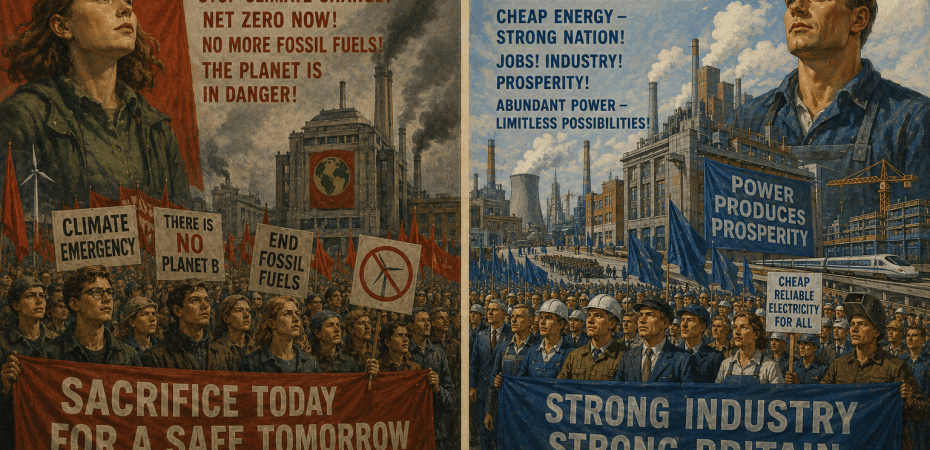
On the 29th July 2026, Alistair Heath, Editor of The Daily Telegraph, published an article that began with words I would not have expected to see in his newspaper even five years ago:
“Climate change is real, but Britain can do almost nothing about it. The war against global warming has been lost, with only grievous collateral damage to show for it. We have crippled British industry, hammered consumers and pushed the grid to the brink of blackouts, all with no discernible impact on global emissions and the climate.
“It’s time to accept this sobering reality, cut our losses, cease tilting at (and building) windmills, ditch the despicable con that is net zero, and learn to cope with, and whenever possible, even enjoy, a warmer, drier, more volatile Mediterranean climate, if that is indeed to be our fate.”
The article was followed almost at once by angry replies from the environmental Left. One of these came from Sodium Haze:
“Journalism has been purchased as a public good, gutted, converted to pump out churnalism and propaganda for the rich, made wholly unfit for any of the foundational civilisational roles it should play. That impoverishment is the key loss which has left Britain’s public life morally and spiritually bankrupt and we will make no headway on any topic until this is more widely recognised.”
There is a great truth buried in this indignation. Anyone who looks to the regime media for a disinterested description of the world is a man who deserves most of the beliefs he acquires there. I certainly do not regard Alistair Heath as a prophet suddenly descended from Sinai with the tablets of truth. I have always found him a charmless man, bordering on the repulsive. Last year, I was asked whether I thought his articles might be written by a chatbot. My answer was that they might be, but that it was equally possible they proceeded from a mind that had independently achieved the mental habits of a chatbot. I will leave that matter there.
Sodium Haze is nevertheless wrong in the particular and right in the general. He is wrong that global warming constitutes the emergency we have been assured for thirty years that it constitutes. He is right that we are being managed through the newspapers. The importance of Heath’s article lies not in whether Heath himself believes every word of it. It lies in the fact that an argument until recently confined to dissidents has been admitted into one of the principal newspapers of the British governing class.
Something has changed. Before asking what, however, let us look at the climate case itself. I am not a climate scientist. I have no intention of pretending to competence in the modelling of atmospheric feedbacks or ocean heat transfer. I accept that carbon dioxide is a greenhouse gas. I accept that human beings have increased its concentration in the atmosphere. The IPCC goes much farther and describes human influence on recent warming as unequivocal. Anyone who wishes to overthrow that conclusion scientifically must do so with scientific evidence.
But that is not the proposition on which the political case for Net Zero was sold. The proposition was catastrophe. And catastrophe has the useful quality of generating predictions. In 2006, Al Gore was explaining that mankind had perhaps ten years before crossing a point of no return. His film An Inconvenient Truth popularised predictions of disappearing Arctic ice, enormous sea-level rises and a procession of ecological disasters. In 2009, the then Prince of Wales announced that we had ninety-six months to prevent “irretrievable climate and ecosystem collapse”. Earlier environmental panics had followed much the same pattern. Mineral resources were about to run out. Acid rain would devastate forests. The ozone hole would expose us to intolerable solar radiation. AIDS was going to kill millions in Britain within a few years. Mad Cow Disease was expected to destroy the brains of a substantial part of the population.
The precise claims varied. The grammar remained constant: disaster was imminent; there was little time; governments must acquire new powers or spend large amounts of money; scepticism was irresponsible. The dates arrived. The world remained.
That does not prove that every environmental concern is fraudulent. It does something more modest and more damaging. It destroys the presumption of authority. When someone has repeatedly announced the end of the world and the world has failed to end, it is no longer enough for him to put on a white coat and demand obedience. The burden of proof shifts. You no longer need to be a scientific expert of any kind simply to notice that all the dates dated predictions of the past thirty years have been falsified, and to conclude that all the present one are probably just as false.
Nor has the physical world behaved in every respect as the catastrophe story encouraged us to expect. One of the most remarkable environmental developments of recent decades has been global greening. In 2016, a NASA-reported satellite study found significant greening across roughly a quarter to one half of vegetated land and attributed about 70 per cent of the observed greening effect to carbon-dioxide fertilisation. This does not disprove anthropogenic warming. It does make rather awkward the children’s morality play in which carbon dioxide is simply pollution and every consequence of increasing its atmospheric concentration must be harmful.
Agricultural civilisation has not collapsed either. The alleged relationship between rising temperature and human welfare has proved far more complicated than the sermons allowed. Human beings adapt. Crops change. Irrigation improves. Technologies are invented. Rich societies protect themselves from heat and cold better than poor societies. The sensible question was always whether whatever warming was likely to occur would impose costs greater than the costs of preventing it. Instead, we were told that the science had somehow answered an economic and political question before the question itself could be discussed.
But that is enough of the climate change case. For the record, I do not believe it. I have never believed it. And I leave it there. I pass instead to the more interesting matter. Why were we preached at for more than thirty years? The easiest explanation concerns the non-entrepreneurial wing of the bourgeoisie. Climate alarm created employment on an heroic scale. Researchers needed grants. Universities acquired institutes. Local authorities required climate officers. Consultants prepared sustainability reports. Charities acquired directors of environmental policy. Corporate bureaucracies sprouted departments whose employees attended conferences to discuss the wickedness of economic activity while drawing salaries from it. None of these people needed to be consciously dishonest. Give a reasonably intelligent man a respected occupation whose existence depends on a proposition, and he will generally discover excellent reasons for believing the proposition.
This class has become one of the characteristic products of modern Western society. It creates nothing and administers much. Its members lack the vulgar gifts needed for entrepreneurship and often despise those who possess them. Climate policy was made for them. It transformed incapacity for production into a claim to supervise those who produced.
Above these people stood interests of greater importance. Carbon trading, renewable subsidies, green investment mandates and the elaborate financial products constructed around them, created artificial markets of immense value. These markets were not free markets distorted by occasional intervention. They were creatures of political decree. Without governments announcing limits, targets and compulsory transitions, many of the corresponding streams of income would never have existed. These people did not need to believe that switching on a bedside lamp would turn the Earth into Venus. It needed everyone else to believe something sufficiently close to this for carbon itself to become a financial asset.
Both interests remain. Neither explains why the tone is now changing. For that, we must look at the third and largest purpose served by the climate narrative. Since about 1990, whether by explicit design or by the convergence of interests that usually passes for design in modern politics, the strategic tendency of the Western ruling class has been towards deindustrialisation. The purpose was never stated in those terms, and perhaps no committee ever formulated it. Power rarely operates through written orders. But the tendency was clear. Manufacturing was transferred to East Asia. Energy was made expensive. Domestic extraction was obstructed. Industrial employment diminished while finance expanded.
This suited the monied interest very well – and the monied interest, as I never stop arguing, is presently the ultimate power in our civilisation. Industry creates awkward kinds of people. It creates capitalists whose fortunes depend on actual productive assets sunk into particular places. A man who owns a steelworks in Sheffield has an attachment to Sheffield that cannot be replicated by a fund manager whose portfolio can move electronically from London to Singapore. Industry also creates skilled workers who know that society needs what they do. Such men earn reasonably secure incomes, live in settled communities and may develop the deplorable habit of asking who governs them and why. Britain once contained millions of such people. Their destruction was one of the principal achievements of the economic settlement begun under Margaret Thatcher. High interest rates and an overvalued pound destroyed enterprises that might otherwise have survived, while the State itself escaped the full adjustment. In short, the costs of ending inflation were imposed disproportionately on productive industry rather than on the swollen State whose deficits had helped create the inflation. The destruction of the coal communities removed another independent concentration of working-class power and cleared the ground for the managerial society that followed.
The process was sold as economic modernisation. Climate policy later supplied it with a moral theology. Closing a factory was no longer merely efficient. It was saving the planet. Preventing the exploitation of domestic energy was an act of virtue. Making electricity expensive became evidence of seriousness. A manufacturing country had once regarded cheap and abundant energy as a blessing. Under the new dispensation, scarcity became righteousness.
The underlying international strategy seemed brilliant during the 1990s. China would become the sweatshop of the world. Western consumers would buy what Chinese workers produced. Western financial institutions would own claims upon the resulting flows of trade. Britain could become a nation of lawyers, administrators and financial intermediaries, while grubby production happened elsewhere.
It has not worked. China did not remain a giant sweatshop. It used Western investment, Western technology and its own formidable abilities to become the greatest industrial power in the world. Russia did not collapse under sanctions. The attempt to use economic exclusion as an irresistible weapon exposed the dependence of Western economies on the physical production they had spent decades exporting. More recently, the Iran war has added to the growing suspicion among Western strategic planners that financial dominance and expensive weapons systems cannot substitute indefinitely for productive capacity.
The old arrangement assumed that the West could stop making things because anyone who did make things would remain politically subordinate. That assumption has died.
Artificial intelligence has supplied another shock. Whatever else AI may bring, it consumes electricity on a breathtaking scale. The International Energy Agency projects worldwide data-centre electricity consumption at about 945 terawatt-hours by 2030, more than twice the present level, with AI the largest driver of the increase. AI-focused data-centre electricity demand rose about 50 per cent during 2025 alone. In the United States, official projections have data centres taking somewhere between 6.7 and 12 per cent of national electricity consumption by 2028. There is no conceivable AI supremacy without immense quantities of reliable electricity.
And so the strategic calculation has reversed. Cheap energy is no longer an embarrassment to be taxed out of existence. It is a requirement of power. The significance of Bill Gates’s intervention last October should be understood in this light. On the 28th October 2025, The Guardian reported:
“Bill Gates has called for a ‘strategic pivot’ in the effort against the climate crisis, writing that the world should shift away from trying to limit rising temperatures to instead focusing on efforts to prevent disease and poverty.”
Gates did not announce that climate science was fraudulent. He expressly maintained that climate change would cause serious harm. But he rejected the doomsday framing and argued that temperature and emissions should cease to dominate the allocation of resources. That is how great regime narratives normally end. They are seldom confessed as lies. They become yesterday’s truth.
The difficulty is that Western societies, though increasingly authoritarian, have not yet achieved the fluidity of Oceania in Nineteen Eighty-Four. The enemy cannot be changed halfway through Hate Week with everyone instantly remembering that he has always been the enemy. Climate alarm has been preached in schools, universities and newspapers for a generation. Careers rest on it. Industries have been created around it. Millions sincerely believe it. You cannot announce on Monday morning that the emergency was exaggerated and expect the apparatus to disappear by lunchtime.
What you can do is change the emphasis. You concede that climate change is real. You insist that the danger remains. You continue to praise the intentions of those who spent the money. Then you explain, sadly but firmly, that mitigation has failed. China will not cooperate sufficiently. The developing world will industrialise. The warming is therefore unavoidable. We must turn from prevention to adaptation.
At that point, almost every practical conclusion changes while the old doctrine is formally preserved. Coal, gas and nuclear power can return because adaptation requires cheap electricity. Industrialisation can return because dependence on China has become dangerous. Air conditioning ceases to be a sin because people must be protected from heat. Desalination becomes admirable. The climate bureaucracy can slowly be reduced, though perhaps with generous pensions for those who spent their careers frightening us. No one need admit anything.
This is why Heath’s article matters. George Monbiot understood the change immediately, though he explained it according to his own ideology. Writing in The Guardian a week later, he complained that the argument had moved from denying climate change towards admitting it while saying that meaningful prevention was now impossible. He regards this as another device for protecting fossil capitalism. I suspect something larger.
Heath’s article should be read as one item in the preliminary bombardment against Net Zero. It does not say that the climate narrative was false. That would provoke unnecessary resistance and raise awkward questions about the trillions already spent. Instead, it says the narrative is no longer operationally relevant. We tried. We failed. Britain is too small. China emits too much. Let us adapt. This is not repudiation. It is controlled demolition.
Jordan Peterson’s intervention two days later is more aggressive. He attacks climate catastrophism as an ideological weapon against industrial capitalism and rehearses the failures of previous predictions. His strongest material is not his psychoanalysis of environmentalists but his insistence on the neglected balance sheet: planetary greening, technological adaptation and the enormous opportunity cost of the energy transition. His Telegraph article appeared on the 31st July, directly after Heath’s intervention. The sequence is suggestive.
I am not claiming that Heath received an envelope from some committee in the City instructing him to begin the retreat. That is not how the governing class operates. Its members notice what opinions suddenly become respectable. Editors sense which direction the wind is blowing. Politicians discover new convictions. Think tanks publish reports. The conclusions emerge by osmosis, and afterwards everyone congratulates himself on having thought independently.
We have seen the same process elsewhere. The ruling class strategy that required deindustrialisation has reached the end of its usefulness. The world it created has become dangerous to those who created it. China possesses the factories. Russia possesses resources and military endurance. Artificial intelligence demands power stations on a scale incompatible with an energy policy devised around abstinence. The host body has been weakened too far. Therefore the West must be reindustrialised. Energy must become abundant again. Some part of national cohesion must be restored. The ideological furniture of the past generation will not all survive the rearrangement. Net Zero is among the larger pieces marked for removal.
This is why the climate change scam is not collapsing. Collapse would imply the exposure of falsehood followed by disgrace. Nothing so satisfying should be expected. The narrative is being retired because the strategic circumstances that made it useful have disappeared.
Yesterday, industrial weakness served the ruling class. Today, industrial weakness threatens it. Yesterday, expensive electricity assisted the destruction of troublesome productive interests. Today, expensive electricity threatens the data centres on which the next structure of economic power will depend. The science has not changed sufficiently to explain the political reversal. The interests have.
This is how the climate change scam will end. There will be no confession and probably no apology. The windmills will continue turning while the subsidies are quietly revised. The committees will keep meeting until their members can be pensioned off. Yesterday’s moral imperative will become one consideration among many. Those who ruined industries and impoverished households in the name of saving the planet will explain that circumstances have changed.
And perhaps they have. What has certainly changed is what our masters presently require of us. The lie will not be exposed. It will simply cease to be useful.

Discover more from The Libertarian Alliance
Subscribe to get the latest posts sent to your email.
Related posts:


Powered by YARPP.
While deindustrialisation was certainly real, there was a simultaneous although smaller (because a smaller part of the economy) attack on farming, so it wasn’t about promoting ‘the simpler life’, even in the purely negative sense of a lower standard of living but still a tolerable and sustainable standard of living.
Was this agenda ultimately aimed at democide? If not, was there really a belief everyone can be a ‘fund manager working on a plane between London and Singapore’? Managing funds that represent what?
I think the many different strands – de-industrialization, expensive energy, anti-car policies, attacks on farming, COVID overreach, attacks on free speech, and even the obvious, sustained failure to control immigration – are, very likely, all parts of a single master project. That project, I would guess, is not so much democide as cultural genocide. It is aimed at destroying, not only the visible results of, but also the culture and the spirit that brought about, the Enlightenment and the Industrial Revolution.