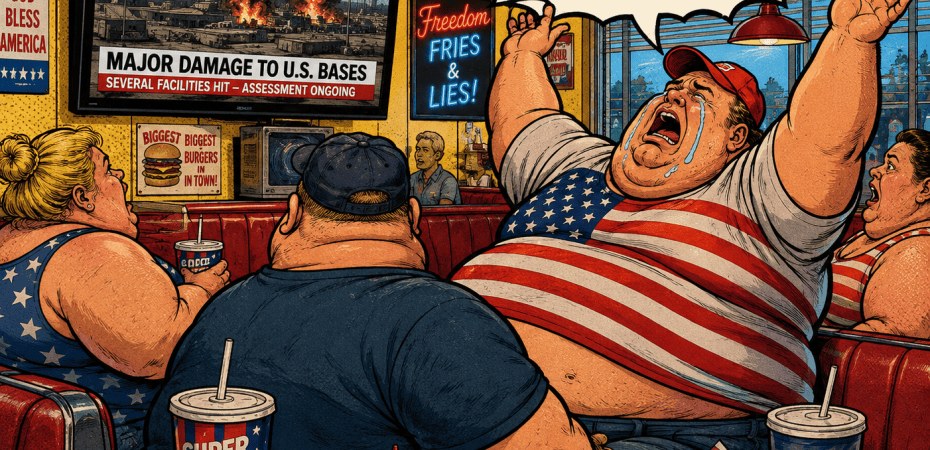
Donald Trump came to office promising to end America’s endless wars. He mocked the invasion of Iraq. He ridiculed the pretensions of the Washington foreign-policy establishment. He assured his supporters that American lives and money would no longer be squandered in conflicts that served no identifiable American interest. This was not a marginal promise. It was perhaps the main reason why millions of Americans voted for him. They had grown weary of twenty-five years of military adventures that had destroyed states across the Middle East while bringing neither security nor prosperity to the United States itself.
Today those promises lie alongside so many others that have disappeared into the memory hole. America has spent six months fighting another Middle Eastern war. Hundreds of billions of dollars have been frittered away. Oil prices remain high, and may rise higher. Shipping through the Strait of Hormuz has never returned to normal. American prestige has suffered its gravest military humiliation since Vietnam. Even Reuters, which has no obvious desire to flatter Tehran, now describes a President desperately searching for a politically survivable exit from a conflict he declared would be over by the middle of April.
Mr Trump now occupies perhaps the most unenviable position of any American President since Lyndon Johnson discovered that Vietnam refused to conform to Pentagon briefings. Every course now open to him carries serious political costs. If he accepts the emerging Iranian-Omani arrangements concerning the Strait of Hormuz, he must acknowledge an Iranian position that Washington insisted throughout the spring could never be tolerated. If he resumes large-scale bombing, he risks another strategic failure while using up still more American munitions and further destabilising world energy markets. He will also enter the Congressional mid-term elections with just the sort of expensive foreign war he promised would never occur. If he continues the present mixture of blockade and increasingly theatrical threats, he does nothing more than prolong an expensive stalemate that satisfies nobody.
This is not the position of a statesman choosing among attractive alternatives. It is the position of a gambler who has exhausted his credit and is now deciding which creditor he can least afford to disappoint.
The obvious question therefore presents itself. How did the President place himself in such a position? There are only two explanations that deserve serious consideration. The first is that Mr Trump genuinely believed the extraordinary assurances repeatedly offered before the war began: that Iran would collapse after a brief aerial campaign, that its political leadership could be removed without provoking wider consequences, that the Strait of Hormuz could always be kept open by American naval superiority, and that overwhelming military technology would once again substitute for political intelligence. If this explanation is correct, it reveals a level of credulity remarkable in any man entrusted with the largest military establishment in history. One expects such fantasies from newspaper columnists and retired generals seeking consultancy contracts. One expects rather more scepticism from a President.
The alternative explanation is scarcely more reassuring. It is that Mr Trump understood perfectly well the risks involved but discovered that he lacked the political freedom to resist pressures exerted by interests for whom war with Iran had become an ideological necessity irrespective of the consequences for the United States. Throughout the conflict his public conduct has suggested a man repeatedly attempting to escape from commitments he no longer wishes to honour, only to reverse himself almost immediately under pressures that remain largely invisible to the ordinary voter. His brief enthusiasm for the Memorandum of Understanding, followed by his almost immediate retreat from it; his extraordinary proposal to become the “Guardian of the Hormuz Strait,” followed by its equally rapid disappearance; his alternating promises of negotiation and threats of annihilation—all suggest not coherent strategy but a President oscillating between incompatible demands.
Neither explanation reflects well on the office he holds. One presents a President incapable of understanding the consequences of his own decisions. The other presents one who is unable to act independently on his own judgement. The observable facts do not require us to decide between them. They merely require us to acknowledge that one, or perhaps both, must contain a considerable measure of truth.
Mr Trump’s defenders continue to point towards tactical successes. Iranian facilities have undoubtedly suffered damage. Senior officials have been killed, or perhaps murdered. Military installations have been destroyed. Yet wars are not won by compiling impressive lists of demolished targets. They are won by achieving political objectives. On that measure the campaign has become an exercise in cumulative failure.
Reuters inadvertently acknowledges the central point in a sentence that almost disappears amid the diplomatic reporting. The proposed settlement, it notes, would give Tehran influence over the Strait of Hormuz “that it never possessed before the war.” One could hardly compose a more devastating summary of strategic defeat. The principal consequence of a war supposedly undertaken to reduce Iranian influence has been to increase it. Lawyers will no doubt spend years debating the precise legal form of whatever arrangements finally emerge. Geography is rather less interested in legal drafting. The political reality is that Iran now negotiates from a stronger position than it occupied before the first American aircraft crossed its borders.
The same pattern appears everywhere one looks. Washington declared that the Strait would remain permanently open. Commercial traffic remains severely disrupted. Washington declared that Iran’s nuclear programme would be eliminated. It now speaks instead of renewed negotiations. Washington declared that the regime itself might collapse. Instead, it survived, reorganised itself and continues to direct operations across a widening theatre of conflict. The war was sold as a demonstration of irresistible American power. It has become a demonstration of its practical limits.
Perhaps the greatest casualty has been the reputation of the American military establishment itself. For more than three decades it has fought opponents already crippled by sanctions and internal division, or by overwhelming disparities of force. Panama, Serbia, Iraq, Libya and Afghanistan encouraged the comforting illusion that technological superiority had rendered strategy unnecessary. Iran has provided a much sterner examination. Geography, industrial resilience, missile technology and patient political leadership have proved more difficult to bomb into submission than Pentagon briefing papers appeared to suggest.
The consequences extend beyond the Persian Gulf. Reuters quotes former American intelligence officials warning that China, Russia and North Korea are studying the conflict closely. One may be certain that they are. Every campaign reveals information. Every prolonged conflict exposes industrial capacity, stockpile management, alliance cohesion and political endurance. Beijing is undoubtedly paying close attention to American munitions expenditure and replacement and domestic political tolerance. So is Moscow. These lessons will remain valuable long after the present conflict has passed into history.
Meanwhile, the domestic political position deteriorates steadily. Reuters notes that administration officials privately expect the conflict still to be unresolved when voting begins for the Congressional mid-term elections. The significance of this admission should not be underestimated. Six months ago the administration expected victory by April. Today it merely hopes to avoid complete political disaster by November. Such adjustments in official expectations are often more revealing than any number of triumphant presidential speeches.
The Memorandum of Understanding signed in June therefore deserves to be reconsidered, not because it represented an ideal settlement but because it represented the only serious recognition, however reluctant, of military reality. It accepted what months of fighting had demonstrated: that the United States could not compel unconditional Iranian submission without assuming risks that neither its allies nor its electorate were prepared to bear. It offered the possibility—no more than that—of ending a war that had already achieved almost none of its declared objectives.
Mr Trump grasped at that document because he recognised, however briefly, that it offered the only credible route away from an increasingly disastrous enterprise. His subsequent retreat from it merely demonstrated how difficult credible retreats become once wars have been launched on extravagant promises of easy victory.
Reuters describes the President as confronting “a menu of bad options.” The phrase is restrained. The truth is harsher. Washington is no longer choosing between victory and compromise. It is choosing among different forms of defeat, each carrying its own political costs.
The Judgement of History has already descended on Mr Trump’s second term, and on his entire political career since 2016. It is never kind to leaders who begin unnecessary wars upon confident promises of quick success. It is even less forgiving when those promises are followed by months of contradictory improvisation and steadily diminishing credibility. Mr Trump promised peace and delivered another Middle Eastern war. He promised swift victory and now searches for an exit. He promised American strength and has instead demonstrated American limitation. He promised that the Strait of Hormuz would remain beyond Iranian influence. His negotiators now contemplate arrangements that recognise that influence.
The search for an honourable defeat has therefore become the defining feature of American policy. Whether such a defeat remains available is another question. Opportunities for dignified withdrawal seldom improve with the passage of time. They usually disappear when governments continue insisting that victory lies only one more offensive beyond the horizon.
Discover more from The Libertarian Alliance
Subscribe to get the latest posts sent to your email.
Related posts:
 The Islamabad Standoff: America’s Strategic Defeat Disguised as Diplomacy
 The Real Defeat of America
 Iran: The Last Blunder?
 Iran, Biden, Trump: Senile and Braindead vs Senile but Demented
 Iran: The Epstein War
Iran: Is One Picture Worth a Thousand Words?
Iran: The Epstein War
Iran: Is One Picture Worth a Thousand Words?
 Trump’s War on Iran: The Same Old Lies That Led America into Iraq
 Trump, Iran and a Revolution within the Ruling Class
 Trump Supporters Got Conned: Foreign Policy Failures, Iran, and the Coming Blowback
 The “Rescue Mission” That Wasn’t: How Washington Repackaged a Failed Iran Operation into a Manufactured Triumph
 Did Trump Win the Iran War? A Critique of Brandon Smith
 My Vote for Trump and the Moral Catastrophe in Iran
Powered by YARPP.