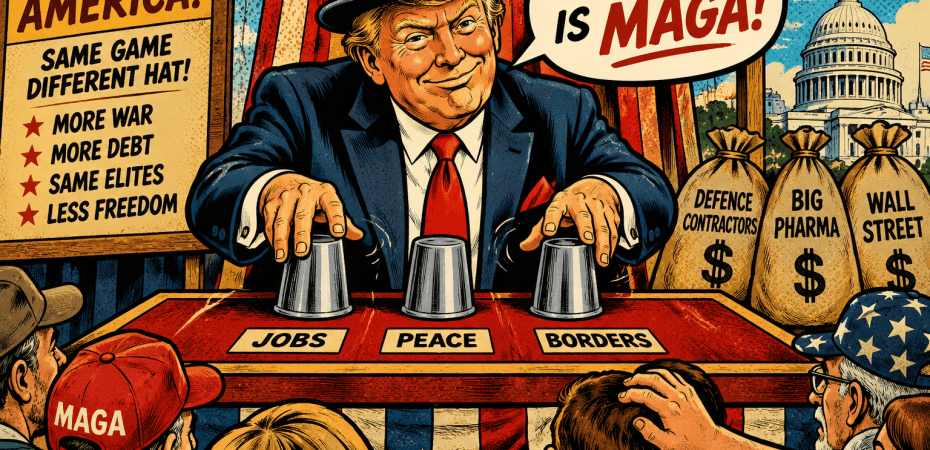
Donald Trump’s second presidency should eventually be remembered as one of the great wasted opportunities in American history. This is not because he failed to make America great again, whatever that was supposed to mean. Political slogans are necessarily imprecise. It is because he was elected to destroy—or at least seriously weaken—a political order that millions of Americans had correctly concluded was no longer governing in their interests, and he has ended by revealing himself as one of its most grotesque products.
There will be time enough for the historians to decide how much of this was fraud from the beginning and how much was corruption by office. I increasingly suspect the distinction is unimportant. Trump said things that needed saying. He understood, or appeared to understand, that endless foreign wars were bleeding the country while enriching people who never fought in them; that America’s industrial destruction was not compensated by cheaper televisions; that immigration on the scale permitted since the 1960s was transforming the country without the consent of its existing population; and that the respectable institutions of American life had become remarkably proficient at lying while retaining the vocabulary of public service. Millions who had stopped believing Republicans believed Trump because he seemed to hate the people they hated for reasons closely resembling their own.
That was the bargain. It is now broken beyond repair. The Iran war is not simply another failed military adventure. It is the event that explains Trump’s presidency. On 28 February he began the regime-change war that he had spent years assuring his supporters he would avoid. Seven months later, the war continues; the Strait of Hormuz has been largely closed, energy prices have risen sharply, American weapons stocks have been depleted and Washington is now searching for some formula by which the catastrophe can be brought to an end without requiring its author to admit what he has done. Reuters reports that the war had cost $38 billion by 1 August, with the Congressional Budget Office projecting another $3 billion for every additional month; it also reports that almost all American long-range precision missiles have been consumed and may take years to replace.
The political consequences are beginning to follow the military ones. A Reuters/Ipsos poll completed on 20 September put Trump’s approval at 32 per cent, the lowest of his political career; only 34 per cent of respondents supported the strikes on Iran, while Republican approval of Trump had fallen nine points in a week. Republican Senate candidates who formerly supported the war are already discovering principles of restraint as the midterms approach.
We should resist the temptation to enjoy any of this. There is something pleasurable about watching a fraud exposed, but America is paying for the exposure. Trump did not gamble his own money on Iran. He gambled American lives and American security. The casino remains open because the house has discovered that presidents can lose other people’s money indefinitely.
Nor can the matter be dismissed as one unfortunate error in an otherwise successful presidency. Iran matters because it completes the pattern. Trump promised government for Americans and produced government by personal whim. He promised an assault upon corruption and presided over an administration in which loyalty to himself became the chief political virtue. He promised to end the foreign-policy consensus and finally embraced its most dangerous assumption—that American military power can rearrange societies thousands of miles away at tolerable cost. He denounced the debt and added to it. He mocked the intelligence agencies and yet left the surveillance state substantially intact. He identified the Republican establishment as part of the problem, captured its party, and then allowed much of its substance to survive beneath different rhetoric.
His tragedy, if so vulgar a man can be allowed one, is that he correctly identified much of what was wrong with America and then became a concentrated expression of it.
This is why the eventual collapse of Trump must not be followed by a restoration of the Republican Party that existed before him. Nothing could be more disastrous than another procession of respectable men explaining that the fever has broken and that America can return to normal. Normal produced Trump. Normal produced Iraq. Normal produced the financial crash and the bailouts, industrial decay, the national debt and the peculiar system in which ordinary Americans are lectured about market discipline by corporations permanently attached to Washington. Trump was not an interruption of this order. He was what happened when the order became intolerable and the rebellion against it was entrusted to a confidence man.
The first task after Trump is therefore not restoration but separation. The American Right must separate itself from Trump the man without surrendering the truths that made Trump possible. This distinction is essential. The establishment would dearly like to arrange matters so that repudiating Trump means repudiating every grievance to which he gave expression. We shall be told that opposition to the Iran war was isolationism, that hostility to mass immigration was xenophobia, that objections to deindustrialisation were economic ignorance, and that distrust of federal agencies was paranoia. Having converted Trump into a universal receptacle for everything disreputable, respectable opinion will invite Americans to pour their grievances into the receptacle and throw it away. They should refuse.
Trump’s failure does not make the Iraq war wise. It does not make an economy dominated by debt and financial manipulation healthy. It does not make the national-security bureaucracy trustworthy. It does not make it sensible to import labour while artificial intelligence threatens enormous disruption to employment. It certainly does not establish that America’s interests and those of every foreign government described as an ally are identical. The peculiar trick of the coming restoration will be to argue that because Trump lied about these things, the things themselves were lies.
This is where Tucker Carlson’s present importance lies. Carlson supported Trump, defended him and helped create the political climate in which his return to office became possible. He now says that he regrets doing so, and his break was precipitated above all by the Iran war. In July he went further, arguing that on the decisive questions of “war and finance” Republicans and Democrats operate in effective agreement, and saying that he intended to help create a third party.
Whether Carlson himself is capable of building such a party is almost beside the point. I rather doubt that he is. He is a broadcaster of unusual intelligence and instinct, not an organiser, and his recent ten-point programme contains enough romanticism and half-digested economics to keep an army of critics occupied. But Carlson has understood the central fact that Trump accidentally revealed and then tried to conceal: the political division that matters increasingly runs across the two parties rather than between them.
His programme begins with an elementary proposition. Government exists for the people over whom it governs. The proposition sounds banal only because its opposite has become normal. Once we accept it, much else follows. Foreign policy should be judged by whether it makes Americans safer, not by whether it satisfies the ambitions of foreign allies, defence contractors or Washington think tanks. Economic policy should be judged partly by whether ordinary people can acquire property, form families and live without becoming permanent debt-servants. Immigration policy should be determined by the interests of existing citizens. The criminal law should bind officials as firmly as it binds everyone else. Secrecy should require justification rather than disclosure. War should again become an extraordinary measure of national defence instead of a presidential prerogative.
None of this requires a dictatorship or even a particularly powerful federal government. Much of it requires the opposite. The great mistake of Trumpism was to imagine that the administrative state could be conquered by putting the right Caesar at its head. Once Caesar had captured Washington, he would purge the wicked, reward the virtuous and restore the republic by executive order. This was always nonsense. A government sufficiently powerful to save you by personal decree is sufficiently powerful to ruin you when the person giving the decrees changes his mind. Trump has provided an unusually expensive demonstration. His supporters spent years celebrating executive power because their man possessed it; they are now discovering that the man was the least reliable part of the arrangement. A post-Trump Right worthy of survival must therefore rediscover an older American suspicion: political power does not become harmless because someone you like exercises it. The presidency itself needs cutting down.
War powers should return to Congress in substance and not merely in constitutional theory. Emergency powers should expire automatically unless renewed by the legislature. Classification should be drastically reduced. Domestic surveillance should require genuine judicial control. The federal government’s ability to pressure private companies into doing what it cannot constitutionally do itself should be treated as government action. Presidents should once again be presidents rather than elected kings surrounded by lawyers explaining why whatever they did yesterday was within Article II.
Above all, the next political movement must not be another cult. This may be the hardest lesson for the people who wore the red hats. Trump was entertaining. He was magnificently rude to people who richly deserved rudeness. At his best he smashed through euphemisms that had protected bad policies for decades. These were real talents, and denying them merely prevents us from understanding his success. But none of them was character. None was judgement. None was fidelity to principle. A free people should never again invest so much hope in one man’s personality.
Carlson’s ten principles—fairness, sovereignty, production, beauty, health, honesty, optimism, wisdom, decency and unity—are better understood as questions than as a manifesto. Some of his answers are questionable. The questions are harder to dismiss. What would American economic policy look like if its purpose were not simply to increase measured GDP but to sustain an independent citizenry? What would foreign policy look like if avoiding unnecessary war were treated as a success rather than evidence of weakness? What would Washington look like if officials knew that lies, secret dealings and abuses of power would eventually be exposed rather than classified for seventy-five years?
There is a libertarian answer to much of this that Carlson sometimes approaches but does not quite reach. America does not principally need a better governing class. It needs fewer matters entrusted to any governing class. It needs a government strong enough to perform its proper functions and too weak to manufacture new ones whenever an ambitious politician sees an opportunity. It needs markets without corporate privilege, property without permanent dependence on credit, and national sovereignty without the fantasy of managing the rest of mankind.
There is also a conservative truth that libertarians have sometimes been too reluctant to acknowledge. Liberty does not subsist in a vacuum. A country whose population has no shared inheritance, whose productive economy has been stripped for parts, whose public spaces become uglier by the year and whose citizens increasingly encounter one another principally as economic units will not remain liberal merely because somebody quotes the Constitution at it. Free institutions require habits and loyalties that the institutions themselves cannot manufacture. This is where Carlson’s emphasis upon the family, production, beauty and national cohesion is worth taking seriously even when his prescriptions are not. A civilisation cannot be reduced to an annual GDP figure. Men will not die for a tax jurisdiction, and they will not raise children for the benefit of an economy that regards those children chiefly as future consumers.
But neither should the post-Trump movement turn these truths into another programme of federal compulsion. Washington cannot decree beautiful towns into existence. It cannot create happy families by subsidy. It cannot manufacture virtue in a Department of National Virtue. The purpose of political reform should be to remove the arrangements that penalise these things, not to create another bureaucracy charged with producing them.
That is the dividing line the next American Right will have to understand. The old Republican Party worshipped corporations and called the result capitalism. Trump worshipped executive power and called the result populism. Neither is liberty.
There is another danger. Once Trump finally crashes and burns, the temptation for revenge will be enormous. His enemies will want prosecutions; his remaining followers will want counter-prosecutions; everyone will have a list. Some prosecutions may be justified where actual crimes can be proved under laws that would have been applied to anyone else. But the governing principle must be Carlson’s first one: fairness. The point of replacing arbitrary government is not to acquire the power to practise arbitrariness upon different victims. No special immunity for presidents. No special persecution of former presidents. One law. That would be revolutionary enough.
And then there is Iran. Whatever settlement eventually ends this miserable war, there must be an accounting—not a partisan show trial, but a public accounting. Who decided upon the war? What objectives were specified? What intelligence was presented? What promises were made about duration and cost? What foreign governments influenced the decision? What did Congress know? What did the public not know? What has the adventure cost in money, lives, matériel and strategic position?
The documents should be published. The testimony should be sworn. If the answers embarrass Trump, let them embarrass him. If they embarrass Democrats who supported the same policy, so much the better. The purpose is not vengeance. It is to make the next war harder to begin.
For that is the final lesson of Trump. The United States was offered a rebellion against an establishment that had become insulated from the consequences of its own mistakes. Instead of dismantling the insulation, Americans elected a man who promised that his instincts were a substitute for institutions. For a while, the spectacle was exhilarating. Then the instincts changed.
The failure of Trump should therefore end more than Trump. It should end the notion that salvation will arrive wearing a baseball cap. It should end the Republican presumption that anyone who despises the Democrats must eventually come home. It should end the conservative habit of confusing gigantic corporations with free enterprise and presidential swagger with national strength. Most important, it should end the belief that Americans must choose between the administrative oligarchy they revolted against and the mountebank who betrayed their revolt.
Trump promised to drain the swamp. He discovered that he rather liked the water. When he finally goes under, the task will not be to pull him out. It will be to drain the damned thing.

Discover more from The Libertarian Alliance
Subscribe to get the latest posts sent to your email.
Related posts:
 Trump and the Nuclear Threshold: A Man Unfit for Office
 America’s Singapore: The Iran War and Imperial Collapse
 A War Washington Cannot Win
 America Hijacked: An Honest Indictment That Lets Trump Off the Hook
 Iran: Is One Picture Worth a Thousand Words?
Iran, Biden, Trump: Senile and Braindead vs Senile but Demented
Iran: Is One Picture Worth a Thousand Words?
Iran, Biden, Trump: Senile and Braindead vs Senile but Demented
 Trump, Iran and a Revolution within the Ruling Class
 Trump Supporters Got Conned: Foreign Policy Failures, Iran, and the Coming Blowback
 Power v Piety: Trump, Vance, and the War They Do Not Understand
 Trump’s Iran Debacle: The Empire Discovers Its Limits
 Did Trump Win the Iran War? A Critique of Brandon Smith
 My Vote for Trump and the Moral Catastrophe in Iran
Powered by YARPP.