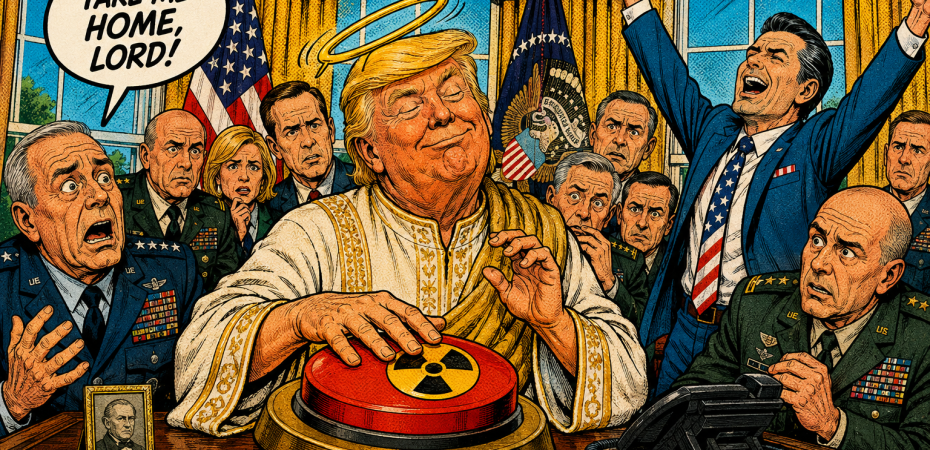
What sort of president has to be asked whether he intends to drop a nuclear weapon on a country that does not possess one? Donald Trump was asked that question in the Oval Office on August 31. His answer was supposed to reassure us. Instead, it displayed the vanity and contempt for human life that now make him unfit to remain president.
“Well, I would never say that, but the answer is yes,” Trump replied when asked whether he had ruled out using a nuclear weapon against Iran. He then said there was “no reason for it” and called the reporter’s question stupid. According to Trump, Iran had already been defeated militarily, so why would he use a nuclear weapon “on top of them”? The exchange was recorded in a contemporary transcript and reported by The Washington Post.
His denial is worthless. It is worthless because Trump began it by saying that he would “never say” what he proceeded to say. It is worthless because he changes positions as his mood changes. Most of all, it is worthless because the question did not materialize out of the humid Washington air. It followed public allegations that nuclear use against Iran had been discussed inside his administration, along with an official Pentagon effort to develop nuclear options that a president might regard as usable.
Former Representative Marjorie Taylor Greene made the most direct charge. On August 16, she wrote that officials were discussing the use of nuclear weapons against Iran in strategy meetings. “It’s real. I’m not speculating, I know,” she claimed. A White House spokesman answered that Greene had no idea what she was talking about. Greene did not name her sources or produce minutes from the meetings, so her claim is not proven. That distinction matters, even when the man at the center of the story has spent years treating truth as a disposable inconvenience.
Yet Greene was once among Trump’s most devoted defenders. Her accusation appeared amid an actual debate in Washington about lowering the practical threshold for nuclear use. At the Strategic Command Deterrence Symposium in August, Under Secretary of War for Policy Elbridge Colby said the government needed “credible, rational nuclear options” that a president exercising common sense would actually implement. Those are Colby’s words, preserved in the published transcript of his remarks.
Such language may sound sober inside a conference hall. That is how the managerial state launders madness. It replaces the incinerated family with an “option,” calls the option “rational,” then passes a briefing folder up the chain of command. By the time the folder reaches the Oval Office, mass killing has become another choice on a menu.
A tactical nuclear weapon is still a nuclear weapon. The adjective does not clean the radiation out of it. It does not guarantee that fallout will respect national borders, nor does it prevent another nuclear power from misreading the attack as the opening move in a larger war. “Tactical” is the word officials use when they want civilians to imagine a slightly larger artillery shell rather than a breach of the nuclear barrier that has held since 1945.
Trump’s admirers will say that every president receives nuclear options. They will add that the United States has never adopted an unconditional no-first-use policy. Both statements are true, and neither disposes of the issue. The danger lies in preparing first-use options for a frustrated president during an unsuccessful conventional war against a non-nuclear state, then presenting those options as credible instruments rather than weapons whose central purpose is deterrence.
Ronald Reagan was no pacifist. He armed the United States heavily and confronted the Soviet Union when it possessed enough warheads to destroy the country many times over. Even so, Reagan and Mikhail Gorbachev declared in their 1985 Geneva statement that “a nuclear war cannot be won and must never be fought.” They understood something Trump appears temperamentally incapable of understanding: possessing immense power places a greater obligation on a ruler to control himself.
The presidency is not supposed to be an instrument for one old man’s wounded pride. Trump promised to end foolish wars. He presented himself as the enemy of the foreign-policy establishment and asked Americans to believe that “America First” meant attending to our own country. I believed enough of that promise to vote for him. What we received was another imperial presidency, except this one is conducted by a man who treats yesterday’s assurance as an obstacle to today’s impulse.
His disclaimer therefore has no value beyond the hour in which he uttered it. Trump has spent his public life making declarations that expire whenever they cease to flatter him. An assurance concerning nuclear weapons requires steadiness across administrations personal humiliations. It cannot depend on whether the president woke up pleased with the television coverage.
Notice also the cheapness of his answer. He did not reject nuclear first use because slaughtering civilians would be monstrous. He did not say that breaking the nuclear taboo could expose Americans to retaliation or drive every vulnerable country to seek its own bomb. He said there was “no reason” to do it because Iran was already defeated. In Trump’s telling, restraint was just unnecessary force against a beaten opponent. That leaves open what he might do if he decided tomorrow that the opponent was not beaten after all.
This is the moral emptiness beneath the bluster. A president fit for office would understand that the nuclear threshold cannot rise and fall with his assessment of the latest battlefield report. He would also understand that losing control of a conventional war does not create a license to vaporize a city or poison the ground around a hardened military site. Trump seems to regard every limit as an insult directed at him personally.
His record makes the present alarm harder to dismiss. In 2016, Joe Scarborough reported that Trump had repeatedly asked a foreign-policy adviser why the United States could not use its nuclear weapons. Trump’s campaign denied the account. During that campaign, however, Trump also resisted taking nuclear use off the table and wandered through contradictory statements about first use. None of this proves that he ordered or approved a plan to strike Iran with a nuclear weapon in 2026. It does establish a long pattern of fascination with the alleged usefulness of weapons that more responsible presidents treated primarily as a deterrent.
The constitutional issue is just as serious. No president should be able to take the country from an undeclared war into nuclear first use according to his private judgment. Congress has spent decades surrendering its war powers, while legislators discover their constitutional courage only after the bombs are falling. The result is a system in which one man can initiate catastrophe and lawyers will argue afterward about which authorization supposedly covered it.
Removal from office is not a punishment reserved for completed disasters. The purpose of the Twenty-Fifth Amendment and impeachment is to protect the country when a president cannot be trusted with the powers he holds. We do not wait for a motel boiler to explode after smelling gas in the utility room. We shut it down and keep people away until the danger is gone. Nuclear command requires at least the same practical sense.
The allegation about Trump’s internal discussions remains an allegation. It should be investigated immediately, under oath, with the relevant military advice and presidential directives placed before Congress. Officials who attended the strategy meetings should be compelled to say whether nuclear first use against Iran was proposed, who proposed it, and how Trump responded. If he requested such an option or seriously pressed for its use, the case for his removal is complete.
Even without that final proof, Trump’s behavior has already disqualified him in the broader sense. He has permitted a government debate in which nuclear weapons are advertised as usable instruments, while his own history makes every ambiguity more dangerous. When finally challenged, he offered a petulant answer whose logic could reverse with the next setback.
No free people should have to trust their continued existence to Donald Trump’s mood. His supporters once said his unpredictability would frighten foreign governments into obedience. Now it frightens Americans who can see where imperial vanity leads when conventional force fails. A nation that leaves such power in his hands is no longer governing itself. It is waiting for the temper of one contemptible man to determine whether the nuclear age enters its final chapter.
Discover more from The Libertarian Alliance
Subscribe to get the latest posts sent to your email.



Great article. Unfortunately, the campaign promises did largely contradict the temperament of the man.