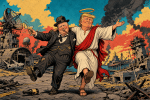
What would an American victory over China look like? I don’t mean the kind drawn with arrows on a Pentagon briefing slide. I mean a victory that leaves American families safer, American liberties intact, our productive economy stronger, and our sons home rather than dead in the Taiwan Strait. Nobody in Washington seems able to describe such an outcome. They can describe deployments. They can describe targets. They can describe the next appropriation for Lockheed Martin. Victory remains a little hazy.
That should tell us something. The United States is drifting toward a war that its ruling class cannot define and may not be able to win. No war at all would be the ideal outcome. After that, unpleasant as it is to say, a decisive defeat for the Washington establishment might be preferable to an inconclusive struggle that destroys the Pacific economy and ends in a nuclear exchange.
I still see the occasional motel guest wearing the flag on his shirt, his cap, and sometimes his jacket as well. I don’t hold it against him. He is probably displaying affection for the country where he grew up, not for the Bureau of Alcohol, Tobacco, Firearms and Explosives or the National Security Council. Yet that distinction, once confined to cranks and old libertarians, is becoming easier for ordinary Americans to understand. America is one thing. The government headquartered in Washington is another.
The official story says that the United States must deter Chinese aggression, defend Taiwan, preserve freedom of navigation, and uphold the “rules-based international order.” The first three claims at least describe recognizable concerns. The last is a phrase used whenever the actual rule cannot be found in any treaty and the people invoking it would rather not say who wrote it. China is a powerful authoritarian state. Its government suppresses dissent and claims sovereignty over Taiwan. None of that obliges Americans to accept a war fought several thousand miles from California in waters beside the Chinese mainland.
Nor does it answer the military question. American sea power grew from American industrial power. The fleets that defeated Japan were backed by steel mills, shipyards, oil fields, machine shops, and a workforce capable of replacing losses at a rate no opponent could match. Modern Washington kept the fleets, or at least the expensive appearance of them, while allowing much of the productive system beneath them to decay.
The numbers are no longer easy to dismiss. The United Nations Industrial Development Organization calculated that China produced 31.8 percent of global manufacturing value added in 2023. The American share was 15 percent. China’s manufacturing economy was therefore a little more than twice the American total by that measure, not three times larger as some commentators have claimed. The more cautious number is bad enough. China also dominates commercial shipbuilding, while American yards struggle to deliver the Navy’s existing orders on time. A Congressional Research Service report cited an unclassified Navy comparison suggesting that China possessed about 230 times America’s gross-tonnage shipbuilding capacity. CRS properly warned that commercial tonnage cannot be converted directly into complex warships. Even after that qualification, the disparity is a strategic fact, not a debating point.
Washington’s position is rather like that of a man who sold his gun collection, borrowed against his house, and then challenged the fellow who bought the guns to a duel. The man may own an excellent suit. His lawyer may have a large office. Neither will pull a trigger.
China has also spent decades developing missiles intended to keep American ships and aircraft away from its coast. The Pentagon’s own reporting says China possesses the world’s leading hypersonic-missile arsenal and can produce a broad range of advanced ballistic and cruise missiles. It has built its forces around the problem Washington is daring itself to present: American carriers, regional airfields, surveillance systems, and the long supply lines required to support them. The United States would be projecting military power across the Pacific. China would be fighting beside its own industrial base.
This does not prove that every carrier would sink within minutes or that the war would be over by breakfast. Those claims exceed the public evidence. War games are constructed models, not prophecies. Their results depend on assumptions about warning time, Japanese participation, missile reliability, submarine effectiveness, and whether China begins by striking American bases. A 2023 Center for Strategic and International Studies project ran 24 invasion scenarios and found that Taiwan remained autonomous in most of them. That finding hardly amounted to an easy American victory. The simulations commonly imposed devastating losses on the United States, Taiwan, and Japan. Earlier CSIS discussion of the project described dozens of ships lost, hundreds of aircraft destroyed, and tens of thousands of military casualties.
The same research also makes clear why sweeping predictions should be treated carefully. Invasion is only one possible conflict. CSIS ran another 26 games for a 2025 study of a Chinese blockade. The outcomes varied according to the preparations and decisions built into the scenarios. What remains constant is the risk. Once American and Chinese forces begin destroying one another, no analyst can promise that the conflict will remain conventional. Both countries possess nuclear weapons. Both would face pressure to escalate before their vulnerable forces were lost. The clever men who assured us that Iraq would be quick and inexpensive would presumably assure us that escalation could be managed. They have clean fingernails because other people scrub the blood from the floor.
There is another reason Washington is becoming dangerous. Its economic weapons no longer command the obedience they once did. Sanctions worked best when the United States controlled access to the central machinery of world trade and could isolate a target without creating a serious alternative system. China changes that calculation. It can buy Russian commodities and Iranian energy. It can supply machinery, vehicles, electronics, and consumer goods. Trade can increasingly be settled outside the dollar system. None of this requires a grand anti-American alliance. It requires only countries willing to conduct commerce after Washington has told them not to.
That is what enrages the foreign-policy establishment. China has not only accumulated weapons. It has made disobedience more practical. Washington closes one door and Beijing opens another. The arrangement may favor China, and smaller countries may discover that Chinese power has its own price. Still, a government under American sanctions no longer faces the same choice between submission and ruin. The empire’s financial blockade has begun to leak.
An establishment accustomed to obedience may respond to declining power with restraint. My own reading of history suggests the opposite possibility. Status becomes more precious as its material basis disappears. Every act of independence looks like a challenge. Every regional dispute becomes a test of credibility. Officials who cannot repair a bridge in Ohio begin talking about red lines in the South China Sea.
Donald Trump was supposed to break with this racket. I understand why people believed him. I voted for him hoping that “America First” meant fewer wars and less tribute to foreign interests – some attention to the country beneath the imperial superstructure. Yet tariffs and demands for greater military deference do not end the empire. They make its declining power more candid. An America First policy would ask whether Americans benefit from risking San Diego for Taipei. The imperial policy begins with the assumption that Washington must remain supreme and then sends Americans the bill.
Alan Bickley’s analysis of Britain applies with very little alteration here: the relevant political question is not simply who holds office, but whose interests the state regards as its own. A government may keep the national name, fly the national flag, and tax the national population while operating as an occupying apparatus. Its managers draw resources from the territory and use them to sustain a wider system of power. Elections may replace the personnel without changing the purpose.
That is increasingly how Washington appears from the interstate exits. It extracts taxes, borrows against the earnings of children not yet born, monitors financial transactions, and tells small businesses which permissions they need to remain open. Abroad, it uses the same population as collateral for debts and military commitments the population never seriously approved. The American people become the tax base and recruiting ground for a system that does not regard their independence as its object.
Calling this an occupation is an analogy, not a claim that foreign troops have seized the Capitol. The occupiers are largely domestic. They speak American English and give one another medals with eagles on them. What makes the analogy useful is the separation of interest. The Washington system uses America as an imperial platform much as an occupying authority uses a captured province: for revenue, manpower, strategic depth, and legitimacy. It demands patriotic loyalty from people whose communities it has stripped for parts.
This is why the defeat of the American ruling class would not necessarily be the defeat of the American people. A lost war would bring dead Americans, shattered families, economic disruption, and perhaps repression at home. Nobody with any affection for this country should welcome those things. Defeat is “almost as good” as peace only in the narrow sense that a clear imperial reverse might end a doomed project before it consumes another generation. There is nothing good about the road to that lesson.
We should also remember what happened after earlier defeats. Washington left Saigon and the American republic survived. It abandoned Kabul after twenty years of lies, and ordinary Americans did not lose their homes because the Taliban returned to power. The ruling class suffered embarrassment. Contractors lost a stream of guaranteed revenue. Pundits had to change the subject. The United States remained.
A defeat in war with China would be far more dangerous, which is why it must be prevented. The practical policy is armed neutrality in the quarrels of East Asia and trade without political submission. Add to this the rebuilding of productive capacity for American needs. Taiwan’s future should be settled without an American war. China should face firm defense at the actual borders of the United States, not an open-ended American claim to military primacy off the coast of Fujian.
If Washington starts this war and loses it, Americans should refuse the claim that we have all been defeated together. The empire’s prestige is not our liberty. Its access to foreign bases is not our property. Its ability to dictate commercial relations between other countries is not our prosperity.
The best result is still peace. It leaves Chinese people alive, Taiwanese homes standing, and American sailors with a future beyond the steel compartments of a sinking ship. But peace will require Americans to understand who is leading them toward war and whose interests that war would serve. Once that distinction is made, the threat of imperial defeat loses some of its power over us. Washington may discover that the country it has occupied in spirit no longer consents to be sacrificed for the view from its capital.
Sources
- United Nations Industrial Development Organization, International Yearbook of Industrial Statistics 2024: China accounted for 31.8 percent of global manufacturing value added in 2023, compared with 15 percent for the United States. UNIDO report
- Congressional Research Service, China Naval Modernization: Implications for U.S. Navy Capabilities: discussion of China’s shipbuilding capacity, the limitations of the 230-to-one gross-tonnage comparison, and the strategic implications of the disparity. CRS report
- U.S. Department of Defense, Military and Security Developments Involving the People’s Republic of China 2025: assessment of China’s missile arsenal and naval-industrial capacity. Defense Department report
- Center for Strategic and International Studies, The First Battle of the Next War: description of the 24 Taiwan-invasion game iterations and their heavy losses. CSIS report launch
- Center for Strategic and International Studies, Are Washington and Beijing on a Collision Course over Taiwan?: warning that individual war-game results are not reliable predictions and summary of the severe losses in the invasion scenarios. CSIS analysis
- Center for Strategic and International Studies, Lights Out? Wargaming a Chinese Blockade of Taiwan: description of the 26 blockade simulations published in 2025. CSIS blockade study

Discover more from The Libertarian Alliance
Subscribe to get the latest posts sent to your email.