What happens when an empire built by men of ability falls into the hands of placemen?
Britain supplied the classic answer at Singapore in February 1942. Before the Second World War, Singapore was the great British naval and commercial base at the bottom of the Malay Peninsula. It guarded the sea route between the Indian Ocean and the Pacific. British officials called it the “Gibraltar of the East” and encouraged the world to regard it as an impregnable fortress. Its guns, docks, fuel tanks, warehouses, and reputation were supposed to secure British power across Asia.
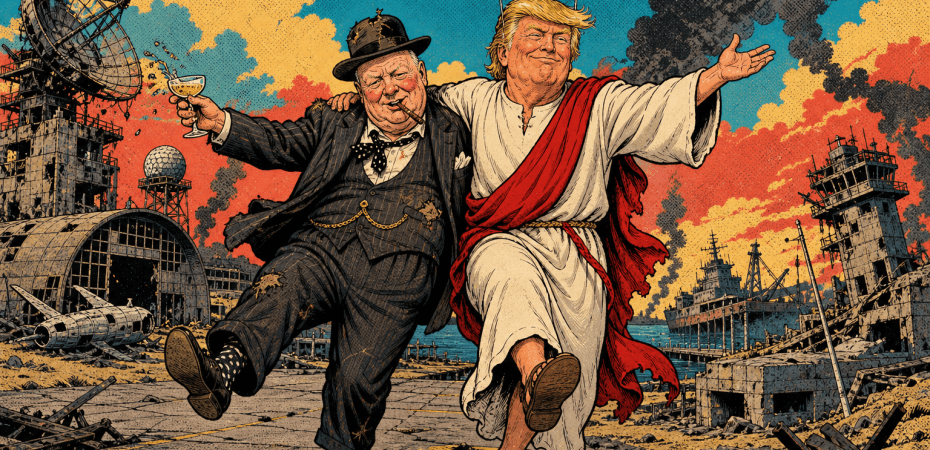
Then the Japanese attacked from the direction the British had failed to prepare for. They did not begin by sailing obediently into the largest British coastal guns. They landed farther north in Malaya and drove down the peninsula. Japanese aircraft controlled the sky. Japanese troops moved rapidly through jungle and plantation country that British commanders had treated as nearly impassable. The battleships Prince of Wales and Repulse, sent to demonstrate British naval power without adequate air cover, were sunk by Japanese aircraft in December 1941. By the time the attackers crossed onto Singapore Island, the fortress had been isolated from the military system that was supposed to sustain it. The final surrender came on February 15, 1942. British and Commonwealth forces were short of ammunition, food, and secure water. Lieutenant General Arthur Percival surrendered more than 64,000 troops in Singapore, in addition to the forces already lost during the Malayan campaign. Winston Churchill, the drunken fool in charge at the time, called it the worst disaster and greatest capitulation in British history.
The importance of Singapore was larger than the territory lost. Britain survived and continued fighting the war, but the legend of effortless British supremacy in Asia died in a week. Colonial subjects saw that the imperial master could be defeated. Allies recalculated what British promises were worth. Japan discovered that the reputation of the British Empire was considerably stronger than the forces available to defend it.
That is the comparison with America now. Singapore was not simply a lost battle. It was the moment when a long structural decline became visible to everybody at once.
The British Empire had not been built by fools. There was little moral goodness in much of the project, but there had been strategic intelligence. Earlier generations understood shipping lanes, industrial production, finance, and the political management of distant possessions. They built an imperial system in which naval power rested upon bases, repair yards, merchant shipping, local alliances, and an administrative service able to turn orders issued in London into action thousands of miles away.
By 1942, too many British officials had inherited the map without inheriting the intelligence that created it. They treated Singapore’s reputation as a substitute for preparation. They assumed the Japanese were technically inferior and incapable of rapid operations through Malaya. Commanders prepared to meet the attack anticipated in staff exercises while the enemy fought a different campaign. When evidence contradicted the assumptions, the assumptions were defended.
This is what happens when the builders of an empire are replaced first by caretakers and then by bumbling placemen. The placeman knows the correct language. He understands whom to flatter and which inconvenient report should be buried. What he cannot do is reconsider the system from first principles. He mistakes the continued existence of headquarters, titles, and impressive weapons for proof that the machinery behind them still works.
America has reached its Singapore stage. The United States still possesses enormous destructive power. Britain possessed enormous power in 1942. The question is whether that power can be delivered where it is needed, supplied under attack, repaired after losses, and sustained longer than the enemy can endure.
The insane war with Iran has forced that test. It did not create every American weakness. It exposed them and made them interact. The Navy’s shortage of sealift was one problem. Its maintenance backlog was another. Limited missile inventories and dependence on foreign mineral processing existed before the first strike. Political isolation had been growing while Washington bullied allies and called the result leadership.
The Iran war brought those weaknesses together in one system. A damaged forward base lengthens the supply line. The longer supply line occupies more oilers and cargo vessels. Ships kept at sea require additional maintenance precisely when access to repair facilities has become uncertain. Missiles fired in the Middle East cannot remain available in the Pacific. A carrier sent to cover one theater leaves less power in another. Political leaders then conceal the shortages because admitting them would expose the foolishness of the war.
That interaction is the heart of the collapse. A building can stand for years with bad wiring and a leaking pipe. It may even look respectable from the parking lot. Then one short circuit starts a fire, the damaged pipe deprives the firefighters of water, and the whole structure goes down. The defects were already present. The fire made them act together.
The Iran war was the fire. The undue influence of the Israel Lobby was the chief political force that brought the fire about.
That term should be used precisely. It does not mean American Jews, many of whom oppose the war and the Israeli government’s conduct. It means the organized collection of lobbying groups, major donors, political action committees, officials, defense interests, and media advocates that has made unconditional support for Israel a test of political acceptability in Washington. AIPAC is its best-known organization, but the network extends well beyond AIPAC.
The documentary evidence of institutional preference is open. The United States agreed to provide Israel with $38 billion in military assistance between fiscal years 2019 and 2028. Congress added billions more after October 7, 2023. Members of both parties describe the commitment as “ironclad,” as though an American foreign policy judgment were a permanent oath to another government.
Money alone does not prove that the lobby caused a particular war. The broader conduct supplies the causal argument. Politicians who question aid face organized donor pressure and well-financed primary campaigns. Israeli descriptions of regional threats pass rapidly into American official language. Israeli strategic objectives become American commitments, even where the material costs fall overwhelmingly on Americans. Israel receives weapons and diplomatic protection. When those instruments fail to impose the desired regional settlement, American ships and service members are placed in the line of retaliation.
No lobby could exercise that influence without American collaborators. Presidents sign the orders. Congress supplies the money. Defense contractors take the contracts, while think tanks manufacture respectable phrases for policies already decided elsewhere. The Israel Lobby did not storm Washington from outside. Washington’s ruling class embraced it because the arrangement rewards politicians and connected businesses while transferring the risk to people who do not attend donor dinners.
The war with Iran was therefore not an accidental crisis that happened to encounter an aging Navy. It was a chosen war, urged in pursuit of Israel’s regional objectives and fought by an American establishment whose members had insulated themselves from the consequences. Its planners assumed that Iran would absorb the punishment, lose the capacity to respond, and accept whatever political settlement Washington announced. Britain’s commanders at Singapore made their own version of the same mistake. They prepared for an enemy who would behave according to British expectations.
Iran did not need to defeat the United States ship for ship. Japan did not defeat the whole British Empire ship for ship in 1942. It had only to attack the vulnerable junctions in the system and demonstrate that British guarantees could fail.
The destruction or disabling of a central naval base is therefore the closest American equivalent of Singapore. Bahrain is not merely a collection of buildings beside the Persian Gulf. It supplies communications, repair facilities, storage, and command infrastructure for the Fifth Fleet. Remove it from reliable use and American ships must depend upon support delivered across far greater distances, including the roughly 2,200 nautical miles from Diego Garcia to the Gulf of Oman.
That distance converts a local military setback into a theater-wide logistical crisis. Supply vessels spend more time in transit. Carrier operations consume fuel and munitions that arrive less frequently. Machinery wears down while access to heavy repair facilities becomes more difficult. Commanders begin choosing which shortage can be endured because they no longer have the capacity to solve all of them.
Singapore had also been more than a fortress. It was a naval base whose docks, fuel stores, and position allowed Britain to turn distant imperial claims into usable power. Once it fell, the Royal Navy had to withdraw its effective center of operations thousands of miles westward. The map of British possessions remained impressive. The infrastructure that made the map defensible had disappeared.
That is why Singapore belongs in this article. It is not an ornamental historical reference. It describes the mechanism by which imperial decline becomes imperial collapse. A great power loses a logistical hinge. The enemy discovers that the supposedly impregnable system is brittle. Allies begin to doubt its guarantees. Commitments that looked separate suddenly compete for the same limited resources. Prestige, which once deterred challenges, begins attracting them.
Above all, Singapore shows how quickly perception can change. On February 14, 1942, Britain was still regarded as the ruling imperial power in much of Asia. On February 15, that claim had become incredible. The surrender did not create every British weakness overnight. It revealed that the empire’s rulers had been living on accumulated reputation.
Washington is doing the same. Its officials count aircraft carriers without counting the oilers required to support them. They announce missile strikes without measuring replacement time. They extend guarantees without asking whether the same forces have already been promised elsewhere. They confuse the ability to destroy a target today with the capacity to control the consequences tomorrow.
The present American collapse was not inevitable. Structural weakness could have led to retrenchment and repair. A serious government would have reduced unnecessary commitments, rebuilt productive capacity, and designed its military around defending the United States. Instead, the Israel Lobby and its American clients pushed the country into a war against Iran. That war activated every weakness at once.
This is how an imperial Singapore happens. The long decay supplies the conditions. The placemen supply the complacency. A war chosen for somebody else’s interests supplies the final test. Then the world sees what was hiding behind the flag.
Sources consulted: the Congressional Research Service report U.S. Foreign Aid to Israel: Overview and Developments Since October 7, 2023; the U.S. Army official history Strategy and Command: The First Two Years; the Commission on the National Defense Strategy; the Government Accountability Office’s 2026 review of military readiness; the Center for Strategic and International Studies report Empty Bins in a Wartime Environment; and the U.S. Geological Survey’s Mineral Commodity Summaries 2026.

Discover more from The Libertarian Alliance
Subscribe to get the latest posts sent to your email.