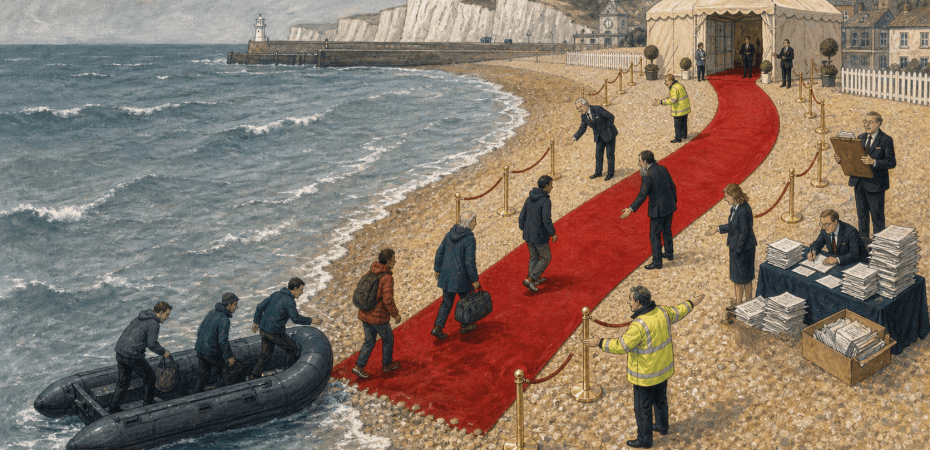
There is a story circulating on the Internet about the small boats that has almost everything required for political success. It is infuriating and adorned with just enough legal terminology to sound as if someone has looked it up. According to this story, migrants who land on a Kent beach under their own power become illegal immigrants and must immediately be detained and deported. The British Government therefore sends Border Force or the Royal National Lifeboat Institution to collect them just offshore. Once lifted into a British vessel, the passengers are supposedly transformed into “disembarked persons.” They can then be carried into Dover, where they claim asylum and settle down at the taxpayer’s expense. The RNLI is consequently not a lifeboat service but a taxi company, and the answer is to stop giving it money. It is a satisfying story, which may explain why no one spreading it seems to have asked whether “disembarked person” is an immigration status recognised by British law.
It is not. Being taken aboard an RNLI lifeboat does not confer leave to enter, refugee status or a permanent right to remain. International maritime law does not say that the flag on a rescuing vessel determines where a rescued person must be given asylum. UNHCR has long stated that boarding such a vessel does not by itself amount to entering the territory of its flag state, still less create an obligation to grant permanent asylum.
Nor does a man who steps out of a dinghy at Dungeness thereby activate a machine that must detain and deport him at once. Governments possess extensive powers of immigration examination and detention. They also have powers of removal. This does not mean that every clandestine arrival is automatically detained until an aircraft carries him away. Asylum claims intervene, as do the availability of documents and the willingness of another country to receive the person. Legal limits on detention also matter. Above all, the Government must possess the administrative competence and political determination to use the powers Parliament has given it.
The distinction that appears to have inspired the story is real, but it is more prosaic. Current Home Office guidance on irregular arrival says that people intercepted or rescued at sea and brought ashore under official supervision do not technically “enter” in the same way as someone who evades immigration control. They “arrive” and are treated as arriving passengers, subject to examination under the Immigration Act 1971.
This does not wash away the unlawful journey. An arriving passenger can be refused leave or detained in appropriate circumstances. He may fall within a returns agreement. He can make an asylum claim after reaching land, but making a claim is not the same as having it accepted. The Nationality and Borders Act 2022 expressly prevented asylum claims from being made at sea, so the act of boarding a lifeboat cannot itself create one.
The official language still deserves attention. A person who has paid a smuggler, boarded an unsuitable craft and attempted to enter Britain without permission is brought ashore and processed as an “arriving passenger.” This is one of those phrases that reveals the administrative mind at work. A man with no passport or visa is placed in the same conceptual drawer as someone coming down the gangway of a ferry. The difference remains visible in the file, no doubt, but it has first been wrapped in language that makes a deliberate breach of the border sound like a delayed arrival at Heathrow.
Yet the terminology is not what keeps people here. They remain because removal can be difficult and because successive governments have been unable or unwilling to make it otherwise. Identity may be disputed. Countries of origin may refuse to cooperate. Claims and appeals take time, while the State lacks enough secure accommodation to detain everyone throughout the process. Ministers announce powers with great ceremony, but the institutions below them convert these promises into correspondence and delay.
That is the real scandal, and it needs no maritime fairy tale. Britain has constructed a system able to receive irregular arrivals with impressive efficiency. It can issue paperwork and transfer them into an asylum process. What it cannot reliably do is reach a prompt decision and remove those whose claims fail. The apparatus becomes energetic at the point of admission and strangely contemplative at the point of departure.
The same correction must be applied to the French position. France is not breaking some simple rule of international maritime law whenever a dinghy leaves its coast. Maritime law imposes duties to assist people in distress. It does not give French patrol boats an unlimited right to board or tow any moving vessel merely because its occupants are probably attempting illegal immigration. An intervention that causes a capsize may kill the people it is supposed to save. The question is not whether French officers can see the boat, but whether it can be stopped safely and within their operational powers.
This does not absolve the French Government. It has often behaved as if a departure becomes a British problem at the moment the boat leaves the sand. British money has financed French officers and equipment for years, while crossings have continued. France does not wish to retain people determined to reach Britain. Britain pays France to prevent departures, and every failed interception transfers another social liability across the Channel.
The claim that France refuses to bring passengers back because rescue would give them a new entitlement to asylum is nevertheless false. A person already in France can ask France for asylum without first enjoying a ceremonial trip in a patrol boat. Rescue creates duties concerning safety and non-refoulement; it does not award refugee status. France has also been intercepting large numbers before they reach open water. A French Senate report stated that its forces prevented 28,357 people from crossing in 2024 and intercepted 68 per cent of attempted boat departures.
Maritime interception has also become more common. In June 2026, the Home Office reported that revised French tactics had stopped six so-called taxi boats at sea and returned everyone aboard to France. Several suspected smugglers were prosecuted. The Government has therefore conceded through its own announcements that returning boats to France can be legally and operationally possible. What was previously described as too dangerous or troublesome became feasible once new vessels and a change of doctrine appeared.
This does not prove that every boat can be stopped without unacceptable risk. It does suggest that official descriptions of what is impossible are often statements about present policy rather than permanent facts of law. A government can spend years explaining that its hands are tied, then discover a new freedom of movement after a sufficiently embarrassing meeting with another government.
The assertion that the small boats are not at risk should also be abandoned. An overloaded inflatable, often without a competent crew, is dangerous even in calm weather. Crossing one of the busiest shipping routes in the world magnifies the risk. Engines fail and tubes collapse. Passengers can fall overboard or suffer exposure, while overcrowding itself may make a boat unstable. In 2024, according to evidence reported by the French Senate, 78 people died on the maritime route. To claim that these craft are never in danger is not scepticism about government propaganda. It is a refusal to look at the water.
It does not follow that every encounter is a rescue of people seconds from drowning. Many operations are controlled interceptions. Border Force locates a boat, takes its passengers aboard and carries them to Dover because the Government has decided that this is safer than allowing the journey to continue in the original craft. The language of rescue can therefore blur an important distinction. Saving someone from immediate peril is not identical to completing a journey that the passenger intended to make, though one operation may turn into the other as conditions change.
The public is entitled to notice this ambiguity. An independent review of Border Force, commissioned by the Home Office, acknowledged that Border Force was effectively rescuing people and escorting them into port, thereby enabling their arrival. It also observed that Border Force cutters were designed for interception rather than mass rescue. HM Coastguard coordinates rescue operations but owns no rescue vessels of its own in the Channel, so it must task Border Force or the RNLI when a vessel is needed.
The RNLI does not decide what happens after disembarkation. Its crews do not determine admissibility or asylum claims. They cannot negotiate a returns agreement with France, and they have no control over where Border Force patrols. When tasked by the Coastguard, they go to sea and recover people from unsuitable boats. Once those people are ashore, responsibility passes to the State.
In 2025, according to the RNLI’s published Channel figures, only 1.2 per cent of its launches were to small boats. The charity says that other agencies, principally Border Force, assisted 94.3 per cent of the people recorded as making the crossing. These are the RNLI’s own figures and may properly be scrutinised. They do not support the claim that the charity’s principal purpose has become running a ferry service from mid-Channel.
Defunding it would therefore punish the only conspicuous participant that neither designed nor controls the policy. The crews who answer a Coastguard request cannot know that an inflatable remaining upright at the moment of sighting will remain so until it reaches land. They cannot hold an immigration hearing on the deck. Nor can a coxswain safely improvise his own border policy while surrounded by frightened passengers in a crowded boat.
Independent lifeboats provide no answer to the underlying problem. They operate under the same law of the sea and face the same duty to preserve life. If asked to assist people in danger, they must decide the matter according to maritime conditions rather than the immigration status of those aboard. Replacing the RNLI with smaller independent services would therefore leave the border policy unchanged while reducing Britain’s ability to rescue fishermen and everyone else who gets into trouble around the coast.
The proper objection to the present arrangement is not that rescue changes a migrant’s legal essence. It is that rescue and immigration control have been muddled together because the Government has no convincing answer to what happens next. Once a passenger reaches British custody, reception is organised. Removal is another matter.
As of 30 June 2026, official figures for the Anglo-French arrangement showed that Britain had returned 1,087 small-boat arrivals to France. Under the reciprocal side of the scheme, it had admitted 1,117 approved applicants from France. Against the 187,779 recorded small-boat arrivals between 2018 and the end of 2025, this was less a closing of the route than an unusually expensive exchange programme.
The Government had at last proved that returns to France were diplomatically possible. It had also arranged to replace almost every person returned with another arrival. We are told that the object is deterrence, yet the scheme preserves a matching inflow. The border is supposedly being secured, while the principal activity after interception remains reception and processing.
The gamble remains attractive because reaching British waters commonly leads to access to the asylum system. Since 2018, Home Office statistics show that 95 per cent of recorded small-boat arrivals have claimed asylum. Of those who had received a substantive initial decision by the end of 2025, about 60 per cent were granted refugee status or some other form of protection.
Some of these people have genuine claims and others do not. A serious state would distinguish between them quickly. It would detain where this was lawful and necessary, then remove failed claimants without allowing every case to sink into years of administrative mud. If Parliament wished to admit refugees through controlled routes, it would determine the number openly. It would not allow smugglers to decide who reaches the head of the queue by selling places in a dinghy.
Such a state would also stop hiding political decisions behind the lifeboat. The Government can be attacked for financing a reception system without maintaining an effective removal system. France can be attacked for accepting British money while allowing departures it sometimes has the means to prevent. Ministers can be attacked for confusing the announcement of legal powers with their consistent use. None of this requires pretending that a volunteer lifeboat crew confers asylum by pulling someone from the sea.
The RNLI does not open the border. It merely prevents some of the bodies from washing through it. The people responsible for the border are safely ashore, surrounded by civil servants and legal advice, explaining once again that the latest agreement has solved the problem. If the public wishes to withdraw its support from someone, it should begin with the politicians who created the arrangement rather than the boatmen sent out to keep it from becoming a floating mortuary.

Discover more from The Libertarian Alliance
Subscribe to get the latest posts sent to your email.



The boats would stop if these illegals were held in a camp, similar to the ones they left on Northern France, no hotels, no houses, no phones, no freedom to wander, rape and commit crime, no cash, no benefits.
The boats would stop if Royal Navy or Border Guard vessels machine-gunned them until nobody was left alive, which is what would happen if those in command were not traitors to their nation.