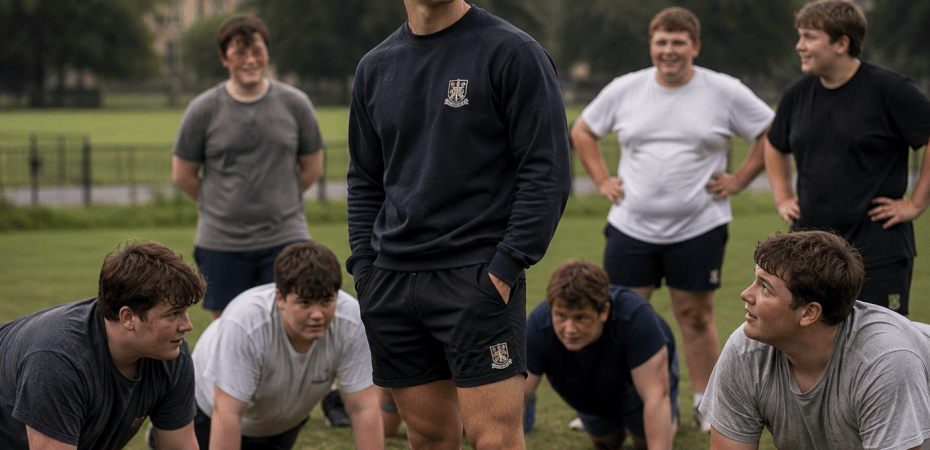
For reasons I do not choose to discuss again, half a dozen boys from my year have spent the past eight months following my advice on diet, exercise and general self-improvement. They do so with a degree of obedience I had not thought possible in persons of only moderate intelligence. Before they accepted the offer I made without expecting anyone to take it, they were indistinguishable from the rest of the year: permanently tired, mildly to grossly overweight, fed entirely on industrial carbohydrates, convinced that every difficulty in life could be solved without sustained effort. Looking at me each day, and then at themselves in the changing-room mirror, they concluded that one of us must understand something the others did not. Having reached that sensible conclusion, they placed themselves, so far as their nature allows, under my supervision.
The transformation has been remarkable. None has become another version of me. Nature does not distribute her gifts equally, and I remain comfortably without peer. Yet each has become unmistakably healthier than he was. Their shoulders have broadened. Their waists have narrowed. Their skin has cleared. They walk differently and stand differently. They carry themselves with a confidence that no amount of motivational speaking could produce. An interesting hierarchy has established itself within my year. At the summit stands a certain young man of matchless grace and brilliance. Beneath him comes his small band of disciples, boys who have accepted that reality is under no obligation to flatter their feelings. Beneath them lie the bloated dross who continue drifting from lesson to lesson carrying paper bags from Greggs, drinking fluorescent energy drinks before nine in the morning, and farting softly through double History while wondering why they are permanently exhausted and permanently dissatisfied with their own appearance. These are creatures who will lose their teeth before they lose their virginity. Great or small, every society has its elite. The elite in my school is plainly made up of those who look to me for guidance. Needless to say, their political education has accompanied the physical, and I may soon start dressing them in black uniforms.
None of these improvements required unusual genetics, or either expensive supplements or any revolutionary method hidden behind a subscription. They came from abandoning a handful of common falsehoods and replacing them with truths that everyone of sense, from the Greeks onward, has known. We have become so accustomed to sickness that health now appears mysterious, and so accustomed to obesity that a lean physique is treated as the product of extraordinary luck or impossible self-denial. Neither proposition is true. What is true is that the modern world has forgotten what a healthy man looks like.
The first lesson is that almost everyone begins by asking the wrong question. People ask how many calories they should eat. I tell them to forget calories for the moment and ask something more fundamental: what exactly are you eating? Only after that question has been answered is it worth discussing quantities. This sounds obvious, which may explain why modern dietetics has managed to forget it. Never before has a nation devoted so much energy to discussing healthy eating while becoming steadily fatter. Every packet carries nutritional information. Every supermarket contains an aisle of “healthy choices.” Television doctors explain fibre, cholesterol and calorie deficits. The government prints glossy leaflets. Schools teach healthy eating. Yet every year the British grow flabbier. That ought to suggest that something has gone wrong.
What has gone wrong is that we have ceased to distinguish food from edible produce. Walk around any supermarket and much of what fills the shelves amounts to a recipe for slow suicide: brightly coloured breakfast cereals, protein bars, reduced-fat desserts, meal-replacement drinks, energy beverages and an astonishing variety of packaged substances that have passed through more processes than a graphics card. These products are sold as food. They are often fortified with vitamins, decorated with reassuring labels and accompanied by smiling advertisements. They are nevertheless industrial products, designed above all to be profitable by being convenient and difficult to stop eating.
The consequences are visible everywhere. The average Englishman begins his day with sugar disguised as breakfast, continues with starch disguised as lunch, finishes with processed carbohydrates disguised as dinner, and spends the evening wondering why he feels permanently hungry. He believes he suffers from a mysterious metabolic disorder. More often than not, he is living on food engineered to encourage him to eat more of it.
I do not reject calorie counting. The laws of thermodynamics remain what they have always been. If someone consistently consumes more energy than he expends, he will gain weight; if he consumes less, he will eventually lose it. No sensible person disputes this. The mistake is imagining that all calories behave identically inside the body, as though the human organism were a boiler into which fuel is shovelled indiscriminately. The body responds differently according to the source of those calories. Consider two young men consuming roughly the same amount of energy. One eats steak, eggs, yoghurt, potatoes, fruit and vegetables. The other lives largely on breakfast cereal, supermarket sandwiches, biscuits, soft drinks and whatever is available from Greggs after school. On paper the calorie totals may not differ. In reality they are conducting two different biological experiments. The first meal nourishes. The second fills and, if its recipient is lucky, does nothing else.
Protein is very satisfying. It supplies the amino acids from which muscle, hormones and enzymes are built. Natural fats slow digestion and provide stable energy. Whole foods require more effort to digest and encourage steadier blood sugar. They make it easy to stop eating once you have had enough. Highly processed carbohydrates do the opposite. They are digested and absorbed rapidly and leave behind a renewed and impressively efficient appetite. The body is fed in the mathematical sense while remaining unsatisfied. People therefore continue eating, not because they lack self-control, but because the food itself has done little to satisfy the biological systems that regulate hunger.
This is why I smile whenever someone tells me he is surviving on twelve hundred calories a day while living largely on low-fat yoghurt and meal deals. He imagines he is demonstrating heroic discipline. Usually he is demonstrating that he has been following bad advice with unusual determination. Several of the boys who asked for my help arrived in this condition. They had already proved they could starve themselves. What they had never attempted was feeding themselves properly. Their diets consisted of industrial food eaten in measured quantities. They were permanently hungry, permanently tired, permanently convinced that they were cursed with slow metabolisms. The first thing I changed was not the number of calories they consumed. It was the source of those calories. Protein came first. Eggs replaced cereal. Meat replaced processed sandwiches. Greek yoghurt replaced flavoured desserts. Potatoes, rice and fruit replaced confectionery and packaged snacks. Only after proper food had become habitual did we concern ourselves with finer adjustments to energy intake.
This frightened them at first. Years of failed dieting had taught them to fear food itself. Every additional potato seemed a step towards obesity. The opposite occurred. Training improved because their muscles contained more glycogen. Recovery became easier because they possessed enough protein to repair tissue. They moved more throughout the day because they no longer existed in a permanent state of semi-starvation. Sleep improved. Concentration improved. Their bodies abandoned the prolonged conservation mode into which months of unnecessary deprivation had driven them. The result was not miraculous. It was physiological. A body that is properly nourished behaves differently from one that believes famine has arrived.
Genetics, sleep quality, stress and total activity still matter, and extreme restriction can produce short-term results for some people. The decisive point remains that nutrition is not principally about eating less. It is about eating intelligently. A diet of steak, eggs, fish, vegetables and fruit may contain more calories than one based on breakfast cereal and Greggs, while producing a healthier and stronger body. The important distinction is not between abundance and restraint. It is between nourishment and imitation.
Britain solved the problem of producing enough calories over a century ago. In doing so it created a new problem that never existed before. Millions of people now consume more energy than any previous generation while remaining undernourished. They are simultaneously overfed and underfed. Their stomachs are full, but the body still searches for nutrients that industrial food is not designed to provide. They blame their metabolism, their genetics, their thyroid or bad luck. Few stop to consider that the body may be responding rationally to irrational treatment.
This is why I distrust official dietary advice. It begins with nutrients rather than food. We are instructed to reduce fat, increase fibre, monitor sodium, count calories and memorise tables of recommended daily allowances. There is some truth in these recommendations. But they miss the larger point. So long as hunger was avoided, human beings managed to remain healthy for thousands of years without calorie-counting applications or brightly coloured food pyramids. They did so because they ate things they recognised as food.
That is not an argument for romanticising the past. My ancestors also lacked antibiotics, the Internet, central heating and decent dentistry, none of which I propose to surrender. It is merely an observation that technological progress is not identical with biological wisdom. We have become clever at manufacturing edible substances while becoming incompetent at nourishing ourselves. The triumph of the food industry has been to persuade millions that convenience and nutrition are interchangeable. They are not. Convenience is a commercial virtue, nutrition a biological necessity.
I have therefore reduced all my dietary advice to a handful of rules so simple they sound childish:
- Eat food rather than products.
- Build every meal around protein: eggs or Greek yoghurt at breakfast; meat, fish or eggs at lunch and dinner.
- Do not fear natural fats.
- Treat sugar as an occasional pleasure rather than a staple.
- Regard industrially manufactured carbohydrates with permanent suspicion; potatoes, rice and fruit are not the enemy once the rest of the diet is in order.
- Walk every day.
- Lift heavy objects regularly.
- Sleep properly.
Repeat these habits until they become unremarkable. None of them is revolutionary. Their ordinariness explains why modern society has forgotten them. Daily walking and progressive resistance training amplify the dietary changes. Good habits reinforce one another. The boys who chose to follow my advice now eat more food than they did when we began. They are also leaner, stronger and more energetic. The boys who preferred to continue trusting supermarket advertising and official dietary orthodoxy remain where they were, except perhaps a little fatter and more bleary than before. I draw no sweeping scientific conclusions from this experiment. It is possible that I have been fortunate in my choice of disciples. Then again, it is possible that reality continues to operate according to principles that fashion has temporarily forgotten.
The body, unlike food manufacturers and social media influencers, has no interest in flattering our illusions. It neither rewards fashionable opinions nor punishes political incorrectness. It responds only to what we do to it. We may deceive ourselves for a time. We may even persuade our neighbours. The body, however, keeps its own accounts. Every meal, every walk, every hour of sleep and every training session is entered faithfully into the ledger. Years later, when we look in the mirror, we discover that the account has been balanced with honesty. The body never lies.

Discover more from The Libertarian Alliance
Subscribe to get the latest posts sent to your email.


Well done Bryan.
Laughed my head off over those first paragraphs.
But absolutely spot on, especially the exercise piece.
Living in darkest Jockshire, the only thing I’d add is periodic infusions of porridge made from milled oatmeal soaked in water overnight on the back of the Aga taken with some salt and good dollop of cream. Mustn’t forget the lentils, though!
Onwards and upwards!
Sir Bryan Mercadente, the Leader of the Black Shorts!