
There are some headlines one wants to believe. The Economist’s recent “How dementia is being defeated” is certainly one of them. Dementia is among the illnesses I find most frightening, perhaps because it seems to attack something unusually close to the person himself. Cancer may destroy the body while leaving the mind untouched until near the end. Dementia can instead dismantle memory and judgement while the body continues. Anyone who has watched an elderly relative begin confusing names, forgetting conversations or eventually failing to recognise people he has loved for decades will understand why predictions of a coming “dementia tsunami” have had such power.
The good news in The Economist is therefore genuinely good. There is now substantial evidence that, among people of the same age in richer countries, dementia has become considerably less common than it was in previous generations. P. J. Eric Stallard and his colleagues have drawn attention to striking cohort effects in American data. One study discussed in their 2025 JAMA article found dementia incidence 77 per cent lower among people born in 1932–41 than among those born in 1902–11; a larger meta-analysis of almost 50,000 people across American and European studies found incidence falling by about 13 per cent per decade between 1988 and 2015.
That is sufficiently remarkable that it deserves to alter how we think about old age. It does not, however, quite justify saying that dementia is being “defeated”.
What appears to be happening is subtler and, in some respects, more interesting. We may have spent several decades preventing dementia without realising that we were doing so.
A steep generational improvement
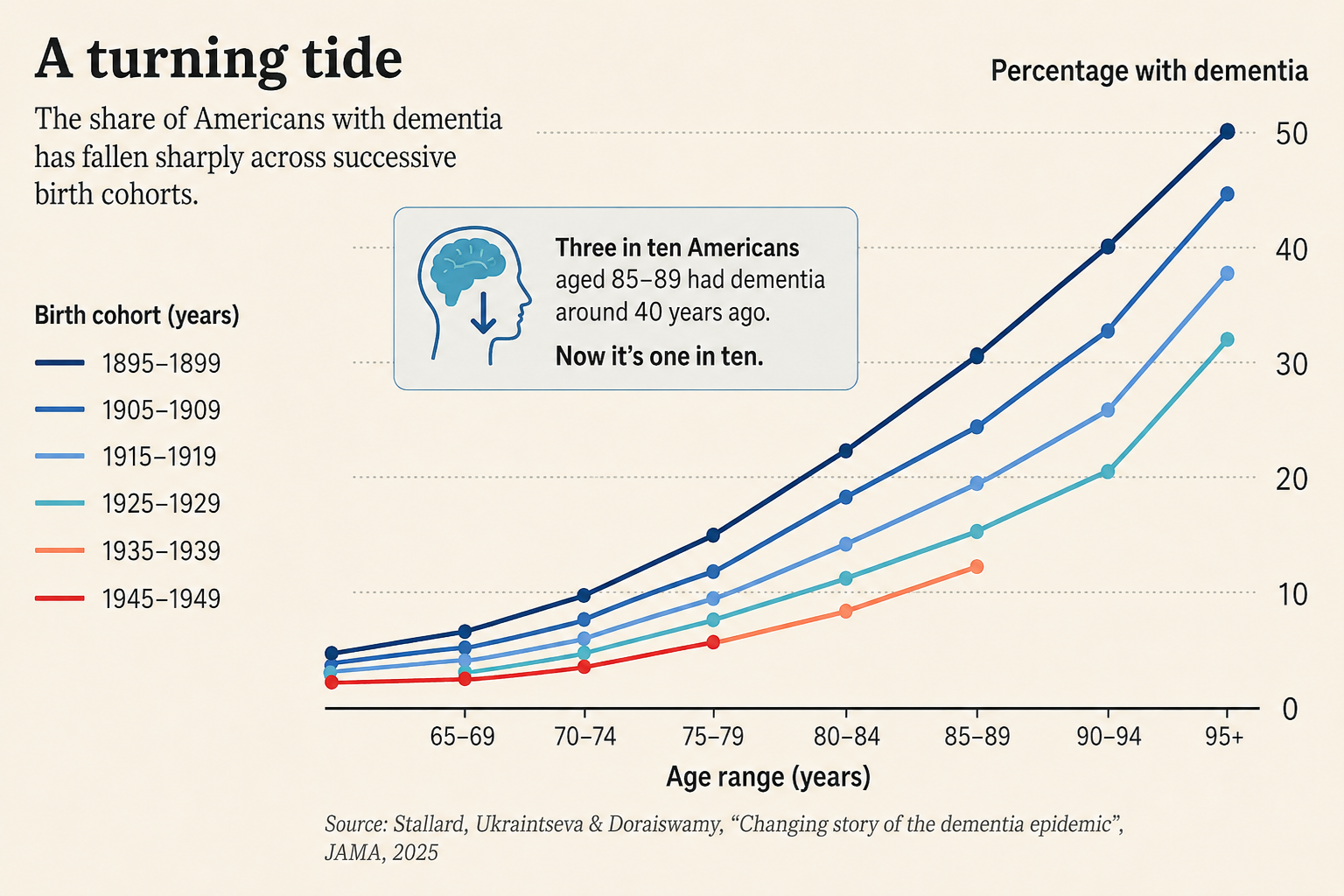
The first graph reproduced with The Economist article is perhaps its most important. Instead of simply asking how many elderly people have dementia, Stallard compares people of the same age who were born in different periods. The distinction matters. Imagine two men aged 85. One turned 85 in 1982 and another in 2022. Simply saying that dementia is common among 85-year-olds obscures the possibility that these two men entered old age with very different brains, arteries, educations and medical histories.
The older man may have grown up when secondary education was much less universal, smoked for forty years, had untreated hypertension from middle age and survived several minor strokes. The later man may have spent longer at school, stopped smoking at 45, taken treatment for high blood pressure and cholesterol and arrived at 85 having avoided serious vascular disease. Chronologically they are the same age. Biologically they are not necessarily comparable. This is what the cohort data seem to reveal.
Stallard and his co-authors argue that the familiar assumption of a fixed age-specific dementia rate is increasingly hard to defend. Successive American birth cohorts have experienced substantially lower prevalence at equivalent ages. That is more than a statistical curiosity. Many frightening forecasts work by taking the dementia rate currently observed among, say, 85-year-olds and multiplying it by the much larger number of 85-year-olds expected in future. If the underlying rate itself is falling, the prediction exaggerates future disease.
This does not mean future numbers will necessarily fall. Age remains overwhelmingly important, and populations in Europe, America and East Asia are ageing rapidly. A 2025 Nature Medicine analysis still projected new American cases increasing from roughly 514,000 annually in 2020 to about one million in 2060 under its modelling assumptions. Globally, the widely cited Global Burden of Disease projection rises from about 57 million people with dementia in 2019 to approximately 153 million in 2050, with much of the increase occurring outside wealthy Western countries.
So there is an important difference between saying an individual’s risk at a given age is declining and saying the total number of patients will decline. The Economist generally recognises this distinction, but its headline rather cheerfully runs ahead of its argument.
We may already know part of the explanation
The most fascinating part of the story is that there is no obvious miracle cure behind the decline. Indeed, the pharmaceutical history of Alzheimer’s disease has until very recently been depressing. Treatments directed specifically at the disease have generally produced disappointing results. Lecanemab, for example, can remove amyloid and produced a statistically significant slowing of cognitive decline in early Alzheimer’s disease, but the effect is modest rather than restorative and must be weighed against adverse effects including amyloid-related brain swelling and bleeding.
The large improvement between generations appears instead to have coincided with much less glamorous changes. People smoke less. High blood pressure is detected and treated. Cardiovascular medicine has improved enormously. Education lasts longer. Hearing aids and cataract surgery are better. Severe strokes are less common in many rich countries. More people survive middle age without accumulating the same degree of vascular injury. This fits well with what researchers know about dementia.
The 2024 Lancet Commission identified fourteen potentially modifiable risk factors and estimated that, in aggregate, addressing them might prevent or delay around 45 per cent of dementia cases worldwide. They include limited education in early life; hearing loss, hypertension, obesity, smoking, depression, physical inactivity, diabetes, high LDL cholesterol and excessive alcohol use during middle age; and later-life factors including social isolation, air pollution and untreated loss of vision.
One should immediately put a brake on that figure. “Potentially preventable” does not mean that a physician can identify 45 per cent of future cases and stop them. Population-attributable fractions are modelled estimates based on associations, prevalence and assumptions about causality. Risk factors overlap. Removing one may change another. Some apparent causes may partly be early manifestations of disease.
Depression is an obvious example. People with depression show substantially higher rates of later dementia, but this does not establish that every case of depression physiologically causes subsequent cognitive deterioration. Depression may be causal in some pathways, share causes with dementia in others, or occasionally appear during the long preclinical stages of neurodegeneration.
This is why I am cautious about the language of “modifiable risk”. It is useful, but can become misleadingly managerial. Human biology is not a dashboard on which fourteen sliders can simply be moved into their optimal positions.
Nevertheless, the broad conclusion seems difficult to avoid: what is good for the cardiovascular system is often good for the brain. That ought perhaps not to surprise us. The brain is extraordinarily dependent on blood flow. Years of hypertension, diabetes, vascular inflammation and small-vessel injury do not suddenly become irrelevant because the organ affected happens to contain consciousness.
The FINGER trial matters
The strongest objection to lifestyle epidemiology is always that healthy people tend to do many healthy things at once. Someone who exercises regularly may also be wealthier, better educated, less likely to smoke, more socially engaged and more likely to seek medical treatment. If he develops less dementia, which of those characteristics caused the difference?
This is why the Finnish FINGER study was so important. Beginning with older people considered at elevated risk of cognitive decline, researchers randomly assigned participants either to ordinary health advice or to an intensive multidomain programme combining diet, exercise, cognitive training and management of vascular risk. After two years, the intervention group performed significantly better on the study’s composite measure of cognitive function.
This does not prove that dementia can usually be prevented by joining a gym and eating salad. The trial examined cognitive decline over a relatively short period, not lifetime avoidance of Alzheimer’s disease. Nor does it tell us which ingredient mattered most. But it does something important. It moves the argument beyond correlation. There is now respectable experimental evidence that intervention in ordinary aspects of health can influence cognitive ageing. This strikes me as more encouraging than yet another antibody costing thousands of pounds.
The strange case of the shingles vaccine
The most extraordinary section of The Economist concerns vaccination against herpes zoster, or shingles. Wales introduced a shingles vaccination programme using an age cut-off. People just young enough to qualify received the vaccine; otherwise very similar people who had passed the threshold did not. This created what epidemiologists call a natural experiment.
The resulting study is striking. Researchers found that actually receiving the vaccine was associated with about a 20 per cent relative reduction in new dementia diagnoses over seven years. Because eligibility depended sharply on date of birth, the design offers stronger causal evidence than an ordinary comparison between people who voluntarily seek vaccination and those who do not. The obvious temptation is immediately to declare that infections cause Alzheimer’s disease. We should resist it.
The study itself is much more careful. The result could mean that preventing reactivation of varicella-zoster reduces inflammatory or neurological damage relevant to dementia. Vaccination might also stimulate the immune system in some more general protective way. Further work is needed, and the infectious contribution to Alzheimer’s disease remains unsettled. But the result is difficult to dismiss. A separate observational analysis comparing recombinant and live shingles vaccines has also reported a lower subsequent dementia risk with the recombinant vaccine.
If this effect survives further testing, it may turn out to be one of those medical discoveries that arrived sideways: a treatment designed for one disease quietly preventing another. There is something pleasingly anti-grandiose about that.
What worries me about prevention rhetoric
I am strongly attracted to the preventive interpretation of dementia because it restores some agency without pretending that human beings control everything. But that last qualification matters. If one reads enough modern health advice, life begins to resemble a prolonged examination in which every ordinary pleasure earns or loses marks towards one’s eventual manner of death. Exercise or dementia. Floss or dementia. Socialise or dementia. Sleep eight hours or dementia. Control cholesterol or dementia. The unfortunate man who cannot sleep then acquires the additional consolation of knowing that his insomnia may be damaging his brain. There is a moral danger here. The discovery that disease is partly preventable easily mutates into the assumption that disease is deserved. It is not. A person can exercise, study Latin, maintain an ideal blood pressure, eat fish, avoid cigarettes and still develop Alzheimer’s disease. Another can smoke until 75 and die mentally sharp at 96. Population risk is not individual destiny.
Nor do genes cease to matter because environment matters. APOE ε4 remains a major risk factor for Alzheimer’s disease, with risk rising especially for those carrying two copies. Yet genetic susceptibility and modifiable factors appear to interact rather than belonging to separate worlds.
The Christian vocabulary is useful here, even if one need not be Christian to understand the point. Prudence requires that we care for the body. It does not permit us to imagine that bodily decay is simply punishment for bad management. Mortality is not a technical failure.
Education may be doing more than we thought
One aspect of the argument deserves particular emphasis because it is easily reduced to a statistic: education. The association between more education and lower dementia risk has often been explained through the idea of “cognitive reserve”. A better-trained brain may possess more redundant or flexible networks, allowing it to tolerate pathological change for longer before symptoms become obvious. That interpretation is plausible, though not wholly settled. But there may be a broader effect. Education changes occupations, income, reading habits, social networks and the kinds of mental work people continue performing throughout life. Someone who has spent fifty years reading, calculating, arguing and learning may reach old age with a different cognitive history from someone whose schooling ended at fourteen and whose work allowed little intellectual stimulation.
I hesitate to turn this into yet another utilitarian argument for education. A civilisation should teach people history, mathematics, languages and literature because knowledge has intrinsic value, not merely because Cicero might postpone dementia. Still, it would be satisfying if education turned out to protect not only civilisation but also the physical organ that sustains our awareness of it.
So, is dementia being defeated?
Not yet. The phrase implies an enemy in retreat before a decisive medical campaign. What the evidence actually suggests is stranger. Some forms of dementia appear to be becoming less common at particular ages because the entire course of life has changed. Better childhood education may matter sixty years later. Treating hypertension at fifty may protect memory at eighty. Fewer cigarettes, better hearing, reduced stroke risk, improved diabetes care and perhaps vaccination each contribute small pieces to a process unfolding across decades. That is not defeat in the manner of antibiotics defeating bacterial pneumonia. It is civilisation altering the terrain on which disease develops.
There is also no guarantee that the favourable trend will continue. Rising obesity and diabetes could work in the opposite direction. Social isolation may increase despite digital communication. Greater longevity means that more people survive into the ages where dementia becomes common. Low- and middle-income countries will experience population ageing without necessarily acquiring all the protective advantages rich countries accumulated during the twentieth century. The global burden may therefore rise even while age-specific risk in England, Finland or America continues falling.
Yet I would rather end with hope than qualification. For most of my life, dementia has been described as one of those horrors we must simply expect from an ageing population. Research now suggests that this fatalism was mistaken. The brain apparently carries the history of the whole person: education, circulation, hearing, exercise, infection, social contact and metabolic health all leave traces. Some of these things can be changed. We should not tell an 80-year-old with dementia that he failed to prevent it. Nor should we promise a 40-year-old that good behaviour will guarantee mental clarity at 90. But we can reasonably say something more modest and perhaps more useful: the future is not fixed.
The generation now reaching old age appears, at equivalent ages, to be keeping its mind better than the generation before it. If we understand why, and if the improvement can continue, one of the darkest assumptions about ageing may have to be revised. The Economist calls this dementia being defeated. I would put it differently. We are finally discovering that dementia is not always inevitable. That is less dramatic, but it may be better news.
Bibliography
Eyting, Markus, Min Xie, Felix Michalik, Sebastian Heß, Sooyoung Chung and Pascal Geldsetzer. “A Natural Experiment on the Effect of Herpes Zoster Vaccination on Dementia.” Nature 641 (2025): 438–446. The Welsh age-eligibility experiment found that receipt of the shingles vaccine was associated with an approximately 20 per cent relative reduction in new dementia diagnoses over seven years. Nature
https://www.nature.com/articles/s41586-025-08800-x
Fang, Michael, Jiaqi Hu, Jordan Weiss, David S. Knopman, Josef Coresh, et al. “Lifetime Risk and Projected Burden of Dementia.” Nature Medicine 31 (2025): 772–776. The study estimates lifetime dementia risk in the United States and projects roughly one million new cases annually by 2060 if current age-specific risks persist. Nature
https://www.nature.com/articles/s41591-024-03340-9
DOI: https://doi.org/10.1038/s41591-024-03340-9
Livingston, Gill, Jonathan Huntley, Kathy Y. Liu, Sergi G. Costafreda, Geir Selbæk, et al. “Dementia Prevention, Intervention, and Care: 2024 Report of the Lancet Standing Commission.” The Lancet 404 (2024): 572–628. The Commission identifies fourteen potentially modifiable risk factors and estimates that addressing them could prevent or delay around 45 per cent of dementia cases. The Lancet
https://www.thelancet.com/article/S0140-6736%2824%2901296-0/fulltext
Ngandu, Tiia, Jenni Lehtisalo, Alina Solomon, Esko Levälahti, Satu Ahtiluoto, et al. “A 2 Year Multidomain Intervention of Diet, Exercise, Cognitive Training, and Vascular Risk Monitoring versus Control to Prevent Cognitive Decline in At-Risk Elderly People (FINGER): A Randomised Controlled Trial.” The Lancet 385 (2015): 2255–2263. This landmark Finnish trial found significantly better cognitive outcomes after a two-year multidomain intervention. The Lancet
https://www.thelancet.com/journals/lancet/article/PIIS0140-6736%2815%2960461-5/fulltext
Nichols, Emma, Jaimie D. Steinmetz, Stein Emil Vollset, et al. “Estimation of the Global Prevalence of Dementia in 2019 and Forecasted Prevalence in 2050: An Analysis for the Global Burden of Disease Study 2019.” The Lancet Public Health 7 (2022): e105–e125. The study projects an increase from about 57 million people living with dementia in 2019 to approximately 153 million in 2050. The Lancet
https://www.thelancet.com/journals/lanpub/article/PIIS2468-2667%2821%2900249-8/fulltext
Stallard, P. J. Eric, Svetlana V. Ukraintseva and P. Murali Doraiswamy. “Changing Story of the Dementia Epidemic.” JAMA 333, no. 18 (2025): 1579–1580. The article discusses the pronounced decline in age-specific dementia prevalence across successive American birth cohorts. JAMA Network
https://jamanetwork.com/journals/jama/article-abstract/2831385
DOI: https://doi.org/10.1001/jama.2025.1897
Taquet, Maxime, Quentin Dercon, John A. Todd and Paul J. Harrison. “The Recombinant Shingles Vaccine Is Associated with Lower Risk of Dementia.” Nature Medicine 30 (2024): 2777–2781. This large observational study found a lower subsequent dementia risk following the recombinant shingles vaccine than following the older live vaccine. Nature
https://www.nature.com/articles/s41591-024-03201-5
van Dyck, Christopher H., Chad J. Swanson, Paul Aisen, Richard J. Bateman, Christopher Chen, et al. “Lecanemab in Early Alzheimer’s Disease.” New England Journal of Medicine 388 (2023): 9–21. The phase-three trial found that lecanemab substantially reduced amyloid but produced a comparatively modest slowing of clinical decline, while also causing amyloid-related imaging abnormalities in some patients. New England Journal of Medicine
https://www.nejm.org/doi/full/10.1056/NEJMoa2212948
DOI: https://doi.org/10.1056/NEJMoa2212948
Wolters, Frank J., Lori B. Chibnik, Reisa A. Sperling, et al. “Twenty-Seven-Year Time Trends in Dementia Incidence in Europe and the United States: The Alzheimer Cohorts Consortium.” Neurology 95, no. 5 (2020): e519–e531. This pooled analysis of seven population-based cohorts found that dementia incidence declined by approximately 13 per cent per decade between 1988 and 2015.
https://www.neurology.org/doi/full/10.1212/WNL.0000000000010022
DOI: https://doi.org/10.1212/WNL.0000000000010022
The Economist. “How Dementia Is Being Defeated.” The Economist, 9 July 2026; print edition, 11 July 2026. This is the article under review and the immediate source for the presentation of Stallard’s cohort findings, the Dutch modelling work, FINGER and the shingles-vaccine evidence.
https://www.economist.com/briefing/2026/07/09/how-dementia-is-being-defeated
Discover more from The Libertarian Alliance
Subscribe to get the latest posts sent to your email.


