Anyone who still thinks of modern medicine as a disinterested search for truth has not been paying attention. In 2012 GlaxoSmithKline paid three billion dollars to settle American charges that included promoting Paxil for depressed children on the strength of a trial whose unfavourable results had been dressed up as favourable. Three years earlier Pfizer had paid $2.3 billion over the illegal marketing of Bextra. Merck kept selling Vioxx until 2004, by which time an FDA scientist reckoned it had caused somewhere between 88,000 and 140,000 excess cases of serious heart disease in America alone. Purdue Pharma pleaded guilty over the marketing of OxyContin in 2007 and pleaded guilty again in 2020. In 2020 the Lancet had to retract a study on hydroxychloroquine resting on data from a company called Surgisphere, which would not let anyone audit the data. When researchers at Amgen tried to reproduce fifty-three “landmark” papers in cancer biology, they managed six. I have written before on these pages about statins, and I see no reason to withdraw a word of it. A great deal of what passes for medical science is marketing in a white coat, conducted by companies that treat fines as a cost of business and by academics whose careers depend on publishing something, whether or not it is true.
None of this means that the people who shout loudest against the medical establishment are any better. It is a natural mistake to suppose that, because one side lies, the other must be telling the truth. Scepticism is a method, and a method has no friends. If I distrust a cardiologist’s view of statins because his department is funded by the people who make them, I must apply the same suspicion to a man who tells me the official medicine will kill me and then offers me something from his own catalogue. The point of noticing that Big Pharma buries inconvenient trials is to demand better trials. It is not to give up on evidence altogether and start believing whatever is printed under a picture of a kindly doctor.
I am led to these reflections by an article that appeared on 9 October on the website of Dr Joseph Mercola. It is called “The Mystery of Transplanted Consciousness — When Organs Transfer More Than Function,” and it is credited to “A Midwestern Doctor”, a pseudonymous physician whom Dr Mercola describes as a longtime reader of his site who must stay anonymous because he is “still on the front lines treating patients.” The piece is an abridgement of something longer, and its thesis is announced in the first paragraph: that along with a heart, lung or kidney, the recipient may receive “aspects of the donor’s consciousness, personality, memories, and even skills.” A banner at the top warns that this is “an older article that may not reflect Dr. Mercola’s current view on this topic.” I should very much like to know what his current view is. Whatever it may be, he thought the article worth putting out again, with a summary box of highlights, and so he must take responsibility for it.
Dr Mercola is an osteopathic physician from Illinois who has built one of the most profitable health businesses on the internet. The formula is simple. Alarm the reader about the official remedy, then sell him the alternative. Over the years this has brought him several warning letters from the American Food and Drug Administration about the claims made for his products, and in 2016 a settlement with the Federal Trade Commission under which he agreed to refund up to $5.3 million to people who had bought his tanning beds on the understanding that they did not raise the risk of skin cancer. In 2021 the New York Times called him the most influential spreader of coronavirus misinformation online. Of course, there is nothing in itself wrong with that, as the “information” put out by the authorities was lies. No, I do not care much for the New York Times, and I care even less for the self-appointed censors who put him at the top of their list of people to be removed from social media. But a man can be persecuted by the wrong people and still be talking nonsense. Dr Mercola is sometimes right about the drug companies, because that is not difficult. His judgement on anything else should be measured by what he chooses to publish, and on this occasion he has chosen to publish a ghost story.
The article begins in the usual way. “The evidence for this phenomenon has been accumulating for decades,” we are told, “yet mainstream medicine largely ignores it because it challenges fundamental assumptions about where consciousness comes from.” Notice what this does. It turns neglect into proof. If doctors took the claim up, that would show it was serious; since they do not, that shows they are afraid of it. There is no state of the world in which the claim comes out badly. This is the reasoning of the astrologer and the flat-earther, and it is exactly the reasoning that a sceptic of the medical establishment ought to be able to recognise, because it is the same manoeuvre the establishment uses when it dismisses every critic as an “anti-science” crank.
Then come the studies. The first is the work of “Dr. Benjamin Bunzel at the University Hospital in Vienna,” who studied 47 heart transplant patients. The paper exists, in Quality of Life Research for 1992, though its lead author was Brigitta Bunzel, which suggests that the Midwestern Doctor has not looked at it very closely. Its findings were that 79 per cent of the patients said their personality had not changed, 15 per cent said it had changed but because they had survived a life-threatening illness, and 6 per cent, which is to say three people, attributed a change to their new hearts. The article gives the 79 per cent, adds of its own accord that these patients “showed signs otherwise,” passes in silence over the 15 per cent, and builds its case on the three. The silent 15 per cent are the most interesting finding in the paper. They are people who went through the most frightening experience of their lives, came out of it alive, and found themselves altered. Nobody needs a theory of cellular memory to explain that.
The article then says that “approximately 10% of heart transplant recipients” report emotions they believe came from their donor. I have not been able to find where this figure comes from. What I have found is a survey published in 2024 in the journal Transplantology by Mitchell Liester and his colleagues, who are sympathetic to the idea and recruited their 47 respondents largely through Facebook and support groups. Even with that sample, the result tells against the Midwestern Doctor. Heart recipients reported personality changes at almost exactly the same rate as recipients of kidneys and livers: 91 per cent against 88. If the heart has some special code, it is keeping it well hidden. What the survey does suggest is that people commonly feel changed after a transplant, which is hardly surprising when you consider what they have been through and what they are taking afterwards. Corticosteroids are notorious for their effects on mood and appetite. Tacrolimus and ciclosporin, the standard drugs used to prevent rejection, can cause anxiety, depression and changes in taste. A patient who wakes up craving food he never liked has more plausible explanations available than the soul of a stranger.
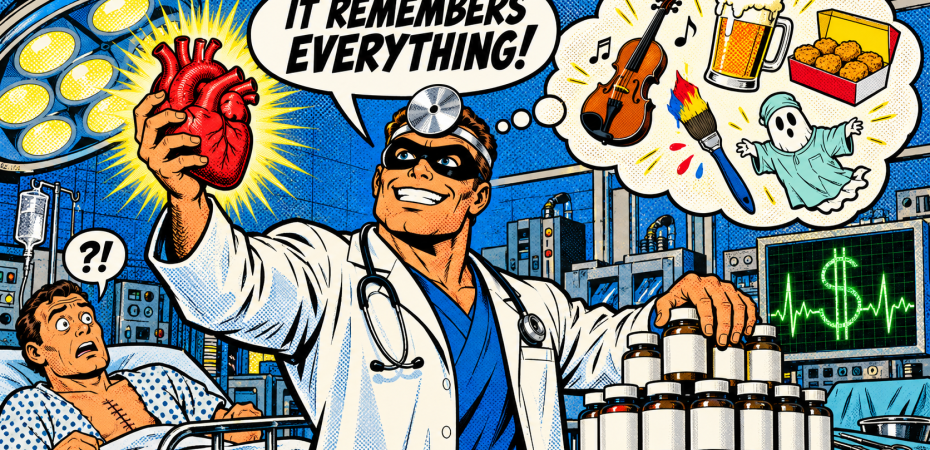
This brings us to the stories, which are the real substance of the article. The best known is that of Claire Sylvia, who had a heart-lung transplant at Yale in 1988 and published a memoir called A Change of Heart in 1997. She was a real woman, and her donor was a real young man, Tim Lamirande, killed in a motorcycle accident in Maine. She says that after the operation she craved beer and chicken nuggets, that she dreamed of a young man called Tim whose surname began with L, and that his family later confirmed his fondness for both. The whole of the evidence for this is her own book and the interviews she gave to promote it. No one wrote down the dream and sealed it before she had learned enough about her donor to look for his obituary. I do not accuse her of lying. I simply observe that memory is obliging, that people who have been given a stranger’s heart very often think hard about the stranger, and that a fondness for beer and chicken nuggets in an American young man in the 1980s is not much of a fingerprint.
Most of the other cases come from Paul Pearsall, whose book The Heart’s Code appeared in 1998. The Midwestern Doctor assures us that his cases “deserve serious consideration” because of “his meticulous citations and published academic paper with independent verification.” The paper is real. It appeared in 2000 in a small journal called Integrative Medicine, and it describes ten cases gathered by interview. There was no independent verification. The recipients are anonymous. Nothing they said was recorded before they could have learned anything about their donors, and the interviews were conducted by men who already believed in what they were looking for. One of Pearsall’s co-authors, Gary Schwartz, went on to publish a book claiming laboratory evidence that mediums can talk to the dead. This is the source of the foundry worker who took to classical music after receiving the heart of a young violinist, and of the widow whose secret word “copacetic” was echoed by the man who got her husband’s heart. They are touching stories. They are also impossible to check, which is a great convenience in a story.
The prize exhibit is the case of the eight-year-old girl who received the heart of a murdered ten-year-old and began having nightmares about the killer, from which, we are told, the police identified and convicted the murderer on “completely accurate details about timing, weapon, location, and the victim’s final words.” Dr Mercola’s editors thought this good enough for the summary box at the top of the page. Pearsall did not see the case. He reported it at second hand, as something a psychiatrist had described at a meeting. There is no name, no city, no police force and no trial. Consider what such a case would have been if it had happened. A murder conviction obtained on the strength of a child’s dreams about another child’s death would be among the most famous cases in the history of criminal law. Defence lawyers would have fought it all the way to the highest court in the land, and journalists would have camped on the doorstep of every person involved. Nobody has ever found it. A story that cannot be traced to a single named person or document is not evidence of anything except the willingness of people to repeat it.
The rest of the article descends from there. We are given a man whose drawing improved after his transplant, on the dubious authority of the Daily Mail. We are given the second-hand report of “one of my colleagues” whose patient decided to change sex after receiving a woman’s heart, and a reader’s account of a man whose sexual appetite increased after he was given a pig’s heart valve. Pig valves used in surgery are chemically treated tissue with no living cells. If the pig’s personality survives that, it is a tougher animal than the Midwestern Doctor himself. We are told that DMSO “likely would help transplanted organs, but this hasn’t been tested,” which is the whole method of the article compressed into a single sentence. We are told that the COVID vaccines raise the risk of rejection and that “numerous publications have now corroborated this link”. In fact there are case reports, which is what you would expect after billions of doses, and the larger studies have not shown it. We are offered a list of eighteen traits said to mark out the recipients most open to receiving their donors’ personalities, including a “feminine perspective” and being a “music lover”, which reads like the small print of a horoscope. And we are told that emotions trapped in the transplanted organ can be released by psychedelic therapy, by EMDR or by hypnosis.
The most contemptible passage is the one that asks whether people “who didn’t want their organs harvested” may have been “transplanted into recipients,” who then absorb the trauma of the harvest. There is a real scandal close by. In June 2025 the American Health Resources and Services Administration reported, after a four-year investigation, that a Kentucky procurement organisation called Network for Hope had pressed hospital staff to continue in dozens of cases where the process should have been stopped, in some of which the patient showed signs of life. That is a serious matter about the definition of death and the incentives of the people who collect organs. It deserves clear and careful treatment. The Midwestern Doctor uses its shadow to give his ghost story a frisson, and by tying a real concern to the transmigration of souls he has made it easier for the procurement industry to dismiss every critic as a crank.
I can anticipate the reply. Science has been wrong before. The heart has its own small network of nerve cells, some tens of thousands of them, and we do not understand consciousness. All this is true, and none of it helps. The transplanted heart is cut off from the recipient’s nervous system, and kidneys and livers do not have even the nerve cells. More to the point, the claim is not beyond investigation. Take a few hundred recipients. Before any contact with the donor’s family, have them write down whatever impressions they have of the donor, and seal the envelopes. Then compare. The experiment would cost almost nothing and could be done in any large transplant centre. In nearly thirty years since The Heart’s Code, none of the people who believe in this has done it. I suspect they know what it would show, or they find that the anecdote sells better than the trial. Either way, they are doing the same thing that we rightly despise in the drug companies, which is to keep the evidence that would test the product out of sight while selling the product.
I do not want Dr Mercola banned. I want him read with the same suspicion that he urges on his readers when they look at a pharmaceutical advertisement. An alternative medicine industry that matches the vices of the old one, with anonymous authorities instead of named ones and testimonials instead of trials, is not an alternative. It is a rival firm in the same trade. The free market in ideas works only when the buyers keep their wits about them, and the readers who have learned not to believe GlaxoSmithKline should not be expected to switch off their judgement because an article flatters their distrust.
Pascal said that the heart has its reasons, which reason does not know. Dr Mercola has his reasons too, and they are not hard to find. What he cannot do is persuade me that he takes his readers seriously when he gives them an article like this one and invites them to call it evidence.
Sources:
- Mercola: “The Mystery of Transplanted Consciousness”
- Bunzel et al. 1992, Quality of Life Research
- Carter et al. 2024, Transplantology
- WKYT: Kentucky nonprofit pushed organ procedures despite signs of life

Discover more from The Libertarian Alliance
Subscribe to get the latest posts sent to your email.