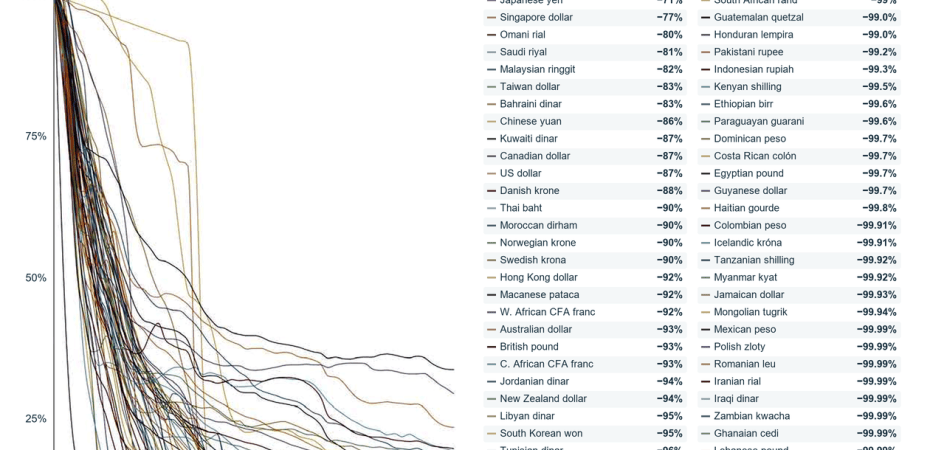
There is a chart taped to the wall behind my front desk, just under the sign that says checkout is at eleven. A guest saw it last week while I was running his card and asked if it was a heart monitor. It looks like one. Sixty-odd colored lines start together at the top left, in 1971, and then every one of them drops. Some slide down gently and some go over a cliff, but by the time they reach the right-hand edge they are all lying near the bottom, and none of them has climbed back up. It shows what has happened since August 1971 to the purchasing power of the world’s paper currencies, the ones backed by nothing except the say-so of the governments that print them.
The guest was a long-haul driver from Ohio, and when I explained the chart he looked at it for a while and said he had always thought the problem was prices going up. I told him that was one way of putting it. The other way, which is the honest way, is that the money has been going down. The bread and the diesel and the motel room are what they always were. It is the yardstick that keeps shrinking, and it has been shrinking on purpose, by people who are paid to look after it.
The numbers down the right-hand side of the chart come from the IMF and the World Bank, and they are about as cheerful as a foreclosure notice. The best performer of the lot is the Swiss franc, which has lost 66 percent of its purchasing power since 1971. The Japanese yen has lost 71 percent and the Singapore dollar 77. Those are the winners. At the bottom you find the Turkish lira, the Venezuelan bolivar and the Serbian dinar, each down more than 99.99 percent, which is the polite way of saying they have been wiped out and replaced, some of them more than once.
The two lines I care about are in the middle. The US dollar is down 87 percent. A dollar bill of 1971 now buys what thirteen cents bought then. The British pound, which my readers over there still carry in their pockets, is down 93 percent, so a pound note from the year Britain went decimal is worth about seven pence in the money of that year. These are the two currencies that ran the world for most of the last two centuries. The pound was the money of the Victorian empire, and the dollar has been the money of everything since 1945. If any paper money was going to hold its value, you would have bet on one of these. Both have gone the same way as the rest, only more slowly.
What strikes me most is that there are no exceptions. If one country had wrecked its money, you could blame its politicians. When sixty countries do it, with different languages, different parties and different economic theories, all heading the same direction and differing only in speed, you are looking at the way the system works. Since 1971 money everywhere has been a liability of the state, created at the discretion of officials and redeemable in nothing but more of itself. Give people that power and they will use it. The chart shows what they did with it.
The chart starts in 1971, but the dollar’s troubles started earlier, and it is worth knowing how it lost its anchor, because it was not lost by accident. From 1879, when the paper greenbacks of the Civil War were finally made redeemable again, until the First World War, a dollar was a fixed weight of gold and any American could walk into a bank and demand the metal. Prices went up in some years and down in others, but over the whole period the dollar held its value. A man who put away a twenty-dollar gold piece in 1880 could spend it in 1913 and get about as much for it.
The Federal Reserve was set up in 1913 to make the money more elastic, and it certainly managed that. In 1933 Franklin Roosevelt ordered Americans to hand in their gold coins and bullion at the official price of $20.67 an ounce. Early the next year, with the gold safely in government vaults, he raised the price to $35, which was a devaluation of about 40 percent imposed on the people who had just been made to sell. Private ownership of gold bullion stayed illegal in this country until the last day of 1974. That is a part of American history they don’t spend long on in school.
After the Second World War the Bretton Woods arrangement kept a link to gold, but only for foreign central banks. You and I could not redeem a dollar. The French government could, and by the late 1960s it was doing so, because Washington was paying for Vietnam and the Great Society by issuing more dollars than its gold could cover. On August 15, 1971, Richard Nixon went on television and closed the gold window. He said the suspension was temporary. It has lasted fifty-five years. Gold was $35 an ounce the day before. This summer it was around $4,600. You can say gold went up a hundred and thirty times, or you can say the dollar went down, and I know which description is closer to the truth. The Treasury still carries its gold on the books at $42.22 an ounce, which tells you how seriously anyone in Washington takes the idea that a dollar ought to mean something fixed.
The British story is older and, if anything, sadder. The pound was tied to gold for most of two hundred years. Britain suspended payment during the wars against Napoleon and went back to gold in 1821, and from then until 1914 the gold sovereign was the pound. Prices rose and fell with good harvests and bad, booms and busts, but the general price level when the First World War broke out was lower than it had been in the early 1820s. Think about that. A whole lifetime, and then most of another one, went by without the money losing value. A Victorian clerk who saved a sovereign as a boy could spend it in old age and get his money’s worth. That was the world in which the British built railroads all over the planet and lent money to everyone else, and it is not hard to see the connection.
Then came 1914. Convertibility was suspended in practice as soon as the war started. Winston Churchill put Britain back on gold in 1925 at the old prewar rate, which was too high after all the wartime inflation, and the country was forced off again in September 1931. After 1945 the pound was tied to the dollar under Bretton Woods and devalued twice, from $4.03 to $2.80 in 1949 and then to $2.40 in 1967, when Harold Wilson told the British public that the pound in their pocket had not been devalued. So the 93 percent on my chart flatters sterling. The pound had already lost most of its value before 1971 started.
The 1970s were when the British found out what money with no anchor at all could do. The Heath government let credit rip in the Barber boom, and inflation hit about 27 percent in 1975. The next year Britain had to go to the IMF for a loan, like a country in South America. It took deep recessions under Margaret Thatcher to bring prices back under control. More recently the Bank of England bought £895 billion of mostly government bonds in its quantitative easing programs, held its interest rate at a tenth of one percent, and then watched consumer price inflation reach 11.1 percent in October 2022. The officials who had said the inflation would be transitory kept their jobs. The savers who believed them lost their money.
Nobody runs a currency down for ninety years by mistake. Somebody gains from it, and in both countries the biggest gainer is the government itself. It is the largest debtor in the land, and every point of inflation shaves something off what it owes in real terms. Inflation also raises taxes that nobody voted for. In Britain the income tax thresholds have been frozen since 2021, and every time wages rise to catch up with prices, more people are dragged into higher bands. Here in America, capital gains are taxed on the nominal number, so if I sell a piece of land that has only kept pace with inflation, the IRS still treats the paper gain as income and takes its cut of a profit I never made.
The next in line are the people closest to the new money. An Irish banker called Richard Cantillon noticed back in the 1700s that new money does not raise all prices at once. It goes first to whoever gets it first, and they spend it before prices have caught up. These days that means the big banks, the bond dealers, and anyone who already owned stocks and real estate when interest rates were pushed to the floor. The losers are at the far end of the line: the waitress whose raise comes a year late, the retired couple living on a fixed pension, and the young family trying to buy a house that doubled in price while their savings account paid nothing. I see a lot of that last group at my counter. They are not poor and they are not lazy. They did what they were told, which was to work and save, and they are being robbed by the money itself.
So I want a gold standard back, a real one, where any citizen can take a dollar or a pound to the bank and get a fixed weight of gold for it. I also want to be straight about what that would cost, because the people who sell gold coins on late-night television usually aren’t, and the economists who oppose it have some real points.
The first is that gold money can fall in value as well as rise, and when it rises, prices fall. Between the early 1870s and the middle 1890s prices dropped for twenty years in both Britain and America. That was hard on anyone who owed money, especially farmers who had borrowed to buy land and then saw their wheat and cotton fetch less every year. William Jennings Bryan built a whole presidential campaign in 1896 on the anger. The gold standard years also had their financial panics, in 1873, 1893 and 1907, with banks failing and depositors lining up in the street. The money supply depended partly on whether somebody found a new goldfield in South Africa or the Klondike, which is an odd way to run an economy.
The second point is the 1930s. Most economists now believe, and Ben Bernanke made his name partly by arguing, that the countries which stuck with gold longest suffered the worst of the Depression. Britain left in 1931 and recovered sooner than France, which held on until 1936. Roosevelt’s devaluation, which I just finished criticizing, did coincide with the start of the American recovery. I don’t think that settles the matter, but I would be a fool to pretend the argument doesn’t exist.
The third point is the one that bothers me most. Every gold standard so far has been suspended the moment it got in the government’s way. Britain dropped it in 1797, 1914 and 1931. America dropped it in 1861, 1933 and 1971. A law passed by Congress can be repealed by Congress, and a government that wants to fight a war or bail out its friends will always find a reason. Gold has never stopped a determined state. It has only made the state pay a visible price for what it did.
Having said all that, I would still take the deal, and I think anyone who looks at the chart behind my desk ought to take it too.
Start with the falling prices of the late nineteenth century. They were hard on debtors, but they happened while the American economy was growing faster than at almost any time in its history. Railroads were laid across the continent, steel output went through the roof, and real wages rose. Prices fell mostly because the country was getting better at making things, which is how it ought to work. When a factory learns to make shoes for less, the shoes should get cheaper. Under paper money that saving is quietly taken away and handed to whoever got the new money first. Under gold it went to the man buying the shoes.
The panics were real, but we have hardly been short of them since we got rid of gold. We had the inflation of the 1970s, the savings and loan collapse, the dot-com bust, and the crash of 2008, which came close to taking the whole banking system down. The Federal Reserve was created after 1907 precisely to stop panics, and on its watch we got the worst one in history in 1929. A managed money has not given us stability. It has given us the same booms and busts, followed by rescues paid for by everyone who holds the currency.
As for the 1930s, what failed then was not the old gold standard of the nineteenth century. It was a patched-up postwar version in which central banks held each other’s currencies as reserves, sat on gold instead of letting it flow, and fixed exchange rates at levels chosen for national pride, Churchill’s pound being the obvious example. That is an argument against central bankers playing with gold, and I accept it. It is a much weaker argument against gold itself.
The deepest reason, though, is the difference between costs you can see and costs you can’t. When a gold standard bites, it bites in the open. Prices fall, a bank fails, a politician has to explain why he can’t spend what he promised. People complain and the arguments happen in public. Paper money lets the cost be hidden. Nobody votes for a 93 percent tax on savings, but the British have paid one since 1971, a few points a year, and the government never had to defend it. Every boom and bust under gold was over in a few years, and afterward a dollar was still a dollar. The losses under paper are permanent. The thirteen cents my 1971 dollar is worth today are never coming back.
And even if gold has never stopped a government that was set on breaking it, it has made the breaking expensive. Roosevelt had to confiscate people’s coins. Nixon had to go on television on a Sunday night and close the window. Those were acts people noticed and historians still argue about. Today the Fed or the Bank of England can add hundreds of billions to the money supply at a meeting most people never hear about. A rule that forces the government to break it publicly is worth a great deal more than no rule at all.
What would it take? The important word is convertible. Bretton Woods let foreign central banks swap dollars for gold and left the rest of us out, so the only people with the power to call the government’s bluff were other governments, and they had their own reasons to keep quiet. A real gold standard puts that power in the hands of every person who holds the currency. If the Fed or the Bank of England printed more than people wanted to hold, they would take the surplus to the counter and ask for gold, the reserves would drain, and the bank would have to stop. Millions of ordinary people would be doing the checking, and none of them would need a seat on a monetary policy committee to do it.
The practical problems are serious, and I won’t pretend otherwise. The United States holds a little over 8,100 metric tons of gold, which at this summer’s prices comes to less than a trillion and a quarter dollars, against a money supply many times larger. The British are worse off, because Gordon Brown sold more than half the country’s gold between 1999 and 2002, close to the bottom of the market. So the new parity would have to be set well above today’s price, or the convertible currency brought in alongside the old one and allowed to win people over. Whatever the rate, it would have to be chosen with care. Churchill’s mistake in 1925 was to pick the old rate out of pride and then squeeze the British economy to fit it. We would need to do the opposite, and pick a rate the existing price level could live with.
I expect there would be some hard years. There might be falling prices in some industries, higher interest rates for a while, and politicians unable to promise everybody everything. I think that is a fair price for money that holds its value across a lifetime, and for a government that has to ask openly when it wants more of our money instead of taking it quietly out of our savings.
The driver from Ohio checked out the next morning. On his way past the desk he stopped to look at the chart again and asked whether any of those lines had ever gone back up. I said none had, not in fifty-five years and sixty-odd countries. He said that sounded less like an accident than a policy, and I told him he had understood it better than most of the people who run the Federal Reserve will admit to understanding it. A gold standard would not make our governments honest. Nothing will do that. What it would do is put a limit on how far they can cheat us without our noticing, and after half a century of watching those lines go down, I think a limit is worth almost any price we would have to pay for it.

Discover more from The Libertarian Alliance
Subscribe to get the latest posts sent to your email.
Related posts:
 Gold Is Down. So What? Why I’m Still Buying Gold and Silver
 The Return of Honest Money: Why the Great Bull Market in Gold and Silver Has Barely Begun
 Gold, Silver, and the Managed Demolition of Western Money
 Going for Gold
 Going for Gold: A Note of Caution to Bryan
Too Soon, Not Too Wrong: Gold and the Meaning of a Fall
 Gold and Silver: Another Interim Report
 The Lure of Gold
 The End of Fiat and the Return of Gold
 Gold Is Heading East – And So Is Financial Power
 France Brings Gold Home as Global Trust in Dollar System Collapses
 Britain’s Debt is a National Scam: A Case for Repudiation
Powered by YARPP.