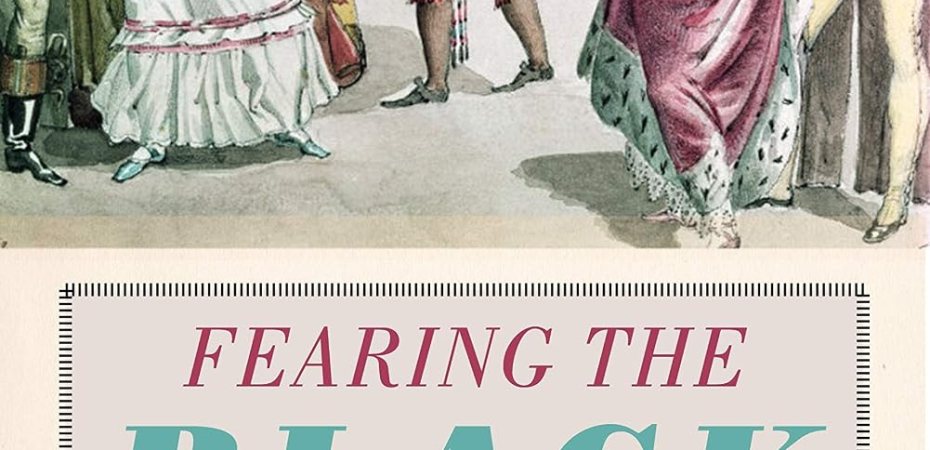
Sabrina Strings,
Fearing the Black Body: The Racial Origins of Fat Phobia,
New York University Press, New York, 2019, 283 pp.,
ISBN 978-1-4798-1980-5 (cloth), 978-1-4798-8675-3 (paperback)
I came to this book while writing my reply to Da’Shaun Harrison, whose essay on “anti-fatness as anti-blackness” was handed out in one of our PSHE lessons. Harrison leaned on Strings for the history, and got her wrong. Having said so in print, I thought I had better read the original, in case Harrison had misreported a good book. I expected a bad one. I can now report that it is every bit as bad as I expected, and that it is bad in several ways I had not thought to expect.
The book, the acknowledgements tell us, grew out of a question the author’s grandmother used to ask: “Why are all these white women dying to be thin?” (p. 213). It is a good question, and it has some fairly obvious answers. Not being ugly is one. Class is another. A third is that food became cheap and plentiful in the nineteenth century, so that being fat stopped proving you were rich. A fourth is the discovery that being very fat is bad for you. Strings rejects the fourth outright and has little interest in the third. Her thesis is set out in the introduction: “two critical historical developments contributed to a fetish for svelteness and a phobia about fatness: the rise of the transatlantic slave trade and the spread of Protestantism” (p. 6). From this she concludes that “the phobia about fatness and the preference for thinness have not, principally or historically, been about health” (p. 6). The last sentence of the book puts it more strongly still: “the fear of the black body was integral to the creation of the slender aesthetic among fashionable white Americans” (p. 212).
Strings describes her work as “possibly the first historical study of fat phobia and thin fetishism in the West” (p. 6). She says that she used “two comparative historical methods: process tracing and historical narrative” (p. 8). In practice, this means collecting every remark she could find in which a European or an American said something about fat and something about race, and then arranging the remarks in chronological order so that sequence can stand in for cause. The result is a long book in which the black body of the title is missing for most of the time, in which the evidence repeatedly points the wrong way, and in which the author has too often not read the sources she cites.
Start with the first third of the book, which refutes its own subtitle. Part I is called “The Beauty of the Robust”, and its argument is that Renaissance Europeans admired plump women, and admired black women along with them. Dürer, who supplies the epigraph, wrote of the Africans he had seen that he “never beheld finer figures” (p. 15). Strings tells us herself that “black women were incorporated into the High Renaissance rhetoric and imagery of beauty as equally voluptuous, if socially inferior, counterparts to European women” (p. 9). When the European image of black women changed in the seventeenth century, it changed in the wrong direction for her thesis. In her own words, they were “transformed from voluptuous bodily exemplars in the sixteenth century to little, low, and foul in the seventeenth century” (p. 64). So, for the first two centuries of the slave trade, black women were either admired for being plump or despised for being small.
The eighteenth century does not help her much more. Bernier, whom she credits with the first racial classification, thought the people of the Cape “smaller, thinner, with uglier faces” (p. 72) than other Africans, and wrote that some of the black women he had seen would “put in the shade the Venus of the Palazzo Farnese” (p. 73). Buffon called the plump black African “well-made” and said of the women of Senegal that, “colour alone excepted, we find among them, women as handsome as in any other country of the world” (pp. 78–9). Sparrman, who unlike most of these authors actually went to the Cape, said the Khoikhoi were slender because they were “stinted and curtailed in their food” (p. 88). Hawkesworth, writing up Cook’s voyage in 1773, found them “in general of a slim make, and rather lean than plump” (p. 89). The fat black woman that Strings wants to find arrives very late, in a few French naturalists who never left their desks, and in the wretched exhibition of Sara Baartman, whose story is genuinely vile and has been told before, and better, by Clifton Crais and Pamela Scully, on whom Strings relies.
Now consider who, in her own pages, was actually being mocked for fatness in the seventeenth and eighteenth centuries. There is Falstaff, and the “fat paunches” of Love’s Labour’s Lost. There are Sydenham’s gouty English gentlemen, and George Cheyne, who weighed thirty-four stone at the age of thirty-two (p. 102). There are the bloated ladies of The Spectator, the Countess of Orkney sneered at by Lady Mary Wortley Montagu, and the women of Rubens, of whom Joseph Spence complained that “His very Graces are all fat” (p. 112). Every one of them is white. When the story crosses to America, it becomes Anglo-Saxons laughing at the Irish, and then Nordics laughing at Italians and Jews. Charles Davenport’s examples of “fleshy races of men” are “the South-Russian Jews, especially of the female sex; and certain of the Chinese” (pp. 158–9). Elliott Joslin’s fat diabetics are Jews (p. 196), and Henry Friedman’s are southern Italians (p. 195). Of the eight chapters, the black body is the main subject of two, and in one of those it is admired.
Strings answers this by saying that the Irish and the Italians were insulted by being called part-African. Her chief witness for the Irish is the ethnologist James Cowles Prichard, who, she says, argued in The Eastern Origin of the Celtic Nations (1831) that the Celts were related to “‘Asiatics,’ people who today might largely be considered Arab or North African” (p. 130). The full title of Prichard’s book is The Eastern Origin of the Celtic Nations Proved by a Comparison of Their Dialects with the Sanskrit, Greek, Latin, and Teutonic Languages. It is remembered in the history of linguistics for showing that Irish and Welsh belong to the Indo-European family, alongside Latin, Greek and German. Prichard, in other words, put the Celts in the same family as the Anglo-Saxons, and the “Eastern” origin he had in mind was India. Strings appears to have read the word “Eastern” on the title page and thought of Arabs.
This is not the only place where she has not read what she cites, or has not checked what she remembers. She says that the black maids of Catherine of Aragon were ridiculed in 1501 by “Sir Thomas More, key counselor to Elizabeth’s father, King Henry VII” (p. 54). Elizabeth’s father was Henry VIII, and in 1501 More was a young lawyer of twenty-three who counselled nobody. In A Midsummer Night’s Dream she discovers “Shakespeare’s dismissal of black femininity” (p. 55) in the abuse thrown at Hermia: “Away you Ethiope!” Hermia is an Athenian girl who is short and dark, and Lysander calls her an Ethiope in the way that a boy at my school might call a pale friend Casper. The Masque of Blackness was put on by “Jacob I’s queen” (p. 55) and found loathsome by “Sir Carleton” (p. 56), who was Sir Dudley Carleton to everyone else. Henry VIII broke not with Rome but with “the Norman papacy” (p. 128). Tobias Venner, writing in 1620, is credited with “using for the first time the word ‘obesus’” (p. 57). Obesus is classical Latin, found in Celsus, Columella, Horace, Vergil and Suetonius. In the American chapters, Godey’s Lady’s Book prints an essay “written by a woman named Leigh Hunt” (p. 134). The essay gives a woman’s weight in stone, which no American does, and its author was surely James Henry Leigh Hunt, the English essayist and friend of Keats and Shelley, who was a man. Somebody at New York University Press was paid to read this book before it was printed.
The errors would matter less if the method were sound. It is not. The argument proceeds by juxtaposition and by adverb. One thing “may have” influenced another; a man “likely” read a book; it “is perhaps for this reason” that something happened. When Cuvier writes of Baartman’s body with distaste, we are told that “Arguably, Cuvier saw in Sara what he despised in himself” (p. 97), because he grew fat in later life. When Gainsborough paints slender women, he “may have tried to accurately reflect the slender forms of the wealthy women he painted. . . . Or he may have taken a bit of artistic license” (p. 121). Either way, it counts as evidence. When Lady Mary praises the plump figures of Turkish women and laughs at a fat English countess, this shows that plumpness was fit only for “colonial Others” (p. 117). The Ottoman Turks of 1717 were nobody’s colony. They had besieged Vienna within living memory.
The American chapters work the same way on a larger scale. The evidence for a racial motive behind the slender ideal is mostly women’s magazines. Godey’s Lady’s Book tells its readers that “The Anglo-Saxon race of women are taller and slenderer than were the Grecian females” (p. 137). Harper’s Bazar sneers at “African savages” and the “Turkish seraglio” (p. 142). Cosmopolitan praises tall, slim beauties with Scotch blood in their veins. I do not doubt that magazine editors in the nineteenth century were snobs, or that many of them were pantomime villain racists. But snobbery of this kind attaches itself to whatever the fashion happens to be, and supplies the reasons afterwards. Had fashionable women in 1880 been plump, Harper’s would have explained that the Anglo-Saxon race was naturally robust and the Irish scrawny with drink.
Strings’s own sources show this happening. In 1810, Samuel Stanhope Smith thought the Anglo-Americans more slender than the British, and put it down to the cold (p. 133). By the 1880s, the doctors thought American women dangerously thin. John Harvey Kellogg, eugenicist, racist and breakfast-cereal pioneer, wanted girls with “plump arms, broad backs, and a full chest” (p. 178), and declared that “The only hope for the race is in the future of its girls” (p. 179). As late as 1927, Morris Fishbein, an editor of the Journal of the American Medical Association, was reporting that “many observers” blamed feminism for “the fad for slenderization” (p. 185). So the same racial anxiety that supposedly produced the cult of thinness was, a few pages later, demanding that white women put on weight. A cause that can produce opposite effects explains neither of them.
This brings me to the real weakness of the book. Strings’s thesis needs the medical case against fat to arrive late, as a rationalisation of a prejudice already formed. To make it arrive late, she has to explain away the doctors who appear in her own pages. Tobias Venner warned of the ill effects of corpulence in 1620 (p. 57). Sydenham found that gout most often struck the “gross and corpulent” (p. 58). Cheyne collapsed at thirty-four stone, lost about half his weight on milk and vegetables, and felt better (pp. 102–3). When a contributor to JAMA in 1900 cites Hippocrates on the infertility of fat women, Strings calls it “a touch of Greek philosophizing” (p. 193). It is nothing of the kind. The passage comes from Airs, Waters, Places (21), a medical treatise, and describes the Scythians: their women are fat and seldom conceive, while their slave women, lean from hard work, conceive at once. The link between obesity and the failure to ovulate is now ordinary gynaecology. A Greek physician noticed it some two thousand years before anyone had heard of Barbados.
Her treatment of the actuarial evidence is worse. In 1912, Louis Dublin and his colleagues drew up tables of weight and mortality from the records of “hundreds of thousands of policy holders at forty-three insurance companies” (p. 188). Strings calls these “health insurance companies” (p. 187). They were life insurers. They paid out when their customers died, and so they had every reason to price the risk of fatness correctly and no reason at all to indulge the aesthetics of Godey’s Lady’s Book. Her objection to their figures is that the researchers “overlooked what today is a recognizable issue in statistical analysis: small differences can become statistically significant when there is a massive number of people in the study” (pp. 188–9). This is a muddle. A large sample makes an estimate more precise. It does not make a large effect small. The figures she herself quotes from Dublin’s later work show women a quarter above the average weight with a death rate 74 per cent above the average (p. 197). That is not a rounding error. The same 1912 tables found that being overweight was good for you under the age of thirty-five (p. 188), which is an odd result for a racist conspiracy to have produced.
Ancel Keys, who renamed Quetelet’s index the body mass index, is convicted of calling obesity “ugly” and of describing fat people as “clumsy” and “hard on furniture” (p. 198). These remarks, Strings says, “make it hard to believe that his work in this area was fueled exclusively by medical findings” (p. 198). That a scientist dislikes what he studies tells you nothing about whether his numbers are right. Oncologists are not fond of tumours.
There is one serious point buried in all this. The body mass index is a crude measure, and it does not mean the same thing in every population. Strings mentions evidence that black Americans have greater bone density and muscle mass than white Americans at the same BMI (p. 202). That is worth knowing. But notice what the medical profession has done with such evidence. In England, the National Institute for Health and Care Excellence now tells doctors to use lower BMI thresholds, not higher ones, for people of South Asian, Chinese, Middle Eastern, black African and African-Caribbean background, because their metabolic risks begin at a lower weight. Medicine adjusts its categories when the data require it. A system built on the fear of the black body would not have spent the last decade worrying that it was missing disease in black patients.
The epilogue gives the game away. Strings sets two studies of 2013 against each other. One, led by Ryan Masters, attributed 18 per cent of American adult deaths to obesity and found the highest share among black women. The other, a meta-analysis led by Katherine Flegal of the Centers for Disease Control, she prefers. She reports that Flegal found the overweight had a lower risk of death than people of “normal” weight, and that the mildly obese “had a mortality risk that mirrored that of people of ‘normal’ weight” (pp. 207–8). Both findings are real. What she does not report is that the same study found obesity of all grades taken together raised the risk of death by 18 per cent, and that a BMI of 35 or more raised it by 29 per cent. The study she offers as her best evidence contradicts her conclusion, and she has left that part out. Instead, she tells us that Masters was “a newly minted Ph.D.” while Flegal has “more than 100,000 citations” (p. 209). I had thought the point of the book was that we should stop deferring to medical authority.
The most damaging passage in the book is one that Strings seems not to have noticed. Asking whether black women knew they were the target of all this, she finds “little evidence of a sustained engagement with fat phobia as ‘black’ or the slim ideal as ‘white’ until the last few decades of the twentieth century” (p. 211). The discussion, she concludes, “circulated largely in elite white spaces, and among white persons” (p. 211). I agree. On her own evidence, white people spent four centuries sneering at fat white people, with the occasional black woman brought in as a foil, and a great many more who were praised or ignored. The idea that fat is essentially black was not established by the slave traders or the Puritans. It was established in the late twentieth century, largely by academics, and this book is one of the instruments by which it is still being established. Harrison’s essay is what happens when someone reads it and believes it.
I will admit what can be said for the book. The illustrations are well chosen. The chapter on the eighteenth century, with Cheyne and The Spectator and Lady Mary, is entertaining. Strings has spent a good deal of time in digitised newspaper archives, and anyone wanting to write a proper history of fashion, class and the body in America could use her quotations as a starting point, provided he checked every one of them. None of this rescues the thesis. It only means that the raw material for a decent book on a narrower subject is buried in a bad book on a grand one.
The grandmother’s question deserved a better answer. Why are all these white women dying to be thin? Strings says that they were running from the black body. Her own evidence says that they were running from other white people: from the Irish cook, the Italian, the Jewish matron, the fat duchess, and the woman they would become if they ate what had become cheap enough to eat every day. Some of them were also running, sensibly, from diabetes. I have spent the past year getting boys at my school to lose fat, and not one of them has been fleeing the black body. They are fleeing what they see in the changing-room mirror, and the mirror has no politics.
In my reply to Harrison, I said that Harrison had misread Strings. Having now read Strings properly, I am not sure the misreading did much harm.

Discover more from The Libertarian Alliance
Subscribe to get the latest posts sent to your email.
Related posts:
 The Body Never Lies: Why Physical Excellence is One of Life’s Greatest Investments
 Blood Pressure, Beyond the Slogans: What the Best Evidence Really Shows
 Junk Food for Junk People, and the Joy of Watching Them Rot
 Obesity as a Behavioural Addiction: A Study in Therapeutic Evasion
 Bodybuilders, Bulimia, and the Terror of Looking Good
The Clot and the Creed of Progress: Reflections on Malcolm Kendrick and the Dogmas of Cardiology
 Some Provisional Truths About Diet and Health
 The Pill That Makes Us Thin: Orforglipron and the Medicalisation of Appetite
 Lose Fat, Not Yourself: Why Structure Beats Motivation
 Salt and Blood Pressure: the Danger of Medical Absolutes
 Burn the World, Keep the Pizza
 Why Not God? by Charles Mastroni: A Catholic Review
Powered by YARPP.