As often as I look in the newspapers, I see that we are to be prepared for a big war with Russia. The details change from week to week, but the burden of the message does not. At a recent conference of the Royal United Services Institute, the experts agreed that our armed forces had no plan for a fight lasting longer than a few weeks, and that something must be done about it. Last December, the Chief of the Defence Staff, Sir Richard Knighton, told us that “sons and daughters” would have their part to play, which I take to be the official way of preparing parents for the telegram. I have no doubt that the people who rule this country would like such a war. It would excuse every failure of the past thirty years, and it would justify every power they have not yet thought to take. But I am dubious that there will be a war, because I doubt if there can be a war.
I should explain what I mean. I do not suppose that Russia is a harmless neighbour, or that there will never be another severed cable in the North Sea or another poisoning in a cathedral city – assuming, what is doubtful, that the Russians were behind these. Nor do I rule out a brief exchange of fire somewhere on the edges of Europe. The war for which we are being prepared is something larger. It is a war of national mobilisation, fought over years, of the kind this country fought between 1914 and 1918, and again between 1939 and 1945. Such a war requires material and moral means together. A State must have money and the things that money buys, and it must have young men who will fight and a population that will bear the cost. My argument is that the British State no longer has enough of either.
Let me begin with money, since the newspapers so rarely do. In 1914, this country was the greatest creditor nation in the world. The State took about an eighth of the national income. The national debt had been paid down through a century of general peace and stood at something over six hundred million pounds, its interest a trifling charge on the revenue. There was, in consequence, room for almost unlimited mobilisation, and the room was used and wasted. By the end of the war, the national debt had grown more than tenfold, and the standard rate of income tax had gone from one shilling and twopence in the pound to six shillings. Every penny of that was found because the starting position had left so much to be found.
The position in 1939 needs more care, and I will not pretend otherwise. The debt left over from the Great War was enormous. In proportion to the national income, it was larger than our debt is today, and anyone who wishes to argue that we are as well placed as our grandparents may point to this fact. I concede it. Yet the character of that debt was very different. Most of it was long-dated and at fixed rates of interest. The largest single stock, the War Loan, had been converted in 1932 from five per cent to three and a half, and it carried no date by which the Treasury was obliged to repay it. Interest rates were low and were kept low. Taxes took something over a fifth of the national income and could be pushed a long way higher before they broke anything. There was also a great accumulation of foreign investments, built up over a hundred years, that could be sold to pay for imports. Even so, the money ran out. By the end of 1940, the country had almost nothing left with which to buy American weapons, and the war continued only because the Americans agreed to Lend-Lease. If the second war was beyond our means with all those advantages, I fail to see how a third could be fought without them.
Today, the State takes about thirty-six per cent of the national income, and the Office for Budget Responsibility expects this to rise to thirty-eight per cent by the end of the decade, which would be the highest burden ever recorded. Net debt stands at about ninety-four per cent of national income. Interest on it cost about a hundred and ten billion pounds in the last financial year, which is nearly twice what we spend on defence. About a quarter of the gilts are index-linked, so that every rise in inflation, which has always been the companion of war, adds automatically to the bill. Borrowing this year has already overshot the forecasts, and further increases in tax are generally expected in the Budget at the end of this month. Nor is there a patient lender waiting in the background. In the autumn of 2022, we were given a demonstration of what the bond market thinks of an unfunded promise from a British Government. Mrs Truss proposed a cut in taxes without explaining how it would be paid for, and the gilt market did more than anyone to remove her within weeks. A Government that cannot cut taxes by a few tens of billions without a run on its debt is in no position to borrow the hundreds of billions that a real war would need. The British State is not formally bankrupt. It is, however, in the condition of a client whom I would once have advised to stop borrowing at once and to hope that the bank did not call in the overdraft.
Money, in any case, is only a claim on things, and wars are fought with things. In both the great wars, this country possessed a first-class industrial base. Germany made more steel than we did in 1914 and in 1939, but our own industry, joined to the resources of an empire and the command of the sea, was able to match it and, in several things that mattered, to beat it. In 1940, British factories made more aircraft than German factories. The shipyards of the Clyde and the Tyne could replace losses that would have finished most countries. Today, our steel output has fallen to about four million tonnes a year, the lowest since the Great Depression, and around seven tenths of the steel we use is imported. Russia made nearly sixty-eight million tonnes last year. Western officials estimate that Russian factories produced two million or more artillery shells in 2024, while our own production has been so small that the Government talks of multiplying it many times over and would still fall far short. We cannot make our most advanced weapons without American components and American consent. The minerals on which modern weapons depend are mined or refined largely in China, and the sea lanes along which they must come are no longer ours to command. In 1939, the Royal Navy had well over a hundred destroyers. It now has six, with a few more frigates, not all of them at any one time fit to go to sea.
Then there is the question of fighting manpower. One of my grandmothers gave birth to five sons. One of them was lost on the Arctic convoys, another in North Africa. Of course, she was sad, but she ended the War still with three sons. That was the arithmetic of a country in which large families were normal, and it was on that arithmetic that the generals of both wars were able to draw. Most British parents now have one or at most two children, and the fertility rate in England and Wales has fallen to about 1.4, the lowest ever recorded. A mother who loses her only son loses the whole of her posterity, and she knows it. I do not think such parents will be pleased to risk losing everything they have. Nor do I think that Ministers, who must face those parents at the next election, will much enjoy the experience of trying to make them.
The composition of our young men has also changed. On any reasonable reading of the census, something like a third of the young men in this country were either born abroad or are the sons of parents who were. The exact figure may be argued about, but not its order of magnitude. I will be fair here. Men of foreign birth have fought bravely for this country before now, and some do so today. The Indian Army of the Second World War was the largest volunteer army in history. But those men served an empire that paid and honoured them, and whose authority they accepted. Allegiance is not conferred by a passport. Many of the young men I have in mind are happy enough to receive the benefits of living in our country, but I doubt that many of them regard the British State as something worth dying for, and some have families and sympathies in places where British foreign policy has done a great deal of harm. Any attempt to make them fight would, I suspect, be resisted with firm and effective violence. The authorities know this, which is why conscription, if it came, would never be applied evenly. A conscription that fell in practice on the native young alone would be more than even the present political class could carry.
This brings me to the matter of legitimacy. At least half the electorate in 1939 disliked the government of the day. Mr Chamberlain was despised on the Left and distrusted by a good many in his own party. But disliking a government is not the same as believing it to be illegitimate. The man who voted Labour in 1935 still believed that the King’s Government was, in some broad sense, his own, and that those who administered it were on the whole honest men. The number of people in this country who believe the British State to be their legitimate representative and trustee is now a dwindling minority. In 2024, the British Social Attitudes survey found that forty-five per cent of respondents “almost never” trusted governments of any party to put the needs of the nation above the interests of their party, which was the highest figure on record. Earlier that year, YouGov asked people under forty what they would do in the event of a world war. Thirty-eight per cent said they would refuse to serve if conscripted, and thirty per cent that they would refuse even if Britain faced imminent invasion. Most people are at least inclined to the view that we are ruled by moral garbage who are at war with us. You are more likely to get young men to die for their mobile telephone company than for the British State. At least their mobile telephone companies give them what they pay for.
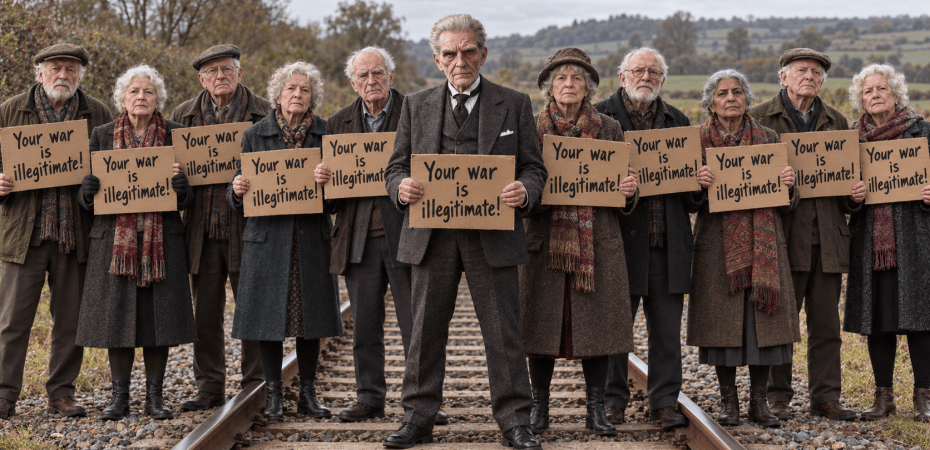
There is also a much larger and better organised awkward squad than there was in 1914 or 1939. I do not approve of Hamas. Nor do I approve of Palestine Action, whose habit of breaking into factories and damaging property is a crime by any standard I recognise, though I think it was an abuse both of language and of law to proscribe it as a terrorist organisation. But I have been impressed by the tactics of those who have demonstrated against the Gaza massacres, and particularly of those who have demonstrated against the ban. Since the summer of 2025, people have been sitting down in public places, very often elderly and respectable people, holding cardboard signs that declare their support for Palestine Action. They have been arrested in hundreds at a time. By the time the High Court ruled the ban unlawful in February, some 3,400 had been arrested, and hundreds more have been arrested since. The police have been obliged to commit large numbers of officers to every demonstration, and the courts to work through a queue of defendants, many of them drawing the state pension. These tactics will be used again on a much larger scale in the event of war, and especially of a war attended by the conscription of the young. Imagine hundreds of the very old sitting along the length of a railway line, while hundreds more block the motorways and picket the gates of munitions factories and supply depots. Any war effort could be brought to a speedy halt by ten or twenty thousand committed activists.
Will the authorities use violence against such demonstrators? They would like to. But consider the matter as a lawyer must. Suppose that I were the manager of a railway company, and the Government ordered me to keep the trains running whether or not anyone was sitting on the tracks. English law has never accepted that an order from a superior excuses a man who kills. If a train ran over a pensioner, the driver and I would be facing charges of manslaughter, and the company a prosecution under the Corporate Manslaughter and Corporate Homicide Act 2007. I would therefore insist on written orders. These would not make the killing lawful, but they would place the whole responsibility where it belonged, openly with those at the top. Would a British Prime Minister dare to sign such orders? I doubt it. The alternative is to clear the lines by arrest, and that is already being tried with results that should give the authorities pause. Our prisons are so full that in 2024 the Government released thousands of prisoners early to make room for others. Twenty thousand pensioners who would rather go to gaol than move can neither be accommodated nor ignored.
I return, finally, to the matter of legitimacy. The two great wars of the last century could be presented as legitimate because the regime media was the only media. Once war was declared in 1914, the great newspapers lied with a single voice, and the Defence of the Realm Act dealt with most of those who did not. In 1939, the BBC had a monopoly of broadcasting, and the Ministry of Information saw to the rest. When all the newspapers shouted in unison that the Germans were bestial aggressors, there was no alternative view that could reach ordinary people. We now have an alternative and free media, and it cannot easily be silenced. The Government would doubtless like to silence it, and has gone some way towards building the machinery, but it has not yet found a way to stop people from reading and watching what they please. There is no justification for a British war with Russia, and this case would be put consistently and every day to an audience of millions. Russia has spent more than four years fighting its way slowly across eastern Ukraine, and the suggestion that it means to march on to the Channel will not survive a few minutes of scrutiny. Ukraine is not a member of NATO, and we have no treaty obligation to fight for it. Even where an obligation does exist, the North Atlantic Treaty requires each member only to take “such action as it deems necessary”. These points cannot be answered by shouting, and shouting is now the only answer our rulers seem able to give.
I do not say any of this with satisfaction. A country that cannot fight a long war may also find it hard to defend itself, and there may come a time when we regret the condition into which our rulers have brought us. That, however, is an argument for changing our rulers and their policies, and not for believing what they tell us. Nor do I rely on the good sense of the people who govern us. They may still blunder into something they cannot finish, as the Americans have lately done in the Gulf. What I doubt is that they can carry a long war against Russia through all the stages of money, munitions, men and consent that such a war requires. Therefore, I will continue about my normal business, unconcerned by the war hysteria. My grandmother’s generation had good reason to dread the telegram boy. I suspect that the present generation of parents will meet the recruiting sergeant, if he ever comes, with something less than resignation, and that the men who would send him know it already.
Sources:
- IBTimes UK: debt interest about £110bn against defence about £62bn; net debt 93.8% of GDP
- OBR forecast of a record tax burden of 38% by 2030–31
- worldsteel: Russian steel output in 2025
- The Manufacturer: UK steel at about 4Mt, the lowest since the Depression
- RFE/RL: Russian shell production
- Radio X: Knighton on “sons and daughters”
- SSBCrack: the RUSI conference
- YouGov: under-40s and conscription
- NatCen: British Social Attitudes trust figures
- Spill: Palestine Action rulings and arrest numbers

Discover more from The Libertarian Alliance
Subscribe to get the latest posts sent to your email.
Related posts:



Powered by YARPP.
Reginald:
Well done. An excellent article, succinctly put. Demoralising, but true.