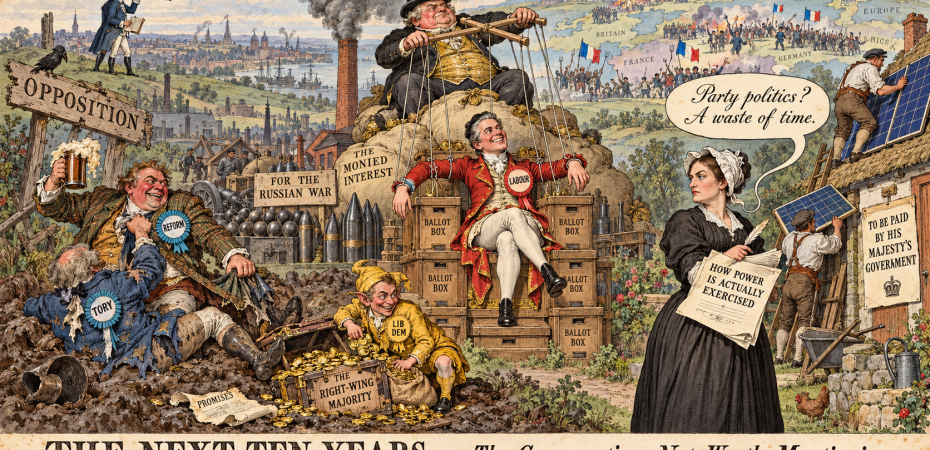
It occurred to me last week that none of us at the Libertarian Alliance has written anything about the Conservative Party for months. I did not watch any of its conference in Birmingham. I did not read the reports of the speeches, and I could not tell you who any of the shadow ministers are, or whether there are still enough Conservative MPs to fill a shadow cabinet without giving some of them two jobs each. The most I know about the Party is that it is led by a Nigerian woman with an unpronounceable name. Every so often she makes an unlikely promise. Someone told me afterwards that this year’s was a £10 billion “Britannia Shield” to protect the country from drones and missiles, the scope of which the Party then explained to be a good deal narrower than it had sounded in the hall. Nobody believes these promises, and I certainly pay them no attention.
The Conservative Party is a waste of time. Rather than say more about it, I will set down what I think is going to happen in this country over the next ten years. Some of it will be wrong. Forecasting is a humbling trade, and the reader is welcome to come back in 2036 and laugh at me. But I would rather be wrong about something that matters than right about the reshuffling of a shadow cabinet nobody can name.
The election
Andy Burnham has been Prime Minister since 20 July. He has said more than once that he will not call an early election, on the ground that he does not think people want one. Politicians say this sort of thing until the moment they stop saying it. Unless he is stupid, which is always possible, he will go to the country in the near future, probably once he has some plan or other to wave about and before the novelty of not being Keir Starmer wears off entirely.
The professional pollsters think this would be a dangerous gamble. YouGov has Labour and Reform level on 23 per cent, and John Curtice says the numbers are not there. I think they are reading the wrong numbers. Add the Reform and Conservative votes together and there is a clear right-wing majority in the country. But those votes will not be added together, because the two parties will spend the campaign attacking each other, and our electoral system rewards the largest minority in each seat rather than the largest body of opinion in the nation. Labour won its present majority in 2024 on barely a third of the vote. It can do the same again against a divided right, and even on a bad night it will have the Liberal Democrats to fall back on. A coalition of the two would make very little practical difference to anything, since their disagreements are mostly matters of tone.
The division of the right is not something I am inventing to make the arithmetic work. It is the declared policy of both its leaders. The Nigerian woman with an unpronounceable name told her conference, of those who want an electoral pact, “we are not uniting with that”. Nigel Farage has spent the past year treating the Conservative Party as a quarry from which to dig out ministers and councillors, and he will not stop now.
The fate of the right
Reform will probably be the largest opposition party after that election. I have no idea who still votes Conservative, or who will do so under its present leadership. Let me be clear, for the benefit of any police officer reading this, that I am expressing no illegal opinion about Nigerian women with unpronounceable names. In the nineteenth century, when Britain was both more homogeneous and more nationalist than it is now, Benjamin Disraeli rose to lead the Conservative Party and to be Prime Minister twice. He was born a Jew, was mocked as one for most of his career, and got to the top anyway. There is no reason in itself why a Nigerian woman with an unpronounceable name cannot do the same. What matters is that Disraeli was a man of first-class intellect and abilities, and the Nigerian woman in question with the unpronounceable name might have trouble scraping into the third class.
So Reform will take most of the right-wing vote, and it will spend most of the next Parliament trying to finish off what remains of the Conservative Party. Led by Mr Farage, it will spend whatever time it does not give to that project tearing itself apart. I have written before about the quality of the people it has been collecting from the scrapheap of the older parties, and I see no reason to revise my opinion. A party that makes room for Nadhim Zahawi has made room for the kind of quarrels that follow men like him wherever they go.
What Labour will do
The resulting Labour government, with or without its Liberal Democrat lodgers, will complete the remodelling of the country into what the monied interest wants it to be. I expect this to involve rejoining the European Union, perhaps by stages, so that the final application can be presented as the tidying up of arrangements already in place. It will involve some degree of reindustrialisation, because you cannot prepare for a war with Russia using management consultants and call centres, and preparation for that war is the third part of the programme. Factories will be built again in this country, but they will be built to make shells and drones, and the men who work in them will be told that their wages depend on a permanent emergency.
It will also involve electoral reform. This may or may not be a good thing. A system of proportional representation would in principle free voters from the misery of choosing the least bad candidate who might win, and I am not among those who think the present system a sacred inheritance. But electoral systems are designed by the people who will benefit from them. The Government has already promised votes at sixteen. I expect whatever comes next to be drawn up with great care so that it is as bad as possible for every part of the right, and so that any party that does come through it is obliged to govern in coalition with people the governing class can trust.
Against all this there will be no effective opposition. The two right-wing parties will be too busy positioning themselves for the election after next to oppose anything seriously. In any case, they already belong to the political cartel that obeys the monied interest. An opposition that hopes to govern does not dismantle the machinery it expects to inherit. The Online Safety Act was passed by a Conservative government, and the Conservatives in fourteen years of power repealed nothing of substance that Labour had put in place before them. Reform says it would repeal the Act. I will believe that when I see Mr Farage standing at the despatch box with the repeal Bill in his hand, and I do not expect to see that.
The people and the State
Mass immigration will continue. It suits large employers, landlords, universities and the State’s own client industries, and none of the parties with any chance of power intends seriously to stop it. Even if it did stop tomorrow, differential birthrates would carry the change forward on their own. At the 2021 Census, those who described themselves as White British were 74.4 per cent of the population of England and Wales, down from 80.5 per cent ten years before, and the net migration of the years since has been the highest in our history. The traditional population of this country will become a minority within the lifetime of children now at school, and in ten years the process will be far enough advanced that no one will be able to pretend otherwise.
The ethnic tensions that follow will be managed by increasingly authoritarian government from the centre. This will be disguised by schemes of devolved government: more mayors, more combined authorities, more regional assemblies with impressive titles. I hardly need point out that the present Prime Minister made his name as one of these mayors. Devolution of this kind gives very little power to the people of a region. What it does give is jobs, budgets and status to the governing class and its various clients, while the decisions that matter about policing, speech, money and borders continue to be taken in London.
The present order of things will become more authoritarian in the traditional ways. We shall have more police powers, more surveillance and more offences carrying longer sentences. But it will also become increasingly totalitarian in its management of opinion and its punishment of dissent. According to figures obtained by The Times, the police in England and Wales were already arresting more than twelve thousand people a year for what they said online or in messages. That number will go up, and the definition of what may not be said will go on widening. Most people will not be arrested. They will simply learn to keep quiet, which is the purpose of the exercise.
Revolution and its uses
There is no hope to be found in electoral politics. Instead, I expect that some time in the next ten years there will be a wave of populist revolutions throughout Europe. I use the word loosely. I mean risings and disorders large enough to frighten governments, rather than storming of palaces. I do not welcome them. Unless they are led by men of genius, like Lenin or Khomeini, revolutions are greatly overrated as a means of achieving political change. They usually end with the crowd going home and the officials going back to their desks, sometimes with a new portrait on the wall.
Their value lies elsewhere. The resulting instability may sharpen a split we can already see within the actual ruling class, between those who think the present course can be held by force and propaganda and those who suspect it cannot. A reforming wing may gain the upper hand and set about giving the people enough of what they want, or enough of the appearance to amount to some reality, to restabilise the system. In the direct sense, then, revolutions are another waste of time. In the indirect sense, they are a kind of opinion poll, more expensive than the ones YouGov conducts but much harder to ignore, which the reformers can wave about in their arguments with their colleagues. What happens after that is beyond my powers of prediction.
Why I am not in despair
Does all this mean economic impoverishment? I do not think it does. I am not a political optimist, but I am an economic optimist. The wars in the Ukraine and in the Middle East will be settled on terms more or less unfavourable to the West. These settlements will be followed by a restructuring of the Western powers, intended to recover some of the technological and economic primacy they have lost to China. This may restrain some of the authoritarian and totalitarian tendencies I have described, since rich and confident governments have less need to be frightened of their own people. Or it may not. What matters is that there will be a burst of economic growth.
Part of that growth will come from energy. Either the green targets will be quietly abandoned, or they will be altered in ways that allow cheap energy to be produced without fossil fuels. I know the objection: the sun does not shine much in an English January, and nobody has yet found a cheap way of storing a summer’s electricity for the winter. It is a fair objection, and I do not dismiss it. But the cost of solar panels has fallen by roughly nine tenths since 2010, the cost of batteries has fallen nearly as fast, and I see no reason why the remaining problems should not yield to the same combination of engineering and greed. It can be done without building nuclear power stations everywhere, though I would have no objection to a few.
Here I must declare an interest. I am ready and waiting for the British Government to pay for solar panels to be fitted to my house. At present it offers a zero rate of VAT on their installation, which expires in March 2027. That is not enough. I want direct subsidy or heavy tax relief on the purchase and fitting of the panels. I have spent my whole adult life paying for other people’s subsidies, from wind farms in the North Sea to the pension arrangements of the BBC, and I see no reason why the flow should not occasionally run in my direction. I will put the money to better use than they did.
What is left to do
I therefore see no reason whatever to involve myself in party politics. It is a waste of time. The real decisions have already been made, and voting, where it is still allowed, will serve only to give them legitimacy. Any political writing that is not a waste of time should be given to uncovering and analysing how power is actually exercised in this country, by whom and for what purpose, and to producing a body of work that can inform and inspire the next generation, which will have to deal with what this one has left behind. That is why none of us has written about the Conservative Party for months, and why I do not expect to write about it again.

Discover more from The Libertarian Alliance
Subscribe to get the latest posts sent to your email.
Related posts:
 Britain’s Youth Exodus: Labour’s Crime, Conservative Guilt
 Zahawi and the Managed Collapse of Reform
The Function of Farage: A Commentary on Marian Halcombe’s Analysis
 Rupert Lowe: Wrecker or Useful Wrecker?
 Makerfield and the Politics of Pressure
 Burnham’s Thermidor
 Peter Mandelson: Oh to Be in England Now that Thermidor is Here
 Michael Howard: Architect of the Police State, Victim of the BBC
 The Budget that Cannot Yet Be Written
 Britain and the End of the Illusion of Plenty
 The Thucydides Trap Sprung by Default: Trump in Beijing and the Welcome Eclipse of a Malignant American Empire
 George Galloway for Prime Minister!
Powered by YARPP.