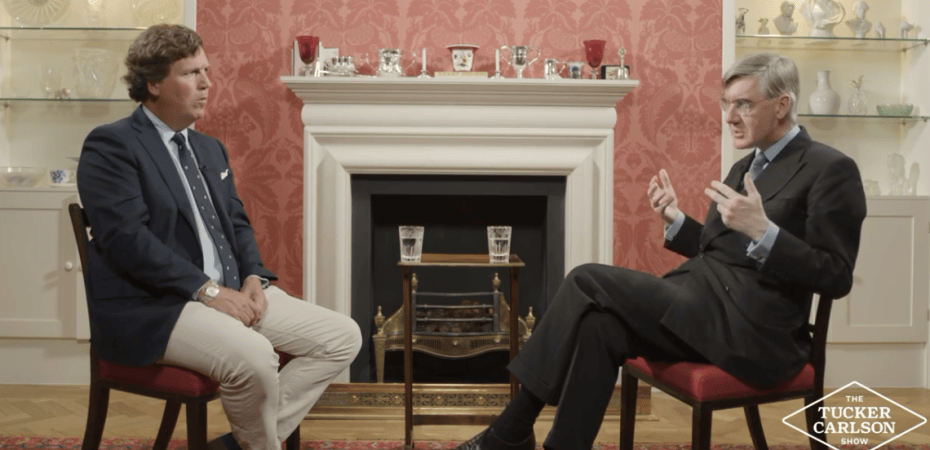
I have no time for watching videos. But I will read their transcripts when made available. Therefore, if I did not watch it, I have read Tucker Carlson’s interview with Jacob Rees-Mogg, published on the 2nd October 2026. The most revealing part of the interview with comes towards the end. After nearly an hour discussing Russia, deterrence, the world wars and the international order, the conversation reaches the freedom of British people to speak in their own country. Rees-Mogg supplies this extraordinary reassurance:
“They’re not oppressing anything that I’ve tried to say…” — 58:04
He immediately seeks to qualify it. Nevertheless, the instinct is revealing. Here is a former senior minister, confronted with the suppression of other people’s opinions, reaching first for the fact that his own opinions remain comfortably expressible.
Carlson interrupts:
“That’s not how free speech works.”
Quite. A political order cannot be judged by how pleasantly it treats Jacob Rees-Mogg.
The interview ranges widely. Rees-Mogg argues that military preparedness deters Russia, that the integrity of nation states is essential to international order, and that Britain has an interest in supporting Ukraine. Carlson repeatedly asks what these commitments cost, how they benefit British people, and whether Britain’s rulers are more attentive to distant frontiers than to the condition of their own country. They dispute the justification for the world wars, the bombing of Hiroshima and Nagasaki, immigration, sovereignty and the policing of speech.
But the central political revelation is much simpler. Rees-Mogg can recognise failure. He can describe it. He can occasionally deplore it in language strong enough to satisfy a conservative audience. What he does not provide is a convincing account of why anyone should entrust the remedy to the political class that presided over it.
That is what makes him, in my judgment, a City spiv masquerading as a gentleman. The phrase describes a political performance: the cultivation of reassuring manners and traditional associations while selling another instalment of the same exhausted Conservative promise. His career in finance and his role in establishing Somerset Capital Management are matters of public record. So are his appointments as Leader of the Commons, minister for government efficiency and Business Secretary. This was a man inside government, with access and influence, not an eccentric spectator watching events from a country drawing room.
The cultivated traditionalism therefore deserves to be tested against results. Knowledge of historical precedents is no substitute for preserving an actual liberty. A politician does not conserve a country merely by sounding as though he remembers it.
Consider his account of free speech:
“We have historically protected freedom of speech through the way politicians have behaved and we are now attacking freedom of speech and I’m deeply concerned about that.” — 54:58
This is a serious admission. “We are now attacking freedom of speech.” Yet shortly afterwards the gravity diminishes:
“I’m not in favor of the way free speech is being policed in this country.” — 57:57
And then:
“There’s some overzealous enforcement of laws that are meant to stop. Harassment, which to my mind go much too far, but there has been, as yet, no attempt to stop free political speech.” — 59:51
The transcript’s punctuation is awkward, but the argument is clear. What he first identifies as an attack on freedom becomes excessive enthusiasm in administering otherwise respectable laws.
This is the language by which a governing establishment excuses itself. The machinery is fundamentally sound; someone has operated it rather too vigorously. There is no need for a searching examination of what Parliament authorised, what the police have come to regard as their function, or what ordinary people learn to leave unsaid. There are merely unfortunate excesses.
His distinction between objectionable restrictions and “normal political discourse” is even more revealing:
“They are not affecting normal political discourse.” — 59:51
Who defines normal? Political freedom matters because people disagree about what may respectably be said. If liberty extends only to opinions already recognised as ordinary by former Cabinet ministers, it offers little protection where protection is most needed.
Rees-Mogg adds:
“I’m very against people praying outside abortion clinics being arrested. I think it’s quite improper and is against freedom of speech, but that is not at risk of determining a general election.” — 59:51
Why should that be the test? An abuse does not become tolerable because its victims are too few to change the electoral result. The freedom of a politically inconvenient minority is not a dispensable ornament on a system whose voting arrangements still function. This is where his claim to traditional conservatism becomes particularly threadbare. The defence of inherited liberties ought to involve a profound suspicion of arbitrary power. Instead, we get reassurance that the electoral machinery will continue turning.
His proposed remedy is almost beyond parody:
“We have a functioning democracy, we’ll have a general election, and I hope we will have a conservative government that will restore freedom of speech…” — 59:37
Another Conservative government. Of course. What else could possibly be required after the experience of Conservative government? The party’s record cannot be treated as an irrelevant prehistory. The Online Safety Act received Royal Assent in October 2023 under a Conservative government, creating an extensive system of duties and regulation for online services. Section 9 of the Public Order Act 2023 likewise put restrictions concerning abortion-clinic safe access zones into statute during Conservative rule. Whatever arguments are made for those measures, the underlying powers did not simply materialise with a subsequent government. That does not establish Rees-Mogg’s personal responsibility for every provision. It does destroy the comforting fiction that Conservative politicians can approach the subject as innocent rescuers.
In this interview he identifies no practical achievement of his own that answers the central accusation: that his traditionalism failed to turn back, or establish an effective barrier against, the growth of the ideological and coercive state he now deplores. Where is the durable protection? Where is the institutional change? Where is the reason to believe that another period in office would produce anything better?
Those questions are more damaging than an inventory of his mannerisms. He can deplore the woke police state, as its critics describe modern Britain, while continuing to explain why its workings are less serious than they appear.
The discussion of Palestine Action supplies a particularly unpleasant example. Speaking about the arrest of elderly supporters, he says:
“They’ve arrested elderly people who, to my mind, very silly people, but nonetheless are entitled to their view.” — 01:01:16
He deserves credit for conceding their entitlement. But notice how insistently he returns to the embarrassment suffered by the authorities:
“I think it’s made the government look very foolish.” — 01:01:16
Carlson identifies the misplaced emphasis:
“But what about the elderly people? What about them? … Who cares about the government?” — exchange at 01:01:16
Yes. For the person arrested, the principal consideration is hardly whether the government has incurred a reputational inconvenience. Arrest is an exercise of power against a human being. It cannot be made harmless by observing that ministers look ridiculous afterwards.
Rees-Mogg then offers the consoling thought that overzealous governments:
“Get to look ridiculous.” — 01:01:16
A government can look ridiculous and still frighten people into silence. Ridicule does not cancel police powers. It does not restore the time, money or peace of mind lost by those subjected to them.
The same habit appears in the discussion of immigration. Rees-Mogg admits:
“I think our immigration policies have been catastrophic.” — 34:40
He also acknowledges that the larger issue extends beyond small boats:
“The biggest part, which is now coming down thankfully, but needs to be reduced much further, is legal immigration.” — 34:47
That is a useful distinction. It directs attention towards the decisions of government itself. If the principal issue is legal immigration, then the explanation cannot consist entirely of blaming smugglers, irregular arrivals or administrative inconvenience. Ministers and parliamentary majorities have questions to answer about the system they operated.
Yet when Carlson presses him, Rees-Mogg retreats into:
“There are failures in the administration.” — 35:12
“Catastrophic” policy becomes “failures in the administration.” The vocabulary contracts just as responsibility comes into view.
On foreign affairs, by contrast, there is no shortage of resolve:
“The way to avoid war is to prepare for it.” — 00:16
Later:
“We won’t fight a war if we are defended.” — 20:35
There is a serious argument for deterrence. Rees-Mogg’s strongest passage explains why a state needs conventional capabilities between doing nothing and threatening nuclear destruction. Carlson does not dispose of that argument simply by repeating that Russia has nuclear weapons. But a principle of deterrence is not a complete policy. It still requires an account of objectives, resources, limits and risks. When asked where the money will come from, Rees-Mogg replies:
“There’s plenty of money. We’re just spending it all on welfare at the moment.” — 18:58
The contrast in urgency is striking. For military expenditure there is money to be found and strength to be projected. For the domestic suppression of speech there are qualifications, reassurances and the prospect of another election.
He is willing to contemplate the gravest personal consequence:
“You cannot say this country must be strong and must be ready to go to war without thinking that if it came to a bomb dropping on your house, that is a bomb you would have to accept.” — 56:39
That is more honourable than demanding risks from which he explicitly exempts himself. It still does not answer the question of what risks he is entitled to recommend for everyone else, or why the defence of British freedom should sound so urgent abroad and so comfortably postponable at home.
Carlson is not an infallible guide through these matters. His sweeping historical counterfactuals and his suggestion that overwhelming destructive capacity could simply “end the war” require arguments he does not supply. Nor does the cost of defeating an aggressor, by itself, establish that accepting the aggressor’s victory would have been preferable. The case against Rees-Mogg does not require accepting every Carlson assertion. It rests on Rees-Mogg’s own combination of admission and evasion. For voters who repeatedly supported the Conservatives from 2010 onwards in the expectation of restraint, national continuity and the protection of liberty, the grievance is intelligible and bitter:
We gave them our votes; they promised conservatism; we got leftism with a blue rosette.
That is a political verdict on a broken bargain. The language of betrayal is deserved wherever leaders solicit votes for principles they then decline to defend. Calling them traitors to their promises expresses that judgment; it need not pretend to be an allegation of treason or a finding of criminal electoral fraud.
What this interview supplies is a reason to withhold every further advance of trust. Rees-Mogg recognises enough of the damage to sound sympathetic, minimises enough of it to protect the establishment, and finally offers the Conservative Party as the cure. An opposition still dominated by the authors and apologists of that failure has no claim to be believed merely because it has changed seats in the Commons. Until it accepts responsibility, identifies the powers it would repeal, and demonstrates a willingness to confront the institutions it previously accommodated, there is no sound reason to expect a worthwhile conservative restoration from it.
The interview ends with Rees-Mogg declaring:
“I’m not pessimistic about the ultimate success of free speech in this country.” — 01:02:35
How agreeable for him. The people who require protection from the state need something more substantial than his optimism. They need enforceable liberties and politicians prepared to secure them. Rees-Mogg offers polished conversation and another invitation to trust his party. We have heard the sales pitch before. The gentlemanly performance does not improve the merchandise.

Discover more from The Libertarian Alliance
Subscribe to get the latest posts sent to your email.
Related posts:
 Boris Johnson: The Butcher as Charlatan
 A Socialism Against the Cartel
 George Galloway for Prime Minister!
 Kemi Badenoch’s Speech: The Last Act of an Unfunny Farce
 Kemi Badenoch’s Reagan Revival: The Last Squeak of a Deflated Party
 The Crossbow Panic: Another Fraud by the British State
 The Kitchen Knife Licence: A State that Fears Its Own Subjects
 Globalism: Weighed in the Balance and Found Wanting
 Britain and the End of the Illusion of Plenty
 Michael Howard: Architect of the Police State, Victim of the BBC
 Britain’s Youth Exodus: Labour’s Crime, Conservative Guilt
 The Ban That Dare Not Speak Its Name: Britain’s War on Political Speech
Powered by YARPP.
Rees‑Mogg offers a simulacrum of liberty: a display of symbols, gestures, and mannerisms — a self‑contained fiction presented as the real thing. He performs the appearance of conservatism, adopting the costume, the historical references, and the aristocratic affectations, yet he never defends the underlying principles. Modern conservatism has become a distortion of classical liberalism, even if not a full inversion. His proposed remedy amounts to well‑mannered lords of the land who promise to treat the serfs humanely. I recall a video in which he petulantly rejected the Enlightenment, insisting that traditional faith should serve as the intellectual foundation.