
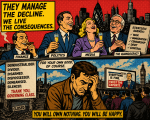
Image credit: Mohamed_hassan from Pixabay
I have spent the last year and more writing two strands of essays. Essays that, to some, may seem rather long, complex and academic. Yet throughout, I have tried my utmost to compress and, if you will, “mince” them into digestible chunks.
One of my strands has been about political theory. I have outlined the ideas of some thinkers of the past; and three in particular. John Locke, one of the good guys. Jean Bodin, who made himself into a really bad guy. And Franz Oppenheimer, another good guy. Further, I have set out, as briefly and clearly as I can, my views on history, ethics, political philosophy and the psychology of those that seek power. And I have given you a broad outline for a new and better system, to replace today’s failed systems of “politics” and “government.”
The other strand has been about what has been happening in politics in recent decades. Particularly in the UK; but I have also cited examples from elsewhere. I gave you, around three months ago, a 4,500-word summary of what is being done to us: [[1]]. And two weeks ago, I reviewed a book by Bernie Spofforth, which tells a lot about the back-story: [[2]].
Today, I begin a new phase of my endeavours. This is the moment, at which I start to use ideas and evidence from the two strands together, in order to start on the path to understanding the roots of what is going on.
What is going on?
The political system we live under has been deteriorating for decades. At least since the 1980s, for those of us who can remember that far back.
Today, we are bombarded by many different kinds of political artillery. We suffer the crazy, fraudulent nett zero and anti-car agendas. Every few weeks or even days, we see yet more proposed violations of our rights and freedoms, such as restrictions on our Internet and social media access, supposedly to “protect children.” We have local government “devolution” that actually centralizes power. We see immigration being allowed, obviously deliberately, to grow out of control. And we have “two-tier policing,” where individuals acting similarly are treated differently.
At one level, what is happening is pretty obvious. Those in government power today are destroying our economy, taxing us out of existence, and impoverishing us all. They are seeking to destroy the rule of law, our individuality and independence, and our rights and freedoms. They are seeking to overwhelm people’s minds with their false narratives. And those who speak out, or even try to speak out, against their predations and injustices are always in danger of being smeared, silenced or suppressed.
They aim to treat us, not as the human beings we are, but as objects to be exploited, or mere numbers in a database. They are seeking to mix into the population large numbers of immigrants, many of whom are not compatible with the indigenous culture. Thus, they are seeking to dilute, and eventually to destroy, the British culture – the very culture that gave humanity the Enlightenment and the Industrial Revolution.
Meanwhile, their cronies and fellow-travellers – a global clique of self-satisfied élites – greedily rake in our money, while helping along the trashing of our rights and freedoms. These cronies include politicians (global, national and local, and of all mainstream parties), government officials, bureaucrats, quangocrats, jobsworths, advisors, influencers, technocrats, academics and “experts,” mainstream media, bankers, financiers, plutocrats, corporate and big-business leaders, and activists for political agendas. It is unsurprising that Reform leader Nigel Farage presents the situation as “the establishment versus the people.”
How are they doing it?
How our enemies are doing all this, too, is not hard to understand. They are implementing policies that they have agreed, without reference to the people they are supposed to serve, with unelected, unaccountable, external parties. In particular, policies rooted in or derived from the “Sustainable Development Goals” of the United Nations. Many of these have been brought in without any public debate, and with minimal or no parliamentary scrutiny.
Even when an MP or two has woken up and started making waves (think Andrew Bridgen on vaccine harms, or Andrea Jenkyns on nett zero), the imposition of the policies blasts ahead without any consideration for the people who will be affected by them. And even when a “consultation” does get offered, the whole exercise is a sham. All responses that go against the establishment agenda are completely ignored.
So, they tax us and use our money to violate our rights, and make us poorer and less free. Nett zero, “biodiversity nett gain,” compulsory COVID vaccinations (while hiding the resulting deaths and injuries), anti-car policies, “devolution” in local government that in reality centralizes power, facial recognition cameras, digital ID, and more. And they love to set arbitrary, collective “targets” and “limits” on what we may do, and to move the goalposts again and again, always in the direction of tightening the noose on us.
By the way, if anyone thinks compulsory digital ID is off the table, look at culture secretary Lisa Nandy’s plans to ban social media for children under 16: [[3]]. By next March! In her own words: “This is a staging post to what must be a very active interventionist state, policing and regulating the online space so that people are safe.” Leaving aside the nastiness of her plans, how can anything that requires on-line age checks be done without a compulsory digital ID?
Our enemies also seek to change the way government operates, always in directions that entrench establishment power. Like taking away juries, and changing voting protocols (such as age limits) to the advantage of the legacy, establishment parties.
They are doing all this at a rate of many new bad laws and negative changes each year. And if these projects, bad for us, bring rich pickings for them and their cronies, they are more than happy with that.
Why are they doing it? And why now?
Just why they are doing these things to us, though – and why at this particular period of history – is far less obvious. That is the question, which I will start to explore today.
The Westphalian state
In the second essay of my theory strand, “The Westphalian state” [[4]], I gave a summary of the political system devised in the 1570s by French monarchist Jean Bodin. It may seem hard to believe, but that set of ideas is still, even today, the design underlying the political system under which we are forced to live.
Sovereignty and subjection
The political set-up, which has become known as the “Westphalian” state, consists of a “sovereign” and “subjects.” They are not equal. The sovereign has “sovereignty” over the subjects, which is reflected in many different ways.
The sovereign has moral privileges. It can make laws to bind the subjects, and give privileges to those it chooses to. It can make war and peace. It appoints the top officials of the state. It is the final court of appeal. It can pardon guilty individuals if it so wishes. It can issue a currency. And it can levy taxes and impositions, and exempt at will certain individuals or groups from payment.
Furthermore, the sovereign isn’t bound by the laws it makes. And it isn’t responsible for the consequences to anyone of what it does – also known as “sovereign immunity,” or “the king can do no wrong.” This immunity is an egregious privilege, because it allows the sovereign, and those acting on its behalf, to operate without any accountability at all.
At the end of that essay, I looked at the meme: “the state is out of date.” And I was in no doubt that this meme is a truth. Moreover, looking at government debt, I concluded that: “As well as being morally bankrupt, the state is all but financially bankrupt.”
Monarchy and élitism
In Bodin’s set-up, the sovereign was an individual, a monarch. But monarchs liked to attach to themselves a cadre of favourites: advisors, supporters, henchmen or a mix of all three. The monarch could dismiss his favourites if he pleased. But if the favourites remained loyal to the monarch, they could usually expect continued favours in return.
Thus, the privileges of sovereignty were in effect extended from the monarch to an élite group around him. The monarch could shower his favourites with privileges, at the expense of everyone else. This led to a governmental system with a small group of courtiers as an élite or ruling class, in between the monarch and the ordinary people.
Divine law and absolutism
Bodin, in common with most Christians of his era, believed that the authority of a monarch came from the Christian deity. And thus, monarchs had a “divine right” to rule. As a quid pro quo, the monarch was expected to obey a “divine law,” set by this deity. This included keeping to any agreement he chose to make with his subjects.
But this same divine law required a subject to obey unquestioningly the ruler that had been set over him. Therefore, it could not protect the subjects against bad treatment by the monarch. Indeed, Bodin said: “The subject is never justified in any circumstances in attempting anything against his sovereign prince, however evil and tyrannical he may be.” In practice, therefore, a monarch could feel that anything he did to his subjects was OK, no matter how much hurt it caused them.
This led to what is called “absolutism.” The first English monarch to take the throne after Bodin’s ideas took root was James I. James certainly believed that he had an absolute, divine right to rule over his subjects. But he was also a half decent man. He did not exploit the people with heavy taxation, and he always sought peace rather than making wars.
His son, Charles I, shared James’s absolutism. But he was far more Machiavellian in character. He sought to impose taxes on the people, without the consent even of the élite group that now formed the parliament. He tried to impose his own religious views, and had dissenters’ ears cut off. He made promises, that he then reneged on. He accepted the parliament’s “Petition of Right,” but then carried on violating it regardless, even to the point of imposing martial law on the people. And he arbitrarily expanded the area of the royal forests, then threw out the people who lived in them.
Charlie got the chopper he so richly deserved. But once the dust had settled, not much had changed, except that the parliament had far more power, and the monarch less. The members of parliament were merely the new group of élite courtiers.
Enrichment, control and persecution
For millennia, states have done three main things to the people they rule over. One, enrich themselves and their cronies at the expense of ordinary people. Two, seek to control people, and make them do other than what they want to. And three, persecute those they don’t like.
Enriching vested interests
We see many instances in history, where vested interests have sought to use the state to enrich themselves or entrench their own privileges.
In 1815, for example, a group of “mercantilists” sought economic policies that would build up the power of the state, and strengthen the recently created “United Kingdom” relative to foreign powers. Their interests overlapped with a class of large landowners (including many members of parliament), who wanted to maximize the income they received from their estates. Together, they made the tariffs and trade restrictions called the “Corn Laws,” which for more than three decades made food in the UK far more expensive than it need have been. Causing food shortages and riots, and contributing in 1845 to triggering the Irish famine.
Controlling the people
Often, vested interests have used state power to maximize their control over the people. For example, by restricting personal mobility (think ULEZ), or by denying basic rights like the presumption of innocence or freedom of speech (think the “climate change” scam and the BBC’s treatment of skeptics). Or by forcing people to do things they do not want to (think compulsory COVID jabs). Or by harassing or ordering around people who have done no real harm to anyone (think two-tier policing).
Persecutions
But the damage inflicted by states and their favourites extends to persecutions too.
Religious persecutions have been perhaps the longest-standing of all. In England, Catholic monarchs persecuted Protestants, and Protestant monarchs and parliaments did tit for tat. Meanwhile, on the continent, church and state combined to persecute religious “crimethink.” The Inquisitions found innocent people guilty, then delegated their murder to the local magnate. Let’s not even think about the Thirty Years’ War, which killed between a fifth and a third of all the people in Germany.
Moreover, persecutions have often been carried out by those who want to scapegoat the kinds of people they hate. Such as the long history of persecuting Jews. Or discrimination on grounds of race, or against people who want to be independent (think one-man businesses and car drivers). Or the labelling as “misinformation” of truths inconvenient to the élites, and criminalization of the truth-tellers.
But the worst persecutions occur when those unhappy at how the state is treating them seek to create change in the system. Think, for example, of the persecutions of the early working people’s movement, which culminated in the Peterloo Massacre.
The Rhythms of History
To the fourth essay in my theory strand, “The Rhythms of History.” [[5]]. There, I set out my view of history in the large.
I see human history as a series of forward moving revolutions, punctuated by times of stagnation or back-sliding. These regressive periods result from counter-revolutions, that are launched by those that want to hold us back. Since the Neanderthal extinction of 40,000 years ago, I see five of these pairs of revolutions and counter-revolutions.
Humanity versus the state
Our first, the Neolithic revolution, was a practical one. We settled down in communities, and started to cultivate crops and domesticate animals. We discovered what it is to be human.
This was later countered by the rise of the political state, enabling a powerful élite to take control over everyone else. The paradigm of the first revolution was Humanity, and the counter-paradigm was the state.
As soon as states were in place, the population became divided into two classes. The politically rich – the establishment or élites – that control and seek to control others. And the politically poor, the rest of us. The politically rich desired, and still desire, to control and (in John Locke’s words) “impoverish, harass or subdue” the politically poor. And whenever they felt the need, they sought to tighten the level of control.
Reason versus the church
Our second revolution was a mental one, enabling us to start to think rationally and abstractly. It began in ancient Greece, and held sway into Roman times. Its paradigm was Reason. It brought new and better ways of organizing civilizations, like Athenian democracy.
But it was countered by the rise of institutional religion, and the church its counter-paradigm. This supported the rise of a priestly élite, that wanted mental control over the ordinary people. State and church worked together to control the people. And the priestly class joined the politically rich, eventually producing the infamous “alliance of squire and parson.”
The Renaissance versus Bodin’s state
Our third revolution was the Renaissance. It was a spiritual revolution, and its paradigm was Discovery. It gave us new moral perspectives, and a feeling of cultural renewal.
Against this, thinkers like Machiavelli and Bodin laid a new groundwork for the state, so it not only demanded obedience from the people, but was also cruel, oppressive, heartless, sly, deceitful and unscrupulous. Orthodoxy, Tyranny, and Dishonesty were its counter-paradigms.
The Enlightenment versus political ideology
Our fourth revolution was another mental revolution: the Enlightenment. Its paradigm was Freedom. And the values that it brought, like individual liberty, and government with the consent of and for the benefit of the people, are supposedly among the foundations of the “democracy” that the current political system claims to respect.
But this was increasingly opposed by a slew of political ideologies, ranging from socialism to nationalism to communism to fascism to social or religious conservatism, whose common counter-paradigm was Collectivism.
The Industrial Revolution versus what we face today
Our fifth revolution was the Industrial Revolution, another practical one. Its paradigm was, and still is, the Creativity that is natural to human beings. It allowed us to flourish in an environment of the free market and honest business, wherever and whenever we had them.
As to the fifth counter-revolution, I will quote my earlier essay directly. “It began during the second world war, with the events that led to the formation of the current international order. Its counter-paradigm is Suppression. Suppression of truth, suppression of rights and freedoms, suppression of prosperity, suppression of our humanity and our creativity. Suppression of us human beings.” Its main thrust today is “a push to suppress our industrial civilization, to shut down the economic free market, and to use taxation, regulation and extortion to squeeze us ordinary human beings out of existence.”
What the last 80 years have brought us
Our enemies’ fifth counter-revolution has brought the UN, its agencies and satellites, grasping big business, the World Economic Forum (WEF), and much else. It has brought out-of-control migration, the perversion of precaution into a tool for tyranny, corruption in science, and governments that don’t care a damn about the interests of the people they are supposed to serve. It has brought contempt for democracy, ever increasing taxation and state control, green and anti-car policies, increasing violations of human rights and freedoms, and lack of respect for us human beings.
Moreover, it has brought us a whole fleet of metaphorical mega-dinghies full of cronies and fellow-travellers, hanging on with all their might to the coat-tails of the political élites. I’ll repeat the list from earlier: politicians (global, national and local, and of all mainstream parties), government officials, bureaucrats, quangocrats, jobsworths, advisors, influencers, technocrats, academics and “experts,” mainstream media, bankers, financiers, plutocrats, corporate and big-business leaders, and activists for political agendas.
Like the priestly class in earlier history, these assorted cronies have allied with the political élites, and by doing so have made themselves politically rich. And today, they are engaging in a rumbunctious feeding frenzy on us, the politically poor.
Oppenheimer’s Razor
I will move, briefly, to the third essay in my theory strand: “Oppenheimer’s Razor.” [[6]].
There, I quoted Franz Oppenheimer’s famous distinction between the “economic means” and the “political means” for the satisfaction of human needs. The economic means is “the equivalent exchange of one’s own labor for the labor of others.” While the political means is “the unrequited appropriation of the labor of others.”
I also introduced what I call Oppenheimer’s Razor. This separates users of the political means from users of the economic means. It divides honest working and business people from those that like to use political power, directly or indirectly, to line their own nests and those of their favourites. In the terms I have been using here, it divides the politically poor from the politically rich.
In conclusion
I will return to Bernie Spofforth’s book, “A War to Win Back Your World,” which I referenced above. Her title clearly describes its subject matter as “a war.” She is absolutely right: we are at war. Yet she hardly ever uses the word “war” in the text of the book itself.
So, helpful as is my wont, I will give you, explicitly, a feel for what this war is all about. Beginning about 80 years ago, and intensifying more and more over the last 40 years or so, they, the politically rich, have been waging war against us, the politically poor. They have been using the state to wage war on the people. If you aren’t already 87 years old or more, you’ve been at war all your life. Even if you didn’t know it.
The scope of the war has widened, so that now most people are involved on one side or the other. I myself joined the ranks of the politically poor back in 2000, when Labour brought in a bad tax law called IR35. As a campaign manager for Reform UK, I guess I have now risen in those ranks to about the level of a colonel.
Our enemies include, but are not necessarily limited to, the list of cronies and fellow travellers I identified above. The war we’re in today is, in Franz Oppenheimer’s terms, between the users of the political means and the users of the economic means. The dividing line between us is what I call Oppenheimer’s Razor.
This is the biggest war in human history. Bigger than either “world war.” It affects, in one way or another, every human being on the planet. At present, we the politically poor appear to be losing this war. The reason is obvious: most of us haven’t even got our boots on yet!
But I’ve got my (metaphorical) boots on. So has Bernie Spofforth. So have quite a few other people, including the nearly 3 million of us who signed the petition against digital ID. And the truth is on our side.
It’s time for you, like the truth, to get your boots on.
[[1]] https://libertarianism.uk/2026/05/23/where-we-are-today/
[[2]] https://libertarianism.uk/2026/09/15/book-review-a-war-to-win-back-your-world-by-bernie-spofforth/
[[3]] https://www.dailysabah.com/world/europe/uk-signals-broader-tech-regulations-beyond-u-16-social-media-ban
[[4]] https://libertarianism.uk/2025/07/18/the-westphalian-state/
[[5]] https://libertarianism.uk/2025/07/27/the-rhythms-of-history-2/
[[6]] https://libertarianism.uk/2025/07/23/oppenheimers-razor/
Discover more from The Libertarian Alliance
Subscribe to get the latest posts sent to your email.
Related posts:
 Just governance
 The Foundations for a Better World
 A possible structure for just governance
 Tax the Rich, Free the Middle Class
 Predatory Precaution
 What should be the functions of government?
 An Examination in the Philosophy of Liberty
 Examination in the Philosophy of Liberty: The Headmaster’s Report
 Where We Are Today
 On Gritting Our Teeth for a Revolution
 The Copyright Clerisy versus the Future: Why AI Must Not Be Hindered
 Mozart’s Finances: Was He Really Poor and Undervalued in Vienna?
Powered by YARPP.