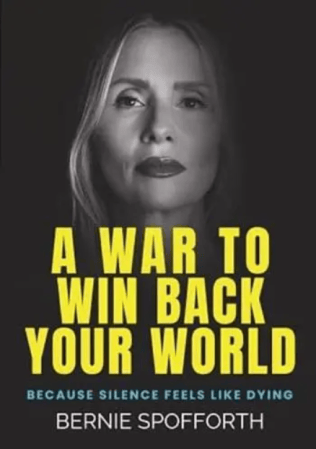
(Image credit: Fisher King Publishing)
A couple of weeks ago, I chanced on a video by Winston Marshall, in which he interviewed Bernadette (Bernie) Spofforth: [[1]]. They talked about many things: free speech, migration, her arrest for a 2024 tweet about the Southport murderer, digital ID, the collapsing UK economy, the ways in which governments of all parties strive to control us, the dishonesty of politicians, and the role of the United Nations in all this. And she mentioned a book she had published, in June 2026, on these subjects: [[2]].
Now, having been trained long ago as a mathematician, I have since become a libertarian writer, a self-taught ethical and political philosopher, something of a historian – particularly in environmental matters – and also campaign manager for my local branch of Reform UK. As well as a member of the civil liberties organization Together, and former deputy leader of its local group. And I have written about many of the same issues Bernie addresses.
So, unsurprisingly, I was interested in this book, published by Fisher King: [[3]]. I determined to write a review of it as soon as I could. This is the result.
Initial impressions
It is a brick of a book – 455 pages. It took me about 17 hours, spread over four days, to read it through and make notes. Fortunately, the weather was generally dry and warm, so I was able to do most of the work sitting on benches overlooking my local lake.
First impression: I enjoyed the back-cover blurb, introducing the book as: “Fearless, frightening, funny and fiercely analytical.” And being strongly opposed to AI, I appreciated the “Human Author” graphic on the reverse of the frontispiece.
As to the author: She has had a varied career in business. Of the eight UK companies of which she has been a director, three are still active. That’s good in the current climate. Swimwear – not exactly an interest of mine – seems to have been the main theme recently. But as the book intimates, she has changed career since 2024. It looks as if she has used her arrest, and its aftermath, to re-shape herself into an investigative journalist.
The book
After the Prologue, which (with a fair degree of emotion) recounts Bernie’s arrest and what followed, the book is in three Parts. Part One, The Machine Is Built, charts the rise of the globalist empire that, day by day, seeks to enslave us all more and more to the whims of its unaccountable élite. Part Two, The Age of Control, is the “meat” of the book, exploring the many different ways in which that empire seeks to control us. Part Three, sadly too short in my opinion, addresses Collapse, Consequence and Resistance.
It is my wont, when I review a text and particularly like something I find, to quote verbatim the text that pleases me. So, I will begin at the end, and give you this: “Now the time for silence from all of us is over. The time to speak truth to power, just as Socrates did, has come. It’s time to live again.”
Amen.
Part One – The Machine Is Built
The UN
Bernie begins with a bolt against the major enemy of humanity today – the United Nations.
I already knew a lot of what is in this chapter. I knew, for example, that the UN has been the driving force behind the green and anti-human agenda, that has been destroying our rights and freedoms since the 1970s. In fact, I have written an essay called “Our Enemy, the UN.”
But I didn’t know about the 2019 Strategic Partnership Framework with the World Economic Forum (WEF), whose purpose was “to accelerate the implementation of the 2030 Agenda for Sustainable Development.” A good catch, Bernie.
The Population Problem
I am well aware of the UN’s role in fanning the replacement migration agenda since 2000, and have written about it myself. But I didn’t know about the book “The Population Problem,” edited by Stanley Johnson, Boris’s father. Another good catch.
The Club of Rome
Two quotes worth repeating. “Crises weren’t problems to solve; they were tools to engineer a common global goal.” And “Government of the many, for the few, by the few.” Moreover, a question: Is it a coincidence that the UN’s “Sustainable Development Goals” and the “Paris Agreement” were signed in the same year, 2015?
The Megaphone
I didn’t before know about the 2018 Global Media Compact, which described itself as “a new drive to advance awareness of the Sustainable Development Goals (SDGs).” In 2018 and 2019, the UN was hard at work promoting its agenda!
Stakeholder capitalism
I share Bernie’s revulsion against “stakeholder capitalism.” She is spot on with her criticisms, and her assignment of much of the blame to the WEF. Whose “programmes have ended up giving far greater influence to global corporations and large NGOs than to ordinary citizens.”
The Head of the Snake
Ah, ECOSOC. “Fullthinkers unbellyfeel ECOSOC,” as I have said elsewhere. This is, indeed, the hub which co-ordinates all the bad things the UN is doing to us.
CRAG and Quangos
Perhaps the most startling revelation in the whole book is the story of the Constitutional Reform and Governance Act (CRAG). This bill was a parting shot from Gordon Brown in April 2010.
“CRAG handed ministers a simple mechanism to ratify international treaties and related agreements… with only a brief and largely passive form of parliamentary oversight.” Section 20(4) of the bill explicates this: [[4]]. Yet the Coalition on taking office, instead of scrapping or amending the bill, continued to implement it. That is evidence that all UK governments of recent decades are, in effect, all one party – the Uniparty. Or is it UNiparty?
This chapter also introduces “quangos.” Implementing the more contentious UK government policies is often done by unelected non-departmental bodies, called quangos. They operate “at arm’s length” from ministers, and so are not directly accountable to parliament. Quangos are supposed to be strictly impartial; but many are quite the opposite. The book gives some good examples, such as Ofcom and the Climate Change Committee (CCC).
Put together the bypassing of parliamentary scrutiny using CRAG, and the implementation of bad policies – including those coming from the UN and EU – by activist quangocrats with a mission to force them on us against our wills, and you have a nightmare. For all of us.
Democracy
“The truth us that democracy has always been more illusion than reality.” Yes, indeed. But myself, I’ll go with Emma Goldman: “If voting changed anything, they’d make it illegal.”
Besides which, a system in which ten people can gang up to tell nine people how they must behave is not going to be sustainable for very long!
Religion
I’m an agnostic, so when Bernie talks of environmentalism looking like a kind of “substitute religion,” I think she understates her case. For me, environmentalism is a religion: I dub it “Gaianity.” And like Christianity, I find it empty. Although I have searched for such things, I have found no more hard, objective evidence proving that there is a “climate crisis” or a “nature crisis,” than there is hard evidence proving the existence of a god.
Part Two – The Age of Control
Part Two of the book is full of detail.
The SDGs
This chapter gives a decent overview of each of the Sustainable Development Goals.
I was rather surprised not to find any mention of air quality under SDG 11, since it is referenced in 11.6 (in the context of cities). For this is one of the two major excuses (the other being “safety”) that national and local governments of all the mainstream parties have been using in order to restrict our freedom to drive. Even outside cities.
“There you have it. The goals no one ever really talked to you about in detail; the laws no one discussed with you; and Agenda 2030, adopted in 2015 by UN member states including the UK. I believe these are the central reasons we are in the state we are in today. Almost all roads lead back to the UN and its goals.” That is spot on.
Climate and Nett Zero
Having some expertise in this area, I can say that Bernie Spofforth understands pretty well what is going on there. And she sums up with: “The science is never really ‘settled,’ but the funding always seems to be. And money, in the end, is the root of all control.”
Seeds and Crops
“If you control the seed, you control the farmer. If you control the farmer, you control the food. And if you control the food, you control the people.” Thank you, Mrs Orwell.
Land
“In the United States, the land grab looks different, but the outcome is identical: fewer farmers, bigger corporations, and plenty of farmland being converted into anything but food.”
The Illusion of Choice
“Small producers often can’t comply with the hefty new regulations and policy frameworks tied to Agenda 2030.” And: “It always comes down to the same thing: consolidation, centralisation and profit at the expense of our freedom.” Plus ça change, plus c’est la même chose.
Energy
“The Paris agreement… also opened a new money stream potentially worth trillions in subsidies, carbon markets and green bonds.” Indeed.
“Without oil, humanity cannot exist as it does now.” True, and raises the question: what are the ulterior motives of those that want to phase out the use of fossil fuels?
She concludes the “Solar Energy” chapter by describing solar power – rightly – as “a shiny scam dressed up as earthly salvation.”
As to wind: “The true cost of wind power is carefully hidden behind a façade of propaganda, while the UK drowns in debt to banks and investors. And those same banks and investors are the ones profiting. Always.”
The Funding of the Unproven
In this chapter, I was impressed by Bernie’s ability to get over the essence of highly technical subjects without using too many numbers. I was surprised to hear of the 2017 “Clean Growth Strategy” for “Britain’s low carbon future” – I had not realized that these ideas were in circulation that early.
Bernie also raises concerns about bad side-effects of nett zero boondoggles such as carbon capture and storage. Even if they had no side-effects, these would still demand “massive public investment in projects that deliver little or nothing for ordinary people, but plenty for the firms being subsidised or funded.”
Land, Oceans and Nature Control
In this chapter – which also covers waste – Bernie looks at the way in which our world is “being wrestled away from the many by the few global organisations you have never voted for, under the guise of ‘climate change’ and ‘saving the planet.’” Not to mention “biodiversity net gain” and similar ruses. And the World Health Organization (WHO) is getting in on the act, too.
Moreover: “The ‘clean’ revolution comes at a very dirty cost.” “The entire foundation of the ‘green revolution’ rests on a dirty, dangerous, geopolitically complex industry with massive environmental and human costs.” And: “This isn’t saving the planet.” It’s strip-mining it in the name of climate virtue.”
And to finish: “When they talk about the cost of living, remember this: the entire green industrial revolution is being funded by you.” That, forsooth, is why the poor are getting ever poorer, while the rich and their politically connected cronies get ever richer.
Control of the People
This chapter is a monster – 96 pages. I confess I sometimes found it hard to keep up my concentration. I think it needs to be divided into more manageable chunks.
It begins uncompromisingly: “The biggest barrier to the delivery of a new world order through the global implementation of Agenda 2030 is us. It was always going to be so. And I think they knew that.” Yes, indeed.
Bernie describes the structure supporting SDG activists as “a professionalised ecosystem of grants, media training, and legal cover, able to mobilise busloads of people with identical placards far faster than any grassroots protest ever could.”
She points out that harmless-sounding SDG targets like “integrated city policies” have led to “surveillance cameras, ULEZ-style charging zones, smart meters, and building codes that force upgrades before you can even rent it out.” And mean that only suppliers with the right ESG or Nett Zero paperwork will get contracts, so small firms who cannot comply will be shut out.
She devotes many pages to the role of the WHO in all this. And she expands on what has been done to us using Brown’s CRAG bill: “‘Best practice’ written by unelected bodies can become law in the UK with nothing but a tweak to secondary legislation… It is laid before overwhelmed MPs for 21 days, and if no one notices or objects, decisions shaped by quangos simply pass into law in all but name.” Shameful. And it’s been going on for 16 years now.
She assembles many different threads into what starts to look suspiciously like a rope. The prevalence of “smart” technologies. (To me, “smart” means “a sharp, stinging pain.”) The UN’s Global Digital Compact – “the policy umbrella under which identity-centric access to online and virtual services can spread.” The five-step process used to suppress those who tell inconvenient truths, exposed in plain language for all to see.
There is a very substantial section on globalism versus religion. She talks of “increasing numbers of people praying to the god of Mother Nature.” (I did tell you I call that religion “Gaianity!”) But I do have a philosophical difference with Bernie here. Like her, I come to ethics from a natural law perspective. But as an agnostic, I do not accept that natural law requires a deity – whether Jahweh, Allah, or the Flying Spaghetti Monster.
For me, the natural law of humanity comes from inside us – from our nature as human beings. And it can be summed up in a famous phrase by John Locke: “being all equal and independent, no one ought to harm another in his life, health, liberty or possessions.” So, I see the natural law, which governs right and wrong, as a core morality, which is independent of culture or religion. If the rules of two cultures or religions are both compatible with that core morality, there should be no problem for people of both to live together.
As I see it, the UN’s agenda to impose a one-size-fits-all framework goes far beyond the core morality, and includes many things that far too easily lead to violations of core rights and freedoms. (By the way, I dub the UN’s religion “UNanimity.” Everyone parrots the UN agenda all together).
Under the heading of Digital ID, Bernie asks an excellent question: “Why do you think we need all that AI capacity?” Part of her answer is, in essence, mine: To run the social (dis-) credit algorithms. Truly frightening.
Under “AI – The Mad Bit,” she says much about the problems which AI is certain to cause all of us. But she seems to miss the most important issue of all: AI makes mistakes. And the damage from trusting such a mistake, to you or others or both, will often be far more than it would have cost to get the job done yourself in the first place.
At the very end of this monster of a chapter, we find: “It seems that through the ages, as humankind has progressed, there have always been the humans that want to shape or control and those who will embrace it. Ah, you’re thinking to yourself, we can just ignore all this and refuse to do as they want. You’re right, you can. Which is why they’re tightening the controls behind the scenes. You didn’t think they’d back off, did you?” Ah yes, the psychopaths.
Money as Control
If the previous chapter didn’t chill your blood, this one will. “Money is the whip of power. It decides what you can own, how far you travel, and the kind of life you have. What used to sit with the individual has drifted to the state.” And its cronies, of course. Power is concentrated in “central banks, global regulators, and a handful of giant asset managers.” And money “has become a privilege, not a possession.”
But when Bernie starts to talk about debt, our points of view diverge. She talks of the national debt as “our” debt. But it’s not my debt. Or your debt. It is the state’s debt. The state today is all but financially bankrupt. And completely morally bankrupt. The solution is obvious. To get rid of the debt problem (and a lot more besides), get rid of the state!
Tightening the Net
I’d call it tightening the noose myself. But we’re thinking along the same lines. The UN is still blasting full speed ahead with “pacts” and “summits,” every one of them going against the interests, rights and freedoms of us human beings. And the traitors to humanity, that call themselves governments, keep on going along and agreeing to them. While forever tightening around our necks the noose of the agendas they’ve previously agreed to. All this must stop.
“If you don’t start taking notice of the bullshit happening all around you, challenge it, speak out against it, and actively fight it, then, like a choking fog, it will envelop us all.” Yes. The light of day, and the energy it brings us, are the best disinfectants.
Dissent
“Without dissent, truth itself dies, because when no one is allowed to question, the only version of reality left is the one approved by the state.”
“It’s not about protecting people, it’s about protecting narratives.”
“They cannot let Agenda 2030 fail; there is far too much money and control at stake.”
Indeed.
Part Three – Collapse, Consequence and Resistance
I’ll repeat: this part of the book is (far) too short!
Decline
“Every system eventually consumes itself.” Well, every empire, at least. Raising four questions: How to push the process along? What to build in its place? How to manage the transition? How to survive into the new world?
A Fork – It Can’t be Both
“Imagine a government brave enough to say ‘to hell with it, we’re starting again.’ And a majority that agrees.” Why else did I become a Reform UK campaign manager? But I’m concerned that we may end up needing a knife, as well as a fork.
“We really are such dickheads.” Two thoughts. One, don’t disparage yourself, Bernie. You aren’t a dickhead, as this book proves. And two, who’s “we?”
“What has taken seventy years to create may take another thirty to dismantle.” That’s far too slow for me personally (I’m 73). I think it can be done a lot quicker, but we’d have to be totally ruthless towards our enemies, which they deserve after what they’ve done to us.
The “all is lost” moment
I was rather disappointed by the final chapter. I hoped to see something about how we re-build after the Revolution. That’s another chapter or several! A hint: Wirtschaftswunder.
I also understand that, probably to avoid censorship and personal risks, Bernie has skipped the three chapters before that. How we start the Revolution. How we conduct it. And how old codgers like me can survive it.
In conclusion
Every good book meets the needs of its time. “A War to Win Back Your World” is exactly the kind of book we need right now. We are at a point in human history where we need a Revolution (and not just a political one). Bernie Spofforth has written a book that is Revolutionary, in the best sense.
There are, of course, a few rough edges. But I sense that this book has potential to trigger a change of mind-set in a significant proportion of the people who read it. And if you feel that change, you will surely want to recommend the book to your friends. I like to think it will become Revolutionary in another sense, too: what goes around, comes around!
As it moves through the population, this mind-set change will build opposition to the United Nations, its “Sustainable Development Goals,” its other agendas, and all those that have promoted, supported or sought to enforce any of its agendas. Including every UK government of all parties since at least the 1980s, and all the government, quango, activist, banker, corporate and big-business, plutocrat, and other cronies that Bernie identifies in her book.
I thoroughly recommend this book. Six stars out of five! Buy it before they ban it!
[[1]] https://www.youtube.com/watch?v=z1w_Jjvu89M
[[2]] https://www.waterstones.com/book/a-war-to-win-back-your-world/bernie-spofforth//9781918396003
[[3]] https://www.fisherkingpublishing.co.uk/
[[4]] https://www.legislation.gov.uk/ukpga/2010/25/section/20
Discover more from The Libertarian Alliance
Subscribe to get the latest posts sent to your email.
Related posts:
 World War III Has Already Begun — But You’re Not Supposed to Notice
 The Permission to Speak: A Review of Britain’s Free Speech Problem
 The Ban That Dare Not Speak Its Name: Britain’s War on Political Speech
 Did Trump Win the Iran War? A Critique of Brandon Smith
 A War Washington Cannot Win
 “Brit Cards” – The Keystone of Our Total State
 Trump’s Gaza “Peace Plan”: A Monument to Folly
 Kemi Badenoch’s Speech: The Last Act of an Unfunny Farce
 The Information State: Politics in the Age of Total Control
Moral Panic as Policy: Censorship wrapped as Child Protection
The Information State: Politics in the Age of Total Control
Moral Panic as Policy: Censorship wrapped as Child Protection
 He Who Does Not Agree, Neither Shall He Eat
 The Ministry of Truth Comes to Britain
Powered by YARPP.