
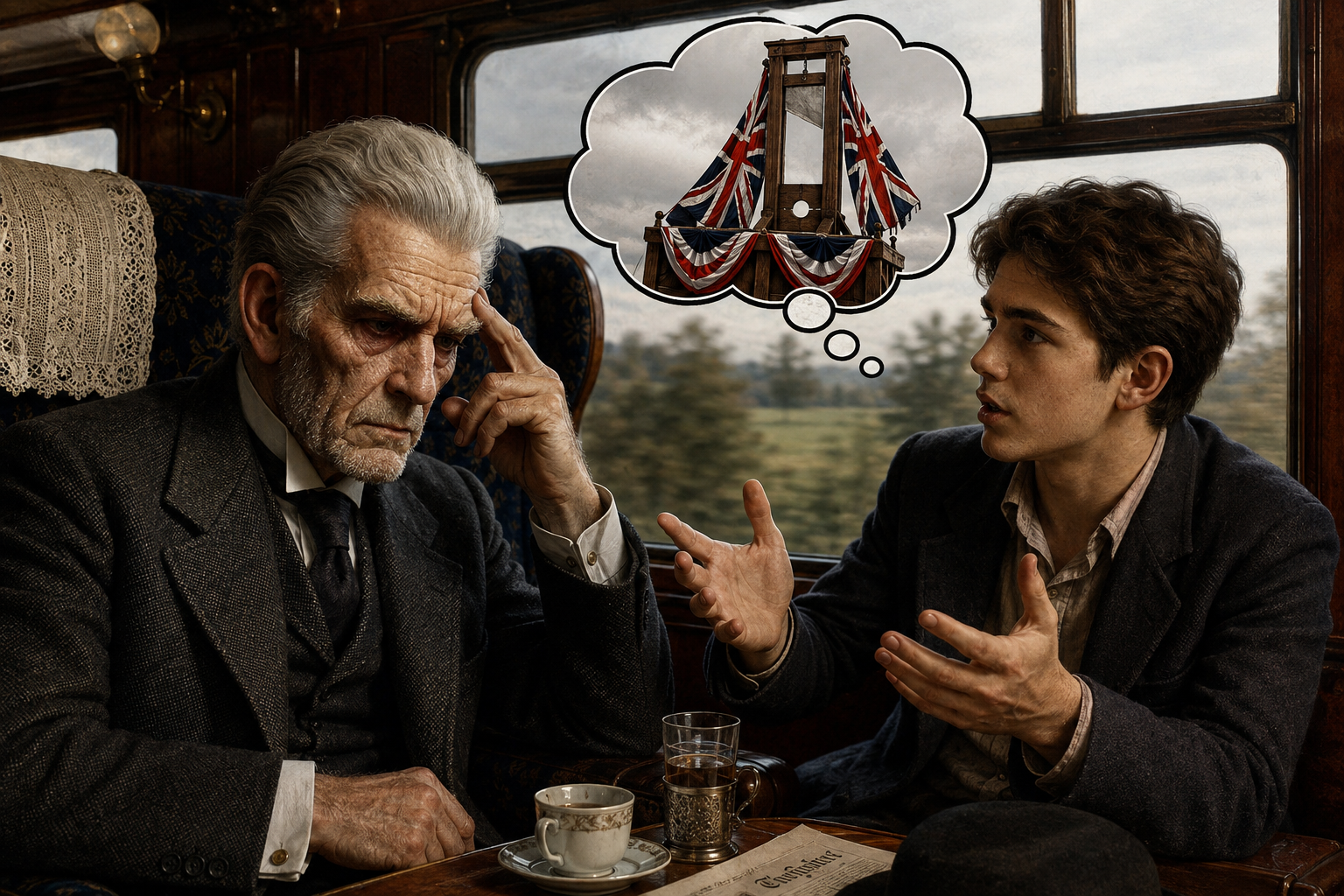
Even at his most outrageous, young Bryan Mercadente can be most persuasive. Every month we share a return railway journey between London and Herne Bay. We meet at Victoria and travel down together. We then travel back together before going our separate ways. Our discussions most often involve the acquisition and benefits of financial independence. On our last journey, Bryan explained his device for taking political power in this country, and then which of our present rulers he would murder and which he would merely cast penniless into the gutter. As a staunch conservative in every sense, I have never had time for talk of revolutionary change. My young friend’s urgency and directness of speech have left me less closed to such change. Do not regard the following as any kind of manifesto. It is better seen as an old man’s attempt to come to terms with a set of changes in our national life he once did not think he would live long enough to see.
Broadly speaking, a defence of the constitutional order in England can be placed on three different foundations. Since the third is in conflict with the first two, I will explain these in turn.
The first defence is conservative. The English Constitution has existed since time out of mind. There is no year to which its origin can be traced – not 1787, or 1789, or 1949. It began as a set of tribal customs that were already ancient when our ancestors left their forests in Northern Europe. Since then, it has unfolded across the centuries. In other countries, a constitution is judged by how well it supports the national life. Found wanting, it will be replaced in the same manner as the earlier experiments that it was itself created to replace. In England, the Constitution is part of our national life. When I was a boy, and I began to read the history of my country, I at once found myself in an argument unfolding across centuries. The debates in the Stuart Parliaments explained the debates in the Parliaments of my own day. I found nothing unfamiliar in the names of institutions and offices, or in their relations to each other. I was brought to realise that the English Constitution is England, and England is its constitution. They are different sides of the same organic whole.
To overturn something old and established would always, unless faced with unavoidable need, be unwise. To overturn a constitution that has ensured so many centuries of political stability, combined with personal freedom and national greatness, would be an act of criminal folly. No doubt, every constitution is a human creation, and nothing created by humans is perfect. Times change, and our understanding and needs change with the times. To say that a constitution that has never ceased to change before our own time should change no more is a proposition that no intelligent conservative would hold. The Constitution has changed and will continue changing. But to sweep it away and replace it with something produced by a committee of politicians and academic lawyers is also a plan that no conservative, intelligent or not, should lightly accept.
The second, or liberal, defence is not inconsistent with the first. In its external appearance, the English Constitution is a royal absolutism tempered by oligarchy. But that is the external appearance. Royal absolutism was brought to an end by the revolutions of the seventeenth century. The effective remnants of the feudal order were swept away in 1641, and not restored in 1660. After that, English life became almost wholly commercial, its laws almost uniquely concerned with the protection of life, liberty and property. The public face of low bows and deferential language, and of walking backwards, should not be taken as the inner essence. An intelligent liberal will join with intelligent conservatives in praising a system that has combined the two mostly opposed ideals of political stability and personal freedom, and will not be friendly to calls for sudden change – and certainly not to schemes of utopian reconstruction.
I turn to the third defence, and this is not so much of the established order in general as of the present order. To say when the process of dissolution began is too hard for an essay of this length to discuss. But, if a date must be given, I will fix on 1940. To say that all was well before then would show an ignorance of pointed and accurate complaints made since the middle of the previous century. It was in 1940, however, that effective power in England fell into the hands of a loose and shifting coalition of political fantasists and asset strippers. Nothing has gone well since. Whatever may have been promised before the votes were counted, every new government has continued stripping us of our ancestral rights. Every public and semi-private institution has been captured and made into tools of absolute and unaccountable power. I mention the House of Lords. This ceased to be a chamber purely of the hereditary nobility in 1958, when a supposedly Conservative Government introduced life peerages. It ceased to take any part of its tone from the hereditary nobility when purged by the Blair Government in 1999. The hereditary element is now extinguished, and the House of Lords is filled with creatures like Theresa May and Doreen Lawrence and Sadiq Khan. Or there is the Monarchy. The late Queen was notorious for paying more attention to the wording of personal cheques than of the documents put before her to sign by her ministers. In particular the disposal of her former daughter-in-law involved her in personal undertakings that will, without changes not contemplated at least since the Exclusion Crisis, involve England in irremediable and even fatal disgrace.
This explains an absence of republican and radical sentiment from the regime media not seen since the later years of Queen Victoria. The established order, as it now exists, is a screen behind which the authoritarian leftists continue their demolition of England. If the ancient fancy dress ball continues, those leading the dance no longer see us, the ordinary people of England, as a participating audience, but as dupes to be lulled into silence by the pretence that nothing substantial has changed.
As I have said, this third defence is in conflict with the other two. But it is the more truthful defence. Any conservative or liberal who makes his old defence is looking back to a state of affairs that no longer exists. The authoritarian leftists who tell us to swoon over Lady Ulula Smyth’s new hat at Ascot are working for a system that does exist, and that is close to achieving our utter destruction as a people. I say that, when I was a boy, to study the history of England was to enter a political debate across the centuries, where everything was quaint but familiar. That is no longer the case. The course of English history, as it was understood by G.M. Trevelyan, and even by A.J.P. Taylor, has come to an end. The only question is what to do about this.
Since I am, by nature, a conservative, I am mindful of Burke’s rebuke to the French liberals:
Your privileges, though discontinued, were not lost to memory. Your constitution, it is true, whilst you were out of possession, suffered waste and dilapidation; but you possessed in some parts the walls and in all the foundations of a noble and venerable castle. You might have repaired those walls; you might have built on those old foundations. Your constitution was suspended before it was perfected, but you had the elements of a constitution very nearly as good as could be wished.
I have to ask how bad things really are. Surely, the English Constitution is still worth fighting for? Surely it will always be easier to restore than to build from nothing? Surely, there are risks of disorder and collapse attending the loss of old associations that outweigh the promised benefits of some new work that lacks ancestral legitimacy? I do ask these things, and I have not reached any final answer. However, the answer I found myself reaching in my latest discussion with Bryan is that things really are as bad as they look.
Even moderate conservatives have at last understood the nature of the Gramscian Long March through the institutions. Those who go beyond mere complaint and despair speak of a counter march. What we have lost we must regain, and we must regain it through the same means as those by which we lost it. The problem here is that the institutions are no longer the same. They are not the same in terms of openness.
When I was young, I was continually astonished by the neutrality in making appointments of the conservatives and liberals who were still mainly in charge of our institutions. Every time I raised an objection, I was told that the best person for the job was being appointed, and that his personal opinions were not matters of legitimate concern. Of course, those opinions were wholly relevant. The moment our enemies had achieved their critical mass, they set about promoting each other and appointing more of their kind, and transforming what they had captured. These people are evil, but they are neither stupid nor naïve. They were welcomed into their present ascendency. They will not be, and are not, so welcoming to their enemies. Every profession and every office is acquiring its loyalty oaths. Even without formal oaths, there is a tight supervision of personal opinions. A few months ago, I discussed a proposal that the General Medical Council should have the power to bar doctors from practising if found guilty of political dissent. I know from my personal experience that various bodies governing the legal profession already perform an informal but effective exclusion of dissidents. Our enemies performed their long march over level ground. Any counter march must be through fields of institutional barbed wire, actively guarded by institutional machine gunners and snipers. Good luck to anyone who thinks he can survive a career in the BBC long enough to reach a position of influence without first surrendering every opinion that might make his influence useful.
The institutions we need to recapture are not open to recapture. They are also no longer so worth recapturing as they were worth capturing. True legitimacy is not an accumulated stock to be sparingly used. Our ancient institutions possessed a legitimacy that was renewed by its manner of employment. Once the hereditaries were at least marginalised, the House of Lords was a glorious prize. It was both ancient and glamorous. Whatever his origins, a Lord was a Lord. It was the same with the Church. To have those was, in large degree, to have control over the English mind. But their capture was like cutting down a Christmas tree. For a while, the old splendour remained; but its freshness had become a wasting asset, incapable of renewal. Even if the ermined trash who now infest the Upper House can be ejected, and even if Mrs Mullally can be unfrocked and sent off to resume her nursing career, do you suppose that these institutions can be put back as they were? Do you really suppose they can regain even the mildly contemptuous affection they held into the 1990s? I do not think they can.
There is the further consideration that the web of institutions that make up our Constitution require specific skills and specific understandings to make them work – to make them work well or work badly is of no technical importance. How many of us possess these skills and understandings? How many of us will ever be allowed to acquire them?
In short, we are shut out of institutions that grow less worth recapturing by the year, and that we do not fully understand how to run. There is much, of course, that two or three generations can change. Many things that were thought politically impossible in 1750 were almost uncontroversial by 1850. But we do not have two or three generations. A constitutional rot that might have been cured with minimal treatment before perhaps 1979 has now gone too deep. It needs radical treatment now or very soon, or it will never be treated.
And this brings us to the need for a revolution. I do not know how or when this will happen. I do not know if it will happen. But I do believe that all the usual conditions for a revolution now exist. There is a growing crisis of legitimacy in the established order. This is widely seen for what it is. I will elaborate on what I have said about the wasting of inorganic legitimacy. Those institutions captured by our enemies are like the flayed skins of their sacrificial victims worn by Aztec priests. Fine enough on their rightful possessors, they soon rotted away and stank on their murderers. We are not far, I suspect, from a moment when the King will be sent out to open a new community centre in the Midlands – and will be greeted with hostile silence by those who bother turning up to observe. To be sure, the electoral results and opinion polls all point to a search for alternatives. The increasingly paranoid authoritarianism of the enforcement agencies points to a realisation that the system is actively hated, and can only be held together by fear of speaking out. We are like one of the Soviet satrapies of the 1980s. The system looks all-powerful, but is liable to collapse at the lightest unpredictable touch.
I still hope that, if there is a revolution, some deal can be made with those who now direct the historic institutions. When the Bolsheviks took power in 1917, they retained large numbers of officials and technical specialists from the order they had overthrown, allowing them to keep their positions and salaries in return for submission to the new order. Perhaps that can happen here. If not, I may agree with Bryan that any reconstruction must be both ruthless and utilitarian. Certain institutions – the Common Law and trial by jury, for example, and freedom of speech – are permanent expressions of the English mind, and must be preserved. Much else, though, it will be right to see as so much excess baggage.
To be specific, I agree that, without a deal, the quickest and surest way to national safety will rest with a strong presidential republic of England, with a restrictive bill of rights and a scaling back of every state function that is not indispensable to maintaining public order or public consent. I further agree with a new culture of radical meritocracy and the aggressive promotion of economic growth by whatever means may be easiest to hand. The short-term object would be to stop the collapse of England. A medium-term objective could be the restoration of hegemony within the British Isles and of respect by the rest of the world. If Scotland wants independence, let it have independence – but let it be the independence it enjoyed before the Union, this being none in any worthwhile sense. But that would be for later. What would need to be done at once is a more careful replay of what was done in France in 1789 and of what was done in Iran in 1979 – a thorough reconstruction of the constitutional order that will bring down and keep out those who would otherwise destroy us.
There was a time when I smiled at Tom Paine’s reply to Burke, that he pitied the plumage, but forgot the dying bird. The more I look at the daily news, the less inclined I am to smile, and the more determined I become to live long enough to see whether Bryan and his friends really do put on their black uniforms and post their lists of the proscribed in Trafalgar Square—and whether, when the day comes, I shall applaud or bolt my door.
Discover more from The Libertarian Alliance
Subscribe to get the latest posts sent to your email.
Related posts:
 Trump’s Gaza “Peace Plan”: A Monument to Folly
 In What Respect is Hamas Winning?
 Stanislav Andreski’s Social Sciences as Sorcery: Enduring Errors and Academic Corruption – Thorsten Polleit, PFS Bodrum 2025
 David Dürr on Swiss Anarchism – Property and Freedom Society Bodrum 2025
 On War, Democratic Peace, and Reeducation: The “German Experience” in Reactionary Perspective
 The Role of Intellectuals and Anti-intellectual Intellectuals
 Trial by Jury and the Logic of Abolition
 Just governance
 The Foundations for a Better World
 Gregory Lauder-Front: Defending a Traditional Britain that is Dead
 The Jury’s Ancient Power: Why Every Englishman Should Know About Jury Nullification
 Pirates, Liberty, and Revolution: Alessandro Fusillo in Bodrum
Powered by YARPP.
I believe in monarchy on principle. An institution is as good or bad as the people who run it so let’s try to reverse Gramsci.