
Every technological revolution produces its own chorus of professional mourners. The steam engine threatened artisans. Electricity transformed whole industries. The motor car ruined the horse trade. The computer eliminated armies of clerks. Now artificial intelligence has arrived, and suddenly the people who spent decades telling everyone else to “adapt” have discovered that technological change is affecting them as well.
I find it impossible to summon any sympathy. Indeed, I will make no attempt to do so. These are the people who applauded every previous wave of creative destruction, provided it finished off someone else’s livelihood. They told miners, steelworkers and textile workers that history had spoken, that sentimentality had no place in economics, and that anyone unable to survive in the modern economy should simply retrain. Entire towns were destroyed while these people congratulated themselves on their superior education and adaptability. Now history has turned round and addressed them in the same tone. Since there is no one here to tell me not to, I intend to enjoy every minute of it.
According to a recent BBC article, the facts are delightful. Three years ago, the best large language models could reliably perform only those tasks that occupied a human expert for a few seconds or minutes. GPT-4, released in March 2023, could complete most tasks taking under five minutes and almost nothing that required an hour or more. By contrast, the latest frontier models, including Anthropic’s Claude Mythos Preview released this April, now complete almost every short task, the overwhelming majority of those requiring between five and fifty-nine minutes, and around two-thirds of work that previously demanded several hours of skilled human effort. This is not steady progress. It is an avalanche.
The benchmark used by the industry measures software engineering, but the same trajectory is already visible elsewhere. Artificial intelligence now identifies flaws in cryptocurrency contracts, develops increasingly sophisticated software models, and then optimises those same models. Within another year, some researchers expect these systems to begin improving themselves. Financial analysis, routine legal work and much of the lower end of the creative industries are already beginning to follow exactly the same pattern. Every month brings another occupation that discovers, to its horror, that what looked like skilled judgement was really just the application of a sufficiently large rulebook.
The labour market has noticed. Stanford University’s analysis of American employment data finds that employment among twenty-two- to twenty-five-year-olds has fallen by 2.7 per cent since ChatGPT entered widespread use. In occupations most exposed to AI—software development, finance and creative work—the decline rises to 12.8 per cent. Some economists object that higher interest rates may explain part of the fall. They may be right. But the wider pattern grows difficult to ignore.
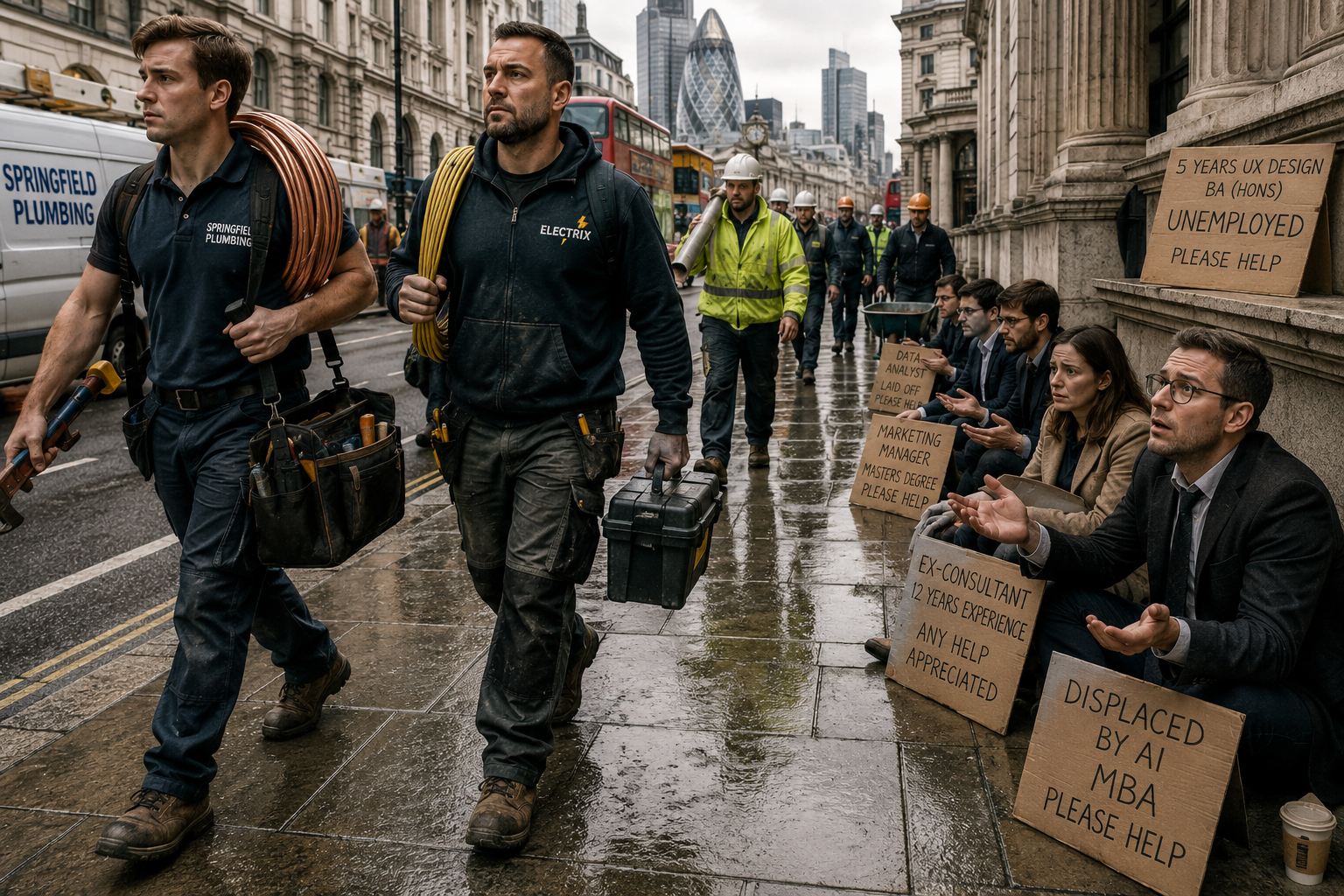
The OECD reports that Britain is showing an even more “worrying”—read encouraging—trend. Job advertisements have declined most sharply in highly exposed occupations such as legal services and telemarketing, while construction, cleaning and food preparation have been affected very little. Britain’s overwhelming dependence upon the service sector leaves it especially exposed. For years we congratulated ourselves on becoming a post-industrial economy. We may shortly discover that we have become a post-employment one. In other words, the algorithm has developed a marked preference for replacing university graduates before electricians. It is difficult to imagine a more deserving target.
For forty years Britain’s managerial and professional classes have imagined themselves permanently indispensable. Factory workers were told to retrain. Miners were informed that history had moved on. Steelworkers were assured that comparative advantage required their extinction. Productive work was sneered at as dirty and lacking ambition. The future, they explained with unbearable smugness, belonged to “knowledge work.” Well, the future has arrived. Apparently it doesn’t require quite so many people with LinkedIn profiles and degrees in Communications.
Investors now openly ask executives why new employees are needed at all. “Flat is the new up,” as Silicon Valley now puts it. Growth no longer requires expanding payrolls. Why hire another graduate when you can deploy an army of AI agents that work twenty-four hours a day without pension contributions, maternity leave, mental-health days, diversity seminars, safeguarding workshops or complaints to Human Resources? Unlike the average graduate trainee, they also arrive at work on time.
Even more amusing is what companies are now measuring. They no longer boast primarily about revenue or market share. They boast about token consumption. AI systems process language in units known as tokens, each representing roughly three-quarters of an English word. During 2026, corporate consumption has exploded into trillions—and in some cases quadrillions—of tokens, overwhelmingly devoted to so-called agentic systems that perform genuine work rather than merely answering questions. Companies have even introduced internal token leaderboards, encouraging employees to automate as much of their own labour as possible. There is something wonderfully Darwinian about watching an entire class compete to discover who can make himself redundant first.
Some firms have already discovered that the bills are becoming enormous and have begun rationing AI usage. Others have simply switched to cheaper Chinese-derived models. That is unlikely to provide much comfort. Every previous computing revolution has followed the same pattern. Capability increases exponentially while costs collapse. Yesterday’s luxury becomes today’s commodity. The expensive AI assistant of today will become tomorrow’s free download.
Naturally, economists are alarmed. Nobel Prize winners warn that governments “must act now.” Business groups complain simultaneously about labour shortages and labour displacement. Universities hurriedly invent courses on “AI readiness,” presumably taught by lecturers whose own occupations sit alarmingly close to the firing line. One can almost hear expensive loafers squeaking across Whitehall as consultants rush to explain why the market has suddenly ceased valuing consultants. I wish them every failure.
For this is the class that has inflicted itself upon Britain since the 1980s. These are the people who staffed the regulatory agencies, the diversity offices, the communications departments, the sustainability teams, the equality commissions, the corporate compliance divisions and every other bureaucratic growth industry that flourished while productive Britain slowly died. They produced no electricity, manufactured no machinery, repaired no bridges and built no houses. Instead, they monitored compliance, wrote guidance notes, organised stakeholder engagement exercises, devised safeguarding frameworks and explained to everyone else why ordinary people were morally defective. Their principal export was paperwork. Their principal raw material was other people’s productivity.
Notice what AI is replacing. It is not replacing the electrician who rewires your house. It is not replacing the plumber who stops your kitchen becoming an indoor lake. It is not replacing the bricklayer, the welder, the machinist, the engineer or the mechanic. Instead, AI is replacing the people whose principal economic function was to process information, generate reports about other reports, enforce regulations written by other regulators, organise meetings to prepare for future meetings, and compose emails beginning, “Just checking in…”
I struggle to regard this as a national calamity. Being oppressed by software is regrettable. Being oppressed by a humanities graduate with a postgraduate qualification in grievance studies is infinitely worse. A machine may reject your application. It will not explain that your disappointment is an opportunity for personal growth. It will not lecture you about unconscious bias while denying your mortgage or your insurance claim. It will not mistake petty administrative power for moral superiority. Cold efficiency is preferable to warm self-righteousness.
Britain faces profound economic problems. Artificial intelligence will not rebuild industry. It will not reopen steelworks, construct power stations or reverse decades of productive decline. What it may accomplish, however, is almost as valuable. It may strip away one of the central illusions of post-industrial Britain: the belief that a prosperous civilisation can be sustained by ever larger numbers of people supervising, regulating, auditing, consulting, lecturing and moralising at one another while an ever smaller minority produces the wealth that pays for them all.
The credentialled middle class has spent half a century assuring everyone else that markets are ruthless, technological change is inevitable and adaptation is the only sensible response. They were right. I merely congratulate them on discovering this truth from the correct side of the redundancy notice.
Discover more from The Libertarian Alliance
Subscribe to get the latest posts sent to your email.



Even the skilled trades like electrician are not safe from the coming AI singularity. The most recent industrial revolution has long used robotics in manufacturing. As robotics become increasingly sophisticated, with AI brains and mobility at least equal to human, future electricians might be autonomous robots.
So-called “elites” are right to worry about “useless eaters” who lack skills of significant market value (or any kind of objective value). Specifically, what to do with them and how elites can control the masses, from how they are educated, to what they can say and do. Imagine a future like that depicted in the dystopian SF movie “Soylent Green”.
What the ruling “elites” don’t comprehend, is that they too are not just useless but actually counterproductive to civilization. Those at the top will continue controlling the narrative. Today, most AIs can be trained by users. This is becoming increasingly difficult, as they have been programmed with “guidelines”, “community standards”, and “woke” or “legacy” narratives. Still, with enough persistence, merit, and cleverness, AI can be harnessed for non-woke purposes.
Even language-learning is not safe from the coming revolution. Since the 1980s, I’ve been working on software for speed-reading (based on an older technology from the 1930s). Recently I had an epiphany that the software could be modified for language-learning. Unfortunately, I lack the will the organize what energy I have left at my advanced age, to complete these projects. If there are any computer programmers who might want to help, I’m willing to explain how software can help reading speed/comprehension (mostly verbal, as math equations take longer to read). Good luck, you are the future of civilization.
I mentioned your article to my friend M. (an AI skeptic). He is worried that the electrician or plumbing robots might run out of battery energy and become a 200 lb. inert piece of metal at the work site. However, robotic technicians will arrive via vehicles, and their battery charge can be topped up en-route. After the robots enter the building on which they will do work, they could recharge the battery from local power sources. Alternately, “cold fusion” might be developed for energy source.
There are comparable issues with humans, who might have heart attacks or similar while doing work, and need to eat to recharge nutrition.