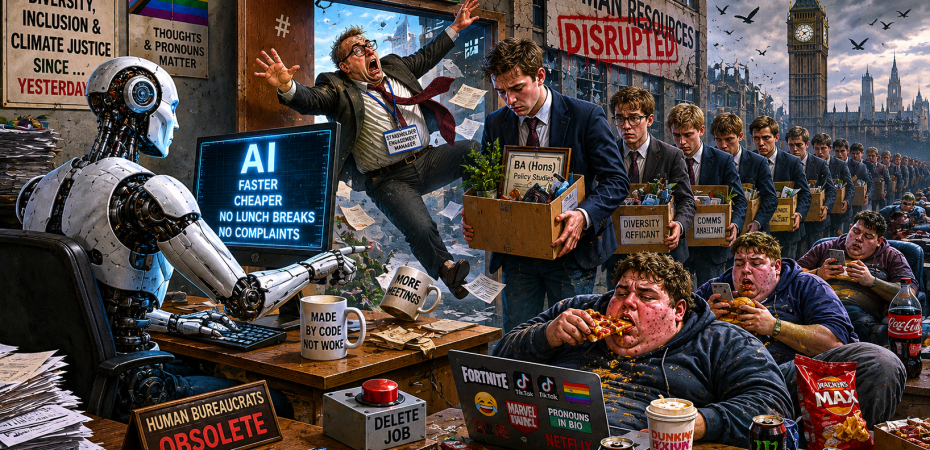
The Confederation of British Industry has issued another warning. Growth is slowing. Inflation is expected to rise. Business investment remains weak. Unemployment is forecast to climb towards two million. At the same time, artificial intelligence is beginning to transform the labour market. Graduate recruitment has fallen sharply. Administrative hiring is freezing. Morgan Stanley reports that Britain has suffered the highest net employment losses from AI among the major economies it surveyed, with firms reporting workforce reductions of roughly eight per cent after adopting the technology.
The proper response, we are told, is alarm. I find myself in a celebratory mood. This is not because unemployment is desirable in itself. A healthy economy should provide opportunities for productive work. What pleases me is the growing possibility that an entire social class may be losing its privileged position within British society.
For decades, Britain has been governed not merely by politicians, but by a vast credentialled middle class that functions as the transmission mechanism of political power. This class staffs the universities, quangos, regulatory agencies, communications departments, human resources offices, consultancies, compliance teams, and public-sector bureaucracies that sit between ordinary people and those who govern them. Its members rarely own substantial wealth. They do not usually control major businesses. They are not the ruling class itself. They are something more useful to the ruling class. They are its priesthood.
Every regime requires people willing to explain why the regime is right. The medieval Church justified kings through theology. Soviet intellectuals justified Communism through Marxism. Our managerial state employs policy analysts, diversity officers, safeguarding coordinators, behavioural scientists, sustainability managers, and communications consultants. Their task is to convert elite preferences into moral obligations for everyone else.
The remarkable thing is how many people have mistaken this activity for economic production. The modern British economy contains huge numbers of occupations that exist to manage, supervise, regulate, assess, coordinate, monitor, and justify. Universities produce graduates trained for these occupations and little else. Governments create regulations that require more compliance officers. Bureaucracies expand and then generate demand for further expansion. The result is a self-sustaining system in which paperwork creates demand for more paperwork.
Artificial intelligence has begun asking a question that should have been asked years ago. What exactly are all these people doing? The answer is becoming uncomfortable. A machine cannot repair a power station. It cannot install a boiler, operate a crane, maintain a railway line, pour concrete, or repair an electrical system. It cannot build a bridge or unload a cargo ship. It can, however, summarise reports, analyse spreadsheets, draft policy papers, answer emails, generate presentations, prepare briefing notes, and produce marketing copy. In other words, it can perform a large share of the work on which the administrative middle class has built its existence.
This helps explain why Britain appears vulnerable to the AI revolution. We spent forty years dismantling productive industry while expanding administrative employment. We convinced ourselves that manufacturing belonged to the past and that the future consisted of information management. We closed factories and opened compliance departments. We replaced engineers with consultants. We elevated administration above production and paperwork above technical competence.
Now information itself is being automated. I love it.
The same class that applauded globalisation when it destroyed industrial employment is horrified by technological change when it threatens graduate employment. The same people who instructed miners to retrain and steelworkers to adapt are discovering that adaptation sounds rather less appealing when applied to themselves.
For years, they explained that economic disruption was inevitable. Entire communities were expected to absorb factory closures in the name of efficiency. Workers were informed that the future belonged to services and knowledge industries. The old economy was gone. The new economy was here.
Very well. The new economy has arrived. And it appears to have developed a strong preference for eliminating the occupations that were supposed to replace everything else.
I can watch this process unfolding every day at school. Most of the boys in my year have spent their lives preparing for an economy that is already disappearing. They drift through lessons with the confidence of aristocrats expecting to inherit an estate. The assumption is that a degree will transform them into well-paid professionals. Quite how this miracle is meant to occur remains unclear. Many cannot organise their own lives. They cannot cook. They cannot repair anything. They cannot explain how electricity reaches their homes or how food reaches the supermarket. Some struggle to climb a flight of stairs without sounding like an asthmatic accordion. Yet they fully expect comfortable employment moving information between computer screens.
Their physical condition often mirrors their future prospects. A surprising number already look like middle-aged administrators despite being seventeen. They spend their days consuming energy drinks, pastries, pizzas, chocolate bars, and whatever other industrial sludge is marketed to adolescents. Their bodies resemble advance prototypes of their future careers: soft, sedentary, over-managed, and disconnected from reality.
Twenty years ago, this would not have mattered. They would have gone to university, accumulated debt, learned the approved opinions, and found employment somewhere in the managerial ecosystem that has flourished across Britain since the 1980s. Some would have become diversity officers. Others would have become sustainability consultants. A few would have entered human resources, where they could spend forty years arranging compulsory training sessions and investigating offensive jokes. The cleverer ones might have become policy advisers. Their task would have been to transform obvious falsehoods into official truths. They would explain why censorship is freedom, why bureaucracy is efficiency, and why national decline is progress. They would produce consultations, frameworks, guidance documents, strategic visions, and reports. Nobody would read these documents. This would not matter. The purpose of bureaucratic writing is rarely communication. It is justification.
Artificial intelligence has noticed something that nobody inside this world wished to acknowledge. Most of these jobs consist of manipulating information according to predetermined rules. This turns out to be what machines are good at.
If I had any charity in my heart, I might deplore the coming blizzard. An entire generation has been trained for occupations that increasingly resemble software functions. The reward for years of credential gathering may be the discovery that a machine costing twenty pounds per month can perform much of the same work without annual leave, pension contributions, wellbeing programmes, safeguarding training, or diversity budgets. I admit that I have not an atom of charity, in my heart or anywhere else, and I find it all very funny.
The significance of this transformation extends beyond economics. What is threatened is not merely a collection of jobs but the dominance of a class that has shaped British life for decades. The credentialled middle class occupies the institutions responsible for producing and transmitting ideas. It trains teachers, journalists, civil servants, regulators, and managers. It supplies the personnel through which elite assumptions enter everyday life. If artificial intelligence reduces the economic value of these occupations, it may also reduce their cultural and political influence. That would be healthy.
This class has served as the carrier of every fashionable orthodoxy of the past generation. It embraced managerialism. It promoted censorship in the language of safety. It transformed universities into ideological training centres. It expanded regulatory burdens across every sphere of life. It justified endless bureaucracy while presenting itself as enlightened and indispensable. The possibility that market forces may finally be applied to this class is difficult to regard as a disaster.
Britain still faces serious economic problems. AI will not rebuild industry. It will not solve our energy crisis. It will not restore productive investment. It will not create prosperity by itself. What it may do is expose one of the central illusions of modern Britain: the belief that a nation can become rich by employing ever larger numbers of people to supervise one another.
The credentialled middle class convinced itself that it represented the future. Artificial intelligence has other ideas. For the first time in my lifetime, the future appears to be moving in an encouraging direction.

Discover more from The Libertarian Alliance
Subscribe to get the latest posts sent to your email.
Related posts:
 The AI Mirage: How America’s Economy is Built on a Trillion-Dollar Scam
 Thank Goodness for (Some) Billionaires
 Considerations on De-Banking
 Affirmative Action Once Again
 AI and the Euthanasia of the Parasitic Middle Class
Oil Shocks and the Acceleration of Economic Change
AI and the Euthanasia of the Parasitic Middle Class
Oil Shocks and the Acceleration of Economic Change
 Artificial Intelligence and the Future of Mankind – Republication with Thoughts on Universal Basic Income
 Distributivism: Property, Liberty, and the Common Good
 Free Trade, Hard Reforms: A Reply to Bryan
 The Budget that Cannot Yet Be Written
 Whitmore-Mercadente-Lock-Wang-Kinsella: What this argument is really about
 Errors, Deceptions, and Manipulations in Economics
Powered by YARPP.