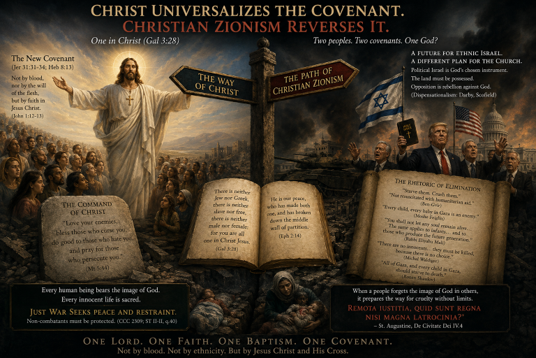
There is a danger in writing about the statements collected below. It is easy to select the most extreme remarks made during a long and bitter war, detach them from the fear and anger in which they were uttered, and then use them to condemn an entire people. That would be intellectually dishonest, and it would reproduce the very sin of collective judgement that these statements so often embody. Israeli society contains men and women who have condemned the war, protested against their government, defended Palestinian civilians, refused military service, or risked social disgrace by insisting that the lives of Arabs remain lives of equal moral value. Former Prime Minister Ehud Olmert has accused the present government of conducting a cruel and purposeless war, while the former general and opposition politician Yair Golan has warned that Israel risks becoming a pariah state if it ceases to behave like a sane country. The existence of such voices matters because it prevents any easy identification of Israel with its worst politicians.
Nor should Christians repeat fabricated accusations merely because they appear plausible. The alleged statement by Bezalel Smotrich that international law does not apply to Jews, and the supposed declaration by Tzipi Hotovely that she could sleep peacefully after the deaths of a million Palestinian children, have not been established by reliable evidence. They should therefore be discarded. False witness does not become permissible when directed against public figures whose genuine statements may already be appalling. Indeed, the invented quotations are peculiarly damaging because they allow defenders of the Israeli Government to dismiss the authentic evidence as one more exercise in hostile fabrication.
Once these qualifications have been made, however, the genuine record remains almost unbearably grave. Ministers, members of the Knesset, rabbis, broadcasters and leaders of the settlement movement have spoken of starving Palestinians, eliminating Gaza, killing children because they may grow into combatants, and treating an entire civilian population as either guilty or irrelevant. These are not words put into their mouths by foreign enemies. Itamar Ben-Gvir said that Israel’s opponents should be “crushed to pieces” and “starved to death”, without the humanitarian aid that would give them oxygen. Zvi Sukkot observed that nearly a hundred Gazans could be killed in one night and that nobody any longer cared. Moshe Feiglin went further, declaring that “every child, every baby in Gaza is an enemy”, and calling for conquest, settlement and the removal of every Gazan child. Rabbi Eliyahu Mali argued that women and infants could be killed because the women produce future terrorists and the infants may become fighters.
It would be possible to analyse these remarks exclusively through international law, the law of armed conflict or the secular language of human rights. All would condemn them. Yet there is a deeper question that these categories do not fully answer. How does a society whose Scriptures contain the commandment against murder, the denunciations of cruelty by the prophets, and the proclamation that man is created in the image of God arrive at a point where religious leaders can speak of killing infants and elected politicians can describe every child of another people as an enemy? My answer is necessarily theological. This is what may happen when a nation preserves the language of divine election while refusing the fulfilment of election in Jesus Christ. It is what happens when the particular covenant is retained but the universal covenant is rejected, when chosenness is detached from its purpose, and when the moral revolution of the Gospel is refused.
This conclusion must not be misunderstood as a claim that Jews are uniquely cruel, or that every Jewish person shares responsibility for the words of these politicians. No Christian may speak in such terms. Cruelty is a universal possibility of fallen human nature, and the history of nominally Christian nations provides more than enough evidence of it. The argument is rather that Christianity introduced into the world a particular restraint against tribal morality, and that societies which reject that restraint are liable to return to the ancient principle that one law governs the treatment of the people within the covenant and another the treatment of those outside it. The temptation is not Jewish in any racial sense. It is human. What is specifically theological about the present case is that the modern State of Israel has wrapped national self-assertion in the surviving language of biblical election, while refusing the Christ in whom that election reached its purpose.
The Covenant Was Always Ordered Towards the Nations
The election of Israel was never intended as a declaration that one ethnic group possessed greater intrinsic worth than the remainder of mankind. God chose Abraham so that “in thee shall all families of the earth be blessed” (Genesis 12:3). The promise was particular in its bearer but universal in its destination. Israel was chosen to receive the Law, preserve the knowledge of the one God, prepare the way of the Messiah and become the instrument through which salvation would be offered to every nation. The election was therefore ministerial rather than proprietary. Israel did not possess God as a tribal deity whose favour guaranteed permanent political privilege; Israel was entrusted with a vocation that pointed beyond itself.
The prophets understood that the Mosaic covenant would one day be surpassed by a new covenant. Jeremiah did not speak of a minor adjustment to Sinai, but of an order that would differ in kind:
“Behold, the days come, saith the Lord, that I will make a new covenant with the house of Israel, and with the house of Judah: not according to the covenant that I made with their fathers in the day that I took them by the hand to bring them out of the land of Egypt; which my covenant they brake… But this shall be the covenant that I will make with the house of Israel; After those days, saith the Lord, I will put my law in their inward parts, and write it in their hearts.”
— Jeremiah 31:31–33
The significant words are “not according to the covenant that I made with their fathers”. The new covenant would not be a simple restoration of the old polity, nor a more successful enforcement of the Mosaic Law. It would internalise the Law and create a people whose relation to God did not depend upon territory, temple, ancestry or the ceremonies of Sinai. Christ explicitly identified His sacrificial death with this prophecy when He took the cup at the Last Supper and said: “This cup is the new testament in my blood, which is shed for you” (Luke 22:20).
The Epistle to the Hebrews draws the unavoidable conclusion. Having quoted Jeremiah’s prophecy at length, it states:
“In that he saith, A new covenant, he hath made the first old. Now that which decayeth and waxeth old is ready to vanish away.”
— Hebrews 8:13
Christianity cannot therefore accommodate the theory that the Mosaic covenant remains alongside the New Covenant as a separate and equally valid dispensation. God does not maintain one saving covenant for the Jews and another for the Gentiles. The Old Covenant was real, holy and divinely ordained, but it was preparatory. Its sacrifices anticipated the Cross; its priesthood anticipated the priesthood of Christ; its temple anticipated the Body of Christ and the Church; its national boundaries anticipated a people gathered from every race.
St Paul makes the same argument in Romans, though he does so with sorrow and with an insistence that the Jewish people have not ceased to be objects of divine love. He distinguishes between descent according to the flesh and membership in the people of promise:
“They are not all Israel, which are of Israel: neither, because they are the seed of Abraham, are they all children… That is, They which are the children of the flesh, these are not the children of God: but the children of the promise are counted for the seed.”
— Romans 9:6–8
This is not racial hostility. Paul himself is a Jew, and in the same passage he declares that he could wish himself accursed for the sake of his brethren. His point is theological: biological descent cannot confer participation in the covenant independently of faith. The promise belongs to Christ, and therefore to all who are joined to Christ. The same argument appears more concisely in Galatians:
“Know ye therefore that they which are of faith, the same are the children of Abraham… For ye are all the children of God by faith in Christ Jesus… There is neither Jew nor Greek… for ye are all one in Christ Jesus. And if ye be Christ’s, then are ye Abraham’s seed, and heirs according to the promise.”
— Galatians 3:7, 26, 28–29
The importance of this passage extends far beyond disputes about ecclesiology. It represents the destruction, within the order of grace, of ethnic privilege. Abraham’s seed is no longer a biological category. The covenantal people is no longer held together by descent, circumcision or possession of a particular land. It is constituted by baptism into Christ. This does not abolish nations or erase ordinary attachments to ancestry and country, but it denies that any nation stands nearer to God by virtue of blood.
St Paul develops the moral implications in Ephesians. Christ has not merely made Jews more charitable towards Gentiles, or admitted certain Gentiles into an essentially Jewish religious commonwealth. He has created something new:
“For he is our peace, who hath made both one, and hath broken down the middle wall of partition between us… for to make in himself of twain one new man, so making peace; and that he might reconcile both unto God in one body by the cross.”
— Ephesians 2:14–16
The phrase “one new man” excludes the Christian Zionist conception of two covenantal peoples with separate historical destinies. There is one Body because there is one Cross. The division between Jew and Gentile is not preserved as a permanent theological structure; it is overcome in Christ. The Catechism describes the Church accordingly as “the People of God in the New Covenant”, while also insisting that the Church remains profoundly linked to the Jewish people, who first received the promises and the revelation of the Old Covenant. Catholic doctrine therefore rejects both crude anti-Judaism and the opposite error of treating the Old Covenant as an independent saving order. citeturn794854search8turn794854search9
The Fathers and the Fulfilment of Israel
The early Fathers did not invent this interpretation as part of some later hostility towards the Jews. They inherited it directly from the Apostles. St Justin Martyr, writing in the middle of the second century and addressing a Jewish interlocutor in the Dialogue with Trypho, does not claim that Christians worship a different God. On the contrary, he insists:
“Nor do we think that there is one God for us, another for you.”
— Dialogue with Trypho, 11
Justin’s dispute concerns not the identity of God but the fulfilment of the covenant. He continues by arguing that Christians have received the new law and the everlasting covenant foretold by the prophets. In Chapter 11, he declares that the Mosaic law was given for a limited purpose, whereas Christ is “the new law” and “the new covenant”. Later, when considering the descendants promised to Abraham, Justin identifies Christians drawn from the nations as the holy people of promise. He asks Trypho whether Christians are not the people whom God promised to raise up through Abraham’s faith. citeturn794854search12turn794854search0
This is sometimes described dismissively as “replacement theology”, as though the Church had arbitrarily evicted the Jews from a possession that remained theirs by hereditary right. That phrase obscures more than it clarifies. Justin’s argument is one of fulfilment and expansion. The Church does not replace Israel with an unrelated Gentile body. The Church is Israel brought to its promised universality, with believing Jews and believing Gentiles made one in Christ. The root remains Abrahamic; the branches now extend through all nations.
St Irenaeus of Lyons, writing only a generation later, makes the same point with exceptional clarity. Against those who treated the Old and New Testaments as the works of different gods, he insists that one divine Word gave both covenants. Yet their unity does not mean that the first covenant remains unchanged:
“One and the same householder produced both covenants, the Word of God, our Lord Jesus Christ.”
— Against Heresies, IV.9
Irenaeus then explains the relation between them. The Mosaic order was a stage in divine education, while Christ restored mankind “anew to liberty” and multiplied grace. Elsewhere he rejects the claim that Jeremiah’s new covenant referred merely to the rebuilding of the Temple after the Babylonian exile. No new covenant was given under Zerubbabel; the people continued to use the Mosaic law “until the coming of the Lord”. It was only with Christ that “the new covenant which brings back peace” went forth over the whole earth. citeturn794854search14turn794854search15
The phrase “over the whole earth” is decisive. The covenant can no longer be confined to the security, territorial expansion or political supremacy of one nation. Its sign is not the conquest of land but the transformation of enemies into one people. Irenaeus connects Isaiah’s prophecy that swords will be beaten into ploughshares with the preaching of Christ among the Gentiles. The fulfilment of Israel is therefore not a Jewish empire with an enlarged territory, but the pacification of the nations through the Gospel.
St Augustine, whose political thought arose amid the disintegration of Roman power, treated the Old Testament as a collection of real events that also prefigured Christ and the Church. He rejected the Manichaean contempt for the Hebrew Scriptures, but he equally rejected the notion that Christians remained bound by the ceremonial order of Moses. In On the Spirit and the Letter, he distinguishes the two covenants by the difference between an external law written on stone and the grace of the Holy Spirit writing the law in the heart. The old law could command righteousness but could not confer the grace required to fulfil it; the New Covenant gives what it commands.
Augustine’s doctrine of the Jews is more complex than a simple narrative of rejection. He believed that the continued existence of the Jewish people served providential purposes, including the preservation of the Scriptures that testified to Christ. Yet their continued historical existence did not imply a separate salvific covenant or a renewed political title to Palestine. Their Scriptures belonged to the Church because their promised fulfilment was Christ. The Old Testament was not abolished as revelation, but its ritual and national forms had reached their end.
The patristic consensus therefore rests on three related propositions. The God of Israel is the God of the Church; the Old Covenant was true and holy; and its promises attain their final meaning in Christ and His universal Body. What the Fathers do not permit is the modern idea that the Jewish people retain a separate covenantal destiny centred on territory, temple and national supremacy. That idea is not ancient Christianity. It is a modern revision, most influential in the dispensationalism of Darby and Scofield, which separates Israel and the Church after the Apostles had united them. As I argued in an earlier article, dispensationalism overturns almost the entire traditional Christian understanding of Israel, the Church and the end of history. fileciteturn1file8
From the Particular Command to the Universal Neighbour
The moral revolution of Christianity follows from this theology of covenant. The Old Testament contains commands given to Israel as a particular people inhabiting a violent ancient world. Some concern the destruction of enemy populations, most notoriously Amalek. These passages are difficult for Christians, and the Church has never treated them as a standing licence for Christian states to identify contemporary enemies with ancient peoples marked for extermination. The Fathers commonly interpreted such commands spiritually: Amalek signifies sin, the passions, or the demonic powers that must be destroyed without compromise. Once Christ has revealed that the struggle of His people is not against flesh and blood, the literal transfer of the ban to a modern population becomes a repudiation of the Gospel.
This is why the modern invocation of Amalek in relation to Gaza is so disturbing. It does not merely employ harsh imagery. It attempts to reactivate the moral universe of sacral war after the coming of Christ. Rabbi Ronen Shaulov’s reported hope that every child in Gaza should starve, accompanied by an invocation of Amalek and the claim that no trace should remain, is an example of this regression. The children are not judged according to anything they have done. Their guilt lies in their membership of a hostile people and in what they may become. That is collective guilt in its most complete form.
Christ’s teaching moves in the opposite direction. When a lawyer asks Him to define the neighbour whom the Law commands him to love, Christ tells the parable of the Good Samaritan. The choice of a Samaritan is essential. Jews and Samaritans were divided by religious hostility, rival sanctuaries and inherited contempt. Christ makes the outsider, the religious opponent, the man who fulfils the Law of love. He does not answer the question “Who is my neighbour?” by marking the boundaries of obligation more precisely. He dissolves the boundaries by asking which man acted as a neighbour to the wounded stranger.
The Sermon on the Mount makes the demand more explicit:
“Ye have heard that it hath been said, Thou shalt love thy neighbour, and hate thine enemy. But I say unto you, Love your enemies, bless them that curse you, do good to them that hate you… that ye may be the children of your Father which is in heaven: for he maketh his sun to rise on the evil and on the good.”
— Matthew 5:43–45
This command does not prohibit governments from defending their populations, nor does it require soldiers to abandon the innocent to murderers. It does prohibit hatred from becoming the principle of policy. Even the enemy remains a creature sustained by the same God, illuminated by the same sun and capable of the same salvation. The Christian may use force against him under strict conditions, but may not deny his humanity or wish evil upon his children.
Christ confirms the meaning of His command in His own Passion. He heals the servant injured during His arrest. He rebukes the disciple who uses the sword. From the Cross He prays for those who crucify Him: “Father, forgive them; for they know not what they do” (Luke 23:34). The Cross is not simply the means by which individual sins are forgiven. It is the revelation of a new moral order in which victory is no longer achieved through the destruction of the enemy, but through the conversion and reconciliation of the enemy.
To reject Christ is therefore not merely to reject one claimant to messianic office while retaining an otherwise complete biblical morality. It is to reject the fulfilment through which the partial and preparatory forms of the Old Covenant are opened to all mankind. Where this fulfilment is refused, election may harden into ethnic privilege, the land may become more sacred than the people living upon it, and enemies may once again be treated not as neighbours to be converted or restrained but as populations to be removed.
That is not an accusation against every Jew, nor a denial that Christians have often betrayed their own Gospel. It is a statement about the theological consequences of refusing the universal covenant. Christians who massacre, deport or starve populations act against Christ. A national Judaism that explicitly rejects Christ does not possess the same internal theological barrier, because it does not accept the authority from which that barrier arises. It may possess other moral restraints, and many Jewish thinkers have articulated them with courage. But the rhetoric under examination shows what happens when those restraints are displaced by an absolutised doctrine of national survival and divine election.
The Disappearance of the Innocent
The authentic statements are most revealing when read not as isolated obscenities but as variations on a common claim: there are no innocent Palestinians. Michal Waldiger’s reported statement that children may have to be killed because they serve as human shields, Moshe Feiglin’s declaration that every baby is an enemy, and Rabbi Mali’s argument that today’s infant is tomorrow’s fighter all collapse moral responsibility into biological and political identity. The child is guilty not because of an action performed but because of a future imagined by the speaker. citeturn441302search14turn441302search7
This reasoning is incompatible with natural justice before it is incompatible with Christianity. Guilt attaches to voluntary acts. A person cannot deserve death for an offence he may commit fifteen years later. If this principle were admitted, every population could justify killing the children of its enemies. The English might have killed German infants in 1919 because some would become soldiers in 1939; the Soviets might have killed Polish children because some would resist Communist occupation; the Palestinians might kill Israeli babies because some will serve in the Israel Defence Forces. The principle destroys all distinction between war and extermination.
The biblical doctrine of personal responsibility directly contradicts collective punishment. Ezekiel, addressing a people accustomed to explaining present suffering through ancestral guilt, declares:
“The soul that sinneth, it shall die. The son shall not bear the iniquity of the father, neither shall the father bear the iniquity of the son: the righteousness of the righteous shall be upon him, and the wickedness of the wicked shall be upon him.”
— Ezekiel 18:20
This passage does not deny that the consequences of sin may spread across generations. It denies that moral guilt is inherited. A child may suffer because of the crimes of adults, but he does not thereby become guilty of those crimes. To regard the children of Gaza as enemies because Hamas committed atrocities on the 7th October is therefore contrary even to the prophetic tradition of Israel.
The language of future danger does not rescue the argument. It is always possible that a child raised in a devastated and embittered society may later become a combatant. It is also possible that he may become a doctor, a merchant, a priest, an opponent of Hamas or a man who wishes only to raise his own children in peace. To kill him now because of one possible future is to substitute fantasy for judgement. More gravely, it creates the very hatred that it claims to anticipate. A policy that kills children because they may grow into enemies is among the surest methods of ensuring that surviving children will do so.
Rabbi Mali’s reasoning is especially revealing because it is presented as an inference from religious law. “Today’s terrorists,” he argued, “are the children from the previous operation whom you left alive.” Women are implicated because they “produce the terrorists”, and infants because they will grow. The logic has no natural terminus. If a woman is guilty because she may bear a hostile son, and an infant because he may become a fighter, then membership of the population is itself the capital offence. The distinction between civilian and combatant disappears not accidentally but by design.
This is why the repeated claim that “there are no innocents in Gaza” is morally more significant than any particular estimate of casualties. Once innocence is denied in principle, every death can be justified retrospectively. The infant beneath the rubble was a future terrorist; the mother seeking food produced terrorists; the doctor treated terrorists; the journalist spread propaganda; the international aid worker sustained the enemy population. A total war requires a total enemy, and the easiest way to manufacture one is to define civilian existence as participation in aggression.
Starvation and the Corruption of Prudence
The statements concerning food reveal the same moral collapse. Ben-Gvir’s demand that the enemy be starved to death and denied aid is sometimes defended on the ground that humanitarian supplies may be diverted by Hamas. That is a real military concern. An army is not required to supply its opponent with the means of continued resistance. Yet it does not follow that food may be withheld from an entire civilian population until political or military objectives are achieved. The principle of discrimination requires every practicable distinction between combatants and non-combatants. The fact that this distinction is difficult does not permit its deliberate abolition.
The rhetoric of starvation is particularly grave because hunger acts most swiftly against those least responsible for war. Armed organisations control stores, transport and distribution. Healthy adult men are more likely to survive deprivation than infants, pregnant women, the elderly and the sick. To use starvation against a population is therefore to choose a weapon whose effects fall disproportionately upon the innocent. It may be described as pressure upon Hamas, but its immediate physical operation is against those with the least power over Hamas.
Catholic Just War doctrine developed to restrain this movement from legitimate defence to collective vengeance. Augustine did not imagine that war could be morally neutral merely because a ruler proclaimed a just objective. He looked to the passions animating the action. In Contra Faustum he identifies “the lust for domination, the cruelty of revenge” and “the desire to do harm” as the dispositions rightly condemned in war. The moral question is not only whether an enemy has committed aggression, but whether the defender now seeks peace or has begun to enjoy punishment.
Aquinas gives this tradition its classical form in Summa Theologiae II–II, q.40. A just war requires legitimate authority, a just cause and right intention. The third condition is indispensable because even a war begun for defence may become unjust through the purpose for which it is continued. Aquinas, following Augustine, states that war may be corrupted when a belligerent intends “to harm or to dominate”. The killing of nearly a hundred Gazans in one night may be militarily explicable; public satisfaction that nobody any longer cares is not. Sukkot’s remark indicates not reluctant necessity but the erosion of moral attention. Death has ceased to require explanation because Palestinian death has become ordinary. citeturn441302search1
The Catechism develops the traditional criteria further. The damage caused by the aggressor must be lasting, grave and certain; other means must have proved impractical or ineffective; there must be serious prospects of success; and the use of force must not create evils graver than those it seeks to remove. The same tradition requires discrimination in the conduct of war: non-combatants, wounded soldiers and prisoners must be respected, while indiscriminate destruction of cities or vast areas with their inhabitants constitutes a crime.
The atrocities of the 7th October provided Israel with a just cause to defend its citizens and recover its hostages. This should be stated without equivocation. The murder, abduction and abuse of civilians were grave acts of aggression, and no government could reasonably be expected to ignore them. Yet a just cause does not confer unlimited permission. It does not make every subsequent action just, nor turn every member of the aggressor’s nation into a combatant. Just War reasoning is cumulative and continuous. Authority, cause, intention, proportionality and discrimination must govern the prosecution of the war, not merely its opening declaration.
When ministers advocate depopulation and settlement, the required right intention becomes doubtful. A war whose declared object is defence may not be used as the occasion for territorial acquisition or ethnic removal. Daniella Weiss’s claim that the Arabs of Gaza lost their right to remain after the 7th October and that Jews will settle the entire Strip transforms the crime of Hamas into collective forfeiture by two million people. Children not born when Hamas took power, opponents of Hamas, and families with no participation in the attack are all treated as having lost their homes through an inherited national guilt. This is not defence ordered towards peace. It is conquest justified by collective punishment.
The Rejection of Christ and the Return of the Tribe
The strongest objection to my argument is obvious. Christian nations have committed atrocities no less terrible than anything advocated in these statements. Crusaders massacred inhabitants of Jerusalem; Catholic and Protestant armies devastated Europe; colonial powers destroyed populations; nominal Christians participated in slavery and aggressive war. How, then, can Christianity be presented as the decisive restraint upon tribal violence?
The answer is that Christians who committed these crimes acted against the clearest principles of their own religion. Their victims, and the saints who opposed them, could appeal to a standard recognised by the perpetrators even when it was violated. Bartolomé de las Casas could denounce Spanish cruelty towards the Indians by invoking one Creator, one human nature and one redemption in Christ. Pope Paul III could declare in Sublimis Deus that the indigenous peoples were truly human and capable of receiving the Faith. The Christian slaveholder might behave monstrously, but he could not make his conduct consistent with the teaching that slave and master were one in Christ.
The rejection of Christianity removes this contradiction by removing the universal theological premise. If membership of the chosen people is again understood through descent, and if possession of the land is treated as an enduring divine grant, those outside the people may become obstacles to the covenantal destiny of the nation. Their existence is then judged less by the universal law than by its relation to national survival. This does not make cruelty inevitable, but it makes a particular form of cruelty easier to sacralise.
The modern Israeli case is complicated by the fact that much of the country is secular. Yet secular Zionism inherited the biblical categories of people, election, return and promised land after discarding the divine purpose towards which those categories were ordered. Religious Zionism has restored explicit theology, but often without accepting the Messiah who universalised the promises. The result is an unstable combination of modern nationalism and Old Testament particularism. The state possesses aircraft, surveillance systems and nuclear weapons, while some of its ideological defenders speak in the language of Amalek and sacred conquest.
This is where the rejection of Christ has political consequences. Christ stands between the ancient command and the modern weapon. He forbids the literal re-enactment of Israel’s wars by revealing that His Kingdom is not of this world, that His servants do not fight to establish it by the sword, and that the neighbour includes the hereditary enemy. Remove Him, and the ancient text may again be pressed into the service of territorial nationalism. What was part of a unique and unrepeatable history of salvation becomes a contemporary programme.
I do not mean that every Israeli consciously rejects the Sermon on the Mount before supporting the war, or that Jewish ethics contain no universal principles. I mean that the moral world disclosed in these quotations is a world from which Christ’s universalisation of the covenant has been excluded. The Palestinian child is not encountered as a neighbour or as a possible member of the same Body. He is encountered as the offspring of the hostile nation, a future enemy and an impediment to possession of the land. Once this theological distance is established, policies that would otherwise appear monstrous may be represented as obedience, necessity or historical justice.
Christian Zionism as Christian Apostasy
The behaviour of Israeli extremists would be less dangerous if Christians judged it according to Christian doctrine. Instead, millions of American evangelicals have adopted Christian Zionism, which instructs them to regard the political ambitions of the modern State of Israel as stages in the providential timetable of God. This is one of the strangest apostasies in Christian history. Men who profess Christ subordinate the Church to a nation that formally rejects Him, and treat the restoration of the Old Covenant’s political forms as more important than the New Covenant established by His blood.
Christian Zionists often claim that supporting every Israeli territorial demand is an act of fidelity to Scripture. In reality, it requires the rejection of the apostolic interpretation of Scripture. St Paul says that the promises belong to the seed, who is Christ, and to those united with Him. The Christian Zionist relocates them in an ethnic state. Hebrews says that the first covenant has become old. The Christian Zionist treats it as politically operative. Ephesians says that Christ has made Jew and Gentile one new man. The Christian Zionist reconstructs the dividing wall and calls its reconstruction biblical fidelity.
This theological surrender has grave moral consequences. If the State of Israel occupies a unique place in prophecy, ordinary criticism of its conduct may appear as resistance to God. Palestinian suffering becomes secondary to the prophetic drama. Settlement expansion, annexation and even talk of rebuilding the Temple can be received with excitement rather than horror. The Christian Zionist does not merely excuse Israeli nationalism. He lends it the moral credit of Christianity while removing the restraints Christianity would impose.
My article last year on dispensationalism traced how this doctrine emerged from the nineteenth-century system of John Nelson Darby and was popularised by the Scofield Reference Bible. It divided Israel from the Church, invented a secret Rapture and transformed the imagery of Revelation into a political timetable. Its historical novelty should be enough to discredit it. Its fruits provide a further judgement. A theology that leaves Christians unmoved by the starvation of children because national Israel must fulfil prophecy is not merely eccentric. It is a corruption of the Gospel.
Israel Is Not Alone, but Israel Must Be Judged
There is a temptation, after making an argument of this severity, to soften it until nothing remains. One may say that every nation behaves badly in war, that Hamas uses civilians, that the quotations come from extremists, and that Israel faces enemies committed to its destruction. Each statement contains truth. Together they do not answer the charge.
The fact that cruelty is universal does not make any particular cruelty less culpable. Hamas’s murder of Israeli civilians cannot make Palestinian children guilty. The use of human shields cannot turn the shield into a legitimate target without regard to proportionality. The presence of dissenting Israelis prevents collective condemnation, but it does not erase the fact that several speakers hold office, sit in the legislature, lead religious institutions or influence public opinion. The significance of these remarks lies partly in their growing normality. The Times of Israel itself reported Sukkot’s satisfaction that the deaths of a hundred Gazans no longer provoked concern. Channel 14 has been accused by Israeli organisations of normalising hundreds of instances of eliminationist rhetoric
Nor does the attack of the 7th October explain everything that followed. Trauma may explain hatred, but it does not justify it. The moral law exists because men under attack are tempted to treat vengeance as justice. A people that remembers its own children murdered should be more, not less, capable of understanding the horror of a dead child. Historical suffering can enlarge sympathy, or it can become a title to exemption. The choice is moral.
The Jewish people have contributed immeasurably to civilisation, beginning with the preservation of monotheism and the Scriptures from which Christianity arose. The offence is therefore not that Israel has failed to live up to some foreign moral standard imposed by enemies. It is that parts of its leadership have repudiated moral insights already present in the prophets, and have done so while invoking the language of the biblical people. “The son shall not bear the iniquity of the father” is not a modern human-rights slogan. It is Ezekiel.
Yet Christianity goes beyond even this prophetic individualism. It teaches that God entered human nature, died for His enemies and created one people from all nations. To reject that light is to remain with shadows that were once preparatory but become dangerous when treated as final. The language of Amalek, sacred territory and hereditary election belongs to a history whose end is Christ. Detached from Him, it may become a machinery for turning political enemies into metaphysical enemies.
The Nation Beneath Judgement
These quotations should therefore be read as symptoms of more than wartime anger. They reveal the moral dangers of a national identity that understands itself through election but refuses the universal fulfilment of election. They show what may happen when the land is remembered but the Beatitudes are not, when Amalek is remembered but the Good Samaritan is ignored, and when the blood of ancestry is permitted to obscure the Blood of the New Covenant.
This does not mean that every Israeli is wicked, nor that the Jewish people are abandoned by God. St Paul forbids Christian arrogance towards the natural branches and speaks of a mystery in which Israel remains beloved for the sake of the fathers. Christians must therefore reject anti-Semitism with the same firmness with which they reject Christian Zionism. The one hates the Jews for being Jews; the other flatters a Jewish state into believing that its national ambitions enjoy divine immunity. Neither treats Jewish people as ordinary moral agents answerable to the same law as everyone else.
The proper Christian response is neither hatred nor indulgence, but judgement under a universal law. Israeli children murdered by Hamas were innocent. Palestinian children killed by Israeli force are also innocent. No doctrine of election, security or future danger can alter this. The image of God is not erased by nationality, and the commandment against murder does not stop at a frontier.
Augustine’s question remains the final test of every state:
“Justice being taken away, what are kingdoms but great robberies?”
— The City of God, IV.4
A nation may possess ancient claims, military power, memories of persecution and allies across the world. None of these constitutes justice. Without justice, national survival becomes organised domination; security becomes a permission to destroy; election becomes pride; and religion becomes a blessing pronounced over force.
Israel is not the only nation subject to this judgement. America, Britain, Russia, China and every other political community stand beneath the same law. Yet Israel cannot claim exemption because of the crimes once committed against the Jews, nor because Christian Zionists have mistaken the modern state for the biblical people of God. The greater the historical suffering and the higher the religious claim, the more terrible the fall into collective cruelty.
The statements examined here are not the inevitable speech of the Jewish people. They are the speech of men who have permitted national fear and religious particularism to extinguish the recognition of their enemies as human beings. They show, in an unusually stark form, what may happen when a political community preserves the idea of chosenness while rejecting the One in whom chosenness became service, sacrifice and salvation for all mankind.
That is the tragedy. Israel was chosen to prepare the way for the Light. A state that invokes Israel’s name while starving children, speaking of infants as enemies and dreaming of removing an entire population has turned away from that Light. Its defenders may call this necessity. Its religious nationalists may call it fidelity. Christians must call it what it is: a return from the universal moral law of Christ to the darkness of the tribe.
Web Sources
Times of Israel, “Ben Gvir Calls on Netanyahu to Bring Home Doha Negotiators: We Need to Starve Hamas to Death.”
https://www.timesofisrael.com/liveblog_entry/ben-gvir-calls-on-netanyahu-to-bring-home-doha-negotiators-we-need-to-starve-hamas-to-death/
Times of Israel, “Religious Zionism MK Appears to Revel in Public Indifference Toward 100 Gazans Killed.”
https://www.timesofisrael.com/liveblog_entry/religious-zionism-mk-appears-to-revel-in-public-indifference-toward-100-gazans-killed-last-night/
Middle East Eye, “Far-Right Israeli Figure Calls Every Child in Gaza ‘the Enemy’.”
https://www.middleeasteye.net/live-blog/live-blog-update/far-right-israeli-figure-calls-every-child-gaza-enemy
Haaretz, “Israeli Police Recommend Closing Case Against Yeshiva Head Who Said All Gazans Should Be Killed.”
https://www.haaretz.com/israel-news/2024-06-18/ty-article/.premium/police-recommend-closing-case-against-yeshiva-head-who-said-all-gazans-should-be-killed/00000190-27d9-d95e-a3ff-effdb62c0000
New Advent, St Justin Martyr, Dialogue with Trypho.
https://www.newadvent.org/fathers/01282.htm
https://www.newadvent.org/fathers/01288.htm
New Advent, St Irenaeus, Against Heresies, Book IV.
https://www.newadvent.org/fathers/0103409.htm
https://www.newadvent.org/fathers/0103434.htm
New Advent, St Augustine, On the Spirit and the Letter.
https://www.newadvent.org/fathers/1502.htm
Vatican, Catechism of the Catholic Church, “The Church—People of God, Body of Christ, Temple of the Holy Spirit”.
https://www.vatican.va/content/catechism/en/part_one/section_two/chapter_three/article_9/paragraph_2_the_church_-_people_of_god%2C_body_of_christ%2C_temple_of_the_holy_spirit.html

Discover more from The Libertarian Alliance
Subscribe to get the latest posts sent to your email.
Related posts:
 America, Israel and The Return of Murder as Policy of State
 Dispensationalism: An American Heresy That Distorts Scripture and Endangers the World
 Ukraine: The Final Collapse
 Power Without Justice: The American Government and the Corruption of Moral Reason
Epic Fury or Unjust War? Iran, Pre-Emption, and the Moral Bankruptcy of Managerial Violence
False Prophecy and Unjust War: A Catholic Rebuke to Christian Zionism and the Attack on Iran
Power Without Justice: The American Government and the Corruption of Moral Reason
Epic Fury or Unjust War? Iran, Pre-Emption, and the Moral Bankruptcy of Managerial Violence
False Prophecy and Unjust War: A Catholic Rebuke to Christian Zionism and the Attack on Iran
 Power v Piety: Trump, Vance, and the War They Do Not Understand
 Iran, 9/11, and the Neocon Road to World War III
 Christian Zionism
 The Joyful Spectacle of American Humiliation: Goliath Slaughtered by Persia
 And the Winner is … Not Israel
 The Empire’s Mask is Slipping
Powered by YARPP.