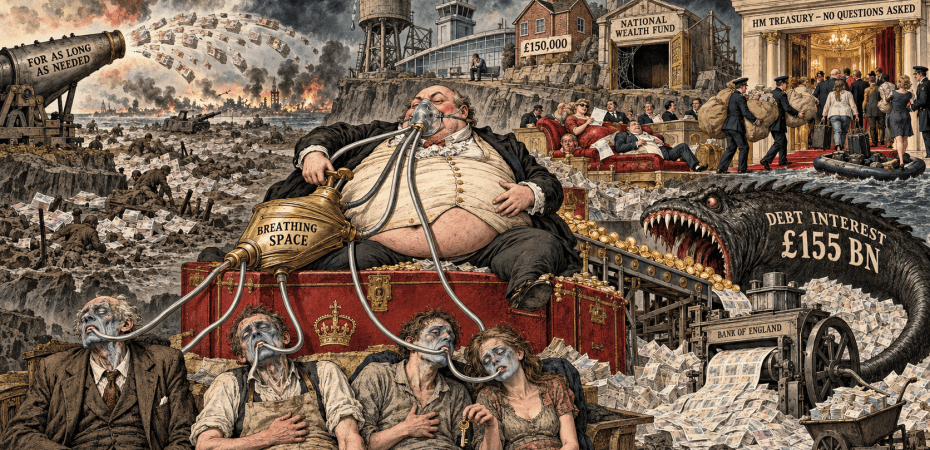
The Treasury has published its Budget, and I have read it. It runs to a hundred and sixty-six pages, and on the back of the title page it tells me that it was “Printed on paper containing 40% recycled fibre content minimum”. That is the one statement in the document I am prepared to accept without further enquiry. The cover carries the motto “Breathing Space for Today, Fresh Hope for the Future”, which belongs to the same family as the claims once printed on bottles of tonic wine. In half a century of practice, I have read a great many documents drawn up by people who needed money and preferred not to say how much. The prospectus of a company that will not see out its second winter has the same habit of speaking warmly of the future and saying as little as possible about the balance sheet.
This was John Healey’s first Budget as Chancellor, delivered on the 28th October, and I will state my case against it at the outset. The British State spends far too much. It spends a great deal of what it takes on people at home who could work and do not, and on people from abroad who should never have been admitted at public expense. It spends more on preparing for a war with Russia that is neither in our interest nor capable of being won, and more again on enterprises that private men would undertake at their own risk if they were worth undertaking at all. To pay for this, it taxes us more heavily than at any time in my life, and it borrows on a scale that has begun to feed on itself. Mr Healey has done nothing to arrest any of this, and a good deal to make it worse.
The size of the bill
Let me begin with the figures, which the Budget prints in its annexes, where few people will look. Total Managed Expenditure, which is everything the State spends, is put at £1,449.2 billion for the present year. It rises to £1,504 billion next year and to £1,697.7 billion by 2031-32 (Table B.4, p. 148). This year it amounts to 45.6 per cent of the national income. The Treasury is not embarrassed by this. On the contrary, it boasts that the Government “is maintaining the highest sustained level of public spending in four decades” (p. 4). I can think of few other organisations that would advertise as an achievement the fact that they have become more expensive to run than at any time since the middle of the 1980s, and none that would expect their customers to be grateful.
The most instructive figure is on page 152, in a chart showing where next year’s money will go. Debt interest will cost £155 billion. Defence, about which we hear so much, will cost £98 billion, and education £153 billion. The State will therefore pay more to its creditors than it pays to teach every child in the country, and more than half as much again as it pays for the armed forces. Against all this spending, receipts are expected to be about £1,392 billion. The difference is borrowed. This year’s borrowing is forecast at £133.2 billion, which is £17.7 billion more than was forecast in March, and of that increase £15.4 billion is accounted for by higher interest on the debt (Table 1.3, p. 26). I shall return to that last fact, because it is the most important in the whole document.
The tax that is not a tax rise
The Budget assures us, on its first page, that it “rejects broad-based tax rises”. This is one of those statements that is true only in the sense intended by its drafter. Everyone remembers the clever witness who answers the question put to him and not the question that should have been put. In 2025, Mrs Reeves raised the rates of tax on income from savings and from property by two percentage points, to take effect from April 2027. Mr Healey will now raise them by a further two points from the same date (para. 2.50, p. 39). A man who lives partly on the interest from his savings, or on the rent from a flat he bought for his old age, will therefore pay four points more than he did when this Government came into office. The Treasury tells us that “84% of income tax payers will be unaffected by these changes”. This means that some sixteen per cent of them will be affected, which on the usual count of income taxpayers is several million people. They are, for the most part, the people who did what every Chancellor since the war has urged them to do, which is to save.
There is more. The Bank Corporation Tax Surcharge is doubled from three to six per cent for fifteen months. The duty on higher-stake gaming machines goes from twenty to twenty-five per cent. The lifetime limit for Business Asset Disposal Relief, which reduces the tax a man pays when he sells the business he has built, is halved from a million pounds to £500,000 (para. 2.53, p. 39). Online marketplaces are to collect VAT on behalf of their sellers. The freeze on income tax thresholds, which Mrs Reeves extended last year, continues to drag people into higher bands as their wages follow prices. By the reckoning of City AM, the tax rises imposed by this Government since the election of 2024 now exceed seventy billion pounds. In March, the Office for Budget Responsibility forecast that the tax take would reach a post-war high of 38 per cent of the national income by 2030-31. None of the measures in this Budget alters the direction of travel.
I will make my concessions. The surcharge on the banks is said to be temporary, and the Government has abandoned its plan to reduce the cash ISA allowance. It has also cancelled the Digital ID scheme (para. 2.8, p. 31), for which I congratulate it without reservation, though I suspect the decision owed more to cost than to any new respect for the privacy of the subject. I note too that pensioners whose only income is the state pension are to be protected from income tax. I have drawn the state pension for seven years, but I have other means, and the new allowance will do nothing for me. Nor do I think it should. What troubles me is the principle on which the Treasury now proceeds, which is that any tax not levied on everyone at once is not really a tax at all.
The idle at home
The largest single heading of expenditure is what the Treasury calls social protection, which will cost £430 billion next year. I must be candid about this, since much of that sum is pensions, and some of it comes to me. The Budget proposes to adjust the triple lock from the next Parliament, so that the state pension follows earnings and no longer ratchets upwards against them. I have always thought the triple lock indefensible. It was a bribe to the most reliable voters in the country, and I would accept its end with better grace than the Government seems to expect of people like me. But the pension is at least paid to people who worked and contributed for forty years. My complaint is about a different class of payment.
According to the Office for Budget Responsibility, the State spent £62.7 billion last year on health and disability benefits for people of working age, which was already more than it spent on defence. It expects that figure to reach £74.9 billion by 2028-29. The Budget itself tells us that “almost one in four of the working-age population is classed as disabled” (para. 5.20, p. 93). I do not believe that a quarter of the Englishmen and Englishwomen of working age are disabled, and I doubt that the Treasury believes it either. Some of them, of course, are seriously ill, and I would not deny them help. Yet when a system pays more to those who are unable to work than to those who are merely unemployed, it will find that the number of people unable to work rises, and it has risen without interruption since the pandemic. The Budget also records “nearly one million young people not in education, employment or training” (p. 7). Its answer is a Jobs Guarantee, which will put them on schemes administered by the same State that has kept them idle. Mr Healey told the House that he would “reject” what he called “crude cuts” to welfare. I understand him to mean that he will make no cuts of any kind until two more reviews have reported and a White Paper has been written, by which time the bill will be larger still.
The idle from abroad
The second class of claimants has come from abroad. I am conscious of the need for care here. A man who crosses the world to work, and pays his way, is no burden on anyone, and the Office for Budget Responsibility found in 2024 that a migrant arriving at twenty-five and earning the average wage contributes more over his lifetime than a native on the same pay. It also found that low-paid migrants impose a net cost on the public finances over their lives, and we have admitted low-paid migrants in their hundreds of thousands. Every one of them needs school places for his children and medical care in his old age, and very often housing benefit and Universal Credit in the years between. Even the pretence that this was being controlled has been abandoned. The Budget promises “the most pro-business migration system” (p. 77), which in practice means more visas and longer ones.
The asylum system is worse, because nothing is contributed at all. When the National Audit Office examined the Home Office contracts for asylum accommodation last year, it found that they were expected to cost £15.3 billion over ten years, against an original estimate of £4.5 billion. In 2024-25 alone, they cost about £1.7 billion, of which £1.3 billion went on hotels. I have no wish to be unkind to people who have fled real danger. But the greater number of those who arrive in small boats have passed through several safe countries on their way here, and they come because they know that once they are here they will be housed and fed and very seldom removed. To use the plain old word, they are scroungers, and the fault lies less with them than with the Ministers who have made scrounging so easy and so well rewarded. A Government that cannot keep out people who have no right to be here, and will not remove them once they have arrived, has failed at the most elementary duty of a State. It then asks the taxpayer to meet the cost of its failure.
Preparing for the wrong war
It is fitting that a former Secretary of State for Defence should now have charge of the Treasury, since a great deal of this Budget reads as if it had been drafted in the Ministry of Defence. The Government repeats its commitment to spend 3.5 per cent of the national income on defence by 2035, with “a target date for 3% in 2030” (p. 8). It confirms full funding for a Defence Investment Plan of £15 billion over four years, partly by cutting the capital budgets of every other department. It is putting £300 million into an unmanned combat aircraft called StormFighter, which sounds like the name of a children’s toy. It directs the National Wealth Fund and the British Business Bank to put up to £5 billion into “defence, dual-use and other sectors that support our national security”. All of this is presented as the necessary response to what the Budget calls “a new era of threat”.
The threat in question is Russia, and the theatre is Ukraine. The Budget makes “over £10 billion of additional financial support to Ukraine” available, on top of “£3 billion a year in military support until 2030-31 or for as long as needed” (p. 8). It explains that this “is in the UK’s national interest” (para. 5.35, p. 97), and it does not trouble to say why. Ukraine is not a member of NATO. We have no treaty obligation to fight for it, and no British interest that I can identify is served by prolonging a war in which Ukraine has been giving ground slowly for more than four years. Russia has taken that time to advance across a few provinces of eastern Ukraine, and the notion that it means to go on to the Channel does not survive a moment’s examination. As I argued in these pages lately, this country could not fight a long war against Russia in any event. We make about four million tonnes of steel a year and have six destroyers. Our political class, moreover, is one that most of our young men would not cross the road to defend. A war that cannot be won should not be prepared for, and still less should it be financed in someone else’s country.
As a lawyer, I am struck chiefly by the words “for as long as needed”. I have advised a good many clients against signing guarantees, and I would have advised every one of them against a guarantee unlimited in time and in amount, given to a party who has every reason to call on it and none to stop. Much of the new support takes the form of loan guarantees, through the World Bank and through UK Export Finance. These do not appear as spending now, which is why Governments are so fond of them, but they become spending when the borrower cannot pay. The Treasury also promises to “consider all lawful routes to ensure Russia pays” (para. 5.38, p. 98), building on the use of profits from frozen Russian assets. I invite anyone who keeps money in London to consider what this precedent means for the security of foreign deposits held here, and what it will cost the City when the next owner of a large fortune decides that his money is safer elsewhere. Defence of these islands is a duty of government. The money in this Budget is going to something quite different.
The State as entrepreneur
The fourth heading of waste is less dramatic, but it may in the end be the most damaging. Under the title “Public control of the essentials”, the Budget announces that “the state will provide greater strategic direction, certainty and accountability” in energy, transport, water and housing (p. 6). It will recapitalise the National Wealth Fund and the British Business Bank with a further £20.4 billion, bringing the capital of what the Treasury calls our “Public Financial Institutions” to £229.3 billion (paras. 4.43-4.44, p. 61). It will introduce a Water Bill “to repeal the statutory ban on public ownership” (p. 57). It welcomes the purchase by the South Yorkshire mayoralty of Doncaster Sheffield Airport, which closed in 2022 because no one could make it pay (para. 4.72, p. 67). It will spend £140 million through a Sovereign AI Unit “to back promising UK AI companies” (p. 6), and it will give ten thousand energy-intensive manufacturers a discount of up to a quarter on their electricity at the taxpayer’s expense.
The objection to all of this is old and has never been answered. If an investment is good, private capital will make it, because private capital is looking for exactly such investments and is very good at finding them. If it is not good, private capital will decline it, and the State then makes it with money taken from people who would have declined it too. The Treasury’s favourite phrase is that public money will “crowd in” private finance. What this means in practice is that the taxpayer takes the first loss so that the private investor can take the profit. I spent enough years drafting such arrangements to know which party usually does better out of them.
Housing shows the method at its clearest. The Budget provides “an additional £1.5 billion to deliver around 10,000 homes in England” (p. 7). That is £150,000 of public money for each home, and the homes will be let at rents well below the market. It also confirms £4.7 billion for “the new Your First Home equity-loan scheme” (p. 7), which is Help to Buy under another name. The House of Lords found that Help to Buy raised prices in the dearer parts of the country by more than it helped buyers, and there is no reason to expect a different result from a scheme built on the same principle. The difficulty with English housing is that the planning system forbids building, and no quantity of subsidy will cure a shortage that the law itself creates. Among the smaller items, I notice up to £5 million a year for “organisations like Dolly Parton Imagination Library” (p. 49). I have nothing against Miss Parton, whose generosity is well known, but I cannot see why the British taxpayer should subsidise an American charity in sending picture books to children whose parents could buy them for the price of a packet of cigarettes.
The loop
I come now to the fact I promised to return to. Borrowing this year has been revised upward by £17.7 billion, and £15.4 billion of that is interest. The Budget admits that the Office for Budget Responsibility now expects “an average of £14 billion per year in extra government debt interest compared to the Spring” (p. 1). The margin by which the Chancellor meets his own rule on day-to-day borrowing has fallen from £23.6 billion in March to £15 billion, and the Treasury’s comment is “This is what a buffer is for” (p. 2). It is indeed what a buffer is for, but a buffer that is spent on interest has bought nothing at all. Public sector net debt is put at 95.5 per cent of the national income this year, rising to 97.3 per cent in 2028-29 (Table 1.2, p. 26).
Consider what this means as a process rather than as a set of numbers. The State borrows because it spends more than it takes. Its debts grow, and the interest on them grows with the debts and with the rate the lenders demand. The interest is itself paid with borrowed money, which enlarges the debt, which raises the interest. Lenders, observing this, ask for more to compensate for the risk, which raises the interest again. About a quarter of the gilts are linked to the retail price index, so that every rise in inflation adds automatically to the bill. Every Budget for twenty years has shown borrowing falling comfortably in the later years of the forecast, and this one is no exception, with borrowing falling to 1.8 per cent of the national income by 2031-32. Every Budget for twenty years has then been followed by another that pushed the fall further into the future. I have known clients who made the same forecasts about their own affairs, and I have attended the meetings of their creditors.
Where does it end? A private debtor in this condition ends in bankruptcy. A State that borrows in its own currency has a further option, which is to have its central bank buy its debts with money created for the purpose. The Bank of England has done this before, creating £895 billion between 2009 and 2021 to buy bonds, and it would certainly do it again if the gilt market refused to lend on acceptable terms. That would keep the Treasury solvent in a formal sense, but it would do so by debasing the currency in which our wages and pensions are paid and our savings are held. Inflation would then raise the cost of the index-linked debt and the rates demanded on the rest, so that the Bank would be obliged to buy more. This is the road that ends in hyperinflation, which is a form of national bankruptcy in which the creditors are paid in full with money that has ceased to be worth anything. I do not say that we shall reach the end of that road next year, or that it will take the precise form it took in Weimar or in Zimbabwe. That is a prediction, and I offer it as one. What I do say with confidence is that we are on the road, and that nothing in this Budget turns us off it.
What a serious Government would do
The alternative is not complicated, though it is hard. A Government serious about the public finances would cut spending by at least a quarter, and would then cut taxes. I should be honest about the scale of this. A quarter of this year’s expenditure is about £360 billion. Debt interest cannot be cut by an act of will, so the reduction must fall on the rest, and it would therefore amount to rather more than a quarter of everything else. It would bring public spending down to about thirty-four per cent of the national income, which is roughly where it stood at the end of the last century. That country was not a wilderness of neglect. It had schools and hospitals, and it did not have a Government that paid more in interest than it spent on education.
The places to begin are the ones I have described. Support for the war in Ukraine should end, and the defence budget should be directed to the defence of these islands rather than to a land war in Eastern Europe that we cannot fight. The National Wealth Fund and the British Business Bank should be wound up and their capital returned to the Treasury, with the subsidies to favoured industries and the whole apparatus of net zero. Asylum support should be confined to the very few who arrive here directly from danger, and the rest should be removed. Spending on working-age sickness benefits should be brought back at least to where it stood before the pandemic, which would require nothing more radical than assessments carried out in good faith. The administrative State itself should be reduced by much more than the twenty per cent cut in departmental administration budgets that the Budget proposes, which it expects to save an additional £595 million in 2029-30 (para. 2.14, p. 33). That is about what the State pays in interest every day and a half.
It will be objected that cuts on this scale would cause a recession. They might cause a short one, and I would not pretend otherwise. But the experience of other countries is less alarming than the textbooks suggest. In 1922 Sir Eric Geddes was set to work on the swollen post-war departments, and the economy did not collapse. The Canadians cut their federal programme spending sharply in the middle of the 1990s, balanced their budget within a few years, and enjoyed a decade of growth. The cuts would also have to be made over a Parliament and not in a single year. The reward would be that taxes could then fall, beginning with the new taxes on savings and with stamp duty, which punishes every man who wishes to move house. In the autumn of 2022, the bond market removed Mrs Truss because she proposed to cut taxes without cutting spending. I believe the same market would reward a Government that cut spending first, and that the fall in the cost of borrowing would do more for growth than every fund and taskforce in this Budget put together.
There is no sign that Mr Healey or Mr Burnham has any such intention. The Budget tells us that “it is not necessarily the case that all departments will see real-terms increases at the next spending review” (p. 5), which is the most courageous sentence it contains, and is offered almost as an apology. Everything else in it assumes that the State will go on growing and that the taxpayer and the lender will go on paying for it. The breathing space on the cover is real enough, but it is the State’s and not ours. It has been bought for another year by taxing the prudent and borrowing against our children, in the hope that the reckoning will fall on some other Chancellor. Of all its hundred and sixty-six pages, only the paper has been recycled to any useful purpose.
Sources
HM Treasury, Budget 2026: Breathing Space for Today, Fresh Hope for the Future, HC 726, 28 October 2026. Page and paragraph references in the text are to this document.
Office for Budget Responsibility, Economic and fiscal outlook, March 2026, on the forecast tax take of 38 per cent of GDP in 2030-31: https://obr.uk/economic-and-fiscal-outlooks/
Full Fact, “Health and disability benefit spending is already higher than defence spending”, 28 May 2026, citing the OBR March 2026 forecast: https://fullfact.org/economy/tony-blair-disability-benefits-defence-spending/
National Audit Office briefing on asylum accommodation, May 2025, as reported by LBC: https://www.lbc.co.uk/politics/uk-politics/asylum-accommodation-treble-expected-price-costing-nearly-155-billion-ten/
Migration Observatory, “The fiscal impact of immigration in the UK”, summarising the OBR’s 2024 analysis of lifetime fiscal contributions: https://migrationobservatory.ox.ac.uk/resources/briefings/the-fiscal-impact-of-immigration-in-the-uk/
City AM, “Healey hikes taxes and delays defence spending as economy set to slump”, 28 October 2026, for the Chancellor’s remarks and the total of tax rises since 2024: https://www.cityam.com/budget-healey-hikes-taxes-and-delays-defence-spending-as-economy-set-to-slump/

Discover more from The Libertarian Alliance
Subscribe to get the latest posts sent to your email.


