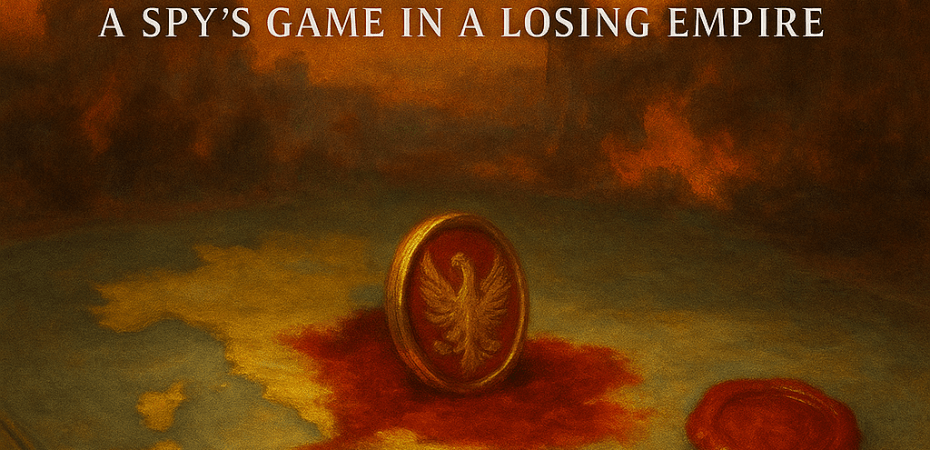
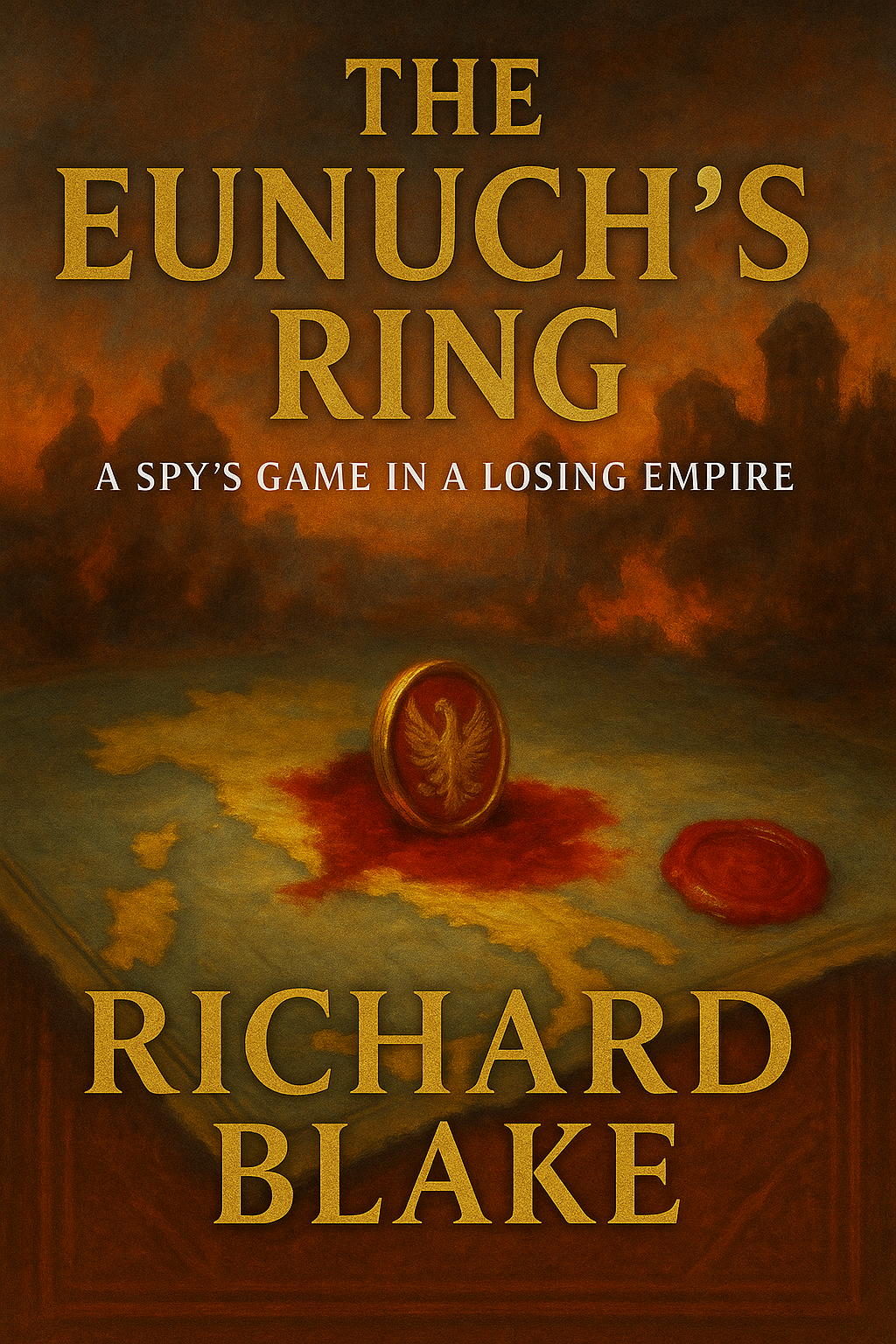
The Eunuch’s Ring
Richard Blake
Hampden Press, 2025
It would be dishonest not to begin with a confession. Richard Blake is Sean Gabb, and Sean Gabb happens to be my Greek teacher. Under those circumstances, it would be difficult for me to give The Eunuch’s Ring an unfavourable review. I might find myself translating Thucydides until my eyes fell out. But as it happens, no special indulgence is needed. This is an extremely good novel.
The protagonist is Roderic of Aquileia — Rodi — a young Goth in the clandestine service of Eleutherios the Eunuch, Exarch of Ravenna. Eleutherios sends him south into the Lombard Duchy of Benevento under the name “Master Ediulf of Salorno”. His cover is almost offensively respectable. He is employed as a Greek tutor to Gisulf, the fourteen-year-old nephew of Duke Arechis. His real purpose is to discover what Arechis is doing with his army and his foreign policy, and to send enough information back to Ravenna for the Eunuch to decide whether he needs to invade and hang everyone.
This is seventh-century Italy, though not the seventh century most people have in their heads — assuming they have anything at all in their heads about the seventh century. The Roman Empire has fallen in the West, except that in another sense it has not. The Emperor still rules from Constantinople. His officials still govern Ravenna, Rome, Naples and other fragments of Italy. They still call themselves Romans, collect taxes, issue decrees and regard the Germanic rulers who have occupied most of the peninsula as temporary nuisances. The Lombards, meanwhile, have been in Italy long enough to start becoming civilised without having entirely stopped being barbarians.
Benevento sits somewhere between the two worlds. The Roman city is still there. So are its palaces, baths, churches, roads, administrative habits and memories. But much of it is falling apart. Buildings intended for a civilisation capable of maintaining aqueducts and municipal government have been inherited by people who can barely keep the roofs on them. Ancient magnificence survives beside timber repairs, accumulated filth and casual violence. The great baths have become cavernous relics of a world that nobody quite knows how to restore.
This is one of the great pleasures of the novel. Most historical fiction takes place in a past that feels suspiciously like the present after someone has switched off the electricity and distributed swords. Blake’s seventh century genuinely feels like another civilisation. Yet it is not an alien civilisation. Everywhere are the remains of Rome. Educated people still speak and write Latin. Greek still matters because the Empire matters. Men argue about theological distinctions that could get them killed. A papal legate negotiates with Arian Lombards while Byzantine officials consider how religious disputes might be manipulated for strategic advantage. At one point Rodi reflects on how the Eunuch might arrange the canonisation of a monk murdered by the Lombards, partly because this would annoy them and make their rulers’ political position more difficult. This is religion, diplomacy and intelligence work all mixed together, which is probably much closer to how politics actually worked than the tidy categories we learn at school.
Benevento itself is ruled, while Duke Arechis is away, by his wife. The Duchess is a pompous alcoholic who somehow manages to be ridiculous, dangerous and genuinely intelligent. Her chief assistant is Clementian, an ancient steward whose peculiar speech and apparently shambling manner conceal a formidable capacity for surviving. Then there is Gisulf, Rodi’s pupil: clever, spoilt, affectionate, manipulative and occasionally terrifying. Aripert, a beautiful young Lombard prince from Pavia, has a complicated history with Rodi involving friendship, sex, rivalry and attempted murder. There are churchmen, soldiers, slaves and assorted political operators, nearly all of whom know something they should not know.
Rodi very quickly discovers the essential principle of Beneventan politics. Everyone is lying to everyone else. The only common interest between the various factions is that they are all lying to him.
Then people start dying.
The first murder is worth waiting for. It is so grotesque that describing it clinically somehow makes it worse. On page 49, Clementian examines the corpse:
Scaring a cloud of buzzing flies, Clementian lifted a cloth from the still face. “Since you asks, Me Lady, I’d say he choked after his cock and balls was pushed down his throat and his lips sewn shut. I can’t see how anyone would survive that for long.”
He paused, a look of grim disgust on his face. His audience of the palace slaves groaned again in unison. He waited for silence, then, in a low and croaking whisper: “That’s assuming he wasn’t dead already from the loss of blood.”
He stepped away from the body and raised his voice. “But I’ll go with choking. That’s a horrid look on his face.”
It is indeed a horrid look.
There are more murders. There are attempted murders. There is torture. There are betrayals, assassins and military violence. At one point someone is dismembered with sufficient thoroughness to make you wonder whether Blake was working from a checklist. Yet the violence never feels pasted on simply to make the book shocking. It belongs to the politics. People kill because killing is one of the available methods of solving problems.
This matters because The Eunuch’s Ring is fundamentally a novel about power. Its characters are not divided into goodies and baddies. They are divided more usefully into those who understand what is happening, those who think they understand, and those who are about to discover that they understood nothing.
Rodi himself is particularly good. He is young enough occasionally to behave like a boy but experienced enough to have lost most illusions about authority. He lies professionally. He manipulates people. When necessary, he kills. Yet he is not simply a cynical little monster. He forms attachments, particularly to Gisulf, and these repeatedly interfere with the clean calculations expected of an intelligence agent.
Gisulf may be the best character in the book. He is simultaneously child, prince and budding politician. His affection for Rodi can be touching, possessive and menacing within a few pages. He is perfectly capable of protesting that his beloved aunt would never arrange Rodi’s murder while Rodi patiently explains how she probably intended to do just that. When Gisulf complains that Rodi has “spent too long among bad people”, the joke is that Gisulf himself is becoming rather good at being one of them.
That exchange also points towards what I think is the deepest theme of the novel. Blake has an entirely healthy distrust of anyone in or near government who says he is acting for the welfare of the governed.
Nobody here simply wants power, of course. That would be vulgar. They want power for entirely admirable reasons. The Byzantines want to preserve civilisation and imperial order. The Church wants to save souls. Lombard rulers defend honour, dynasty and their people. The Duchess talks sentimentally about treating her household as her children. Somehow the practical consequences of all this public virtue include torture chambers, taxation, assassinations, religious persecution and quite a lot of hanging.
This is not a crude libertarian tract disguised as historical fiction. It works because Blake understands that rulers often believe their own excuses. The Duchess is not secretly twirling her moustache whenever she mentions duty. Eleutherios really does have an Empire to defend. The Church genuinely believes religious truth matters. Their motives may even sometimes be good. The problem is what happens when people possessing armies, prisons and executioners become convinced of their own goodness.
Nor does Blake romanticise the alternative. The decline of Roman government has not produced a cheerful society of free individuals exchanging things by mutual consent. It has produced local warlords. Imperial civilisation may be oppressive, but barbarism is not noticeably libertarian either. The choice throughout the novel is usually between different concentrations of power, each surrounded by men explaining why obedience is necessary.
This makes the setting more than decoration. The Eunuch’s Ring takes place at one of the most interesting moments in European history: the point at which antiquity has plainly ended but refuses to go away. Imperial memories remain extraordinarily strong. Men inhabit Roman buildings, use Roman titles, read Roman books and conduct diplomacy in the shadow of Roman law. Yet the Middle Ages have already been born around them.
Blake understands decay particularly well. His Benevento is not picturesque. Ruins are inconvenient. Great buildings have become useless because the social organisation necessary to maintain them has disappeared. But the decay has grandeur. There is something melancholy about people conducting their sordid intrigues inside the architectural carcass of a civilisation immeasurably richer and more capable than their own. Benevento becomes almost another character in the novel: beautiful, filthy, dangerous and living among its memories.
And then the political thriller becomes something else again. Without giving away the later plot, the intrigues within the palace eventually become entangled with the military fate of Benevento itself. Rodi has to move from finding out what other people are planning to helping decide what happens next. Lucas, initially an intelligent carpenter’s mate, becomes important in organising the defence. Gisulf discovers that being a prince is rather more serious when armed men are outside the walls. Even Clementian’s administrative abilities become matters of life and death.
One of the pleasures here is Blake’s refusal to make warfare heroic. Military decisions depend on numbers, intelligence, food, walls, roads and whether supposedly experienced troops actually know what they are doing. During the siege, Rodi dismisses the enemy’s immediate prospects because they are not equipped for serious siege warfare. A message arrives in code announcing that the Governor of Naples is approaching with five hundred cavalry. Clementian immediately decides they are saved. Rodi, being Rodi, wonders whether the five hundred men are veterans or another pack of boys.
That is characteristic of the whole book. Grand historical events are constantly reduced to the human beings who have to make them happen.
At 535 pages, this is not a short read. It does not feel like one. The plot twists repeatedly without becoming incomprehensible, and Blake has the confidence to let scenes develop rather than sprinting from one piece of action to another. His prose is clear and often extremely funny. He has an excellent ear for the comedy of people trying to maintain dignity while surrounded by obscenity, incompetence and death.
The humour matters. Without it, this would be an unbearably grim book. Instead, the horror and comedy sharpen each other. The Duchess can be ludicrous in one scene and frightening in the next. Clementian’s mangled grammar makes him comic until you remember what he is capable of doing. Rodi’s internal commentary on the people around him is often viciously funny, particularly when he is most frightened.
There is also a pleasing absence of twenty-first-century moral tidiness. Nobody has been inserted into the seventh century to explain our values to the natives. Slavery exists. Religious hatred exists. Sex and violence are surrounded by assumptions different from ours. The characters are allowed to belong to their own world.
That may be Blake’s greatest achievement. His early Middle Ages are neither a theme park nor an excuse for modern people to wear funny clothes. They are a civilisation in their own right — or perhaps several civilisations occupying the same geographical space and preparing to kill one another.
I am ordering copies for both grandmothers. One of them was given the job of supervising what I watch on Amazon Prime. She has consequently watched and enjoyed enough sicko Asian horror with me that I think she will manage The Eunuch’s Ring. I am also considering bringing selected passages into PSHE. There is a fat boy in my class with spots and smelly breath who cries and bangs his head against the wall whenever anyone mentions the Ukraine War. The scene involving a gagged prisoner and the progressive removal of bodily appendages sounds educationally promising. PSHE is supposed to prepare us for adult life, after all.
But put my Greek lessons and my grandmother aside. The Eunuch’s Ring deserves a very favourable review. It has a complicated plot that actually rewards attention. Its characters are intelligent enough to surprise one another. Its violence is sometimes horrifying because violence has consequences. Most importantly, it recreates a period almost completely neglected by popular historical fiction: an Italy in which Romans still think the Empire eternal while living among unmistakable evidence that their world has ended.
There is something larger beneath all the murders. Civilisation in this novel is never a permanent achievement. It is something inherited, maintained imperfectly and very easily lost. The Roman baths can stop working. The roads can decay. Literacy can retreat. Government survives throughout — government always seems remarkably good at surviving — but government and civilisation turn out not to be the same thing.
Perhaps that is why the book feels unexpectedly contemporary without ever ceasing to be historical. Everyone in authority has a plan for saving everyone else. Everyone insists that extraordinary measures are unfortunately necessary. Everyone has excellent reasons for wanting more power.
And everyone should probably keep away from the cellar.
Highly recommended.
Discover more from The Libertarian Alliance
Subscribe to get the latest posts sent to your email.