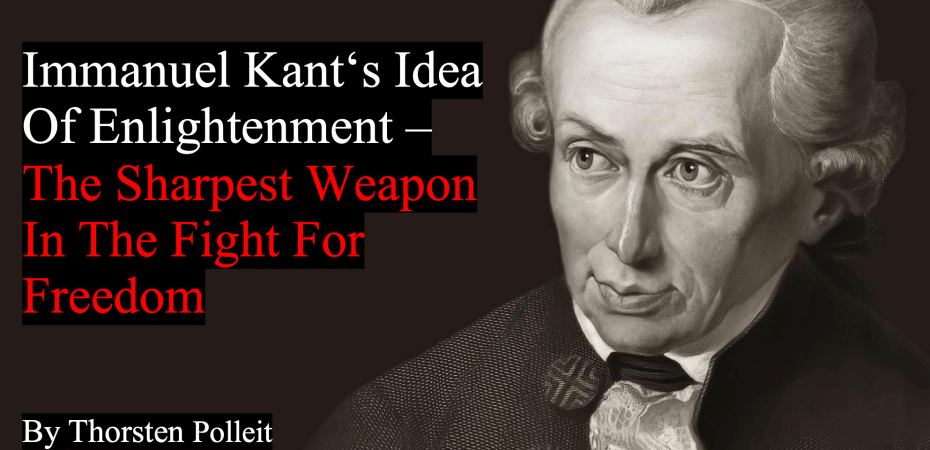
Immanuel Kant’s idea of enlightenment –
the sharpest weapon in the fight for freedom
Speech Given in Bodrum
by Thorsten Polleit
at the September 2024 Conference of the Property and Freedom Society
I.
It is a frontal assault, a full-force attack against Western civilization: Powers are at work that seek to undermine, abolish and destroy people’s freedom, prosperity and peace.
These powers have led many people to follow ideas that come from the socialist-communist-fascist hell’s kitchen, ideas that do not reveal their true origin and nature, though.
They are called Great Reset, New World Order, Green Politics, Net-Zero, advocate “public-private partnerships”, open borders, call for introducing digital IDs, digital vaccine certificates, central bank digital currency.
With the help of these ideas, states and special interest groups (that hijack the states for their purposes) expand their power almost unchecked.
Together they erode the value of money, devalue savings, ruin state finances, undermine private property, make food and energy unaffordable, destroy the family, abolish free speech, secretly erect a command economy that brings impoverishment, oppression and violence to people.
It will become very dark in the Western world if this destructive process is not stopped and reversed quickly.
My talk is meant to help in ending and pushing back the sinister onslaught. Its title is: “Immanuel Kant’s idea of enlightenment – the sharpest weapon in the fight for freedom”. The result of my talk can be summarized as follows:
Getting enlightened is the necessary (and badly needed) groundwork, the indispensable prerequisite in the fight for freedom. Without enlightenment of the people, freedom cannot be maintained, let alone lost freedoms regained.
Many thinkers who have developed theoretical concepts for practical purposes tacitly assume that people have achieved the necessary level of enlightenment. Unfortunately, I believe that this assumption is not justified.
The Western world has been subject to progressive anti-enlightenment for a long time.
A strategy that brings us back to freedom must be based on this rather uncomfortable insight.
What is more, the powers that drive the anti-enlightenment are evil. Let us turn to words from the Bible, Ephesians 6:11-13:
“Put on the full armor of God, so that you can take your stand against the devil’s schemes. For our struggle is not against flesh and blood, but against the rulers, against the authorities, against the powers of this dark world and against the spiritual forces of evil in the heavenly realms. Therefore put on the full armor of God, so that when the day of evil comes, you may be able to stand your ground, and after you have done everything, to stand.”
What we as freedom-loving people can do is to choose the path of enlightenment and walk it undeterred and undaunted – and invite our fellow people to follow us along this path.
But – as the words of the holy scripture remind us – we should not think that we can still win the battle against the evil powers that drive the anti-enlightenment without God’s help, without following Jesus Christ.
Let us begin with the idea of enlightenment.
II.
In 1784, the Prussian philosopher Immanuel Kant (1724-1804) published an essay entitled: “Answering the question: What is enlightenment?” His answer is:
“Enlightenment is man’s emergence from his self-imposed nonage. Nonage is the inability to use one’s own understanding without another’s guidance. This nonage is self-imposed if its cause lies not in lack of understanding but in indecision and lack of courage to use one’s own mind without another’s guidance. Dare to know! (Sapere aude.) “Have the courage to use your own understanding,” is therefore the motto of the enlightenment.”
Immanuel Kant addresses his words to you and me, to all of us. And he says it straight to our faces:
(1) Enlightenment requires that you must overcome your laziness and cowardice, your self-inflicted nonage.
(2) You also must defend yourself against those who keep you stupid, who lock you in an “intellectual prison”, who want to discourage you from thinking for yourself – and I may add: who want to subject you to their wishes and rule, to plunder and impoverish you.
Let me ask you: Are we today – you and I, the majority of people – lazy and cowardly?
It is fair to assume that most people are lazy and cowardly when it comes to defending their own freedom, when it is under attack.
What makes matters worse is that many of us do not find it easy to defend our freedom, because the attacks on freedom are often not, or only with difficulty, recognizable as such.
The enemies of freedom do not openly proclaim their plan; they prefer the policy of deception, false promises, and sabotage, often dressed up in well-meaning words.
For example, governments raise taxes in relatively small steps, and small tax increases do not initially trigger major protests among the people.
But once accepted, there will be more small tax increases, the plunder of the people increases. And at some point, the state has become so financially powerful, and society has become so corrupt, that it is difficult to form any resistance against it.
Or: Socialist fanatics deny that they want to establish socialism, they give their socialist revolution other, pleasant-sounding names – such as “welfare policy”, “green politics”, “climate protection”, “anti-discrimination” etc.
Today’s socialists no longer say “We are socialists”, they say “We want a better, greener, fairer, more inclusive and better world”.
In reality, however, they wish to subjugate, exploit, plunder and enslave the people, some even want to reduce the world’s population – and mostly they do not say this openly and honestly.
And if you do not recognize the attacks on your freedom as such, then of course defending yourself becomes rather difficult.
As a kind of working hypothesis, we should assume that we are not enlightened, that many of us are unable to use their own understanding without the guidance of another.
Quite a few amongst us even suffer from the Stockholm syndrome: They were made to have positive feelings towards their perpetrator, their enemy, the state and its politicians.
Let’s do a little test. If you agree with one of the following sentences, then it is likely that you are not, or at least not fully, enlightened:
- The state (as we know it today) is indispensable for us to live together in peace and freedom.
- Or: Problems such as environmental pollution, old age poverty, economic crises, inflation etc. are the result of capitalism.
- Or: It was because of economic reasons that gold money was replaced by fiat money.
- Or: The quantity of fiat money has to increase over time to allow our economies to grow.
- Or: In modern democracy – understood as majority government – the people govern themselves.
- Or: It is scientifically proven that man-made C02 leads to global warming.
I leave it to you to assess for yourself how enlightened you are.
II.
When we talk about enlightenment and anti-enlightenment, then we are dealing with a problem that is centuries, if not millennia, old.
The problem is that of domination, subjugation: the idea that some may, should or must rule over others. The problem today, in modern democracy, is not much different from what it was in times long past.
Let me ask you a question: How can it be justified that some rule over others?
Common sense tells us that there are only two ways in which people can cooperate with one another: voluntary action on the one hand and coercion and violence action on the other hand.
Voluntary action means that I offer you something and you accept my offer or reject it, just as you wish.
Coercion and violence mean that I force you to accept my offer, and that I punish you if you don’t comply with my wishes.
Either voluntary action or coercive and violent action – there is no third option, tertium non datur.
Against this background we realize that the state (as we know it today) is not based on voluntary action, but on coercion and violence.
The state is a territorial coercive monopolist with the final decision-making power over all conflicts in its territory, and the state allows itself to do something that is forbidden to any of us: take something away from someone against their will.
And because the state is based on coercion and violence (and not on voluntariness), it will become ever larger and more powerful, restricting and destroying the freedoms of citizens and entrepreneurs over time.
Hans Hermann Hoppe expresses this action-logical insight as follows: Even a minimal state sooner or later becomes a maximum state.
You might ask: How can the state become so powerful? After all, those who want to rule over others represent a comparatively small group of people. How can they even gain power to rule?
They can do it in two ways: (1) Those who strive for power subjugate others with the sword, with brute force. But this is arduous and dangerous for them. There is a better way for them.
(2) Those in power get people to agree to being ruled, make them excited about being pushed around.
But how can this be achieved? Easy. For example, the rulers win over the majority of the ruled – by taxing the relatively few high achievers and passing the loot on to the comparatively many low achievers. In other words: The rulers buy the majority with stolen money.
Or: Those striving for power take control over the education system and use the so-called intellectuals for their purposes, for brainwashing.
The state-paid intellectuals proclaim doctrines in schools and universities that glorify the state (and its rulers) as indispensable, as good and right, as the bringer of salvation.
The intellectuals ensure that ideas that favor the rulers spread widely, and that ideas that unmask the rulers are discredited, censored, cancelled.
It is foreseeable that sooner or later special interest groups – with the active help of the intellectuals – will try to harness state power for their own purposes.
And all those who strive for power know that economic theory helps them to gain ever greater power, because economics can significantly influence the ideas of the masses.
The key issue is to conceptualize and practice economics as an empirical science.
III.
At the end of the 19th and beginning of the 20th century, economics was not yet considered an empirical science. That is, economic laws were worked out using logical thinking.
That changed in the 1950s at the latest with Milton Friedman’s essay: “The Methodology of Positive Economics”.
In keeping with Friedman’s thoughts, economics is now taught and practiced basically as an empirical science. Its epistemological pillars are positivism, empiricism and falsificationism.
According to the latter, it is necessary to formulate an economic hypothesis (such as: “If A happens, then B follows”) and then test its truth content by using data.
Experience is seen as the highest level of knowledge, and every truth claim has to be validated on an empirical basis.
In essence, the German Historical School (or more precisely: the Younger Historical School – which is associated with names such as Gustav von Schmoller (1838–1917), Karl Bücher (1847–1930), Lujo Brentano (1844–1931) and Adolph Wagner (1835–1917)) – has won the day.
But that is an epistemological error, it is anti-enlightenment propaganda:
(1) Economic laws can never be confirmed with experience. All experience tells us is that something was this way or that way, but it cannot say that it could not have been otherwise.
(2) Experience cannot be gained without theory; there is no such thing as theory-free experience. We always employ a theory when making an experience. But which theory is the right one, and which is wrong? Positivism-empiricism-falsificationism cannot answer this question.
According to them, there is no such thing as immutable knowledge, there is only hypothetically true knowledge. Consequently, one can never know whether a theory is true or false once and for all.
As a result, there cannot be apodictically true knowledge to be derived from any observation, there is only hypothetically true knowledge at best, according to Positivism-Empiricism-Falisficationism.
(3) We humans do not perceive the empirical world without making presuppositions. Rather, as Kant says, we literally impose qualities on the objects of our experience that come from our cognitive ability.
These are the a priori categories: the conditions of the possibility of experience, as Kant calls them.
A priori knowledge is independent of experience and claims universal validity. Like the law of contradiction in logic: It cannot be the case that a statement is true, and, at the same time, the case that the statement is false.
Empirical experience cannot refute a priori knowledge. Never. A priori knowledge is superior to empirical knowledge; for us humans it represents the form of the highest knowledge.
With a priori knowledge we can – and Ludwig von Mises emphasized this like no other economist before him – make truth statements in the field of human action, in economics.
For instance, we know a priori that socialism does not work, and neither does interventionism; that capitalism is the only possibility for us human beings to form a lasting, peaceful and productive cooperation; that the state’s fiat money did not come into existence through voluntary agreements, but through coercion and violence.
We can know this and other things without resorting to experience, without testing hypotheses, without trying them out.
Whenever we notice that a priori knowledge is relativized, belittled or even rejected in the scientific discourse, we know: Someone tries to switch off our reason, our common sense, that anti-enlightenment is upon us.
If economics is viewed as an empirical science, if a priori knowledge is disregarded, intellectual disorientation and thus highly destructive processes are set into motion, become possible, such as: creating and expanding the state (as we know it today), issuing fiat money, causing inflation, triggering boom & bust, running into over-indebtedness, provoking government-sponsored wars, starting cultural decline, etc.
The anti-enlightenment movement not only takes advantage of peoples’ laziness and lack of courage, it also uses falsehood and lies, restricts free speech and sanctions dissenters.
IV.
So how must the strategy for defending and regaining lost freedom look like? I would like to give you an answer to this question.
(1) The first thing to say is: we have to enlighten ourselves. This is open to each and every one of us, according to Immanuel Kant, thanks to our human intellect.
Enlightenment essentially means thinking for yourself, using common sense, i.e. thinking in an action-logical way, thinking in praxeological terms, as Ludwig von Mises would put it.
At the beginning of action-logical thinking is the sentence “Humans act”. It may sound trivial, but it is anything but trivial. The sentence “Humans act” is a priori true.
And it is an action-logical starting point, which allows us to understand real world issues.
For example, we can know for sure that the acting person pursues goals, that we must use means to achieve our ends; that acting takes time; that we prefer more goods over less goods.
We cannot deny property – understood as property of one’s own body and the external goods that were acquired in a non-aggressive way – without logical contradiction.
What is more, with action-logical thinking we can categorise attitudes towards ourselves and our fellow human beings.
For instance, we know for sure: All actions based on voluntariness are peaceful and friendly; and all those based on coercion and violence (including deception) are antagonistic, hostile.
We know that taxes are forms of coercion and violence, and that the socialists’ effort to abolish private property is not only nonsensical and impossible in terms of logical thinking, we also know that these are deeply hostile actions.
On the path to enlightenment, we also have to learn about the dark side of human existence – perhaps similar to the Italian poet Dante Alighieri (1265-1321), who in his “Divine Comedy” descends into the circles of hell (Inferno) and reaches, at the end of his journey, Mount Purgatory.
Enlightenment means becoming aware that there are people amongst us who do bad things, who do evil, who lie, steal, rob and murder. People who pretend to do good things, but they don’t, they actually do the opposite.
With action-logical thinking, we can understand that in politics, in government, in state and bureaucracy, we meet people who do bad things, terrorise their fellow men with coercion and violence.
It would be downright anti-enlightenment to think that in politics there might be people who are committed to the freedom of their fellow men. The exact opposite is the case!
(I hasten to add that people like, say, Ron Paul in the US are not politicians, they are anti-politicians who want to put a stop to politicians and the state.)
(2) The second important aspect of the freedom strategy is to educate, to enlighten our fellow human beings.
How do we do that? Answer: By passing on the knowledge and insights gained through self-enlightenment.
You start by familiarizing people with the idea of enlightenment, by convincing them of the need for enlightenment in the first place.
The enlightenment of our fellow people must go through the same steps as our self-enlightenment. It must, for instance, take Dante’s path through hell, so to speak, learning some unpleasant truths.
In addition, one must (as Kant says) lose one’s laziness and cowardice, and I would emphasize: lose one’s fear of speaking the truth openly and in a way that others can understand, expose deceptions and lies, do not leave any of them unchallenged.
(3) The third element of the freedom strategy is not to cooperate with the state whenever possible.
Anyone who is enlightened will immediately understand that the state (as we know it today) is not based on the principle of voluntary action, but on the principle of coercion and violence.
The state (as we know it today) must therefore be rejected by enlightened people.
Open, physical opposition is not recommended, however. The state is far too powerful, far too aggressive an opponent to confront it directly.
For example, anyone who does not pay their taxes will be punished, thrown in prison or even killed. Taking this path of resistance, therefore, makes little sense, does not promise any success.
Instead, enlightened people would use every opportunity that presents itself to avoid cooperation with the state.
For example, by not working for the state – not accepting money that the state has stolen from innocent victims.
For the same reasons, entrepreneurs do not business with the state and its representatives.
But what if you have aligned your life, your career, your company to the wishes of the state, and have made yourself financially dependent on it?
To make a hard cut, to quit your job, to give up your pension, to end your business relations with the state is difficult for many people, probably too much to ask of them.
However, they have the option of using their financial resources to advance peoples’ enlightenment – by, say, supporting independent freedom promoting think tanks or by taking an active role in the effort of spreading enlightenment.
There are other ways for non-cooperation with the state.
(1) You hold as little state fiat money as possible. You simply don’t invest your savings in bank deposits and government bonds, but only in real things such as gold and silver coins and in real assets such as housing and company stocks. In doing so, you reduce demand for fiat money and limit the state’s ability to issue new fiat money without causing a monetary debasement that is visible to all.
(2) Or: You stay away from politicians, don’t attend their events, you don’t invite them, and you don’t accept their invitations. Politicians should not be given any opportunity to poison, distort and take over people’s minds.
(3) Or: Do not listen to, read and watch state-controlled media output. A drop in readership, viewers and clicks means that these outlets get less advertising revenues, publish less, cause less damage.
(4) Or: You should make sure that your children do not follow an educational path that leads them straight into the hands of the state, but encourage them to acquire skills that will enable them to produce something that is valued by their fellow people, that people demand voluntarily.
V.
If our self-enlightenment and the enlightenment of others succeed, then, I am sure, all the libertarian concepts that have already been put forward to defend freedom and regain lost liberties will be widely accepted.
It will become possible to end and overcome the state as we know it today by, for example: (i) breaking up large political units into small political units through secession; and (ii) turning small political units voluntarily into private law societies.
The conclusion I would like to draw at this point is this: Enlightenment is the necessary, indispensable step in the struggle for freedom. Without enlightenment, freedom cannot be maintained, let alone lost freedoms regained. It is in the field of enlightenment where further progress is badly needed.
But this will not be enough – as I already noted at the beginning of my talk. Because the forces that are at work, that bring us evil ideas, are simply too powerful; they exceed our human capabilities.
And so I quote the biblical words from the bible again:
“ Put on the full armor of God, so that you can take your stand against the devil’s schemes. For our struggle is not against flesh and blood, but against the rulers, against the authorities, against the powers of this dark world and against the spiritual forces of evil in the heavenly realms. Therefore put on the full armor of God, so that when the day of evil comes, you may be able to stand your ground, and after you have done everything, to stand.”
Dear ladies and gentlemen, our fight for freedom is against evil powers.
We are fortunate, however, that God our Lord, his son Jesus Christ, is our hope and our strength. Those who follow him have nothing to fear, the darkness cannot harm them. Romans 16:20 says: “But the God of peace will soon crush Satan under your feet. The grace of our Lord Jesus be with you!”
And so I end my talk with a short prayer for us:
Heavenly Father, we ask for your gracious support in our efforts to maintain our freedoms and, where they have been lost, to regain them.
Help us in our efforts to replace the bad, evil ideas in people’s minds with good ideas.
Protect us from evil, disempower those who spread bad and evil ideas, so that we can live in peace and prosperity, following Jesus Christ.
Amen.
Thank you for your attention!

Discover more from The Libertarian Alliance
Subscribe to get the latest posts sent to your email.
Related posts:
 Stanislav Andreski’s Social Sciences as Sorcery: Enduring Errors and Academic Corruption – Thorsten Polleit, PFS Bodrum 2025
 Stephan Kinsella on the Common Law: Lessons from Bodrum 2025
Announcing The Universal Principles of Liberty
Stephan Kinsella on the Common Law: Lessons from Bodrum 2025
Announcing The Universal Principles of Liberty
 “Roman Slavery: Horror and Paradox – Sean Gabb in Bodrum”
 Why the Remnant Must Not Go Silent
Powered by YARPP.