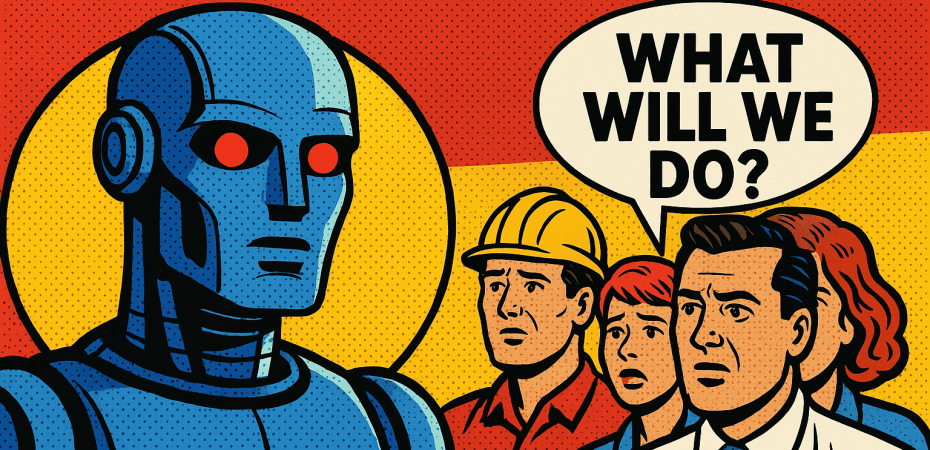
Paul Craig Roberts’ recent article, Artificial Intelligence Is Bringing Us the Communism that Marx, Engels, Lenin, Mao and Pol Pot were Unable to Deliver (27 March 2025), is a bleak and passionate warning. It claims that artificial intelligence will not only destroy jobs and reshape education, but fundamentally erase humanity’s need for purpose—thus ushering in a new form of digital communism imposed by elites. It is, in his view, “the epitome of evil.”
I agree with Roberts on one point: AI brings with it serious risks. The consolidation of digital power into the hands of corporate-state elites, the erosion of privacy, the risk of a passive and deskilled public—these are dangers that merit close scrutiny. But his argument that AI will entirely replace human labour and render mankind obsolete is economically incoherent, historically mistaken, and philosophically confused.
Worse, by misidentifying the nature of the threat, Roberts obscures the true dangers we face—not communism, but technocratic domination.
Roberts’ central claim is that AI differs fundamentally from past technologies. He writes:
As AI replaces human skills, it also destroys human jobs. What people, especially free market libertarian economists, have not understood is that unlike earlier technological advances, AI eliminates the need of humans to do jobs.
He then draws a contrast between AI and earlier transformations such as offshoring or the putting-out system:
Offshoring eliminated Americans jobs by giving the jobs to China, other parts of Asia and Mexico. But still humans did the jobs. Human performance was not eliminated, just a change in location of performance.
In earlier times when technology destroyed household jobs… and relocated them in factories, the technological advance did not eliminate the need for humans to do the jobs. The factory system just collected the jobs under one roof.
But this is a distinction without a difference. Every wave of automation—whether looms, typewriters, calculators, or container ships—has eliminated human jobs in one domain while generating others elsewhere. The point is not whether some people are made redundant. The point is what happens next.
To say “AI eliminates the need for people” is like saying the internal combustion engine eliminated the need for horses and therefore also the need for transportation. It’s a category error.
Roberts invokes the familiar spectre of mass technological unemployment. If machines do all the work, who will earn money? Who will buy the products? He does not elaborate this claim in theoretical terms, but the underlying worry is simple:
AI is a totally different form of technology. It eliminates the need for people. So what does humanity do? The absence of purpose is why Bill Gates and the World Economic Forum want to reduce the world population.
This is a startling leap—from automation to depopulation. And it reflects a static model of the economy: one in which the total number of jobs is fixed, and where new machines simply push people into uselessness. But this is not how real economies behave.
Technological change destroys certain jobs. That is true. But it also reduces the cost of goods and services, thereby increasing real income and redirecting demand to new areas. The classic example is agriculture. In 1800, over 90% of Britons worked on the land. Today, fewer than 1% do—and we are better fed than ever. Mechanisation removed the need for agricultural labour but created demand elsewhere: in manufacturing, services, education, health, entertainment.
Alan Bickley, in The Dangers of AI, offers the same view:
The cheapening of prices for some goods and services will open demand for other goods and services, and therefore of labour. Many of these new things will be new and unexpected… The future is always a surprise.”
Roberts assumes that because he cannot imagine what future jobs will look like, they will not exist. But in 1900, no one imagined the role of computer programmer. In 1980, no one foresaw the emergence of SEO consultants, app developers, or YouTube content creators. Human desire expands. So too does the economy.
Moreover, even in a highly automated society, value does not vanish—it shifts. AI systems are expensive to build and maintain. If they are productive, the wealth they generate must accrue somewhere: to owners, to consumers, to states. The challenge, then, is not that wealth disappears, but that it may be distributed unjustly. That is a political question, not a technological necessity.
Roberts worries that people with no jobs will have no income. But if AI reduces costs to the point that essentials are near-free, this may matter less than he supposes. In Bickley’s words:
A displaced industrial or professional worker pushing trolleys in that Tesco car park might be able to afford a better real standard of living than before the AI revolution.
This is not a fantasy. A cheap television today provides better entertainment than a cinema once did. AI may do to education, medicine, and design what the steam engine did to cloth.
Finally, it is worth noting that AI, like all capital, generates return. In a well-structured society, capital ownership is broadly distributed—through pensions, mutual funds, and small enterprise. If AI does become dominant, the task is to ensure that its fruits are accessible. That is not the fault of AI. It is the fault of our failure to build a just and free civilisation.
Roberts’ article is titled Artificial Intelligence Is Bringing Us the Communism that Marx, Engels, Lenin, Mao and Pol Pot were Unable to Deliver. But this is a misuse of terms. The regimes he names were committed to the abolition of private property and party dictatorship. AI has nothing to do with that.
If anything, AI is being developed by giant corporations in alliance with governments, to reinforce market control—not to abolish it. What we are witnessing is not communism. It is technocracy. Rule by credentialed experts. Enforcement by machine. Ideology via algorithm.
Humans… will no longer be individuals capable of thought. They will be part of a collective with a collective mind imposed by official narratives, with all unofficial narratives censored as misinformation.
This, Roberts gets right. But the problem here is not AI. It is the regime that uses AI. The same regime that promotes censorship, monitors dissent, and degrades traditional institutions. The same regime that refuses to define women, that abolishes borders, that teaches children that intelligence consists in remembering what they are told. These are human decisions, not machine inevitabilities.
AI is a tool. Whether it serves liberty or slavery depends on who controls it.
Roberts asks, “So what does humanity do?” and implies that purposelessness will be our fate. He fears a world in which people are isolated, distracted, disconnected. In this, I agree. If we become consumers of machine content, if we abandon skill, if we live online, then yes—we will be easy to rule and not worth saving.
AI disconnects people from one another and from themselves. I regard it as not merely inconvenience but as the epitome of evil.
This is a moral insight, not an economic one. And it is valid. But it is not inevitable. It reflects our culture’s decadence, not the machine’s power. It is a symptom of spiritual decay—of the loss of religion, rooted community, and serious education. If we raise children on TikTok and antidepressants, it is not AI that has failed us. It is us.
AI is not communism. It is not Maoism, or Stalinism, or the Khmer Rouge with better bandwidth. It is a tool—one that could destroy our civilisation, or elevate it. Whether it does either depends on how we respond.
Paul Craig Roberts sees only doom. He sees machines replacing doctors and lawyers and teachers—and draws the conclusion that mankind will be discarded. But this is not destiny. It is defeatism.
AI is not the end of work. It is the beginning of a new phase of human possibility. The real question is not whether the machines will take over. It is whether we are still capable of governing ourselves.

Discover more from The Libertarian Alliance
Subscribe to get the latest posts sent to your email.
[…] Paul Craig Roberts says no. AI may reshape the economy—but it does not erase freedom or purpose. https://libertarianism.uk/2025/03/30/ai-and-the-end-of-work-why-paul-craig-roberts-is-wrong-about-ar… The Wailing (2016): South Korea’s Masterpiece of Madness and Fear This is horror done right. No […]