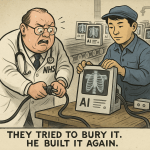
It is hard not to feel disheartened by the news. War in Eastern Europe, disintegration in the Middle East, the criminalisation of truth in Britain, and a ruling class incapable of reform. But in the background of all this, beyond the reach of politicians and their slogans, medicine is still moving forward. Not always reliably. Not always safely. But forward nonetheless.
Over the past month, The Independent has published a series of reports on new treatments and technologies deployed within the NHS. I read these with an unfamiliar sense of hope. However marginal they may be in scale, and however tentative in results, these breakthroughs reveal that science has not yet been fully corrupted. There are still doctors and researchers—perhaps even bureaucrats—who have ignored ideological fashion and are instead working to extend life and reduce suffering.
Let us consider three recent examples, all taken from The Independent.
- Blenrep: A Trojan Horse Against Myeloma
The first article describes the deployment of belantamab mafodotin—marketed as Blenrep—against multiple myeloma, a blood cancer traditionally associated with poor prognosis. Blenrep operates by attaching to the B-cell maturation antigen (BCMA) found on malignant cells and delivering a cytotoxic payload directly into them. The metaphor of the “Trojan Horse” used by the researchers is apt, if somewhat theatrical. Unlike older chemotherapies, which flood the body with poison in the hope of killing faster than they cripple, this is a sniper’s bullet rather than a carpet bomb.
According to Professor Charlotte Pawlyn of The Royal Marsden Hospital, this form of antibody-drug conjugate therapy (ADC) offers “a real chance for remission in patients with very few remaining options.” That it is being made available through an NHS early access scheme is particularly striking. For once, bureaucracy has not killed initiative.
Yet we must be cautious. As the article notes, belantamab was previously pulled from the U.S. market after it failed to meet survival endpoints in a phase III trial. Critics might therefore regard its reintroduction as reckless. But the key point here is not the drug’s perfection, but the agility of the system that reapproved it in targeted cases.
The real innovation lies not merely in the molecule, but in the process. It reflects a shift in how drugs are tested, personalised, and delivered—a shift driven by better modelling, smarter diagnostics, and faster data sharing. And here, as always, it is information technology that makes the difference.
- Histotripsy: The Sonic Scalpel for Liver Tumours
The second article explores a technique called histotripsy—a word that sounds like science fiction and, in some sense, is. Researchers at Addenbrooke’s Hospital in Cambridge have begun treating liver tumours using focused ultrasound waves. These waves create cavitation bubbles within the tumour mass, tearing cells apart mechanically, without cutting, burning, or poisoning.
The appeal is obvious: no incision, no bleeding, no chemotherapy, no ionising radiation. Just waves—silent, invisible, and devastatingly precise. Clinical director Professor Grant Stewart calls the results “remarkable,” and the implications are extraordinary. The technique might one day replace surgery entirely in certain cancers.
One naturally hesitates before declaring any new technology a panacea. We’ve heard too many promises before. But unlike past wonder-cures that demanded total patient surrender to pharmaceutical giants, histotripsy represents a return to first principles. Instead of overwhelming the body with chemicals, it respects anatomy and exploits physics. It is non-invasive, repeatable, and—critically—guided by real-time imaging. It seems more likely to be a genuinely human-centred advance, rather than another arms race in the pharmaceutical-industrial complex.
Again, it is computing power that makes this possible. Real-time guidance systems, machine learning algorithms, and physics simulators model each tumour’s position and density, adjusting wave pulses accordingly. Histotripsy is not simply a matter of better tools—it is the fusion of medicine with intelligent code.
- Pancreatic Cancer: Towards Earlier Detection
Of all the cancers we fear, pancreatic cancer ranks near the top. Its symptoms come late, its progression is brutal, and its survival rate—less than 10 per cent after five years—is a statistical death sentence. But this final article offers a glimmer of change. Researchers have identified a combination of symptoms that may help diagnose the disease up to a year before it would normally present.
The breakthrough came from analysing 28 million electronic health records across the UK. The flagged symptoms—unexplained weight loss, back pain, jaundice, fatigue, and digestion changes—are not new, but the ability to detect subtle patterns among them is. The algorithm developed by University of Oxford researchers sifts through GP records, identifying patients whose profiles suggest early-stage disease.
Here, then, is the clearest example of IT transforming medicine. Doctors cannot be expected to memorise correlations across millions of patient profiles. But a trained algorithm can. In effect, this is predictive analytics applied to life-or-death outcomes. Used properly, it could halve the number of patients diagnosed in late-stage decline.
Of course, concerns remain. Will early warning result in overtesting? Will insurers and civil servants use predictive data against the patients rather than for them? As with all technological advances, the ethical risk grows with the power of the tool. But if properly handled, this use of AI could transform not just pancreatic cancer outcomes but all of diagnostic medicine.
If there is a common thread in all three cases, it is not the individual treatments themselves. It is the changing architecture of medicine. Blenrep is a smart missile, histotripsy is a sonic scalpel, and the pancreatic cancer tool is an early warning system—all made possible by software. Machine learning, pattern recognition, and real-time data analysis now drive the cutting edge of clinical practice. They reduce the cost of trials, shorten diagnostic timelines, and personalise treatment protocols.
One might reasonably ask: how did we get here so fast? The answer, in part, is the Covid era. For all its terrors and hypocrisies, the pandemic forced a radical overhaul of medical research. Trials were accelerated, digital infrastructure expanded, and regulators granted provisional approvals in weeks rather than years. This shift, though fraught with dangers, left behind a more flexible system. Researchers now have access to global datasets. Hospitals are outfitted with more sensors. Patients are more accustomed to digital monitoring. And AI, having been embedded in every stage of the process, now defines the pace of progress.
This is not to say that every consequence is benign. Regulatory capture by pharmaceutical companies, the degradation of informed consent, and the temptation to automate care away from human judgement are all real dangers. But when properly resisted and countered, the informational revolution in medicine holds the promise of real good.
I am not blind to the risks. Technological progress can be misused. The same AI that spots early-stage tumours could one day be used to deny treatment to the politically non-compliant. A government capable of criminalising dissent—such as Britain’s present regime—is fully capable of weaponising medical records.
But it is not inevitable. Not yet. In the meantime, science continues its quiet work. While our politicians squabble, our institutions decay, and our newspapers lie, there are still people doing something worthwhile. And that, for now, is reason enough to hope.

Discover more from The Libertarian Alliance
Subscribe to get the latest posts sent to your email.