This article has nothing to do with libertarianism—or not so far as I can think. But it’s inspired by one of the boys at my school. He is grossly fat, and therefore smelly. This afternoon, he got up from a plastic chair and left behind a damp streak on the seat, where sweat had trickled from the crack between his vast and much-rubbed buttocks. I could smell him from six feet away. It was plain he hadn’t cleaned himself properly after evacuating his bowels. If I were in his position, I would consider suicide. Indeed, I may suggest some of the more inventive forms of self-dispatch I came across in a Japanese film I will one day review.
But that brings me to my theme for today: how the Romans went to the toilet. Again, if you can find anything libertarian in this, good luck to you. But, since Mr Bickley has given them to me, I feel no reluctance to abuse my privileges on this Blog.
So, let’s begin with the basics. The Romans had toilets—real ones, often beautifully made. They also had chamberpots, pisspots, sponge sticks, shared gutters, public latrines, and a general tolerance for bodily processes that would cause modern hygiene fanatics to convulse: and that would include me if I were less in love than I am with the ancient world. It was a world of shit, of smells, of sponge-sharing strangers. But it was also—as was much else in the ancient world—remarkably systematised.
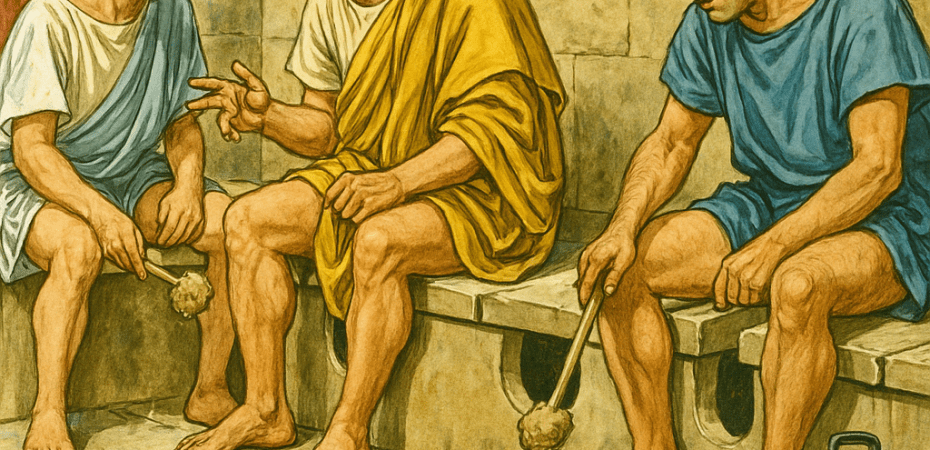
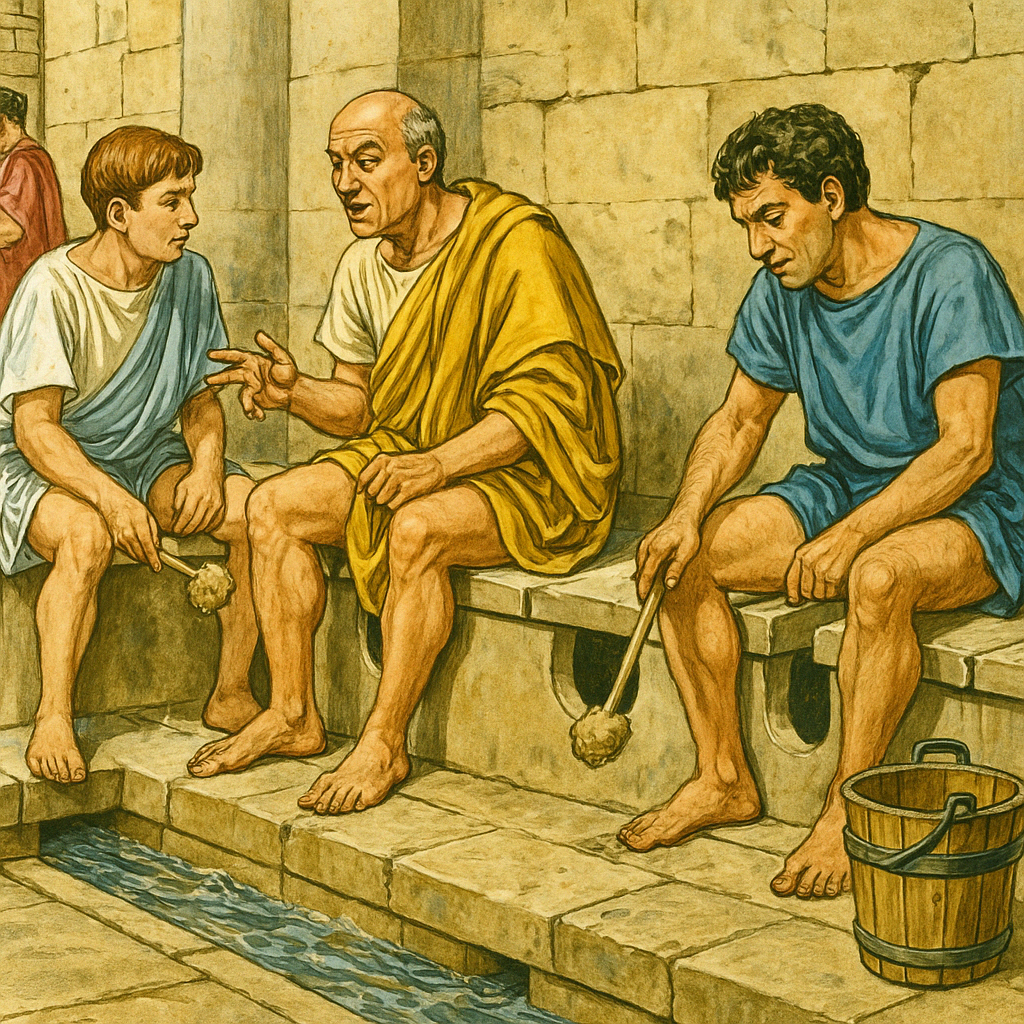
The standard image is of a public latrine (forica), all stone seats and flowing water. You sit with your toga bunched up, you defecate into a gutter below, and you clean yourself with a sponge on a stick—the famous xylospongium. The sponge, of course, was communal. The philosopher Seneca mentions how such tools were always wet and used by others before you: semper aliena et madida spongia (Ep. 70). In Thugga, archaeologists found a recessed slot in the latrine floor for resting the sponge when not in use. Think about that the next time you’re wiping with triple-ply aloe vera quilted.
Communal sponge sharing—it is difficult to imagine a more concise summary of Roman daily life: cleanliness without privacy, hygiene without dignity, and always the risk of dysentery.
Naturally, not everyone wanted to squat in a row beside strangers. Wealthier Romans used chamberpots—matella for men, scaphium for women, lasanum for defecation. Petronius gives us the glorious scene: Trimalchio, a vulgar freedman, urinates into a silver pot held out by a eunuch while playing ball: matellam spado ludenti subiecit. Then, finished, he casually calls for water and wipes his fingers on a slave-boy’s head. Exonerata ille vesica aquam poposcit… digitos… in capite pueri tersit. (Satyricon 27)
This wasn’t even satire. Martial records the practical inconveniences of late-arriving slaves with chamberpots: Dum poscor crepitu digitorum et verna moratur, o quotiens paelex culcita facta mea est! (Ep. 14.119). “While I’m summoning the slave with a finger-snap, and he dawdles—oh, how often the mattress has become my mistress!”
And then there is the matter of the pots themselves. Pliny complains that Mark Antony, no stranger to excess, used golden chamberpots: aureis usum vasis in omnibus obscenis desideriis… Antonius solus contumelia naturae vilitatem auri fecit (NH 33.14.50). “Antony alone debased gold by this insult to nature.” Martial, always ready to mock, adds: ventris onus misero, nec te pudet, excipis auro, Basse (Ep. 1.37). “You catch your belly’s burden in gold, Bassa—and you’re not ashamed.”
The Digest—the Roman legal code—even rules that these items, despite their material, didn’t count as valuables in a legacy: argenta legato non puto ventris causa habita scafia contineri. That is: “I don’t think pisspots count as part of the silverware.” Because apparently once you’ve shat in it, it loses decorative value.
Then there’s the street-level consequence of this whole arrangement: disposal. Most urban Romans lived in multi-storey insulae. These were not equipped with private loos. The result? Chamberpots dumped from windows. Juvenal warns of this in his third satire: tolle periculum est—watch your head. A bucket of piss could fall at any moment. Sometimes the pot went with it. Augustus had to adjudicate a case in Knidos where a slave threw both contents and container at a mob. One of the mob died. Augustus let the man off—on grounds of self-defence—but reportedly included a note of irritation that such trivial matters had reached the emperor’s inbox.
But back to the latrines. The ones at Timgad, for example, are astonishing. A U-shaped gutter runs around the room, fed by a stone basin in the centre. Water flows past the feet of seated users, washing waste into a sewer. Small drain slits between the user’s legs direct spillage into the flow. The stone seats are tenoned into the walls and supported laterally by sculpted dividers shaped like dolphins. Each user had about two foot of space. More than Ryanair offers.
This was a shared, highly visible affair. Gender separation? Possibly not. Privacy? None. Conversation? Likely. You went with friends. You passed the sponge.
And yet, for all the seeming squalor, there was an attempt at design. The grooves in the seat avoided drips at the front. The sloping floors channelled spillage. At Ostia and Pompeii, sponge-rinsing basins were placed at floor level, sometimes connected to the aqueduct. In one case, the water came via overflow from a private nymphaeum—a decorative indoor fountain. Efficiency and aesthetics, in one filthy package.
Still, the sponge. I can’t leave it unexamined. Let’s assume it’s marine (as confirmed by the presence of sponge spicules in the sewers at York). It’s mounted on a stick. You wipe. You rinse in the basin. You return it. Even for a society that bathed often, this is heroic—or depraved.
Seneca again: while discussing the absurdity of fearing death, he mentions suicide by sponge: quid enim turpius quam spongia percussus interierit? “What could be more shameful than to die by sponge?” (Ep. 70). So yes: someone shoved one down his throat—probably after someone else had used it.
This tells us something about Roman attitudes. The body was not private. Nor was its maintenance. Hygiene, like food, like sex, was a public function.
It wasn’t all public, of course. Chamberpots, as noted, were common. In Carnuntum, Austria, archaeologists found dozens—tall, oval, conical pots with wide rims and no handles, shaped for comfortable sitting. Up to two gallons in capacity, though usually used for just one or two. They were made with precision, fired to a fine finish, sometimes decorated with incised grooves. Not cooking pots repurposed—but purpose-built for shit. A whole typology of human excretion.
In sum, Roman toilet culture was marked by pragmatism, hierarchy, and a certain brazen disregard for what we call dignity. You had to go. So you went. Perhaps you were rich, and shat into a silver bowl. Perhaps you were poor, and used a bucket. Perhaps you shared a sponge with twenty strangers and made small talk while you did it. But you went.
And that, dear readers, is more than can be said for the unwashed fat boy at my school. He doesn’t wipe. He doesn’t wash. He doesn’t own a sponge-stick, marine or otherwise. His backside is a tribute not to the communal dignity of ancient Rome, but to the hygienic entropy of a civilisation in decline. I hope he reads this. I hope it wounds him. Or perhaps inspires him to scrub.
If not, I shall find ways to seat him exclusively on chairs of pale cloth and judge him by the stains he leaves behind.
Ancient Sources
- Juvenal. Satires. Edited and translated by Susanna Morton Braund. Loeb Classical Library 91. Cambridge, MA: Harvard University Press, 2004.
- Martial. Epigrams. Edited and translated by D. R. Shackleton Bailey. 3 vols. Loeb Classical Library. Cambridge, MA: Harvard University Press, 1993.
- Petronius. Satyricon. Edited and translated by Michael Heseltine. Loeb Classical Library 15. Cambridge, MA: Harvard University Press, 1913.
- Pliny the Elder. Natural History, Volume IX: Books 33–35. Edited and translated by H. Rackham. Loeb Classical Library 394. Cambridge, MA: Harvard University Press, 1952.
- Seneca. Moral Epistles. Translated by Richard M. Gummere. 3 vols. Loeb Classical Library. Cambridge, MA: Harvard University Press, 1917–25.
- Ulpian. Digest 34.2.27.5. In The Digest of Justinian, translated by Alan Watson. 4 vols. Philadelphia: University of Pennsylvania Press, 1985.
Modern Scholarship
- Hobson, Barry. Latrinae et Foricae: Toilets in the Roman World. London: Duckworth, 2009.
- Koloski-Ostrow, Ann Olga. The Archaeology of Sanitation in Roman Italy: Toilets, Sewers, and Water Systems. Chapel Hill: University of North Carolina Press, 2015.
- Radbauer, Silvia, and Beatrix Petznek. “Chamberpots from the Civil Town of Carnuntum.” In Urination and Defecation Roman-Style, edited by A. O. Koloski-Ostrow, 95–98. Munich: Verlag Marie Leidorf, 2008.
- Wilson, Andrew. “The Latrines by the Forum at Timgad.” In Urination and Defecation Roman-Style, edited by A. O. Koloski-Ostrow, 106–109. Munich: Verlag Marie Leidorf, 2008.
Discover more from The Libertarian Alliance
Subscribe to get the latest posts sent to your email.
Related posts:
 Debasement and Delusion: What Really Happened to the Roman Currency
 GDP and Income Distribution in the Roman Empire
 Roman Life Was Not That Bad: Reply to Sebastian Wang
 How Social Darwinism Made China the Most Successful Country on Earth—and Why the West Can’t Keep Up
 Stanislav Andreski’s Social Sciences as Sorcery: Enduring Errors and Academic Corruption – Thorsten Polleit, PFS Bodrum 2025
 Gaza: Case Study in Moral Bankruptcy
Powered by YARPP.
[…] the first, he mocks a fat classmate for the stain he leaves on a plastic chair. He makes no attempt at […]
[…] 28 June, 2025 […]