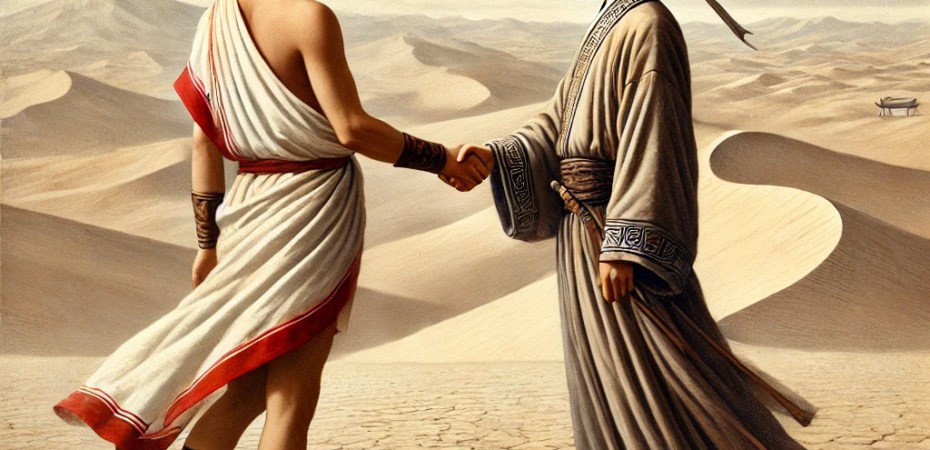
It’s easy to believe that the Roman and Chinese empires never met. Their capitals were separated by nearly six thousand miles of mountains, deserts, and nomadic confederations, not to mention one rival empire. They spoke different languages, worshipped different gods, and knew each other only through stories, more or less fanciful, carried by traders and interpreters. But trade has a way of outpacing diplomats, and silk in particular proved too alluring to ignore. By the early first century AD, the Silk Road was binding the ancient world together with a soft and precious thread that was greatly misunderstood on both sides.
This essay examines the nature and extent of contact between the Roman and Chinese empires, focusing on trade as the key driver of interaction. Drawing on primary sources in Latin, Greek, and Chinese, and secondary scholarship on ancient commerce, it argues that although direct diplomatic relations never took root, the two civilisations developed a shared commercial culture at a distance. This was a relationship mediated by misinterpretation and middlemen, and it tells us as much about the ancient world’s imagination as about its economics.
In Chinese sources, the Roman Empire appears as Da Qin (大秦), literally the “Great Qin”—a label implying a peer to China’s own imperial order. The Hou Hanshu (Book of the Later Han) states:
The kingdom of Da Qin, also called Lijian, lies several thousand li west of Anxi. Its territory measures several thousand li. The inhabitants are tall and upright.
Da Qin was associated with the easternmost parts of the Roman Empire—probably Syria, Egypt, or Asia Minor—rather than Italy itself. Chinese knowledge of Rome was filtered through layers of Hellenistic, Parthian, and Kushan intermediaries, and so the Romans often appeared in Chinese records as Greek speakers or even Indians.
In Roman sources, the equivalent label was Serica—the land of silk. Pliny the Elder, writing in the first century AD, remarks:
The Seres are famous for the wool they comb from the trees.
This ‘wool’ was silk, though Pliny had no idea how it was made. He believed it grew on trees and was combed by forest-dwelling people. The term Seres likely derives from the Chinese si ren (丝人)—“silk people.”
Thus, each empire had its own mythologised image of the other: the Chinese saw Rome as a vast civilised realm of tall, white-robed men, skilled in glassmaking and gold embroidery; the Romans saw China as a remote source of exotic luxury. It was not the other’s political system or philosophy that made the deepest impression—it was trade.
Though the two empires had overlapping spheres of economic interest, they never established official diplomatic ties. This was not for lack of effort. The Hou Hanshu recounts a mission supposedly sent by the Roman Emperor Marcus Aurelius in 166 AD:
In the ninth year of Yanxi [166 AD], Andun, king of Da Qin, sent envoys who offered elephant tusks, rhinoceros horn, and tortoiseshell.
“Andun” is almost certainly a transliteration of “Antoninus,” which scholars take to mean Marcus Aurelius Antoninus. But the embassy probably originated with merchants based in Roman Egypt who sailed to India and made their way overland. The gift items—ivory, horn, shell—suggest not imperial tribute but commercial barter.
The difficulty lay in geography. Between Rome and China lay the Iranian plateau, Mesopotamia, the Hindu Kush, and the Taklamakan desert. No Roman army could cross this terrain, and no Chinese mission could do so without confronting the Parthians or Sogdians. Instead, intermediaries handled the trade: Parthians controlled the overland Silk Road; Arabs and Indians dominated the sea routes.
Greek-speaking merchants played a particularly important role. Chinese Buddhist texts refer to “Daqinshu” (大秦书), or “Roman writing,” to describe Greek letters—proof that from the Chinese point of view, Greeks represented Rome. Even in the Tang dynasty, Greek was still the language associated with Rome, because by then Byzantium was the Roman Empire’s visible successor.
Silk was the commodity that bound Rome and China together. According to the Wei Lue:
The Romans had such a pressing need for silk yarn that they unravelled plain silk textiles to obtain it.
Roman demand was extraordinary. Pliny the Elder complained:
The woman who wears transparent clothing can scarcely be said to be dressed at all.
Yet Chinese sources were mystified. They believed Rome produced its own silk. The Hou Hanshu claims:
They weave cloth that is bright and soft, and they make embroideries of gold thread.
This mutual confusion—Romans thinking silk grew on trees, Chinese thinking Romans raised silkworms—is a vivid example of how commerce outpaced knowledge.
Archaeological finds confirm indirect contact. A Roman glass cup has been unearthed in a Han tomb in Guangzhou. Chinese silk has been found in Palmyra and even at Vindolanda on Hadrian’s Wall. The Kushans in Bactria and Gandhara played a key role in these exchanges. Their coins bore Greek inscriptions to reassure Roman merchants, and their cities served as caravan hubs.
But neither Rome nor China controlled this trade. Pliny laments:
At the lowest estimate, India, the Seres, and the Arabs take from our empire 100 million sesterces each year.
The Hou Hanshu similarly reports:
The people of Da Qin are rich and love their customs. Their products include glass and precious stones.
What emerged was a trans-Eurasian luxury economy. No Roman consul visited Chang’an. No Han envoy arrived in Rome. But Roman glass, Chinese silk, Indian pepper, and Arabian incense all met in the markets of Bactria and Alexandria.
The Roman and Chinese empires never met as equals across a table, but their shadows met in the marketplace. Misunderstood, mediated, and mythologised, their relationship was one of commercial intimacy and diplomatic distance. It reminds us that great civilisations do not need to be neighbours to influence each other profoundly.
If history is a mirror, then the reflection between Rome and China was always distant, and always distorted—and always fascinating.
Works Cited
Greek and Latin Sources
- Pliny the Elder. Natural History. Translated by H. Rackham. Loeb Classical Library. Cambridge: Harvard University Press, 1938–1962.
- Strabo. Geography. Translated by Horace Leonard Jones. Loeb Classical Library. Cambridge: Harvard University Press, 1917–1932.
- Ptolemy. Geography. Translated by Edward Luther Stevenson. New York: Dover Publications, 1991.
Chinese Sources
- Fan Ye. Hou Hanshu (Book of the Later Han). Beijing: Zhonghua Shuju, 1965.
- Wei Lue. In Du You, Tongdian. Beijing: Zhonghua Shuju, 1988.
- Ban Gu. Han Shu (Book of Han). Beijing: Zhonghua Shuju, 1962.
- Sima Qian. Shiji (Records of the Grand Historian). Beijing: Zhonghua Shuju, 1959.
Secondary Scholarship
- Hildebrandt, Berit, ed. Silk: Trade and Exchange along the Silk Roads between Rome and China in Antiquity. Oxford; Philadelphia: Oxbow Books, 2016. Ancient Textiles Series 29.
- Liu, Xinru. “Looking Towards the West—How the Chinese Viewed the Romans.” In Rome and China: Connections between Two Great Ancient Empires, edited volume.
- Sidebotham, Steven E. Berenike and the Ancient Maritime Spice Route. Berkeley: University of California Press, 2011.
- Thorley, John. “The Silk Trade between China and the Roman Empire at Its Height, circa A.D. 90–130.” Greece and Rome 18, no. 1 (1971): 71–80.
- Zhao, Feng. “Unravelling Silk: Archaeological Evidence from the Tarim Basin.” In Hildebrandt, Silk, 2016.
- Hirth, Friedrich. China and the Roman Orient: Researches into Their Ancient and Medieval Relations. Leipzig: Giesecke & Devrient, 1885.
- Whitfield, Susan. Life along the Silk Road. Berkeley: University of California Press, 1999.
- Beckwith, Christopher I. Empires of the Silk Road: A History of Central Eurasia from the Bronze Age to the Present. Princeton: Princeton University Press, 2009.

Discover more from The Libertarian Alliance
Subscribe to get the latest posts sent to your email.