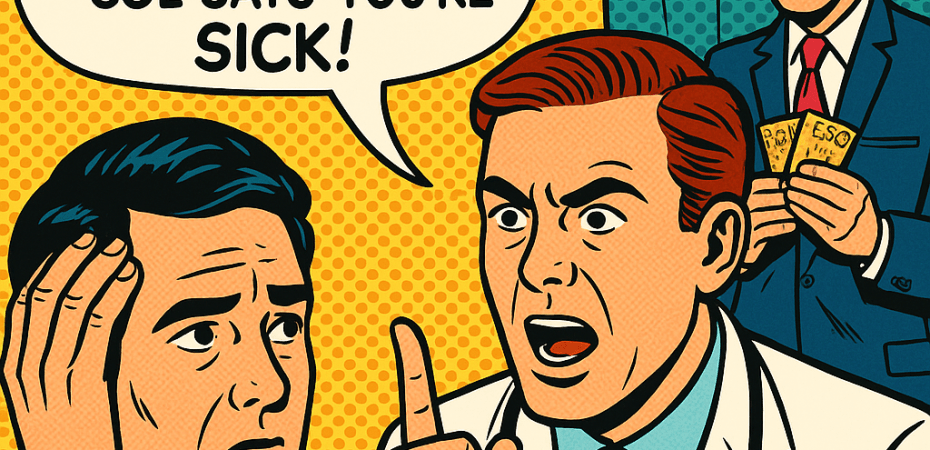
One of the most disorienting aspects of modern medicine is the sense that certainty has outpaced truth. Guideline committees speak with increasing confidence even as outcomes grow more uncertain. Screening thresholds are lowered. “Normal” is redefined. More patients are labelled diseased. This transformation—of risk into diagnosis, and of deviation into pathology—is nowhere more evident than in the treatment of hypertension.
In The Vast Overtreatment of Blood Pressure, “A Midwestern Doctor” offers a detailed critique of this transformation. Like the author’s articles on statins and vaccines, this one is passionate, sometimes overstated, but grounded in serious concerns. If it occasionally sacrifices nuance for rhetorical impact, it also performs a valuable service: it restores scale and proportion to a problem that has been inflated for commercial and institutional convenience.
I do not endorse every conclusion. Some assertions are more provocative than persuasive. But this article deserves careful attention because its central argument—that the treatment of mild to moderate hypertension has been exaggerated far beyond its clinical value—is mostly true.
How High Is High?
The article opens with a simple question:
How did we decide what blood pressure is ‘too high’?
This is not a trivial query. As the author rightly observes, what is now defined as “stage 1 hypertension” (systolic ≥130 mmHg) was for much of the 20th century considered perfectly normal. Indeed, until the 1970s, many doctors did not treat systolic blood pressure under 160 mmHg unless symptoms were present.
The shift began with the Veterans Administration Cooperative Study Group in the late 1960s, which showed that treating patients with diastolic pressure above 115 mmHg reduced strokes. But the author argues that what followed was a cascade of overcorrection:
Each decade, the ‘acceptable’ range narrowed. First 160, then 140, and now 130. At each step, guidelines were updated. But the underlying evidence did not always support the change.
This is true. In 2017, the American Heart Association redefined hypertension to begin at 130/80, sweeping millions of Americans into the category of the “ill.” The author is correct to question whether the benefit of treating these patients outweighs the risks.
Absolute vs Relative Risk
One of the most important contributions of the article is its consistent focus on absolute rather than relative risk. The author writes:
For people with mild hypertension (130–139 systolic), the absolute risk of a cardiovascular event over 5 years is very low. Treating that number with medication may reduce the relative risk by 20%, but the absolute benefit is minuscule.
This echoes criticisms made by epidemiologists such as John Ioannidis and Rita Redberg. In low-risk populations, the number needed to treat (NNT) to prevent one heart attack or stroke is often above 150. Meanwhile, side effects from antihypertensives—dizziness, fatigue, electrolyte imbalance, and kidney damage—are not rare.
The article quotes a 2017 JAMA Internal Medicine study showing that in older adults, aggressive treatment of systolic pressure below 130 increases the risk of falls and hospitalisation. These are not abstract harms. They affect the frail and elderly—those most often targeted for “tight control.”
Where the Article Is Most Persuasive
Several sections are especially compelling. One is the discussion of the SPRINT trial, which has been widely cited to support lower blood pressure targets. The author observes:
SPRINT was stopped early because of perceived benefit. But early termination can exaggerate treatment effects. And SPRINT excluded diabetics and anyone with previous stroke.
This is true. The trial’s much-heralded conclusion—that aiming for 120 mmHg systolic reduces cardiovascular events—applied only to a narrow, highly selected group. Yet its influence on guidelines has been outsized.
Equally sharp is the author’s comment on the lack of patient-centred thinking:
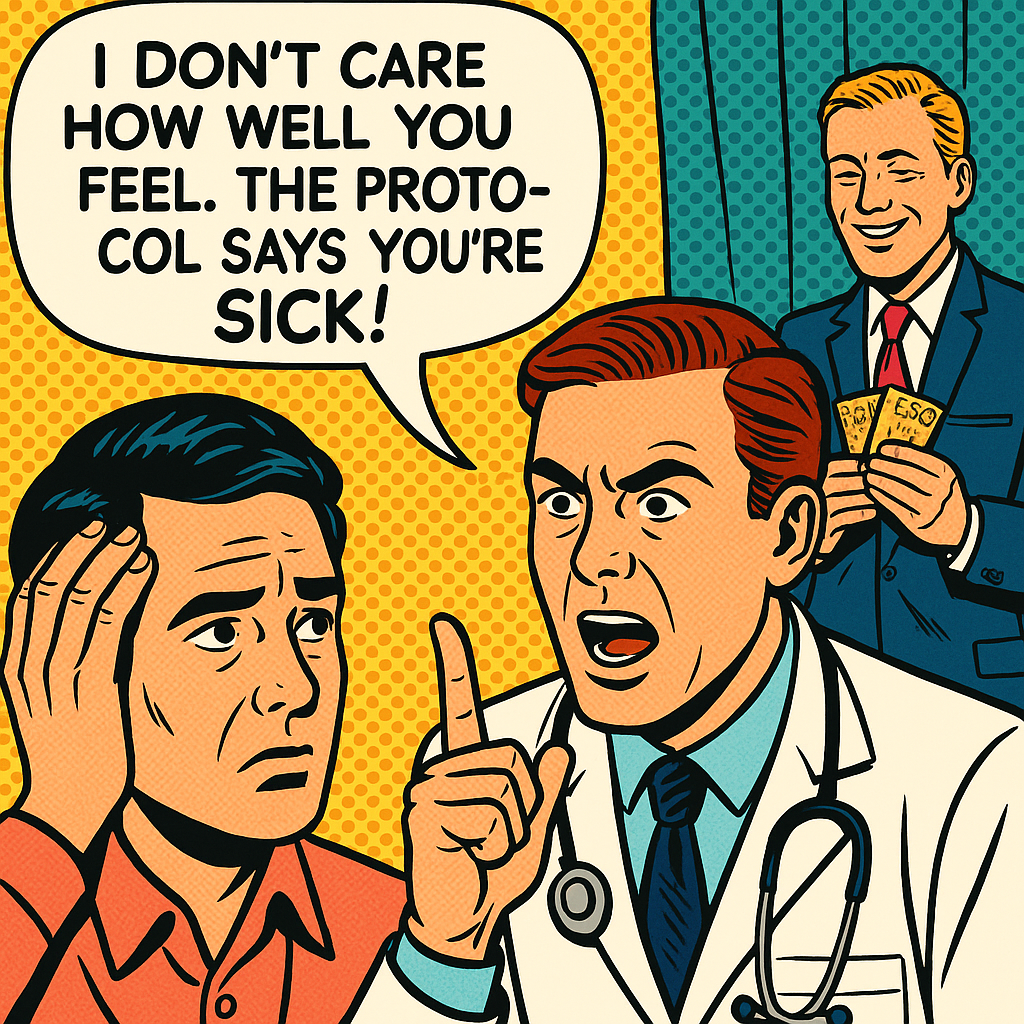
We have medicalised a number. But few ask whether the patient actually feels better. Many feel worse—tired, lightheaded, weak.
This is one of the clearest insights in the article. In the rush to normalise numbers, doctors have often ignored lived experience. One does not need to be an anti-pharmaceutical activist to see the irony in making patients feel unwell in pursuit of a theoretical reduction in stroke risk.
Where the Argument Overreaches
As with the cholesterol essay, the article’s strongest points are sometimes undermined by its weakest. There are moments where scepticism becomes insinuation. Consider the following claim:
I believe hypertension is mostly an invented disease—created by pharmaceutical interests to sell drugs to healthy people.
This is rhetorically powerful, but medically dangerous. Hypertension—particularly when sustained over 160/100 mmHg—is a real risk factor for heart attacks, strokes, and kidney failure. The issue is not that hypertension is a fiction. It is that the threshold for intervention has been gradually lowered until it now includes people who are functionally well.
Similarly, the author implies that blood pressure readings are often meaningless because of their variability:
Blood pressure fluctuates constantly. It can change 20 points depending on stress, posture, or time of day.
True, but misleading. While variability is real, ambulatory blood pressure monitoring and repeated clinic readings provide robust estimates of baseline pressure. Dismissing all readings as unreliable risks throwing out a useful tool simply because it can be misused.
A subtler overreach occurs in the discussion of salt:
There’s no consistent evidence that salt raises blood pressure in healthy people. The demonisation of salt is one of medicine’s biggest mistakes.
This is partly true. In salt-resistant individuals, sodium intake has little effect on pressure. But in salt-sensitive populations—especially those with kidney disease or genetic predisposition—salt can significantly raise blood pressure. A better claim would be that blanket salt restriction may be misguided, not that salt poses no risk to anyone.
What the Article Gets Right That the Guidelines Ignore
The most important truth in the article is its recognition that medicine has lost sight of thresholds. Not all elevations are equal. Not all patients benefit from being treated to target. The attempt to bring everyone into a narrow “ideal” range is both unscientific and harmful.
We now treat people who have never had a symptom, never had a stroke, and never felt ill—just because their blood pressure is 135.
The author rightly points out that many of these people are given two or three medications, often without discussing lifestyle interventions first. They are told they have a disease, and that the only solution is life-long compliance. But in many cases, the risk reduction is negligible—and the side effects are not.
The article quotes a particularly disturbing statistic from a Cochrane review:
In patients with mild hypertension, medication did not reduce the risk of death or major cardiovascular events over five years.
This finding alone should have prompted a re-evaluation of the guidelines. But it didn’t. The inertia of the system, as the author suggests, is too strong.
The Cultural Costs of Medicalising Normality
One of the more interesting observations appears near the end:
When we convince people they are sick because of numbers, we erode their sense of vitality. We train them to see themselves as broken.
This is not a scientific point, but a cultural one. And it is crucial. There is a difference between illness and risk. Between disease and deviation. When medicine loses the ability to distinguish them, it becomes a system of universal surveillance—where health is defined by lab results, and where feeling well is irrelevant if the numbers are wrong.
The article does not just argue against overtreatment. It argues for a rehumanisation of medical judgement. That is its deeper value.
A Final Note on Style and Evidence
As with other essays by this author, the tone is conversational, and occasionally imprecise. There are no footnotes. There is no bibliography. This limits its academic weight. But within its genre—an extended essay by a clinician for a general audience—it is exceptionally strong. It points to a truth that many feel but few articulate well: that we have replaced patient care with protocol enforcement.
It is perhaps best to say that the article asks the right questions. And while not every answer it offers is complete or correct, those questions themselves are worth far more than the rote certainties still echoed in most primary care settings.
Suggested Reading List
Critical of Overtreatment and Guidelines
- Welch, H. Gilbert. Less Medicine, More Health. Beacon Press, 2015.
- Moynihan, Ray, and David Henry. Selling Sickness. Nation Books, 2006.
- Redberg, Rita F. “The Less-Is-More Crusade.” JAMA Internal Medicine, various essays.
On Blood Pressure Variability and Clinical Outcomes
- Cochrane Hypertension Group. “Antihypertensive Drugs for Mild Hypertension.” Cochrane Database of Systematic Reviews, 2012.
- Ioannidis, John P.A. “More Than a Numbers Game: Redefining Hypertension in the 21st Century.” JAMA, 2018.
- Kjeldsen, Sverre E., et al. “Blood Pressure Variability and Risk of Cardiovascular Events.” Hypertension, 2017.
Mainstream but Balanced Views
- ACC/AHA 2017 Hypertension Guidelines.
- NICE Guidelines on Hypertension in Adults (2022).
Data Tools and Monitoring
- The NNT: www.thennt.com – For absolute risk figures across therapies.
- BP TRU and Ambulatory Monitoring Guidelines – For improved accuracy in diagnosis.
Discover more from The Libertarian Alliance
Subscribe to get the latest posts sent to your email.

There is another aspect, which the referenced paper does not address. If an individual is being over-medicated for high blood pressure, this can lead to sudden episodes of low blood pressure (“vaso-vagal episodes.”) These are dangerous – indeed, such an episode was diagnosed as having been the cause of my fall last January, which resulted in a broken arm. And this was not the first time I have suffered injury through such an episode.