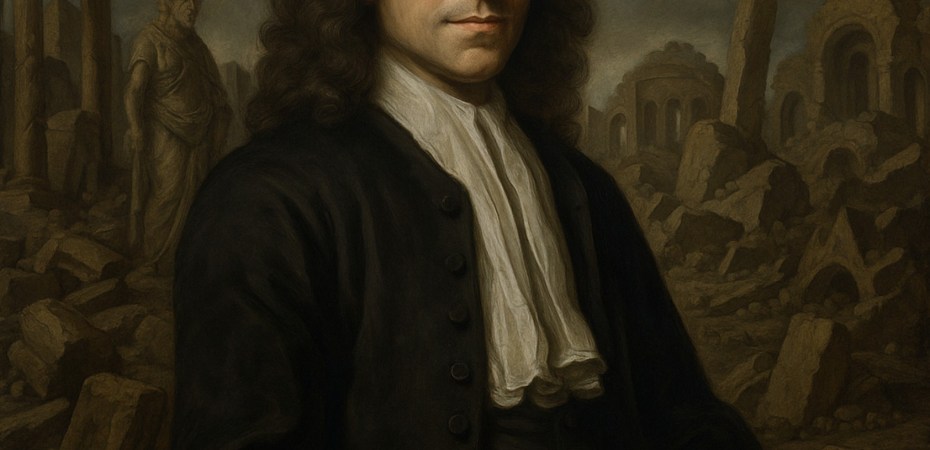
If Descartes built a house on sand, Pierre Bayle spent his life patiently and devastatingly removing the scaffolding. A Calvinist exile who never quite trusted Calvinism, a rationalist who declared reason incapable of resolving metaphysical problems, and an historian who insisted history was too chaotic to be systematised—Bayle was what every modern philosopher pretends to be: an honest man of doubt.
He was born in 1647 in Carla-le-Comte in southern France, the son of a Protestant minister. He converted briefly to Catholicism, then re-converted, and spent the rest of his life as a Huguenot heretic, dodging censorship, exile, and execution. He ended up in Rotterdam, where, until his death 1706, he wrote some of the most brilliant, destabilising prose of the early Enlightenment.
He is now largely forgotten, unless you are French or a devoted fan of David Hume. But he deserves better. If there is a single thinker responsible for the moral and philosophical framework that makes modern liberal scepticism possible—without drifting into relativism or naivety—it is Bayle. And, like most great minds, he has been dismissed because he is inconvenient.
What made Bayle dangerous was not his theology—although the theologians certainly thought so. It was his method. Bayle had no patience for orthodoxies, Catholic or Protestant. His great tool was the footnote, and in his Dictionnaire Historique et Critique (1697), he used it not to clarify but to undermine. The surface entries are sedate; the footnotes explode them.
His entry on David, for instance, notes blandly that the biblical king had many virtues. The footnotes then list his murders, rapes, deceptions, and hypocrisies in such damning detail that even Richard Dawkins might blush. This technique—offering praise with one hand while detonating it with the other—allowed Bayle to say what would otherwise have been censored or burned.
Bayle’s historical writing was not just erudite: it was anti-prophetic. History, Bayle insisted, does not reveal God’s plan. It reveals the passions, errors, and hypocrisies of men. He dismantled the religious and political mythologies of his age with the precision of a watchmaker and the glee of a saboteur. For Bayle, the historian’s duty was not to vindicate a cause, but to confess uncertainty.
In this he was radically modern. He didn’t just doubt specific doctrines. He doubted the possibility of organising knowledge into a system. Unlike Spinoza or Descartes, he did not build cathedrals of reason. He tore them down brick by brick, and invited others to walk freely among the rubble.
It would be easy to call Bayle a Pyrrhonist, and indeed he often called himself one. “Dispute that who will,” he wrote of inter-Christian violence, “for me, I choose to be a Pyrrhonist; I affirm nothing either way, and that suffices for me.” But this isn’t the dreary academic scepticism taught in modern seminar rooms—the kind that doubts the external world until the coffee arrives.
Bayle’s scepticism was moral and political. It was born from real conflict and real persecution. He wrote during and after the Revocation of the Edict of Nantes, when Louis XIV expelled and murdered Protestants across France. Bayle fled, and watched as those who remained were either silenced or butchered. He never forgot.
This experience shaped his philosophy. Bayle’s doubt was not abstract. It was a defence against the savagery of certainty. His works are a continuous assault on religious fanaticism, moral dogmatism, and ideological delusion. The principle is simple: if men stopped pretending to be right, they might stop killing each other.
Bayle’s greatest legacy is his defence of religious tolerance—not tolerance as indifference, but as moral necessity. In a world where different sects all claim truth, and none can prove it, coercion becomes both unjust and absurd.
What makes Bayle unique is that he defended the rights of heretics not despite their errors, but because of them. Unlike Locke, who allowed tolerance only for those who met certain rational and behavioural criteria, Bayle insisted that even those with “errant consciences” deserved full freedom. Truth, he said, does not lose its value by being surrounded by error.
This was not a call for relativism. It was a demand that truth and conscience be separated from state power. That alone puts Bayle at odds with most of his contemporaries—and most of ours. He recognised that every orthodoxy, once armed, becomes tyranny. His own co-religionists, the Reformed, burned Michael Servetus alive. Bayle didn’t excuse it. He didn’t deny it. He called it what it was—murder—and spent the rest of his life making sure no one forgot.
Reading Bayle is like talking to someone who is more intelligent than you, more informed than you, and slightly amused by your attempts to keep up. He’s not cruel, but he has no interest in flattering the reader. He assumes you have either come to think or come to be corrected.
His writing refuses systematisation. His essays sprawl. His entries contradict. His footnotes grow like weeds. And yet, every page bristles with discipline. There is no bluster, no empty rhetoric. Just the facts—and then the trap.
He did not claim to possess the truth. He claimed only that others didn’t. That posture—of methodological scepticism and ethical responsibility—is what distinguishes him from the crowd of Enlightenment pamphleteers who shouted their truths into salons and parliaments. Bayle, always the outsider, always the refugee, preferred to whisper his doubts into the margins.
David Hume once wrote that reading Bayle was what first shook his confidence in rationalist metaphysics. He meant it. Hume’s empiricism—the famous assault on causality and the self—is unthinkable without Bayle. Both men understood that reason is a tool for exposing delusion, not for discovering essences.
Bayle’s insistence that probabilistic reasoning was enough for science, and that certainty belonged only to the fanatics, finds direct echo in Hume’s treatment of natural belief. Where Descartes had demanded indubitability, Bayle and Hume were content with plausibility. This made them, paradoxically, more rational than the rationalists.
Even Hume’s legendary politeness owes something to Bayle. The refusal to dogmatise, the careful irony, the amused detachment—all of it stems from a model set by a man who knew what happened when philosophers got too sure of themselves.
Bayle taught Hume that the sceptic is not the enemy of morality or politics. He is their guardian. By denying certainty, he denies the tyrant his script. By acknowledging doubt, he leaves room for conscience.
In some ways, Bayle anticipated postmodernism—but without the narcissism or the jargon. He didn’t celebrate fragmentation. He simply recognised it. He didn’t deconstruct texts to assert power. He examined them to dismantle illusions. And unlike the Derridean parasites of today, Bayle had read what he was deconstructing.
Hubert Bost, in his Pierre Bayle: Historien, Critique et Moraliste, describes Bayle’s method as one of “ironic demolition.” He never attacked directly. He didn’t denounce his opponents as heretics or fools. He simply laid out the facts until their arguments collapsed under the weight of their own inconsistencies. It is the intellectual equivalent of Jiu Jitsu. Soft power with lethal results.
His power, Bost argues, lies in his refusal to synthesise. “More I study philosophy,” Bayle wrote, “the more I find uncertainties.” This was not despair. It was liberation. What we cannot know, we should not pretend to legislate. What we cannot prove, we should not enforce. And what we believe, we should hold with a trembling hand.
Pierre Bayle is the philosopher the Enlightenment tried to forget. He was too sceptical for the system-builders, too tolerant for the fanatics, too honest for the ideologues. He spent his life exposing the fraudulence of certainty, and in doing so, he preserved the space where freedom might survive. His works are not easy. They are long. They are repetitive. They are sometimes contradictory. But they are always worth the trouble. Because Bayle was the first modern philosopher to say what most still won’t admit: that the world is too complicated, the mind too limited, and human history too drenched in blood for any simple truth to justify violence.
If you want to understand the Enlightenment not as a myth of progress but as a battlefield of ideas—most of them wrong—read Bayle. If you want to understand Hume, start with Bayle. And if you want to understand why most modern intellectuals are either cowards or frauds, contrast their work with Bayle’s.
He was not a saint. He was something rarer: a man who knew that he might be wrong, and acted accordingly.
Reading List: Essential Works by and about Pierre Bayle
Primary Works:
- Pierre Bayle, Dictionnaire Historique et Critique (1697)
- Pierre Bayle, Pensées diverses sur la comète (1682)
- Pierre Bayle, Commentaire Philosophique (1686)
- Pierre Bayle, Nouvelles de la République des Lettres (1684–1687)
English Translations:
- Various Thoughts on the Occasion of a Comet, trans. Robert Bartlett (SUNY Press, 2000)
- Historical and Critical Dictionary: Selections, ed. Richard H. Popkin (Hackett, 1991)
Secondary Sources:
- Hubert Bost, Pierre Bayle: Historien, Critique et Moraliste (Brepols, 2006)
- Richard H. Popkin, The History of Scepticism from Savonarola to Bayle (Oxford, 2003)
- Elisabeth Labrousse, Pierre Bayle (2 vols, The Hague: Martinus Nijhoff, 1963–64)
- Thomas M. Lennon, Reading Bayle (University of Toronto Press, 2021)
- Antony McKenna, Bayle philosophe (Paris: Honoré Champion, 1999)

Discover more from The Libertarian Alliance
Subscribe to get the latest posts sent to your email.