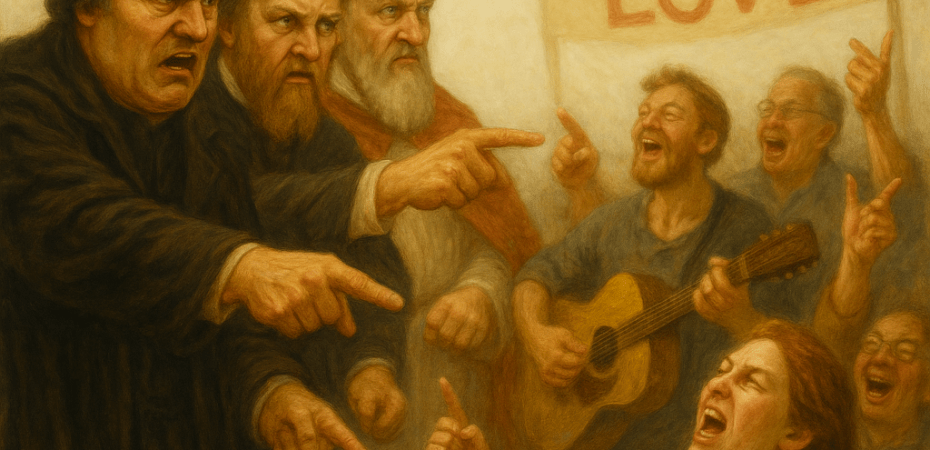
Every year, on 31 October, certain Protestant churches celebrate “Reformation Day,” the anniversary of Luther’s Ninety-Five Theses and the symbolic birth of Protestantism. It is remembered as a clean break — a shattering of medieval dogma and the birth of religious freedom. But the reality, as always, was more tangled and more human. The men who lit the Reformation’s fuse were not modern sceptics tearing down Christianity; they were late-medieval Catholics trying to save it.
Martin Luther, John Calvin, Huldrych Zwingli, and Thomas Cranmer all sought to return to what they imagined was primitive Christianity. They rejected papal authority and reshaped theology, yet in many respects they stood closer to the old Church than do many of their descendants — and, in some ways, than do many modern Catholics.
The real issue of the Reformation was not statues, nor vestments, nor even indeed the Mass. It was the question of authority and the nature of salvation.
For a thousand years, the Church had taught that revelation came through both Scripture and Tradition, guarded and interpreted by the Magisterium — the living teaching office of bishops united under the Pope. Luther’s challenge was simple but devastating: sola scriptura — “Scripture alone.” Every believer, he claimed, could read the Bible and discern God’s truth without clerical mediation.¹ That idea, once loosed, could not be contained. Calvin, Zwingli, and countless others would insist that Rome’s magisterial authority was a human invention. In throwing it off, however, they created something far more fragile: a Christianity with no supreme court of appeal.
Just as radical was their doctrine of justification. Catholics had always seen salvation as a process — the gradual sanctification of the soul through grace, faith, and works united. Luther’s sola fide — “faith alone” — redefined this completely. To him, the believer is justified not because he becomes righteous, but because Christ’s righteousness is imputed to him by faith.² Calvin’s system of predestination extended this logic further: salvation is entirely God’s gift, given or withheld according to His sovereign will.³
To the Catholic mind, these were not reforms but ruptures — the replacement of a living sacramental order with an abstraction. And yet the irony is that the Reformers who made these claims continued to think and pray as Catholics.
Take the Eucharist. Luther never denied that Christ was truly present. “There we have the flat statement,” he wrote, “which cannot be interpreted in any other way than that there is no life, but death alone, apart from His flesh and blood if these are neglected or despised.”⁴ He rejected the philosophical language of transubstantiation but not the miracle itself. Cranmer too spoke of Christ’s presence as “real and effectual,”⁵ not a mere metaphor.
What we now call Protestant “memorialism” would have appalled the first Reformers. They quarrelled with scholastic definitions, but not with the mystery. Five centuries later, many Catholics themselves seem embarrassed by the doctrine their opponents once fought to preserve.
So too with Mary. To modern Protestants, Marian devotion often seems uncomfortably Roman. Yet Luther called her “the highest woman and the noblest gem in Christianity after Christ,”⁶ and in 1544 still referred to her perpetual virginity as “an article of faith.”⁷ Calvin likewise affirmed that Mary was “the Mother of God,” chosen for the “highest honour.”⁸ Zwingli went further, writing, “I firmly believe that Mary…in childbirth and after childbirth forever remained a pure, intact Virgin.”⁹
These men, though polemicists, still lived within the imaginative world of the Incarnation. The Virgin for them was not an idol but a sign of grace — the perfect disciple whose “yes” made possible the redemption of mankind.
That world, half-Catholic still, could no longer survive once authority and sacrament were stripped away. But it shows how incomplete the break truly was.
Luther’s own life offers another paradox. Few modern Protestants would consider private confession essential. Luther never gave it up. “I will allow no man to take private confession away from me,” he wrote in the Smalcald Articles (1529), “and I would not give it up for all the treasures in the world.”¹⁰ For him, hearing the priest’s absolution was no human comfort but the audible voice of Christ.
The Reformation began with the monk’s struggle for peace of conscience; its irony is that the practice that most soothed him was among the first casualties of his own revolution.
The magisterial Reformers were not secularists or iconoclasts in the modern sense. They quoted Augustine more than any modern academic theologian, revered the early Fathers, and feared to depart from the ancient Creeds. Their project was restoration, not demolition. But once the chain of authority was broken, every generation that followed took another step away from the sacramental imagination they had inherited.
The Reformation’s real legacy, then, is not the survival of faith but its fragmentation. Tens of thousands of Protestant denominations now exist, all claiming fidelity to Scripture, yet disagreeing on what Scripture means. The price of rejecting Rome’s interpretive authority was perpetual division.
There is further irony in the modern religious landscape. Luther believed in the Real Presence; many modern Catholics treat it as symbolic. Calvin revered the Virgin; many Catholics barely notice her. Cranmer valued confession; most Catholics now dismiss it as a medieval leftover. The heirs of the Reformers have lost the theology they meant to reform, while the heirs of the Catholics have often lost the conviction that made it worth defending.
Yet one lesson endures. The early Reformers, even in revolt, still believed in truth — objective, binding truth. Their descendants, and ours, live in an age that doubts there is any such thing. In that sense, both Catholics and Protestants of the sixteenth century would find more in common with each other than with us.
The Reformation was born of frustration but driven by conscience. It tore Christendom apart, yet even its fiercest rebels could not escape the faith they opposed. Beneath their rhetoric ran a stubborn Catholic inheritance — the conviction that God acts through matter, that faith is not sentiment, and that the Church, however corrupt, is the body through which grace flows into the world.
If there is a final irony, it is this: the first Protestants were, in spirit, more Catholic than the modern West. They fought for purity; we have settled for confusion. They believed that salvation mattered; we are not sure anything does. The Reformation, for all its errors, reminds us of what both sides once held in common — and what we might yet recover, if we care to be reformed again.
Selected Reading List
Primary Sources
- Martin Luther, The Babylonian Captivity of the Church (1520)
- John Calvin, Institutes of the Christian Religion (1559 ed.)
- Thomas Cranmer, The Book of Common Prayer (1549 & 1552)
- Council of Trent, Decree on Justification (Session VI, 1547)
- Martin Luther, That These Words of Christ, “This is My Body,” Still Stand Firm Against the Fanatics (1527)
Secondary Works
- Eamon Duffy, The Stripping of the Altars (Yale University Press, 1992)
- Alister McGrath, Reformation Thought: An Introduction (Wiley-Blackwell, 5th ed., 2021)
- Diarmaid MacCulloch, The Reformation: Europe’s House Divided 1490–1700 (Penguin, 2003)
- Jaroslav Pelikan, The Christian Tradition, Vol. 4: Reformation of Church and Dogma (1300–1700) (University of Chicago Press, 1984)
- Heiko Oberman, Luther: Man Between God and the Devil (Yale University Press, 1989)
- Joseph Ratzinger (Benedict XVI), Principles of Catholic Theology (Ignatius Press, 1987)
Footnotes
- Martin Luther, Address to the Christian Nobility of the German Nation (1520), in Luther’s Works, Vol. 44, ed. J. Pelikan (Concordia, 1966), pp. 123–138.
- Luther, Lectures on Romans (1515–1516), trans. J. Atkinson (Westminster Press, 1961), p. 82.
- John Calvin, Institutes of the Christian Religion, Book III, Ch. 21.
- Luther, That These Words of Christ, “This is My Body,” Still Stand Firm Against the Fanatics (1527), in Luther’s Works, Vol. 37, p. 54.
- Thomas Cranmer, A Defence of the True and Catholic Doctrine of the Sacrament (1550), ed. J. C. Cox (Parker Society, 1844), p. 187.
- Luther, Commentary on the Magnificat (1521), in Luther’s Works, Vol. 21, p. 326.
- Luther, Sermon on John 1 (1544), in WA 49, p. 321.
- Calvin, Commentary on Luke 1:28, in Commentaries on the Harmony of the Gospels, Vol. 1, trans. W. Pringle (Edinburgh, 1845), p. 32.
- Zwingli, An Exposition of the Faith (1524), in The Latin Works of Huldreich Zwingli, Vol. 3 (Zurich, 1905), p. 275.
- Martin Luther, The Smalcald Articles (1529), in Luther’s Works, Vol. 34, p. 83.

Discover more from The Libertarian Alliance
Subscribe to get the latest posts sent to your email.
Related posts:

Powered by YARPP.
The Gutenberg printing press was invented ~mid-15th century. About 70 years later, Luther started the Protestant Reformation. The movable-type printing press was instrumental in spreading Luther’s writings rapidly across Europe.
The printing press was also helpful in triggering the Renaissance, along with the rediscovery of ancient knowledge brought to the west by scholars fleeing Constantinople after the Jihadist conquest, and other factors (mostly economic).
Much of the ancient knowledge was from Greek thinkers, most importantly Aristotle. This revival of classical western humanism (a paleo rational empiricism) presented an alternative to Christianity. Many Christian humanists, like Aquinas, sought to reconcile the two schools of thought. Thus, Christianity fused with humanism.
As far as we have observed, religion is practiced only by humans. Because of that, and its prevalence among humans, religion is a branch of humanism. Not everything that some humans do, defines humanism. Only that which is in common to all (or virtually all) humans defines what it means to be human. All humans are animals and have the ability to reason; these are the two most important defining characteristics.
Humans communicate through language. Meaningful words are defined empirically, since we are not born with a brain that is hard-wired with a dictionary. Logic, some gestures (like pointing to a thing and at the same time naming it), and other behaviors are hard-wired.
Humans don’t encompass all that exists. External forces are more dominant, and these have influenced human development. For instance, Schumann waves (RF signals produced by lighting) likely influence the evolution of the human brain. Both the external signals and internal brain waves average ~8 hz (cps).