
For more than four thousand years, the rise of great powers followed a single, ugly pattern. Akkad, Assyria, Persia, Rome, the Mongols, Spain, Britain, and finally the United States all built their dominance the same way. They conquered territory, subjugated foreign populations, and enforced obedience at the point of a sword. This was not an occasional tendency. It was the rule of history, repeated so often that it became invisible. Western scholars stopped even questioning it. Power meant war. Expansion meant violence. There were no exceptions.
Then, in the closing decades of the twentieth century, that pattern was quietly broken. Since 1978, China has undergone the most dramatic economic transformation in recorded history. It rose from mass rural poverty to global industrial supremacy in the span of a single lifetime. Hundreds of millions were lifted into modernity. Entire continents were tied into its economic orbit. Yet throughout this ascent, China did not behave like any previous superpower. It did not launch wars of conquest. It did not carve out colonies. It did not march armies across borders to seize land. The historical script that governed every prior hegemon was simply ignored.
This is not an accident, and it is not a temporary deviation. It reflects a completely different civilizational framework, one that Western elites are either incapable of understanding or unwilling to acknowledge.
For thousands of years, Chinese statecraft operated on what might be called a gravitational model of power. The “Middle Kingdom” was not merely a geographic label but a conceptual system. China was the center, and surrounding societies aligned themselves with it not because they were crushed into submission, but because doing so brought material benefits. Trade, stability, cultural exchange, and technological diffusion all flowed outward from the center. Influence was accumulated, not imposed. Alignment was chosen, not dictated.
Western observers, trained on a steady diet of imperial conquest narratives, instinctively dismiss this as propaganda. They cannot process a model of power that does not revolve around military coercion. In their worldview, every rising power must secretly be preparing for war, because that is exactly what every Western power did at the same stage of development. They project their own historical behavior onto China and call it analysis.
The result is a grotesque misreading of reality. China’s global initiatives, especially its vast infrastructure and trade networks, are not precursors to invasion. They are the strategy itself. Railways, ports, energy corridors, and financial systems are being constructed across Asia, Africa, and beyond, binding entire regions into an integrated economic sphere. Countries participate because it serves their interests. They gain access to capital, markets, and development opportunities that the Western system either denied them or deliberately obstructed.
And this is what enrages Washington. American foreign policy elites, steeped in a tradition of domination, cannot tolerate a system they do not control. For decades, the United States maintained its global position through military alliances, financial leverage, and, when necessary, outright destruction of noncompliant states. Nations that refused to align with Washington often found themselves sanctioned and destabilized, or invaded under one pretext or another. This was dressed up as “defending democracy” or “maintaining international order,” but the underlying mechanism was always the same. Obedience was enforced. China’s rise represents a direct threat to that system, not because it is preparing to conquer the world militarily, but because it offers an alternative path to development that bypasses American control. That is the unforgivable sin.
So Washington lashes out in the only way it knows how. Trade wars, sanctions, technological blockades, and endless accusations fill the airwaves. Every Chinese investment becomes “debt-trap diplomacy.” Every infrastructure project is rebranded as a strategic encirclement. The rhetoric grows more hysterical by the year, as if repetition alone can turn speculation into fact.
What we are witnessing is not a rational response to an objective threat. It is the reflexive panic of a declining hegemon confronted with a model of power it cannot dominate and cannot comprehend.
The irony would be glorious if we were not its victims. The United States, whose entire rise was built on territorial expansion and economic coercion, now portrays itself as the victim of an emerging empire that has done none of those things. It warns the world about Chinese aggression while maintaining hundreds of military bases across the globe. It speaks of sovereignty while routinely violating it. The hypocrisy is so blatant that it barely registers anymore.
Meanwhile, China continues to expand its influence through the steady accumulation of economic relationships. Nations are not being conquered. They are being drawn in. Ports are financed, railways constructed, industries developed, and trade flows redirected. The gravitational pull increases year by year, and with it, China’s centrality to the global system.
American policymakers, trapped in a dead framework, respond as if they are facing a replay of the Cold War or the rise of imperial Germany. They prepare for military confrontation, impose punitive measures, and attempt to isolate China from global markets. But these actions often have the opposite effect. They accelerate the very realignment they are trying to prevent, pushing other nations closer to China’s orbit as they seek alternatives to an increasingly erratic and coercive United States.
The deeper problem is not simply strategic miscalculation. It is civilizational blindness. A country shaped by Manifest Destiny, frontier expansion, and global military supremacy cannot easily recognize a form of power that operates without conquest. It sees weakness where there is patience, deception where there is long-term planning, and threat where there is structural transformation.
Until that blindness is addressed, the United States will continue fighting the wrong battle. It will pour resources into military posturing while the real shift in global power unfolds through trade networks, infrastructure systems, and economic integration. It will attempt to contain China using tools designed for a different era, against an opponent that is not playing by those rules.
The most dangerous mistake a declining power can make is assuming that the future will look exactly like the past.
Discover more from The Libertarian Alliance
Subscribe to get the latest posts sent to your email.
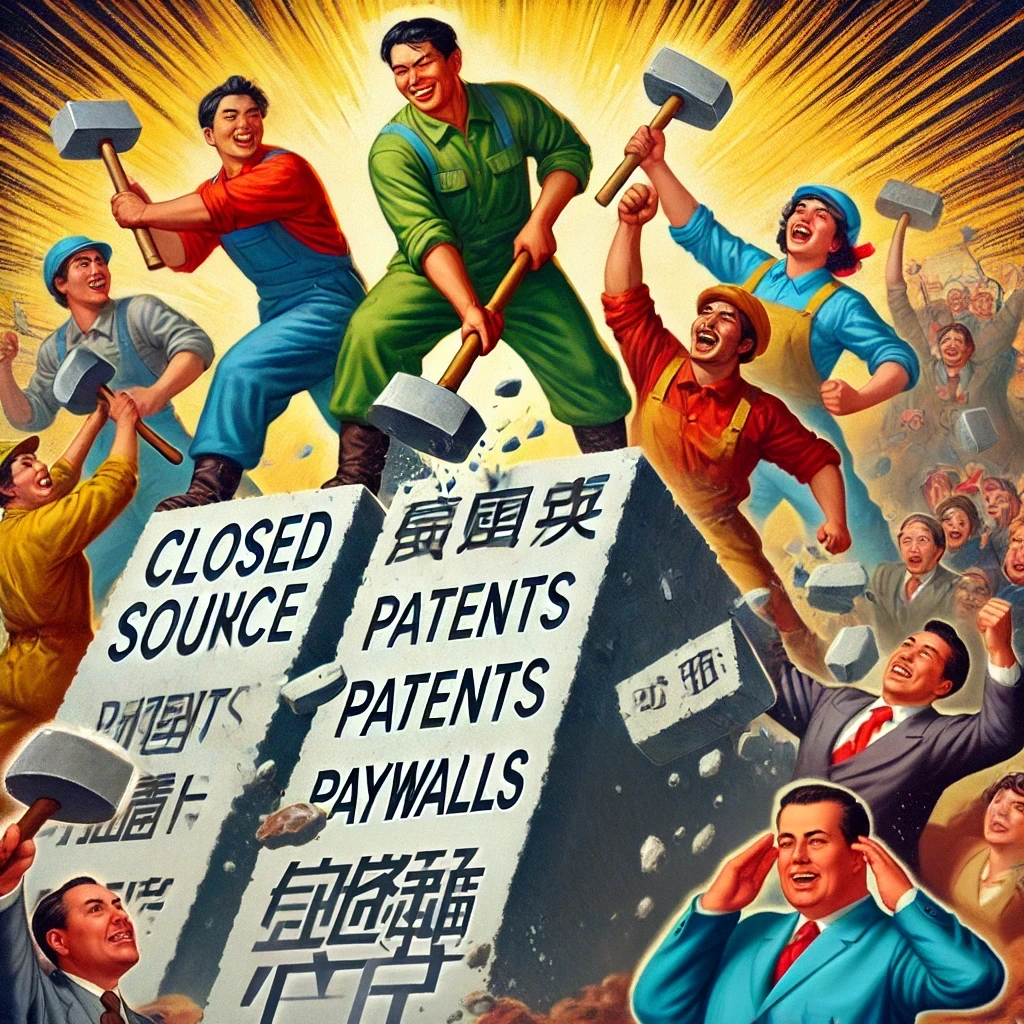
Er… that image is an AI interpretation of what Chinese characters look like — none of them are real Chinese characters or even like them.
Surrealist Algorithm.
Or “Musk’s Little Red Prompt Button.”
Maoist Socialist Realism