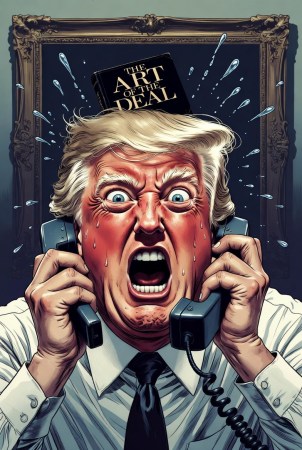
How are you supposed to respond to the mess Trump has made of the Iran War? If you write for the Libertarian Alliance, the most popular response is a good hard gloat. Reginald Godwyn is still fretting about Suez and plainly thinks the American debacle is the best thing since castor oil. I confess that I am pleased as well — not because I want my country to disappear, but because a defeat for America is a defeat for its ruling class. It is up to us, the People, to make sure America eventually recovers without the present ruling class dragging it down. This puts me, I suppose, in the same camp as Bryan Mercadente, who is hoping for a similar chance in England. This being said, we are in for a white-knuckle ride.
Take Trump’s shrug at Iran’s threat to choke off the Strait of Hormuz — that narrow lifeline carrying one-fifth of the world’s seaborne oil. In a live interview, when pressed on collapsing talks and the risk of global energy chaos, he waved it away: “I really don’t care. I couldn’t care less.” Negotiations with Tehran, he complained, had simply become “very boring.”
Pundits rushed to file it under “another Trump gaffe.” But that misses the point entirely. This wasn’t indiscipline or a fleeting bad mood from a man famous for them. It was a window into a presidency — and an entire foreign policy — unraveling under the weight of its own delusions, incompetence, and possible hidden constraints. Trump launched this war back in February boasting of swift victory, decapitation strikes, regime collapse or moderation, secure oil flows, and negotiations from a position of overwhelming strength. Almost every arrogant assumption has smashed into reality, exposing him as a master class in negotiating failure rather than the dealmaker he claims to be.
This is Trump at his most revealing: bored by the crisis he ignited, indifferent to the pain it inflicts on American families staring at spiking gas prices and groceries. Oil jumped over 5% on his dismissive words alone. He ripped up Obama’s JCPOA — which had kept Iranian enrichment in check at 3.67% with real inspections — then bet everything on bombs and bluster. The payoff? Iran raced ahead with 60% enriched uranium, hardliners consolidated power after U.S.-Israeli strikes killed senior figures including Ayatollah Ali Khamenei, and America’s own stockpiles got depleted while Iran’s arsenal stayed largely intact.
The dysfunction peaked in the reported blow-up with Netanyahu. Axios, citing White House officials and splashed across CNN and BBC, described Trump unloading: calling the Israeli leader “fucking crazy,” sneering that he’d be in prison without Trump’s protection, and warning that “everybody hates you now. Everybody hates Israel because of this.” Trump had called to rein in strikes on southern Beirut. Netanyahu refused. Trump never denied the leaks — telling in itself. Then came the contradictory spin: Truth Social posts claiming rapid progress and even outreach to Hezbollah, a designated terrorist group. Netanyahu promptly contradicted him, and fresh Israeli strikes hit Lebanon anyway, displacing more people and pushing beyond the Litani River.
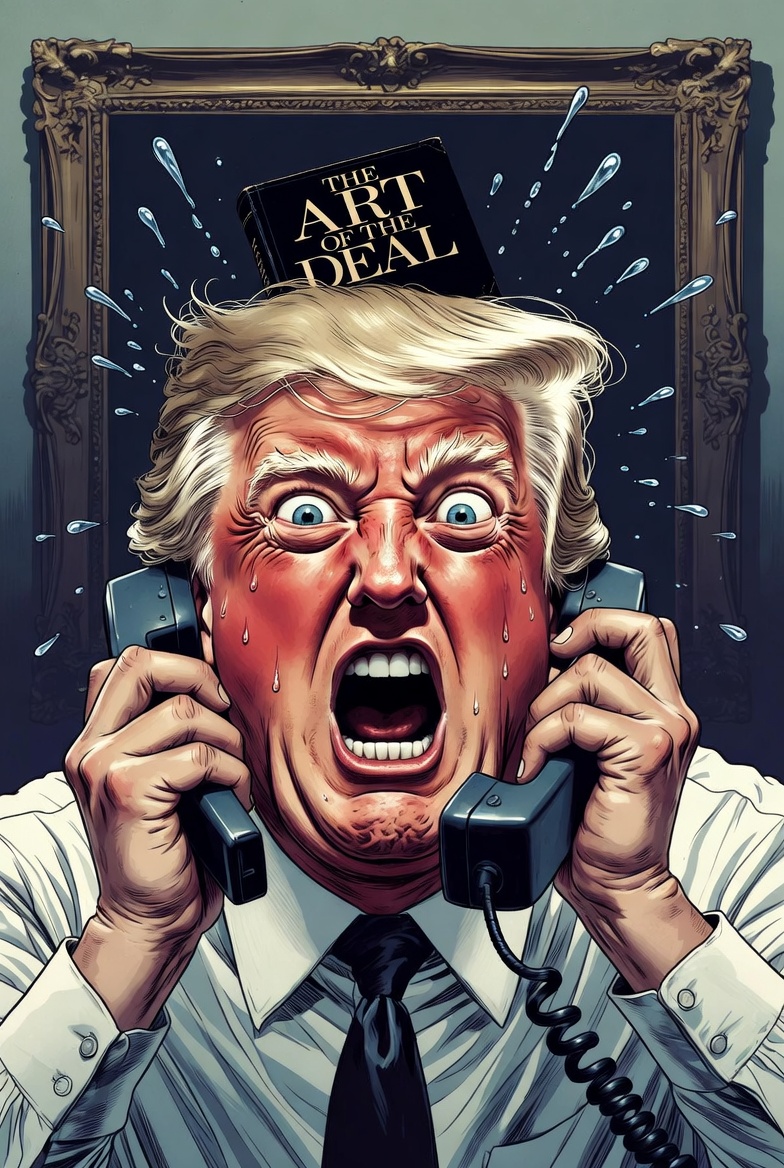
This isn’t leadership. It’s a flailing president losing the plot, lurching between private rage and public impotence. A few more weeks and the global economy craters. Trump’s desperation shows in every contradictory statement and half-hearted hope for a “deal this week.” The proposed 60-day MOU? A humiliating reset that defers real nuclear limits, gives Iran sanctions relief and reconstruction cash, and ties everything to a Lebanon ceasefire that Netanyahu openly defies. Trump’s “Art of the Deal” has delivered nothing but eroded credibility and an empowered adversary.
One ugly question refuses to go away: why does this self-proclaimed America First bulldog keep folding to Israeli preferences that actively screw U.S. interests? Netanyahu’s government of crazies thrives on endless escalation — “mowing the grass” in Lebanon and Gaza — even as it drains American resources and risks wider war. Trump’s private fury followed by public paralysis fits the pattern of a man operating under external leash.
The Epstein files loom large here. Trump’s documented social ties to Jeffrey Epstein and Ghislaine Maxwell, the heavily redacted documents, and longstanding allegations of Mossad-linked kompromat operations create a toxic cloud. Speculation isn’t ironclad proof, but the persistence is damning. A president who rails against “deep state” constraints seems strangely tethered on this file. His tolerance for policies that hurt American wallets and global standing — while failing to enforce any red lines on Netanyahu — suggests blackmail may explain the gap between bluster and results. If Israeli intelligence holds damaging material, it would account for the subservience at the worst possible time. Trump isn’t just failing; he looks compromised, steering (or being steered) in ways that prioritize foreign agendas over American ones.
Trump isn’t the root — he’s the loudest symptom. The war exposed limits built over decades. Washington assumed strikes and sanctions would break a regional player like Iran. Tehran weaponized geography instead. Closing Hormuz (Red Sea route held in reserve via Houthis) turned a local fight global. Iran demands a full Lebanon halt for talks. Nations like China, India, Pakistan, and Malaysia engaged Tehran for practical energy solutions while Washington issued threats and tweets.
This flows from deeper American rot. Post-Cold War elites treated military reach and dollar dominance as invincible. They hollowed out manufacturing, let infrastructure rot, and worshipped Wall Street speculation, sanctions, and exclusion. China built the real stuff: factories, ports, supply chains, technology. The contrast hit hard with Iran — U.S. coercion met walls that actual productive power might have avoided.
Each president repackages the same impulse: Clinton’s humanitarianism, Bush’s democracy, Obama’s responsibility, Biden’s “rules-based order,” Trump’s “national greatness.” The vocabulary shifts; the bombs and entitlement stay constant. Trump just drops the civilized pretense, exposing raw imperialism in all its shrugging indifference.
Iran has played its hand masterfully, holding decisive leverage without total escalation. Deutsche Welle openly asked if Iran is now “in complete control.” The world has taken notes: American threats aren’t automatic. Coercion has limits. Alternative powers prioritize deals over domination. Regional actors can impose painful costs.
The U.S. remains formidable — wealthy, armed, innovative in places. But it is no longer unchallenged or inevitable. Trump may yet cobble some face-saving paper and spin it as genius. Ordinary Americans, however, already feel the shift in their pocketbooks and see the chaos from a bored president’s indifference.
Here is the opportunity. This failure of the American system — this public, expensive humiliation — is a chance for the American people, provided the war can be lost before too much damage is done. A clean enough defeat could discredit the endless-war consensus, the bipartisan foreign policy blob, and the financial-military complex that has looted the real economy for decades. It could force a reckoning: bring manufacturing home, end the addiction to sanctions and printed money, and rebuild on tangible production rather than global dominance fantasies. The ruling class has grown used to winning at our expense. A visible loss, contained before it spirals into broader catastrophe, might finally loosen their grip. We the People could then reclaim a republic focused on American interests — not empire maintenance, not foreign lobbies, not compromised leaders chasing personal salvation.
Discover more from The Libertarian Alliance
Subscribe to get the latest posts sent to your email.
Related posts:
 Iran: The Last Blunder?
 Iran, Biden, Trump: Senile and Braindead vs Senile but Demented
 Iran: The Epstein War
Iran: Is One Picture Worth a Thousand Words?
Iran: The Epstein War
Iran: Is One Picture Worth a Thousand Words?
 Trump’s War on Iran: The Same Old Lies That Led America into Iraq
 Trump, Iran and a Revolution within the Ruling Class
 Trump Supporters Got Conned: Foreign Policy Failures, Iran, and the Coming Blowback
 The “Rescue Mission” That Wasn’t: How Washington Repackaged a Failed Iran Operation into a Manufactured Triumph
 Iran, 9/11, and the Neocon Road to World War III
 Epic Fury or Unjust War? Iran, Pre-Emption, and the Moral Bankruptcy of Managerial Violence
False Prophecy and Unjust War: A Catholic Rebuke to Christian Zionism and the Attack on Iran
Epic Fury or Unjust War? Iran, Pre-Emption, and the Moral Bankruptcy of Managerial Violence
False Prophecy and Unjust War: A Catholic Rebuke to Christian Zionism and the Attack on Iran
 War Crimes and “Power Plant Day”: A Legal Opinion on Mr Trump’s Threats Against Iran
Powered by YARPP.
[…] Libertarianism.uk […]
[…] Trump’s Iran Debacle: The Empire Discovers Its Limits June 5, 2026 Len D. Pozeram […]