A fundamental error of mainstream conservatives is their habit of mistaking symptoms for causes. A train is stabbed up by a migrant. A grooming gang is exposed after twenty years of official indifference. A violent criminal is released early from prison and promptly commits another atrocity. A police force spends thousands of hours investigating social media posts while burglaries are quietly written off. The conservative notices each scandal in turn. He shakes his head. He complains about incompetence. Then he moves on to the next scandal.
What he rarely asks is why the scandals always seem to point in the same direction. More radical conservatives do ask the question, but the answers they give, though interesting, are perhaps not to be discussed on the Libertarian Alliance Blog.
This brings me almost inevitably to the shocking death of Henry Nowak. I suggest this is important not because it was unique. It is important because it was typical. It revealed, as clearly as anyone could want, what the British State has become and what the police have become within it.
The immediate facts are well known. A white eighteen-year-old student lay dying after being stabbed five times by a brown attacker. The stabbings were deliberate and unprovoked. They were filmed by the attacker’s brother, who then called the police and claimed that Nowack had made unkind comments about the colour of their skin. The police arrived within seven minutes, where further details were supplied of the allegedly unkind remarks. These were accepted by the attending officers without question. Nowack was filmed by the officers claiming that he had been stabbed and was unable to breathe. The officers responded by arresting him and putting handcuffs on him. They dragged him over gravel. The last human words spoken to him were a recitation of his rights as an arrested criminal. Shortly after this, he died.
The standard explanation is that mistakes were made in difficult circumstances. Perhaps they were. Policemen make mistakes. Human beings make mistakes. Any institution employing large numbers of people will produce negligence and occasional absurdity. But this explanation leaves unanswered the most important question. Why were these particular mistakes made? Why did events unfold in this direction rather than another? To answer this question, we must begin with the police themselves.
It is fashionable on the political Right to romanticise the police of the past. This is foolish. I have been dealing with them in a professional capacity for decades. They have never been admirable. They have always struck me as lazy, and usually as not very bright. They have often shown themselves to be notably corrupt. They can be personally vindictive. They have frequently preferred easy targets to difficult criminals. The old joke that a policeman would rather arrest a peaceful drunk than a violent gang has never in my experience been without foundation.
Yet there was once a limit to the harm they could do. They lacked both the ambition and the intellectual equipment required for social engineering. A police constable in 1980 may have been a fool. He may have been a bully. He may have been corrupt. What he was unlikely to be was an ideological activist. He did not think his purpose was to transform society. He did not imagine himself engaged in a moral crusade against wrongthink. He did not regard himself as the guardian of approved opinion.
Indeed, one of the strengths of the old constitutional order was that nobody expected much from the police beyond keeping the peace. They were not expected to cure poverty, eradicate prejudice, reshape language, improve attitudes or supervise public morality. Their powers were limited because their function was limited.
The modern police are different. What makes them dangerously different is not that they have become more intelligent. They have not. It is not that they have become more honest. They have not. It is not even that they have become more efficient. The collapse in public confidence suggests otherwise. The danger lies in the acquisition of a political mission.
This transformation did not begin inside the police. It began within the British ruling class. During the twentieth century, and particularly after the 1960s, the governing class gradually abandoned the old liberal understanding of public institutions. These institutions no longer existed merely to administer. They existed to improve. Their purpose became moral rather than practical. Schools ceased to be places where children learned reading and arithmetic. They became engines of social transformation. Universities ceased to be centres of scholarship. They became centres of political instruction. The BBC ceased to be a broadcaster. It became a national tutor. The civil service ceased to administer policy. It increasingly made policy. The police followed the same path.
The result was not immediately obvious. The old forms remained. Policemen still wore uniforms. Patrol cars still drove through the streets. Criminal investigations continued. Yet beneath the surface a profound shift had taken place. The police were increasingly encouraged to regard themselves not as guardians of public order but as managers of social relations.
This was particularly evident in matters of race. The Macpherson Report marked an important stage in this process. Its influence reached far beyond the Stephen Lawrence case. It encouraged a whole generation of police officers to view society through a particular lens. The central assumption became that racism was not merely one social problem among many but the defining moral problem of modern Britain. Every disparity became suspect. Every allegation demanded extraordinary sensitivity. Every interaction acquired ideological significance.
One can debate the merits of these ideas. What cannot be debated is their effect. A police force trained for twenty-five years to regard accusations of racism as uniquely serious will eventually behave as though accusations of racism are uniquely serious. Human beings respond to incentives. Institutions do likewise.
The process accelerated dramatically after the death of George Floyd in 2020. Here was a man – a violent petty criminal, indeed – who died during an encounter with the police thousands of miles away in another legal jurisdiction. Yet the British establishment reacted as though a national trauma had occurred. Politicians knelt. Public bodies issued statements. Vast sums were spent on diversity programmes. Entire institutions entered a frenzy of self-accusation. The lesson absorbed by public officials was unmistakable. Accusations of racism represented the greatest danger they faced. Fail to solve a burglary and little happens. Ignore a shoplifting epidemic and nobody much cares. But become involved in a racial controversy and your career may be over. It is impossible to overstate the significance of this change.
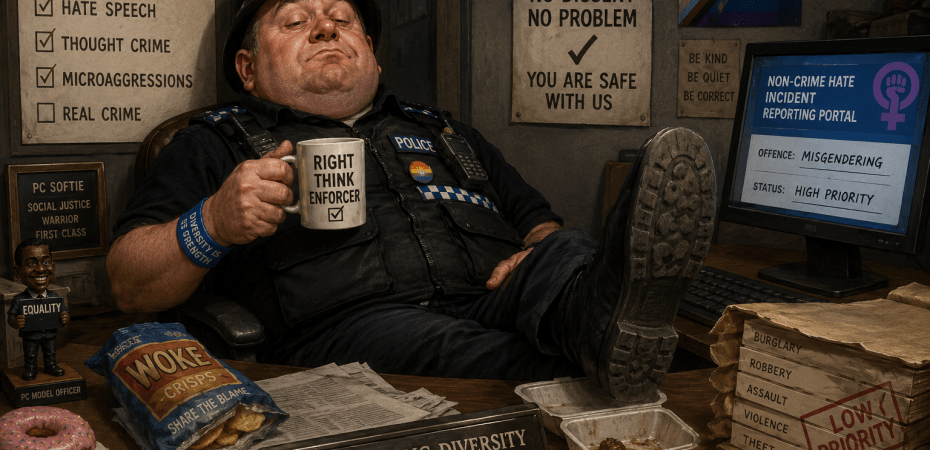
The old police feared complaints from their superiors. The modern police fear ideological accusations. These are not the same thing. A police force that fears accusations of racism more than ordinary incompetence will develop distorted priorities. Its officers will become highly sensitive in one direction and correspondingly insensitive in another. They will learn to see some dangers with extraordinary clarity while becoming blind to others. This helps explain much of modern policing. It helps explain why social media posts receive attention that organised crime does not. It helps explain why non-crime hate incidents were ever considered a sensible use of police resources. It helps explain why officers seem more comfortable monitoring language than pursuing burglars. Most importantly, it helps explain the circumstances surrounding Henry Nowak.
The crucial issue is not whether the officers consciously disliked white people. I think this is what they are trained to do. Whether they do, however, is almost irrelevant. The problem is institutional conditioning rather than personal prejudice. For decades, the police have been trained to regard certain allegations as morally urgent. They have been trained to see society through categories of victimhood and oppression. They have been encouraged to understand some accusations as carrying unique significance.
By the time the officers arrived at the scene where Henry Nowak lay dying, this process had already shaped their assumptions. They did not arrive as blank slates. No human being ever does. They arrived carrying the accumulated habits, fears and priorities of the institution that trained them.
The result was catastrophic. A dying teenager saying “I can’t breathe” should have been the centre of attention. Instead, attention appears initially to have focused elsewhere. A young man saying he had been stabbed should have been treated as a potential victim. Instead, he was treated as the guilty party.
Whether these decisions were conscious or unconscious is beside the point. Their significance lies in what they reveal about the institution itself. The defenders of the present system insist that this proves nothing. It was merely an unfortunate error. Yet institutions reveal themselves through their errors. Success can be manufactured. Statistics can be manipulated. Public relations campaigns can conceal almost anything. Mistakes are more revealing because they expose underlying assumptions. What the Nowak case appears to reveal is a police force whose priorities have been fundamentally distorted by ideology.
Nor should this surprise us. The police do not exist in isolation. They are part of a broader apparatus of governance. The same governing class that transformed the universities transformed the police. The same people who filled public institutions with diversity officers also shaped police training. The same assumptions that dominate the civil service dominate policing. Why should we expect different outcomes?
This brings us to a broader point. For many years, libertarians have criticised the police on the grounds that they are inefficient intrusive. Those criticisms remain valid. But they no longer seem sufficient. The problem is no longer simply that the police fail to protect liberty. The problem is that they increasingly serve purposes incompatible with liberty. A police force dedicated to maintaining public order can at least be restrained. Its objectives are clear. A police force dedicated to social transformation is something else entirely. Its ambitions have no natural limit. Every aspect of life becomes a potential subject for intervention.
This is why the growth of ideological policing is so alarming. The old police were often a nuisance. The modern police increasingly resemble a political institution. They monitor speech. They record lawful opinions. They intervene in political controversies. They enforce norms that Parliament never enacted and voters never approved. They act less as constables than as supervisors of public behaviour.
The case of Henry Nowak therefore extends beyond the loss of a young life. His death exposed a deeper truth about modern Britain. It showed what happens when an institution already burdened by incompetence acquires a political mission. The result is not enlightenment. It is a growing inability to perform the tasks for which the institution supposedly exists. The old police were often stupid and corrupt. That was bad enough. The modern police remain stupid and corrupt. They have simply added ideological zeal to their list of defects. A free society can survive incompetent policing. It cannot indefinitely survive political policing.
That is why the case matters. Not because it stands alone, but because it illuminates a transformation that has been underway for decades. The question raised by Henry Nowak’s death is not whether a few officers made mistakes. I could pass to an examination of the differences between the Nowack and the Floyd cases – why violent rioting of the latter case were argued as pardonable by the same people as are now denouncing the protests over the former as wholly unacceptable. But I live in a country were asking these questions too sharply is dangerous. The question I will ask is whether the institution that produced those mistakes at the scene of the murder has become fundamentally incompatible with the principles of a free society. Increasingly, the answer appears obvious.

Discover more from The Libertarian Alliance
Subscribe to get the latest posts sent to your email.