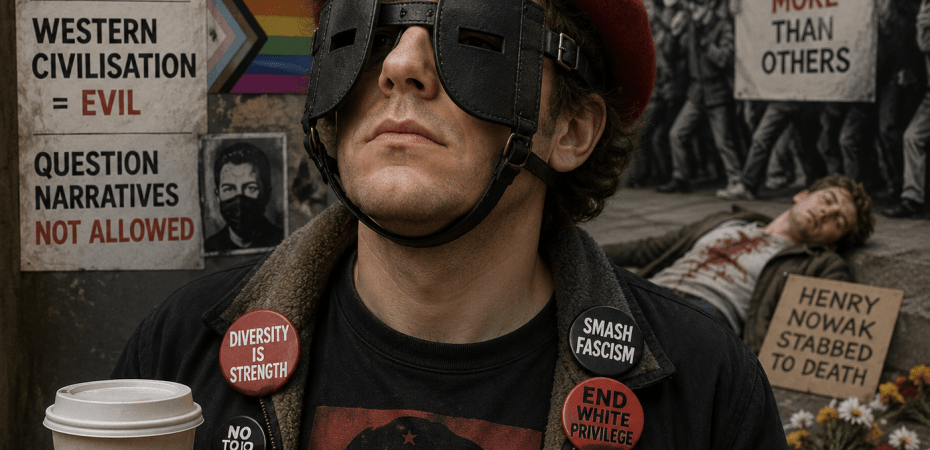
The death of Henry Nowak was a terrible crime. A young man was stabbed to death. The police response appears to have been grossly inadequate. His killer, Vickrum Digwa, was arrested, prosecuted, convicted, and sentenced to life imprisonment. Nothing that follows should obscure these facts. Nor should anything that follows diminish the grief of Henry Nowak’s family, whose dignity in bereavement has been evident throughout.
At the same time, there are events that refuse to remain private. They illuminate wider truths about the society in which they occur. They reveal assumptions and habits of thought that extend far beyond the immediate circumstances. The reaction to Henry Nowak’s death has become one of those events.
Particularly revealing has been the response of the left-wing blogging collective Sodium Haze. Their statement deserves careful attention, not because it is especially unusual, but because it is representative. It expresses with unusual clarity a habit of thought that has become hegemonic throughout much of the contemporary left.nowa
They write:
The murder of Henry Nowak was a heinous act and the police involved after his stabbing behaved appallingly.
His murderer Vickrum Digwa was arrested, tried, convicted and jailed for life. Henry’s family must be devastated but had the grace to plead that their son’s death not be exploited to stoke racial hatred, it has been exploited anyway.
There are over 500 homicides in the UK annually, of which 81% of the suspects are white, but THIS murder fits the narrative of oppressed victimhood that the far right delights in stoking for their own ends, they don’t give a damn about Henry or his family they merely sense an opportunity.
That Nigel Farage seized the opportunity is no surprise, he has no morals and cared not about the pain nor wishes of the victims family either. Farage wants a Trumpian world divided along lines of ethno-religious hatred for in such a world (and only that kind of world) he can gather power to himself.
We can expect the rest of the mainstream political / media complex to jostle for what political advantage they can scratch from this tragedy, they don’t seem to care where these dangerous dynamics can lead, or perhaps they are counting on them.
The argument deserves a serious response. Not because it is persuasive, but because it reveals so much about how large parts of the modern left now understand morality, politics, and race.
The first thing to notice is that the Sodium Haze writers are not obviously bad people. Indeed, I have often found myself agreeing with them. Their opposition to aggressive war is admirable. Their hostility to the Gaza holocaust is admirable. They appear genuinely disturbed by mass killing and by the abuse of power. This makes their reaction to the Nowak case all the more interesting.
The obvious explanation would be hypocrisy. They care about victims when the victims suit their politics and cease caring when they do not. But hypocrisy is too easy an explanation. More importantly, it explains very little. Most ideological movements contain sincere believers. The interesting question is why intelligent and apparently decent people can look at the same event and arrive at conclusions that seem bizarre to outsiders.
To understand this, we need to recognise how radically the modern left differs from the left of even fifty years ago. The traditional left, whatever its faults, tended to think in universal terms. It spoke of workers, citizens, humanity, and social justice. It often divided society into classes, but it generally assumed that moral principles applied equally to everyone. A miner injured by a policeman and a factory owner injured by a policeman were both human beings. One might receive greater sympathy because of his social position, but the underlying moral framework remained universal.
The contemporary left increasingly operates within a different framework. Society is viewed less as a collection of individuals than as a collection of groups. These groups are arranged within a hierarchy of power. Some groups are understood primarily as victims. Others are understood primarily as beneficiaries of oppression. Moral judgement is then filtered through this framework. Once this shift has taken place, apparently inconsistent reactions begin to make sense.
Within this framework, events are not interpreted primarily according to what happened. They are interpreted according to who was involved. A murder committed by a white man against a member of a protected minority can be understood as evidence of wider social forces. It becomes part of a larger narrative. It can legitimately be discussed as a symptom of racism, privilege, prejudice, or structural injustice. A murder committed in the opposite direction creates difficulties. If interpreted collectively, it threatens the existing narrative. If discussed too openly, it may encourage conclusions that the framework itself cannot comfortably accommodate.
The solution is to individualise it. The crime becomes an isolated tragedy. Discussion of wider implications is condemned. Political interpretation is denounced as exploitation. The public is urged to focus exclusively on the grief of the family and the guilt of the individual perpetrator. The same people who normally insist that “the personal is political” suddenly discover the virtues of strict individualism.
This is what makes the Sodium Haze statement so revealing. The writers are not merely expressing sympathy for a bereaved family. They are attempting to define the permissible boundaries of discussion. They are telling us that this particular crime must not be interpreted in the way that many other crimes have been interpreted.
The question is obvious. Why not? The answer becomes clearer when we consider two other cases.
The murder of Stephen Lawrence became one of the defining political events of modern Britain. His death led to years of public discussion, official inquiries, institutional reforms, and extensive debate about race and policing. No one on the contemporary left argued that broader conclusions were illegitimate. No one insisted that the public should concern itself solely with the grief of the Lawrence family. On the contrary, the wider implications of the case were regarded as its most important aspect.
The same was true of George Floyd. Floyd’s death occurred thousands of miles away in another country under another legal system. Yet it generated an extraordinary reaction throughout Britain. Politicians knelt. Corporations issued statements. Public institutions engaged in rituals of self-criticism. Demonstrations filled the streets. Historical figures were denounced. Entire professions were invited to examine their own prejudices. Again, nobody suggested that this was an improper politicisation of an individual misfortune. The transformation of Floyd’s death into a symbol was treated as both natural and necessary.
The contrast with the Nowak case is therefore impossible to ignore. When the victim fits a recognised narrative, wider discussion is encouraged. When the victim does not fit the narrative, wider discussion becomes dangerous. This is not an accidental inconsistency. It is built into the structure of the ideology itself.
What I find most striking about the Sodium Haze statement is its tone of anxiety. The writers are not merely condemning racial hatred. They are worried about what conclusions ordinary people may draw from the case. Their concern is not simply the murder itself. It is the possibility that the murder will alter public opinion. This fear is understandable. For decades, large sections of the British establishment have encouraged the public to think collectively about race. They have promoted diversity policies, anti-racism initiatives, equality strategies, and countless forms of identity politics. Citizens have repeatedly been instructed to view society through racial categories.
The difficulty is that once people begin thinking collectively, they may arrive at conclusions that the architects of identity politics did not intend. If race matters in one context, people will ask why it does not matter in another. If collective responsibility is invoked in one case, people will ask why it is rejected elsewhere. If institutions repeatedly encourage racial consciousness, they should not be surprised when racial consciousness becomes politically inconvenient. The contemporary left finds itself trapped by its own assumptions. It wishes to preserve racial categories while controlling how those categories are interpreted. It wishes to encourage collective awareness while restricting collective conclusions. It wishes to discuss race constantly, but only in approved directions. This is increasingly difficult.
The controversy surrounding the police response deepens the problem. Had Henry Nowak simply been murdered, public reaction would have been severe enough. What transformed the case into a national issue was the allegation that the police treated him as a suspect while he lay dying. Whether every accusation now circulating is fair or not is almost beside the point. What matters is that many people believe the police response reflected institutional assumptions that have developed over many years. The public has watched police forces devote apparently unlimited resources to hate incidents, offensive speech investigations, diversity initiatives, and anti-bias programmes. It has watched officers hesitate in cases involving ethnic sensitivities while displaying remarkable confidence elsewhere. It has watched political leaders repeatedly insist that racism represents the defining challenge of public life.
Against this background, the Nowak case appears to many people not as an isolated mistake but as the logical outcome of broader priorities. One may agree with this interpretation or reject it. What one cannot do is dismiss it as irrational. The interpretation arises naturally from the experiences and observations of millions of people.
This is the deeper significance of the controversy. The issue is no longer race alone. It is legitimacy. Public institutions depend on trust. Trust requires consistency. Citizens must believe that similar cases will be treated according to similar standards. Once that belief weakens, every controversial event becomes politically explosive.
The Sodium Haze writers clearly wish to prevent this outcome. Their intentions may even be honourable. Yet their response is likely to achieve the opposite effect. People become suspicious when they are told not to notice apparent inconsistencies. They become resentful when identical principles seem to be applied differently according to circumstances. Most of all, they become angry when moral rules appear to change depending on the identity of those involved. The insistence that discussion itself is illegitimate merely confirms the suspicion that there is something worth discussing.
The death of Henry Nowak deserves neither exploitation nor suppression. It deserves understanding. That understanding requires us to move beyond slogans and examine the assumptions that shape public debate. The reaction of Sodium Haze is significant because it reveals the tensions within modern left-wing thinking. A movement that once claimed to speak for universal human values increasingly struggles to apply those values consistently. It continues to divide society into categories of victimhood and privilege, yet becomes alarmed when others begin to reason within those same categories. The result is a moral asymmetry that grows harder to defend with every new event.
The writers of Sodium Haze are right about one thing. The Nowak case has become political. But it became political long before Nigel Farage commented on it. It became political the moment the public began asking whether the principles so often proclaimed by our institutions are being applied in practice.
Until that question receives a convincing answer, the controversy will not disappear. Nor should it. A society that can no longer discuss its own contradictions is a society that has abandoned the search for truth in favour of the management of opinion. The former is difficult and often uncomfortable. The latter is easier. It is also the road to intellectual and moral bankruptcy.

Discover more from The Libertarian Alliance
Subscribe to get the latest posts sent to your email.



[…] Halcombe, “Henry Nowak and the Selective Morality of the Left,” Libertarian Alliance (UK) (7 June, […]
[…] Daily Sceptic | Daily Sceptic | Libertarianism UK […]